
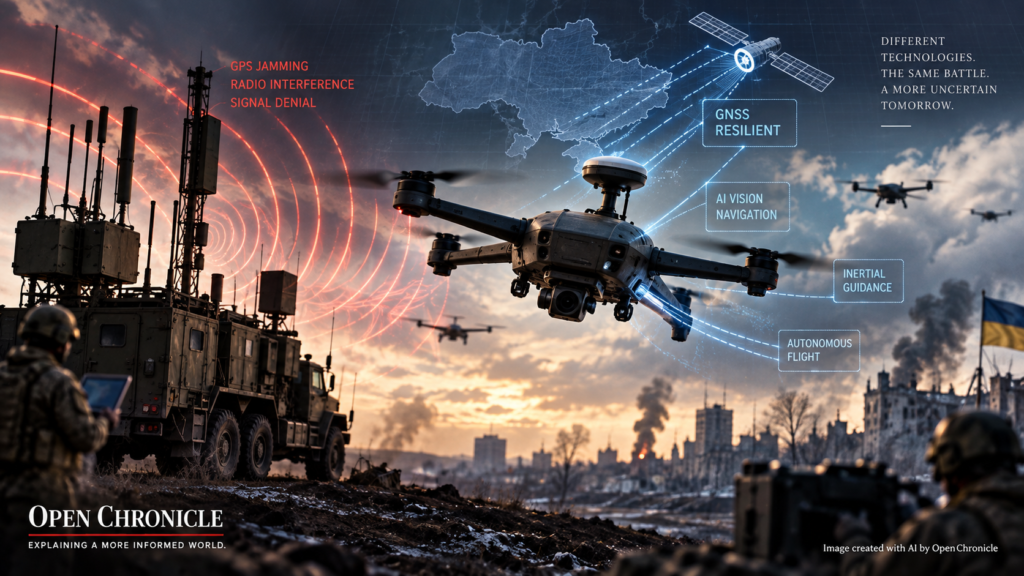
By Open Chronicle Explained
A drone is flying toward its destination when something invisible happens.
There is no explosion.
No missile intercepts it.
Nothing physically touches the aircraft.
But its satellite-navigation signal begins to disappear.
Its connection with the operator becomes unreliable.
The video feed breaks apart.
And within seconds, a sophisticated flying machine may no longer know exactly where it is — or what its operator wants it to do.
The weapon attacking it is invisible.
It is electronic warfare.
Across Ukraine, this contest is happening thousands of times along one of the most electronically congested battlefields ever created.
Russian and Ukrainian forces deploy enormous numbers of drones. At the same time, both sides operate electronic-warfare systems designed to detect, confuse and disrupt them.
The result is an extraordinary technological competition.
Every improvement in drone control produces a new method of interference.
Every new jammer encourages engineers to develop another way around it.
Frequencies change.
Antennas change.
Navigation systems change.
Some drones abandon radio communication entirely.
Others are increasingly being designed to continue flying even when the electronic connection to the outside world disappears.
To understand why Russia and Ukraine are investing so heavily in so-called anti-jam technology, we first have to understand what electronic warfare is actually doing to a drone.
First: How Does a Normal Drone Know Where to Go?
A drone may appear to be a single machine.
In reality, its operation depends on several different information systems.
Depending on its design and mission, a drone may rely on some combination of:
satellite navigation
radio communication
video transmission
inertial sensors
onboard computers
cameras and other sensors
The important point is that these systems perform different jobs.
A satellite-navigation receiver can help the drone determine its position.
A radio link can allow an operator to send commands.
Another link can transmit video or telemetry back to the operator.
An onboard flight computer interprets all of this information and controls the aircraft.
Electronic warfare tries to interfere with those dependencies.
What Is Jamming?
Imagine trying to have a conversation with someone across a room.
Normally, they can hear your voice.
Now imagine hundreds of loudspeakers suddenly producing overwhelming noise between you.
You are still speaking.
Your friend is still listening.
But your voice has been buried underneath the noise.
That is a useful simplified analogy for radio-frequency jamming.
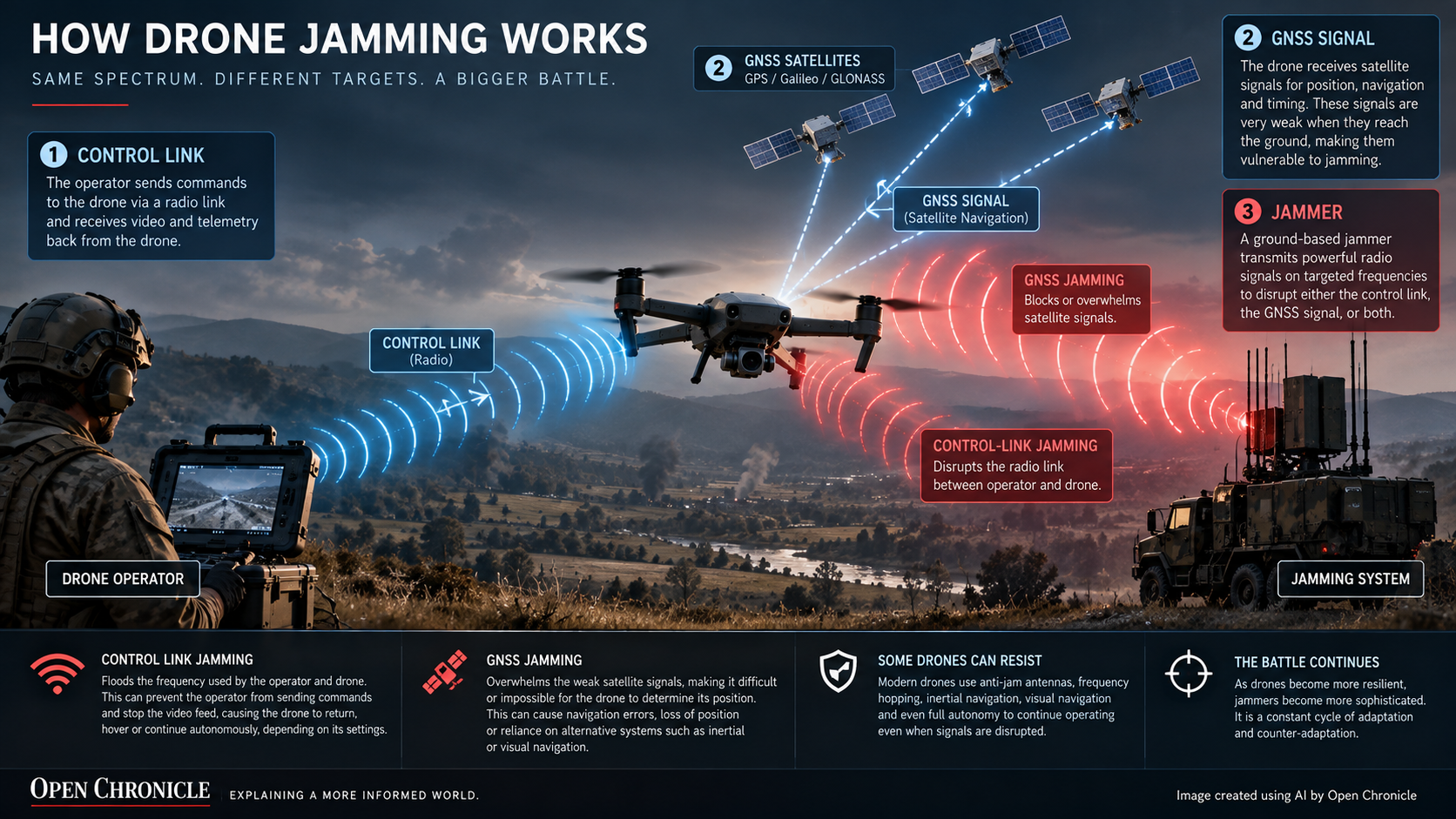
A jammer transmits electromagnetic energy intended to make a receiver unable to distinguish the signal it needs from interference.
Against a drone, the target might be its communication link.
Or its navigation receiver.
Or another radio-dependent system.
The drone has not necessarily been physically damaged.
The electromagnetic environment around it has changed.
What Happens When the Control Link Is Jammed?
Consider an FPV drone controlled by a human operator.
The operator sends instructions:
turn left,
climb,
descend,
accelerate.
The drone receives those instructions through a radio connection.
At the same time, its camera may transmit video back to the operator.
Now introduce powerful interference.
The control link can deteriorate.
The video can become corrupted.
Eventually the operator may lose the aircraft entirely.
For early generations of battlefield drones, severing that connection could be devastating.
But engineers quickly began looking for ways around the problem.
And that started the electronic cat-and-mouse game now unfolding in Ukraine.
Why Not Simply Change Frequency?
That is exactly what drone operators began doing.
Radio systems operate within particular parts of the electromagnetic spectrum.
If electronic warfare systems are concentrated against one range, operators can attempt to move elsewhere.
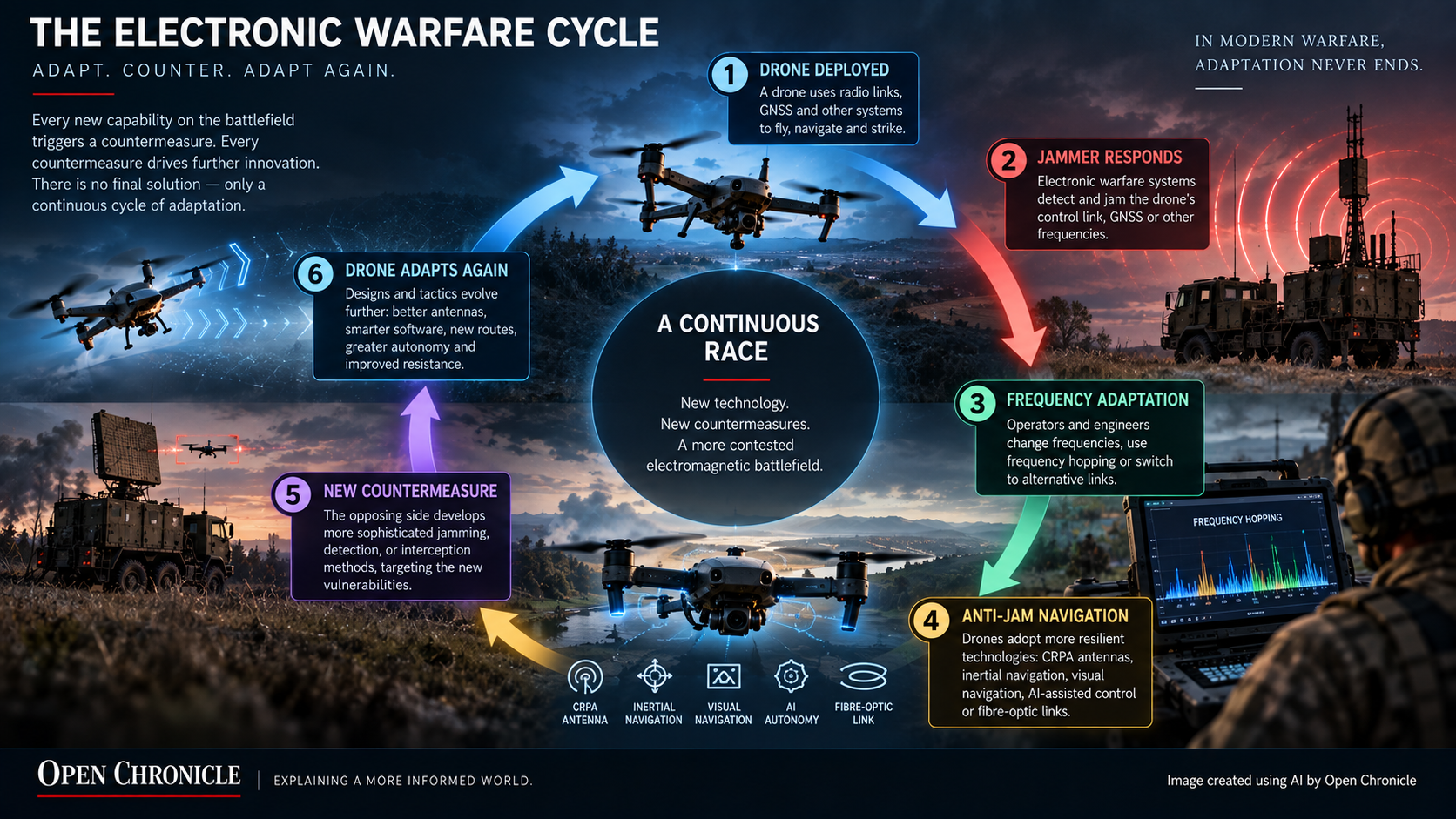
The opposing side then detects the change and adapts its jammers.
The process repeats.
Research by the US Army examining lessons from Ukraine describes precisely this cycle: Ukrainian forces moved drone communications into less commonly used frequencies as Russian counter-drone systems adapted; frequency hopping then became another method of avoiding suppression.
The battlefield therefore becomes a constantly shifting spectrum.
Drone changes frequency.
↓
Jammer detects it.
↓
Jammer adapts.
↓
Drone communications change again.
↓
Electronic warfare adapts again.
There is no permanent winning frequency.
What Is Frequency Hopping?
Instead of transmitting continuously on one frequency, a communications system can rapidly move between frequencies according to an agreed pattern.
Both transmitter and receiver know when to change.
An adversary attempting to jam the connection now faces a harder problem.
It cannot necessarily concentrate all of its interference on one fixed channel.
But frequency hopping does not make a drone magically immune to electronic warfare.
A sufficiently capable opponent can detect patterns, cover broader portions of the spectrum or develop more adaptive jamming.
That is why electronic warfare increasingly becomes a software problem as much as a radio-power problem.
Then There Is GPS Jamming
A drone does not necessarily need its operator’s radio link to be disrupted to encounter trouble.
Its navigation system can also be attacked.
Most people call satellite navigation simply “GPS,” although GPS is actually the American component of the wider family of Global Navigation Satellite Systems — GNSS.
These satellites orbit thousands of kilometres above Earth.
By the time their signals reach a small receiver on the ground or aboard a drone, they are extremely weak.
That creates an important vulnerability.
A nearby transmitter can potentially overwhelm those distant signals.
The drone may suddenly lose reliable satellite positioning.
But that does not necessarily mean it falls out of the sky.
Jamming and Spoofing Are Not the Same Thing
This distinction is important.
Jamming tries to prevent the receiver from obtaining useful navigation information.
Spoofing attempts something more deceptive.
Instead of saying:
You cannot hear the satellites.
Spoofing effectively attempts to tell the receiver:
Here is your satellite information.
Except that information is false.
A navigation system could therefore potentially calculate an incorrect location.
This makes spoofing particularly dangerous.
A system may not immediately realise that anything is wrong.
So How Do You Build an Anti-Jam Drone?
There is no single piece of equipment called an anti-jammer.
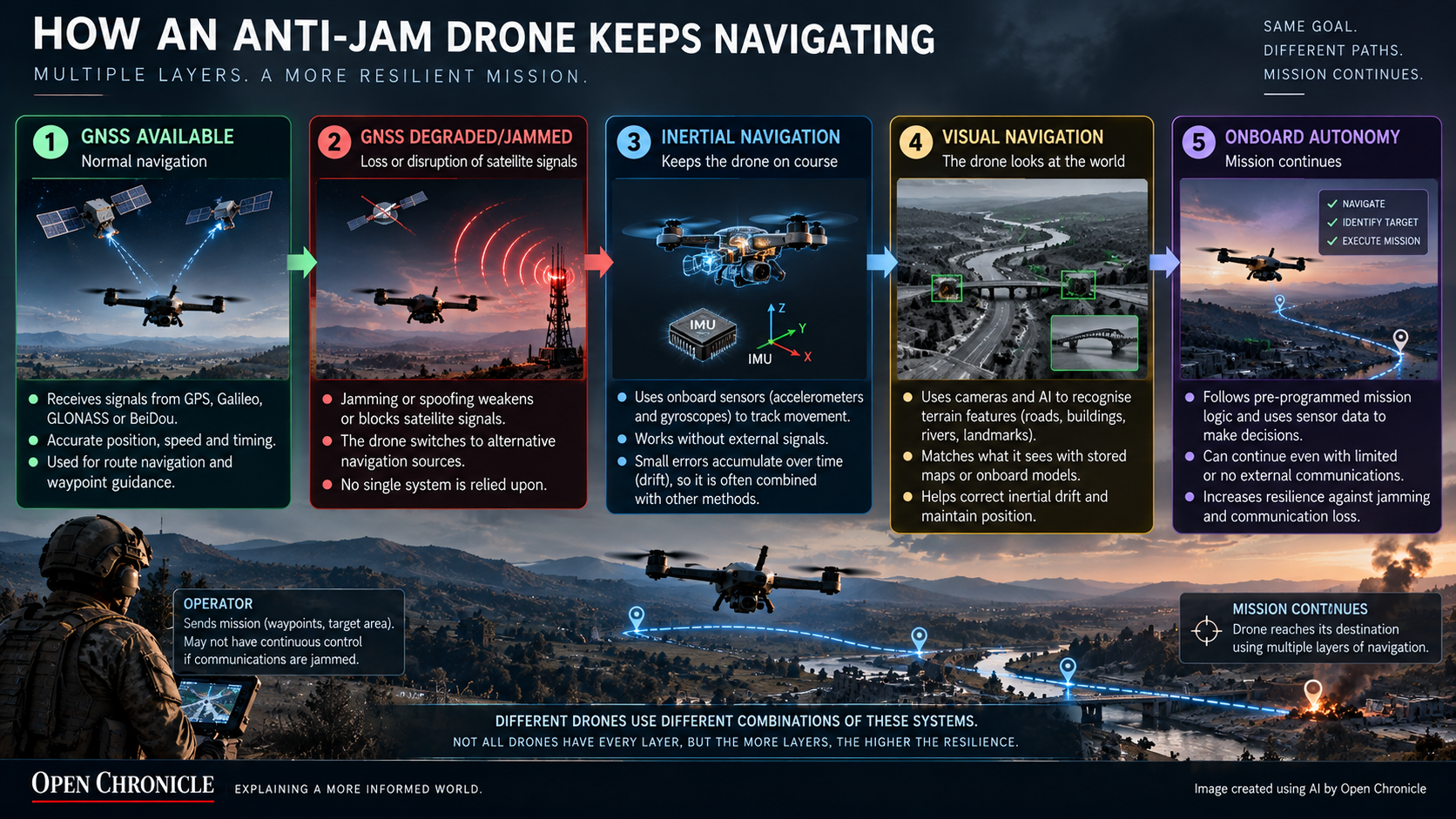
Engineers instead build layers of resilience.
One layer might protect satellite navigation.
Another protects communications.
Another gives the drone an alternative way to navigate.
Another allows it to perform part of its mission autonomously.
Modern drone resilience is therefore increasingly based on a fundamental principle:
Never depend entirely on one source of information.
One Solution: Better Navigation Antennas
One of the technologies receiving considerable attention is the Controlled Reception Pattern Antenna, usually abbreviated to:
CRPA.
Instead of treating signals arriving from every direction equally, these antenna systems use multiple receiving elements.
Signal-processing techniques can then distinguish useful satellite signals from interference arriving from particular directions.
Conceptually, the system can create reduced-sensitivity regions — often described as nulls — toward interference sources while continuing to receive legitimate satellite signals from elsewhere in the sky.
Russia’s Kometa-M family is an important example.
A recent CSIS analysis describes the evolution of Russian Geran drones toward increasingly capable CRPA navigation antennas specifically as a response to Ukrainian electronic warfare.
More antenna elements can allow the system to deal with more interference directions.
This explains why photographs of recovered drone electronics matter so much to intelligence analysts.
The antenna architecture can reveal how the electronic contest is evolving.
But What If GPS Disappears Completely?
Then the drone needs another way of estimating where it is.
One of the oldest solutions is inertial navigation.
Inside an inertial navigation system are sensors capable of measuring movement and rotation.
If the aircraft knows where it started, those measurements can help estimate how its position changes.
This has an enormous advantage:
it does not require an external radio signal.
A jammer cannot simply overpower a satellite transmission because the navigation information is being generated inside the vehicle.
But inertial navigation has a weakness.
Small measurement errors accumulate.
Over time:
small error + small error + small error = increasingly inaccurate position.
This phenomenon is known as drift.
So inertial navigation is useful — but combining it with other navigation methods is better.
The Next Step: Let the Drone Look at the World
This is where cameras and machine vision become increasingly important.
Imagine that satellite navigation disappears.
The drone can still see.
Its onboard computer can potentially examine the terrain below and compare what it sees with stored information.
Roads.
Rivers.
Buildings.
Railways.
Fields.
Intersections.
Coastlines.
Distinctive landmarks.
Instead of asking satellites:
Where am I?
the aircraft begins asking:
What am I looking at — and where should that be?
This is broadly the idea behind visual or optical navigation.
Research and battlefield development around Ukraine increasingly point toward navigation systems capable of continuing missions after both radio and satellite-navigation links are disrupted.
And This Is Where Artificial Intelligence Enters the Story
Traditional autonomous systems follow rules engineers explicitly program.
Modern machine-learning systems can also interpret visual information.
That opens another possibility.
Instead of requiring a human operator to control every final movement, the drone may use onboard processing to identify relevant visual features and assist with terminal navigation.
The more decision-making moves onboard, the less the aircraft depends on continuous communication with a human operator.
That changes the electronic-warfare equation.
A jammer can attack a radio signal.
It cannot jam an algorithm already running inside the aircraft in the same way.
Does That Mean AI Makes Drones Unjammable?
No.
This is an important misconception.
AI does not create invulnerability.
A camera can be confused by:
bad weather,
smoke,
darkness,
camouflage,
changing terrain,
poor imagery,
sensor damage,
or insufficient computing power.
Autonomous systems can also make mistakes.
And removing one electronic vulnerability may create another engineering problem involving weight, power consumption, cost or reliability.
The contest does not disappear.
It moves somewhere else.
The Most Radical Solution: Remove Radio Entirely
One of the strangest technologies to emerge from the war looks almost like a step backward.
A drone flies toward its target.
Behind it trails an extremely thin cable.
Inside the drone is a spool containing kilometres of fibre-optic line.
Commands travel through that physical connection.
Video travels back through it.
There is no conventional radio-control link for an RF jammer to overwhelm.
This produces the fibre-optic FPV drone.
How Can a Drone Fly While Attached to a Cable?
The cable is extremely thin and lightweight.
As the aircraft travels, the fibre pays out from a spool carried by the drone.
The aircraft does not normally drag the entire cable across the ground from the operator.
It progressively releases the fibre as it flies.
Information travels optically through the line.
The result is something unusual:
a highly manoeuvrable unmanned aircraft maintaining a physical communications connection to its operator kilometres away.
Why Can’t Electronic Warfare Jam the Fibre?
Because there is no relevant radio transmission to overpower.
Traditional electronic warfare attacks electromagnetic signals travelling through the air.
The fibre-optic link is physical.
The command and video information travels through the cable.
Conventional radio jamming therefore has nothing to attack in that control link.
Both Russian and Ukrainian forces have increasingly adopted fibre-optic FPVs for precisely this reason.
This is one of the clearest examples of technological adaptation produced by the Ukraine war.
Electronic warfare became so effective that engineers partially bypassed the electromagnetic spectrum itself.
But Fibre-Optic Drones Have Weaknesses
Again, there is no perfect solution.
The drone must carry the spool.
That adds:
weight,
bulk,
drag,
and cost.
The fibre can encounter physical obstacles.
The aircraft’s manoeuvrability can be affected.
And the system’s practical operating environment is constrained by the physical cable.
The drone may be resistant to radio-frequency jamming.
It is not invulnerable to:
physical interception,
other drones,
nets,
gunfire,
terrain,
or attacks on the operator.
Every solution creates another problem.
What About Satellite Communications?
Longer-range drones introduce another layer.
Instead of communicating directly with a nearby ground operator, some unmanned systems can use satellite networks.
That greatly extends potential operating distance.
But satellite communication does not end electronic warfare either.
Russia has been trying to disrupt Ukrainian drone use of Starlink-linked systems, according to Reuters reporting from July 2026, while Ukrainian forces have in turn targeted Russian jamming equipment.
Again the pattern repeats:
new connection → new countermeasure → new adaptation.
Why Doesn’t Russia Just Jam Everything?
Because electronic warfare creates problems for the side using it too.
The battlefield is full of friendly radios.
Friendly drones.
Friendly navigation equipment.
Friendly communications.
If a military indiscriminately floods large parts of the electromagnetic spectrum with interference, it risks disrupting its own systems.
This is sometimes described as electromagnetic fratricide.
The US Army’s study of Russian adaptation in Ukraine notes precisely this problem: electronic-warfare systems must continually account for friendly frequencies while attempting to disrupt enemy ones.
Electronic warfare therefore requires coordination.
The objective is not simply:
produce the most noise possible.
It is:
deny the enemy access to the spectrum while preserving your own.
That is considerably harder.
Jammers Also Reveal Themselves
There is another paradox.
To jam something, you normally have to transmit.
A powerful transmission can itself become detectable.
An adversary may identify where the interference originates.
Once the jammer’s location is discovered, it can become a target.
Electronic-warfare operators therefore face a constant dilemma.
Turn on the system and protect nearby forces.
But transmitting may reveal where the system is.
The electronic battlefield is therefore partly a contest of:
Who can detect whom first?
Why Has Ukraine Become Such an Important Electronic-Warfare Laboratory?
Because few previous conflicts combined drones and electronic warfare at anything approaching this scale.
The Swedish Defence Research Agency, FOI, describes the Ukrainian front as an extraordinarily congested electromagnetic environment containing enormous numbers of radios, drones, radars and jammers.
Technologies that might previously have taken years to move through conventional military procurement cycles can now encounter battlefield countermeasures extremely quickly.
A drone works.
It is deployed.
The opponent studies it.
A jammer appears.
The drone’s frequency changes.
The jammer changes.
A new antenna appears.
A recovered aircraft reveals the modification.
Another countermeasure begins development.
The cycle can happen remarkably quickly.
Electronic Warfare Is Becoming Software Warfare
Early descriptions of jamming can make it sound like a simple contest:
strong transmitter beats weak transmitter.
Modern systems are becoming considerably more sophisticated.
Software-defined radios can alter their behaviour.
Spectrum-monitoring equipment can search for unfamiliar signals.
Algorithms can help classify transmissions.
Jammers can become more selective.
The objective increasingly becomes not simply to blanket an area with interference but to understand exactly what signal is present and disrupt it efficiently.
Russian development of systems such as the reported Tishina prototype illustrates this direction toward more targeted, software-defined counter-drone electronic warfare. Its publicly claimed performance should be treated cautiously because prototype claims are not equivalent to independently verified battlefield capability.
But the direction of travel is important.
The electromagnetic battlefield is becoming adaptive.
And Drones Are Becoming More Autonomous for the Same Reason
If communications cannot be guaranteed, engineers have an obvious response:
make communications less necessary.
A future drone might use satellite navigation when available.
If that disappears, it could rely more heavily on inertial navigation.
If its operator link disappears, it might continue along a pre-authorised route.
Optical navigation could help correct accumulated positional error.
Machine vision could assist during the final stage.
The architecture becomes layered.
GNSS
↓
inertial navigation
↓
visual navigation
↓
onboard autonomy
The objective is not necessarily to make any single system impossible to disrupt.
It is to prevent the failure of one system from causing the failure of the entire aircraft.
The Electronic-Warfare Race
This explains the significance of Russia’s latest efforts to improve anti-jam drone technology.
They are not isolated inventions.
They are another stage in a much larger evolutionary process.
Ukraine develops powerful electronic warfare.
Russia improves navigation resilience.
Ukraine adapts its jammers.
Russia changes antennas.
Ukraine alters the spectrum.
Russia changes communications.
Jamming becomes stronger.
Fibre bypasses radio.
Counter-drone systems target fibre drones physically.
Autonomy reduces dependence on communications.
Detection systems adapt again.
There may never be a final technological winner.
Because each innovation changes the problem the other side must solve.
The Economics Matter Too
There is another dimension that is easy to overlook.
A sophisticated countermeasure may work technically and still fail strategically if it is too expensive.
Suppose a relatively inexpensive drone forces a defender to use an extremely expensive interceptor.
The drone may have created an economic advantage even if it is destroyed.
Electronic warfare became attractive partly because it offered the possibility of defeating drones without firing costly missiles at every aircraft.
But increasingly sophisticated anti-jam drones force defenders to add other layers.
Electronic warfare.
Interceptor drones.
Guns.
Missiles.
Sensors.
Optical detection.
AI-assisted tracking.
The defence becomes a system of systems.
Why This Matters Beyond Ukraine
Military organisations around the world are watching.
For decades, technologically advanced armed forces assumed they could rely heavily on:
satellite navigation,
radio communication,
data links,
and networked command systems.
Ukraine has demonstrated how aggressively an opponent may contest those assumptions.
Future forces may have to operate in environments where:
GPS is unreliable,
communications are intermittent,
drones fill the sky,
and the electromagnetic spectrum is constantly under attack.
That makes resilience increasingly important.
Not just for drones.
For armies.
Navies.
Aircraft.
Missiles.
Satellites.
And potentially civilian infrastructure during major conflicts.
The Battlefield You Cannot See
A photograph of the Ukrainian front shows trenches.
Vehicles.
Soldiers.
Drones.
Destroyed buildings.
What it cannot show is the enormous electronic struggle occurring around them.
Signals are being transmitted.
Detected.
Classified.
Blocked.
Moved.
Imitated.
Protected.
And attacked.
A drone may fly through completely empty-looking air while simultaneously passing through an invisible landscape of competing electromagnetic energy.
That invisible battlefield increasingly determines whether the aircraft reaches its destination.
What? How? Why?
What is drone jamming?
Electronic interference intended to disrupt a drone’s radio communications, satellite navigation or other signal-dependent systems.
How does a drone resist jamming?
There is no single method. Techniques include changing communications frequencies, frequency hopping, improved navigation antennas, inertial navigation, visual navigation, onboard autonomy and fibre-optic control.
What is GNSS jamming?
Interference that prevents a navigation receiver from reliably receiving satellite-navigation signals.
What is spoofing?
The transmission of misleading navigation information intended to make a receiver calculate an incorrect position.
Why are CRPA antennas important?
Their multiple antenna elements and signal processing can reduce sensitivity toward interference sources while preserving reception of useful satellite signals. Russia has progressively incorporated this technology into some long-range attack drones.
Why can’t conventional electronic warfare jam a fibre-optic drone’s control link?
Because its control and video information travel through a physical fibre rather than a conventional radio link.
Does AI make drones immune to electronic warfare?
No. Greater onboard autonomy can reduce dependence on external communications, but autonomous systems introduce their own limitations and vulnerabilities.
Who is winning the electronic-warfare race?
There is no permanent technological winner. Battlefield evidence shows a continuous process of adaptation and counter-adaptation rather than a universal electronic-warfare “shield.”
The Drone That Needs No Signal
Perhaps the ultimate objective of anti-jam technology can be expressed very simply.
For years, electronic warfare asked:
How do we break the connection between the drone and the outside world?
Drone designers are increasingly responding with another question:
What if the drone no longer needs that connection?
That is where inertial navigation, machine vision, artificial intelligence and greater onboard autonomy become so consequential.
The technological race is gradually moving away from merely protecting signals.
It is moving toward aircraft capable of continuing when those signals disappear.
And that may prove to be one of the most important technological lessons to emerge from the war in Ukraine.
Related
Russia Pushes New Anti-Jam Drone Technology as Electronic Warfare Race With Ukraine Accelerates
The Open Chronicle report examining the latest phase of the Russian-Ukrainian competition over drone navigation and electronic warfare.
Read the Open Chronicle report
Understanding the systems behind the headlines.
Explore Open Chronicle Explained →