
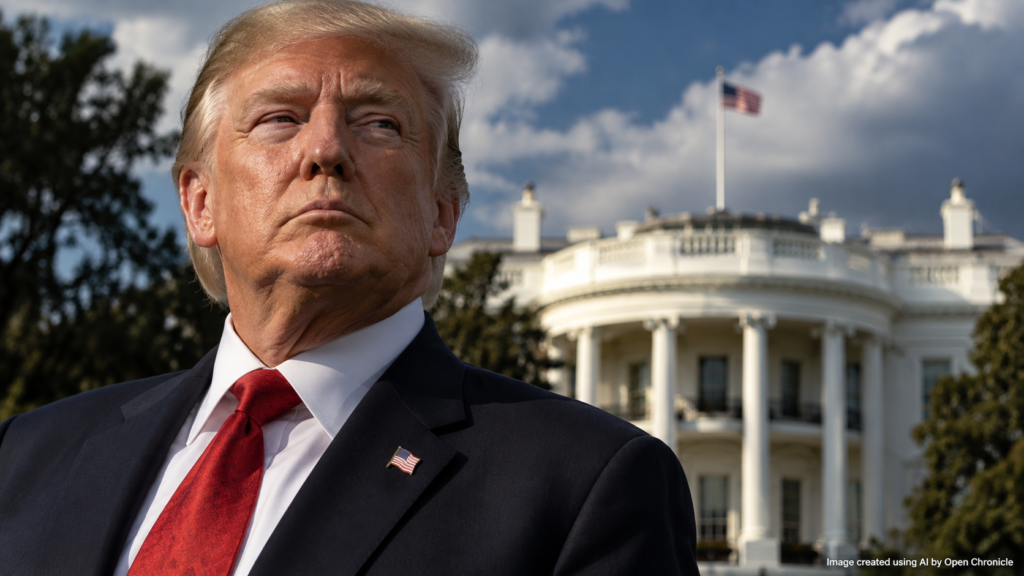
By Open Chronicle with agencies
President Donald Trump said Friday that he is banning CNN, MS NOW and Politico from the White House, sharply escalating his administration’s confrontation with news organisations whose coverage he has repeatedly criticised.
Trump announced the decision on Truth Social on September 18, accusing the three outlets of publishing false information about his administration and the United States. He also suggested that additional news organisations could face similar restrictions. The Associated Press independently reported the announcement Friday.
The immediate practical scope of the order, however, was not entirely clear.
CNN said its journalists were still working from the White House on Friday afternoon after Trump’s announcement, while members of its team continued travelling with Vice President JD Vance as part of the press pool.
That distinction leaves an important question unresolved: whether Trump’s declaration represents an immediately enforceable prohibition on the organisations’ journalists entering White House facilities, a restriction on particular areas and events, or an announced policy that has yet to be fully implemented.
Trump says he wants the organisations out
In his Truth Social post, Trump argued that media organisations should not be permitted to repeatedly publish what he described as false reporting while covering the president and his administration.
Later, when reporters asked him to explain the decision, Trump gave little additional justification.
According to CNN’s account of the exchange, Trump described it as a straightforward ban and said he did not want the organisations in his office or at the White House. He suggested the restriction should extend as far as possible.
He also indicated that the decision might eventually be reconsidered if, in his view, the organisations changed their reporting.
Trump’s characterisation of the three organisations as producing false or misleading coverage is his own assessment. The outlets dispute that description and have defended their journalism.
CNN says threatened ban would violate its rights
CNN responded forcefully, saying it stood behind its White House journalists and their reporting.
The network argued that its journalists have constitutional protections to report on the administration without government interference and said it would regard implementation of the threatened ban as an unlawful restriction on press freedom.
Politico also rejected the president’s action.
The publication said it would continue covering the Trump administration and future administrations fairly and would defend its First Amendment rights against attempts to restrict its journalists.
The Associated Press reported that the threatened restrictions could also affect the established system through which news organisations share coverage of the president, including the television pool that provides access when space prevents the entire White House press corps from attending an event.
A significant First Amendment dispute
The announcement immediately raises constitutional and legal questions.
The First Amendment protects freedom of speech and of the press, but that does not mean every journalist has an unlimited constitutional right to enter every government facility or presidential event.
The legal issue becomes more complicated when the government provides access to journalists and then removes that access because officials object to the content of their reporting.
A significant precedent is the 1977 federal appeals court decision in Sherrill v. Knight. The case established that, once the White House creates a system of press access, decisions to deny a journalist a press pass cannot be made arbitrarily and must satisfy procedural protections. The ruling has played an important role in subsequent disputes involving White House credentials.
Whether Trump’s latest action violates those principles would depend in part on exactly how the administration implements the announced ban, what access is withdrawn and what justification and procedures are provided.
The Jim Acosta confrontation
This is not the first time Trump and CNN have fought over White House access.
During Trump’s first administration, the White House revoked the press credentials of CNN correspondent Jim Acosta following a contentious November 2018 press conference.
CNN sued Trump and several administration officials.
A federal judge subsequently ordered the White House to temporarily restore Acosta’s credential, after which the administration returned his full press pass and introduced new rules governing presidential press conferences.
That confrontation became one of the most prominent disputes over White House press access during Trump’s first term.
The current situation is potentially broader because Trump’s announcement concerns entire news organisations rather than a dispute involving one individual correspondent.
The Associated Press dispute
Trump’s second administration has already been involved in another major legal fight over press access.
The White House restricted the Associated Press’s access to certain presidential events after the news organisation declined to adopt the administration’s preferred terminology for the Gulf of Mexico.
The AP challenged those restrictions in court.
The dispute has continued through litigation and has become part of the wider argument over how much authority an administration possesses to determine which journalists receive close access to the president.
Trump’s latest announcement adds CNN, MS NOW and Politico to an increasingly contentious relationship between his administration and major news organisations.
The Associated Press noted Friday that the president and his administration have also been engaged in disputes or litigation involving several other major media organisations.
From individual reporters to entire organisations
The scale of Friday’s announcement makes it particularly significant.
Presidents from both parties have had contentious relationships with journalists and have complained about reporting they considered inaccurate or unfair. White House officials also routinely decide which reporters receive interviews, invitations and other forms of discretionary access.
A blanket exclusion of news organisations because of their editorial coverage raises a different set of questions.
Trump’s statement explicitly connected the proposed restrictions with his objections to their reporting. That link is likely to be central to any legal challenge if the administration formally implements the ban.
The AP reported that legal precedent could present obstacles to removing press access on the basis of content without an adequate governmental justification and due process.
At the same time, the exact constitutional analysis would depend on the kind of access involved. Access to the White House complex, formal press credentials, participation in the press pool and attendance at invitation-only presidential events do not necessarily present identical legal questions.
Potential consequences for the White House press pool
The dispute could also affect coverage well beyond the three organisations directly targeted.
White House reporting depends heavily on a rotating press pool because it is often impossible for hundreds of accredited journalists to accompany the president into smaller rooms, vehicles or events.
Pool reporters and television crews therefore observe presidential activities and distribute reports, video and audio to the broader press corps.
According to the AP, removing CNN could disrupt the traditional five-network television pool responsible for providing independent coverage of the president.
That makes the controversy more than a dispute about whether three organisations can send reporters into the White House.
Changes to pool participation can potentially affect the material available to many other news organisations and, ultimately, the public.
Implementation now becomes the central question
As of Friday afternoon, there was an important gap between Trump’s public declaration and conditions on the ground.
CNN said its White House journalists remained inside the complex after the announcement. That means the full extent and timing of any new restrictions were still developing.
If the administration formally revokes credentials or excludes journalists from spaces to which comparable news organisations retain access, litigation could follow quickly.
CNN has already indicated that it believes such action would violate constitutional protections. Politico has likewise said it will defend its First Amendment rights.
The White House, meanwhile, could argue that the president and his staff retain significant authority over access to certain presidential spaces and events.
Those competing positions would ultimately have to be assessed against the specific restrictions imposed and existing First Amendment precedent.
What is already clear is that Trump’s announcement marks another escalation in a long-running struggle between his political movement and parts of the American press.
This time, however, the dispute extends beyond criticism of particular stories or individual reporters. The president has publicly declared that three major news organisations should be excluded from the White House because he objects to their coverage.
Whether that declaration becomes a comprehensive operational ban, and whether such a ban survives an expected constitutional challenge, are now the central questions.