
By Open Chronicle with agencies
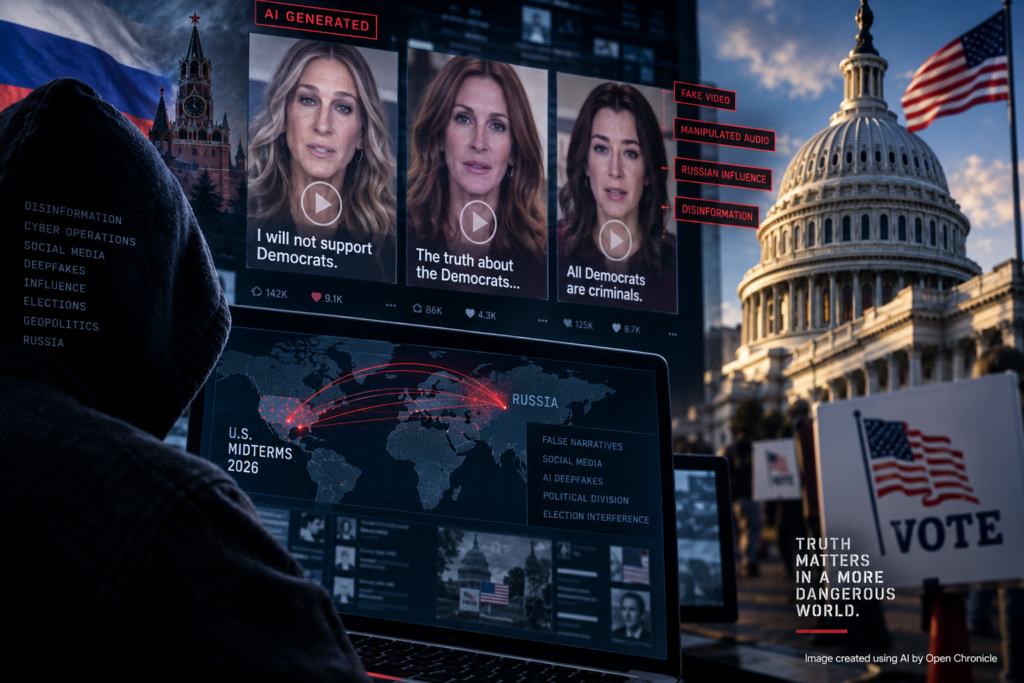
A Russian-linked influence operation is targeting the 2026 United States midterm elections with artificial intelligence-generated videos that falsely depict American celebrities attacking Democrats, according to researchers tracking online disinformation.
The campaign has circulated manipulated videos across social media using cloned voices, authentic footage taken out of context and unauthorised news branding. Researchers cited by AFP have linked the operation to a Russian influence network and warned that additional material is likely to appear as the November elections approach.
The episode highlights an increasingly difficult challenge for election security. Artificial intelligence now allows influence operations to manufacture convincing political content faster and more cheaply than traditional propaganda techniques, while social networks can distribute that material internationally within hours.
Celebrity videos manipulated with artificial intelligence
The campaign uses genuine footage of well-known actors but replaces or alters the audio to make them appear to deliver political messages they never made.
Among the celebrities whose likenesses have reportedly been misused are Sarah Jessica Parker, Julia Roberts and Alyson Hannigan. Some footage was originally produced for advertising campaigns or personalised celebrity video services before being repurposed.
The manipulated clips falsely portray the actors as condemning the Democratic Party and encouraging Americans not to support Democratic candidates. Some have been distributed with the hashtag #AllDemocratsAreCriminals.
Researchers say the operation has also used CNN branding without authorisation, apparently attempting to make the fabricated videos look like material connected to an established American news organisation.
The technique combines several elements that can make modern disinformation particularly effective: recognisable faces, emotionally provocative political claims, authentic video footage and synthetic audio that can initially appear credible to someone encountering a clip while quickly scrolling through social media.
Researchers link campaign to Russian influence network
Researchers have associated the material with an influence operation commonly known as Matryoshka, a network previously connected with Russian information operations.
The attribution comes from researchers examining patterns of distribution, technical characteristics and previous activity associated with the network. It should therefore be understood as an attribution by investigators rather than independent proof that every account circulating the videos is directly operated by the Russian government.
AFP reported that researchers described the campaign as a Russian disinformation operation and said more election-related material could follow.
The operation appears designed primarily to exploit existing political divisions rather than introduce entirely new controversies. By placing fabricated statements in the mouths of recognisable public figures, the campaign can inject inflammatory messages into debates already taking place inside the United States.
AI changes the economics of political disinformation
Foreign influence operations are not new, but generative artificial intelligence has significantly expanded the tools available to those conducting them.
A convincing propaganda video once required substantial editing, specialised equipment and sometimes actors or elaborate staging. AI systems can now reproduce voices, alter photographs and create synthetic video at much greater speed.
The resulting content does not necessarily need to withstand prolonged scrutiny.
For a disinformation operation, reaching large numbers of people before a fabrication is identified can be enough to generate confusion, reinforce existing suspicions or force journalists, campaigns and public officials to spend time disproving false claims.
The campaign targeting Democrats demonstrates this approach. Instead of inventing unknown personalities, the operation reportedly takes familiar actors and genuine footage and changes the political message.
That mixture of real and artificial material can make manipulated content more difficult to recognise immediately.
A campaign focused on Democrats
The content identified so far has specifically attacked Democrats.
That does not establish how effective the operation has been or whether it has meaningfully changed voter attitudes. Evidence that manipulated material is circulating is different from evidence that it has influenced voting behaviour.
Researchers can identify networks, trace distribution patterns and measure engagement, but determining whether such campaigns ultimately change election results is substantially more difficult.
The distinction is important as the United States approaches the November 3 midterms.
Hundreds of House and Senate races, as well as state and local contests, will be decided. Control of Congress will depend on the results, making the election a potentially attractive target for foreign influence operations seeking to amplify domestic political divisions.
The existence of such an operation does not itself indicate which party will benefit electorally or what effect, if any, the campaign will have on the outcome.
Disinformation about the disinformation campaign
The information battle has already developed another layer.
Researchers at the Ukrainian media-monitoring organisation Detector Media reported that a separate network of accounts circulated fabricated material claiming an American journalist had admitted that Democrats themselves created the Russian interference story as a “false flag.”
Detector Media said the supposed admission did not occur and that the genuine reporting being manipulated actually described the Russian-linked operation targeting the midterms.
That represents a familiar feature of contemporary influence campaigns: reports exposing disinformation can themselves become raw material for additional disinformation.
The result can be a cycle in which the original fabrication is followed by competing claims about who created it, making it increasingly difficult for audiences encountering isolated posts to determine the origin of the information.
Social media becomes the principal battlefield
The operation also illustrates why social media remains particularly attractive for foreign influence campaigns.
Short videos can move rapidly between platforms, accounts and communities. Copies can survive even after an original account or post has been removed, while algorithms can expose users to provocative material without requiring them to actively search for political information.
Artificial intelligence adds another complication because different versions of essentially the same narrative can be generated quickly.
Instead of relying on a single viral fabrication, an operator can potentially produce dozens of variations using different public figures, voices and visual styles.
Researchers tracking the current campaign expect further attempts as the election approaches.
Election interference enters the deepfake era
The immediate significance of the campaign goes beyond individual fake celebrity videos.
It demonstrates how political influence operations are evolving from fake accounts, fabricated articles and misleading memes toward synthetic media capable of imitating real people.
For voters, the increasingly realistic nature of AI-generated material means that a video or audio recording can no longer automatically be treated as proof that a public figure actually made the statement attributed to them.
For news organisations and election authorities, the challenge is equally difficult. False material can spread internationally before journalists or technology companies have completed verification.
At the same time, legitimate footage can increasingly be dismissed as artificial, creating what researchers have described as the broader credibility problem surrounding deepfakes.
The Russian-linked campaign targeting Democrats is therefore not simply another episode in the long history of political propaganda. It offers a glimpse of how artificial intelligence could reshape election interference, with genuine footage, synthetic voices, false media branding and social networks combined into political messages designed to look authentic long enough to spread.
With the U.S. midterm elections approaching, identifying the origin and authenticity of viral political content is likely to become an increasingly important part of the information battle surrounding the vote.