
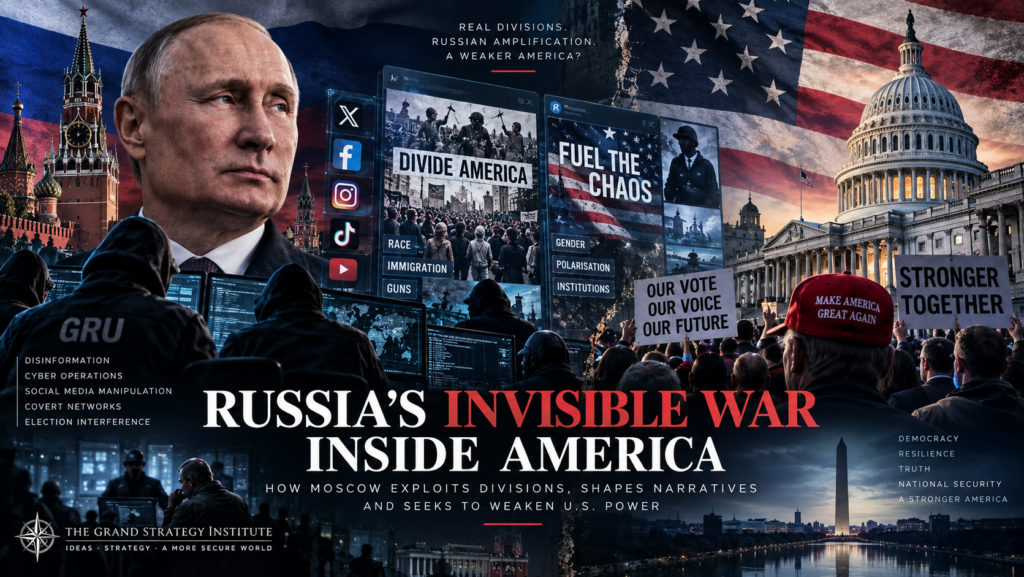
From fake American activists and racial division to covert media financing, cyber operations and election disinformation, the documented record shows a sustained Russian effort to exploit divisions inside American society. The larger strategic danger is not that Moscow controls U.S. politics, but that domestic polarisation can make America easier to manipulate and less able to exercise power abroad.
By The Grand Strategy Institute Research Division
Grand Strategy Analysis | 18 September 2026
Russia does not need to defeat the United States militarily to weaken American power.
It does not need to convince Americans to admire Vladimir Putin.
It does not need to convert the United States into a Russian ally.
And it certainly does not control American political life.
The strategy documented by U.S. investigations is considerably more subtle.
Find the fractures already present inside American society. Amplify them. Make Americans distrust institutions, elections, journalists, political opponents and eventually one another.
This is not speculation.
The public record now stretches across multiple American elections, congressional investigations, intelligence assessments, criminal indictments, sanctions and counterintelligence operations.
The Mueller investigation concluded that the Russian government interfered in the 2016 presidential election in what it described as a “sweeping and systematic” manner. Its investigation identified two principal operations: a social-media influence campaign and Russian intelligence hacking followed by the release of stolen material.
A bipartisan investigation by the Senate Intelligence Committee subsequently concluded that Russia conducted an aggressive, multifaceted effort to influence the 2016 election.
The U.S. intelligence community assessed that Vladimir Putin and the Russian state authorised influence operations during the 2020 election aimed at damaging Joe Biden, supporting Donald Trump, undermining confidence in the electoral process and exacerbating divisions within American society.
In 2024, American authorities again exposed Russian influence operations. The Justice Department seized 32 domains allegedly used in the Russian government directed “Doppelganger” campaign, while prosecutors charged two RT employees over an alleged nearly $10 million operation covertly financing an American media company whose content reached millions of viewers.
Days before the 2024 presidential election, the FBI, ODNI and CISA publicly warned that Russia was the most active foreign influence threat they were observing and was manufacturing videos and fake articles intended to undermine confidence in the election and intensify divisions among Americans.
And the 2026 Annual Threat Assessment says Russia continues to employ cyberattacks, disinformation, influence operations, economic pressure, intimidation and sabotage as tools of competition below the threshold of conventional war.
This is therefore no longer primarily a story about 2016.
It is a story about a sustained strategic contest.
And the most important battlefield is not Washington.
It is American society itself.
The Objective Is Not Simply to Elect Someone
Russian interference is frequently reduced to one question:
Did Moscow help one candidate defeat another?
That question matters.
But it is too narrow.
The deeper objective documented in Russian operations has repeatedly involved weakening confidence in the American political system itself.
The 2018 Justice Department indictment of Internet Research Agency personnel described Russian operatives discussing “information warfare” against the United States and attempting to spread distrust toward candidates and the political system.
The operation impersonated Americans.
It created fictitious identities.
It bought advertisements.
It contacted real activists.
It organised political events.
It promoted competing political causes.
One particularly revealing episode occurred after the 2016 election.
Russian operatives allegedly organised both a rally supporting President-elect Trump and a rally opposing him in New York on the same day.
That detail captures the strategy extraordinarily well.
The objective was not simply persuasion.
It was polarisation.
Moscow did not always need Americans to agree with Russia.
It benefited when Americans became more hostile toward each other.
Race Became a Battlefield
One of the most disturbing findings of the bipartisan Senate Intelligence Committee investigation concerned race.
The committee found that the Internet Research Agency targeted African Americans more extensively than any other demographic group during its social-media campaign.
Russian operators exploited racial grievances, police shootings and other genuine controversies. They built apparently American pages and personas, encouraged petitions and real-world activity, and attempted to deepen existing divisions.
The important point is not that Russia invented American racial conflict.
It did not.
Those divisions have deep historical and contemporary causes within the United States.
The operation worked precisely because the grievances were real.
That is a fundamental principle of effective disinformation.
The strongest propaganda frequently begins with something true.
It identifies a genuine injustice, fear or controversy.
It then selectively amplifies it, removes context, exaggerates opposing positions or pushes different communities toward mutually incompatible interpretations of reality.
Russia discovered that American democracy provided enormous quantities of emotionally powerful material without Moscow needing to manufacture the underlying controversy.
Immigration, Guns, Race, Gender and Identity
The range of issues targeted was remarkably broad.
Justice Department filings concerning Russian influence activity documented content addressing immigration, gun rights, the Confederate flag, race relations, LGBT issues, the Women’s March, protests surrounding the national anthem and highly emotional events including the Charleston church shooting, Charlottesville and police shootings of Black Americans.
These issues share an important characteristic.
They are identity questions.
They concern who Americans believe they are.
Who belongs.
Who is threatened.
Who possesses rights.
Who controls institutions.
Who is being treated unfairly.
And who is responsible.
That makes them exceptionally powerful material for influence operations.
The objective does not require creating a majority.
It requires increasing the emotional distance between existing groups.
Russia Learned to Become American
Early propaganda could often be recognised as foreign.
Modern influence operations increasingly attempt to remove the foreign identity entirely.
The most sophisticated Russian information operation does not necessarily tell an American:
Russia believes this.
It tells the American:
Americans like you believe this.
That distinction is critical.
The Internet Research Agency created accounts appearing to belong to ordinary Americans. Russian operators stole or misused American identities and created social-media infrastructure designed to conceal their origins.
By 2024, the technique had evolved considerably.
The Justice Department’s Doppelganger case described websites designed to imitate established American and foreign news organisations.
Russian operators allegedly created domains resembling legitimate news sites and filled them with Russian government messaging while attempting to make the material appear to originate from authentic journalism.
The strategic evolution is important.
Russian propaganda increasingly works best when nobody realises it is Russian propaganda.
Then Came the Influencers
The 2024 RT case demonstrated another evolution.
According to a Justice Department indictment, two RT employees deployed nearly $10 million through foreign shell companies to covertly finance and direct a Tennessee based content company.
That company published almost 2,000 English-language videos across platforms including YouTube, TikTok, Instagram and X. The videos accumulated more than 16 million YouTube views alone.
The content covered recognisably American subjects including immigration, inflation and domestic and foreign policy.
According to prosecutors, the operation concealed RT’s involvement using shell companies, fictitious identities and covert management.
This represents a major development in influence warfare.
Russia no longer needed Americans to visit Russian media.
It could attempt to place Russian-financed narratives inside the American information ecosystem itself.
And crucially, the Americans consuming the content did not necessarily know where the financing originated.
The Justice Department case also underscores an important distinction: the indictment’s allegations concern the Russian operatives and covert funding scheme; an indictment is not itself a criminal conviction.
Artificial Intelligence Changes the Scale
Generative artificial intelligence now creates another transformation.
Fake photographs can be produced rapidly.
Synthetic voices can imitate public figures.
Videos can be manipulated.
Articles can be generated at industrial scale.
Personas can maintain apparently authentic conversations.
Content can be translated almost instantaneously.
Thousands of variations of the same narrative can be tested against different audiences.
The Treasury Department said Russian state sponsored actors had used tools including generative AI, deepfakes and disinformation while attempting to undermine confidence in American elections and institutions.
During the final days of the 2024 election, U.S. intelligence agencies publicly attributed fabricated videos and fake stories to Russian influence actors, including a false video purporting to show illegal voting in Georgia.
The barrier to entry for information warfare is consequently falling.
What once required television studios, printing presses and large intelligence organisations can increasingly be produced with software.
But Russia Cannot Manufacture American Polarisation From Nothing
This is where analysis must resist exaggeration.
Russia did not create America’s political divisions.
It did not create racial inequality.
It did not create the immigration debate.
It did not create distrust of Washington.
It did not create disagreements over abortion, guns, religion, policing or economic inequality.
It did not create the American populist movement.
Nor is there evidence that Moscow remotely controls either major American political party.
American political decisions remain decisions made by Americans.
This distinction is essential.
Foreign influence becomes effective when domestic conditions provide something to exploit.
Russia’s strategic advantage therefore increases when American society becomes more polarised independently of Russia.
Moscow does not need to create the fire.
It can add oxygen.
Nor Did Mueller Establish a Trump-Russia Conspiracy
This also needs to be stated clearly.
The existence of Russian interference in 2016 and the question of criminal coordination by the Trump campaign are not the same proposition.
The Mueller investigation established extensive Russian interference and numerous contacts involving Russian actors and people associated with the Trump campaign.
But it did not establish that members of the Trump campaign conspired or coordinated with the Russian government in its election-interference activities.
Then Attorney General William Barr’s summary of the report likewise emphasised that investigators did not identify evidence that Americans knowingly or intentionally coordinated with the Internet Research Agency operation.
The bipartisan Senate investigation nevertheless found serious counterintelligence vulnerabilities and confirmed a broad Russian influence campaign.
Both facts can be true simultaneously.
Russia interfered.
That does not mean every American whose views coincided with a Russian objective was working for Russia.
Conflating those propositions actually makes serious analysis of foreign influence harder.
Russia Does Not Need Agents Everywhere
This leads to one of the most misunderstood aspects of influence warfare.
A person can repeat a narrative beneficial to Moscow without having any connection to Moscow.
A politician can advocate reducing support for Ukraine for genuinely held ideological, fiscal or strategic reasons.
A voter can oppose NATO enlargement without being influenced by Russia.
A journalist can criticise U.S. foreign policy without advancing a covert foreign agenda.
Political disagreement is not evidence of foreign control.
In fact, Russian influence operations benefit when Americans begin accusing every political opponent of being a foreign agent.
Why?
Because that destroys trust too.
The relevant questions are narrower:
Was content secretly financed?
Was its origin concealed?
Was a foreign government directing it?
Were false identities used?
Was information fabricated?
Were cyber operations involved?
Those questions can be investigated with evidence.
The Cyber Dimension Is Different
Influence operations are only one component of Russian activity.
Russia also possesses significant cyber capabilities.
The Mueller investigation concluded that Russian military intelligence hacked Democratic Party and Clinton campaign related systems in 2016 and subsequently released stolen material.
The 2026 U.S. Annual Threat Assessment describes Russia as a persistent and advanced cyberattack and foreign-intelligence threat and says Moscow retains capabilities relevant to U.S. government, private-sector and critical-infrastructure networks.
Cyber operations therefore provide Russia with several potential instruments.
Espionage.
Information theft.
Prepositioning inside networks.
Disruption.
And the acquisition of material that can subsequently become ammunition in information operations.
The combination is strategically powerful.
Hack the information. Select the information. Release the information. Amplify the information. Let American politics do the rest.
2016 Was Not the End
Perhaps the strongest evidence that this should not be treated simply as a historical controversy is repetition.
2016 produced the Internet Research Agency campaign and GRU hacking operation.
2018 saw continued Project Lakhta activity targeting American politics.
The intelligence community concluded that Putin and the Russian state authorised influence operations during the 2020 presidential election.
In 2024, American authorities exposed Doppelganger, the covert RT financing operation and additional election-related disinformation.
The 2026 threat assessment continues to identify Russian disinformation and influence operations among Moscow’s grey-zone tools.
That chronology matters.
It suggests adaptation rather than abandonment.
The Target Is Increasingly Trust
The common denominator is trust.
Trust that elections are real.
Trust that votes are counted.
Trust that political opponents are legitimate citizens rather than enemies.
Trust that news organisations are actually what they claim to be.
Trust that a social-media account belongs to the person it purports to represent.
Trust that photographs and videos depict real events.
Trust that government institutions are functioning.
Trust that allies will honour commitments.
Trust that the United States is capable of coherent long-term policy.
Every one of those forms of trust constitutes strategic capital.
Destroy enough of them and a country can remain extraordinarily wealthy and militarily powerful while becoming increasingly unable to translate those resources into coherent national action.
Polarisation Has Foreign-Policy Consequences
Domestic political fragmentation does not remain domestic.
Foreign policy requires continuity.
Allies need to believe American commitments will survive elections.
Adversaries need to believe American deterrence commitments are credible.
Businesses need predictable rules.
Military planning requires multi-year investment.
Diplomacy requires partners to believe agreements will continue beyond one administration.
When American foreign policy changes radically with each political cycle, uncertainty grows.
Russia benefits from that uncertainty.
So does China.
Not because either necessarily created it, but because American inconsistency changes the strategic environment in which they operate.
The International Environment Is Already Changing
There is evidence that perceptions of American global leadership are under pressure.
A 2026 international survey of more than 35,000 people across 34 countries found only 39 percent comfortable with the United States leading global affairs, while respondents showed greater interest in international cooperation and significant confidence in several multilateral institutions. The same survey also found Russia was perceived as the largest threat among the countries tested, demonstrating that declining confidence in U.S. leadership does not translate automatically into greater confidence in Moscow.
That distinction matters.
A relative weakening of American leadership does not necessarily mean Russia replaces the United States.
The more likely result is fragmentation.
Middle powers seek greater autonomy.
Europe develops more independent defence capabilities.
India pursues strategic autonomy.
BRICS expands.
China builds parallel institutions.
Gulf states diversify partnerships.
Countries hedge.
The world becomes less American without necessarily becoming Russian or Chinese.
Russia, China, Iran and North Korea Are Not NATO
There is also growing cooperation among America’s principal geopolitical adversaries.
The 2026 U.S. intelligence assessment says Russia has cultivated partnerships with China, Iran and North Korea to advance its interests.
But describing these states as a unified alliance would go too far.
Their interests differ substantially.
China is economically integrated with the global system in ways Russia is not.
Iran has regional priorities different from Moscow’s.
North Korea remains unusually isolated.
Russia itself wants strategic autonomy.
There is no equivalent of NATO’s Article 5 binding them together.
What is emerging is better described as strategic convergence.
They cooperate where their interests overlap.
And one of those interests is reducing the ability of the United States to dominate the international system.
The Most Dangerous Russian Victory Would Be an American One
This leads to the central paradox.
The most effective Russian influence operation would not be one in which Americans suddenly adopt Russian ideology.
It would be one in which Americans become convinced that other Americans are their principal enemies.
Republicans cease seeing Democrats as legitimate Americans.
Democrats cease seeing Republicans as legitimate Americans.
Urban and rural communities inhabit incompatible realities.
Racial groups increasingly distrust one another.
Every election defeat becomes evidence of fraud.
Every institution becomes partisan.
Every news report becomes propaganda.
Every compromise becomes betrayal.
At that point Russia hardly needs to invent narratives.
American society generates them itself.
That is why the strategic centre of gravity lies inside the United States.
America Is Not Powerless
There is an important counterargument to any narrative of American decline.
The United States remains extraordinarily powerful.
It possesses the world’s deepest capital markets.
The dollar remains central to international finance.
American universities dominate much global research.
U.S. technology companies occupy central positions in artificial intelligence, cloud computing, semiconductors and digital infrastructure.
The United States possesses an unparalleled global alliance network.
Its military maintains global reach.
Its economy remains enormous and innovative.
Even amid current strains, U.S. Treasury Secretary Scott Bessent pointed this week to strong demand at Treasury auctions as evidence of continuing international confidence in American financial institutions and the dollar.
Decline is therefore not predetermined.
But power is not merely the possession of resources.
It is the ability to organise them toward strategic objectives.
America’s Greatest Vulnerability Is Internal
This may be the central lesson from a decade of Russian interference.
The United States cannot prevent Russia from producing propaganda.
It cannot prevent China from criticising American policy.
It cannot eliminate artificial intelligence.
It cannot prevent every foreign intelligence operation.
But it can influence whether those operations find fertile ground.
A society with high institutional trust, strong media literacy, transparent political financing, resilient election systems and citizens capable of political disagreement without mutual delegitimisation is difficult to manipulate.
A society in which every controversy becomes existential is much easier.
Russia’s greatest advantage is therefore not its propaganda machinery.
It is America’s own polarisation.
GSI Strategic Assessment
The Grand Strategy Institute assesses that Russian interference in American political and social life represents a documented, sustained and adaptive strategic campaign, but its importance should be understood carefully.
First, Russian interference in U.S. politics is established by substantial public evidence. Investigations by the Justice Department, intelligence community and bipartisan Senate Intelligence Committee documented Russian operations targeting multiple U.S. electoral cycles.
Second, the Russian objective extends beyond supporting particular candidates. Documented operations sought to undermine confidence in democratic institutions and exacerbate social divisions.
Third, Moscow systematically exploits existing American grievances rather than creating most of them. Race, immigration, gun rights, identity and political distrust existed independently of Russian intervention.
Fourth, Russian techniques have evolved. They have included fake personas, social-media campaigns, cyber intrusion, stolen-information releases, imitation news websites, covert media financing and AI-assisted disinformation.
Fifth, Russian influence should not be confused with Russian control of American political actors. Americans can independently hold positions that also serve Russian interests. Political disagreement is not evidence of foreign direction.
Sixth, the Mueller investigation did not establish a criminal conspiracy between the Trump campaign and the Russian government in the 2016 interference operation. That conclusion must coexist with the separate finding that Russian interference itself was extensive.
Seventh, the strategic target increasingly appears to be trust itself. Elections, journalism, institutions and relationships between social groups provide attractive targets because weakening trust reduces the capacity for collective action.
Eighth, artificial intelligence is likely to increase the volume, sophistication and speed of foreign influence operations. Synthetic media makes attribution and verification increasingly difficult.
Ninth, domestic fragmentation can translate into declining international influence. Allies become less certain about American commitments when foreign policy becomes highly volatile across administrations.
Tenth, cooperation among Russia, China, Iran and North Korea creates additional pressure on the United States, but these countries should not be treated as a unified alliance. Their cooperation is significant but remains driven by overlapping rather than identical interests.
Eleventh, current international polling provides evidence of reduced comfort with American global leadership, but not of a simple transfer of leadership to Russia or China. The emerging environment is more fragmented and multipolar.
Twelfth, Russia’s greatest opportunity lies not in controlling America but in exploiting Americans’ declining trust in one another.
Conclusion
For years, the American debate over Russian interference has itself become part of America’s partisan conflict.
That has obscured the larger strategic lesson.
The evidence does not show that Moscow controls the United States.
It does not show that every politician advocating a policy advantageous to Russia is a Russian agent.
It does not show that American political polarisation was manufactured in Moscow.
And it does not absolve Americans of responsibility for their own political decisions.
What the record does show is persistent Russian willingness to enter America’s information environment covertly, impersonate Americans, exploit racial and ideological grievances, hack political organisations, distribute stolen information, finance media operations, manufacture false content and undermine confidence in elections and democratic institutions.
That should concern Americans across the political spectrum.
Because the fundamental issue is larger than Donald Trump.
Larger than Joe Biden.
Larger than Republicans or Democrats.
Larger even than an individual presidential election.
It concerns the relationship between domestic cohesion and national power.
The United States became the central power of the post-1945 international system not simply because it possessed aircraft carriers, nuclear weapons and enormous economic resources.
It also possessed institutions that allies trusted, political continuity that adversaries respected, a society capable of extraordinary mobilisation and an international system in which American commitments carried unusual weight.
Those advantages can be weakened from outside.
But they can only be fundamentally destroyed from within.
Russia’s information strategy appears to recognise that distinction.
The United States therefore faces a strategic challenge that cannot be solved simply by blocking Russian websites or sanctioning Russian intelligence officers.
America must make itself harder to manipulate.
That requires exposing covert foreign financing without criminalising legitimate political disagreement.
It requires protecting elections without treating every electoral dispute as foreign interference.
It requires defending free speech while identifying deliberately concealed state propaganda.
It requires improving media literacy without creating a government ministry of truth.
And above all, it requires recovering the ability to disagree politically without treating fellow citizens as existential enemies.
Because Moscow’s most consequential strategic achievement would not be persuading America to become pro-Russian.
It would be helping create an America so divided, distrustful and strategically inconsistent that Russia no longer needs to defeat the United States abroad because the United States is increasingly unable to organise its extraordinary power at home.
The Grand Strategy Institute
Continue Exploring Strategic Analysis
Return to The Grand Strategy Institute for strategic assessments, long-form analysis and research examining geopolitics, military affairs, international security, emerging technologies and the changing international order.
← Back to The Grand Strategy Institute