
By Open Chronicle with agencies
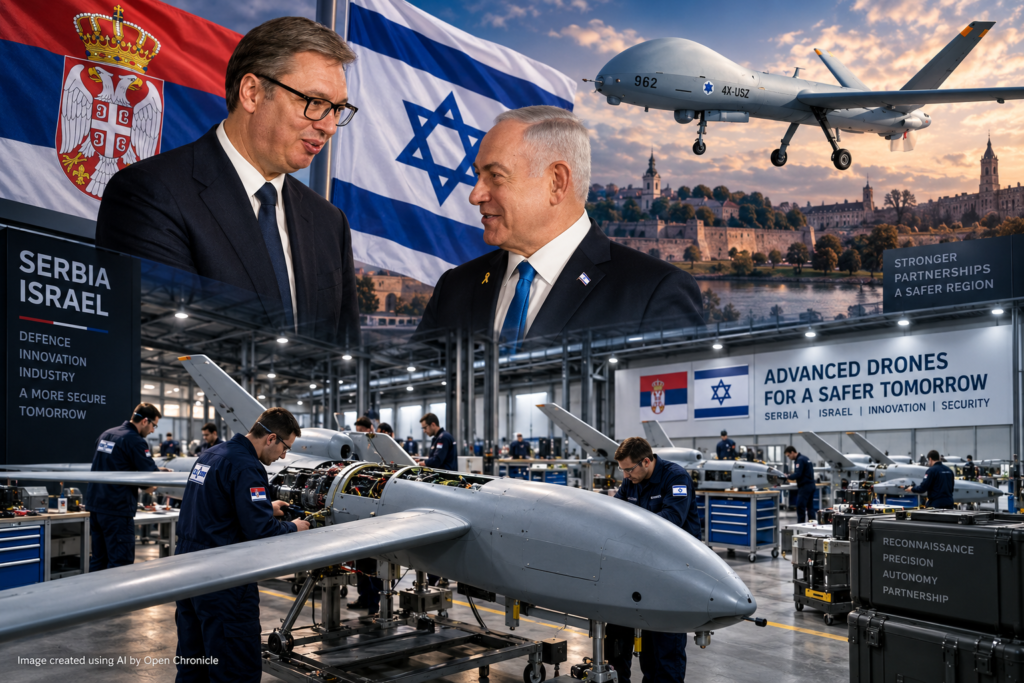
Serbia has opened a new factory to assemble advanced Israeli-designed military drones, marking another step in Belgrade’s rapid military modernisation and its expanding defence relationship with Israel.
President Aleksandar Vučić announced the inauguration on Thursday, saying the facility will manufacture unmanned systems for the Serbian Armed Forces and potentially for export to other countries. The factory is expected to employ around 100 people, while Vučić said Serbia and its Israeli partners plan to establish at least three additional production facilities.
The project reflects a broader transformation of Serbia’s defence strategy. Once heavily dependent on Russian and Soviet-designed equipment, Belgrade has increasingly diversified its military suppliers, purchasing systems from Israel, China and European manufacturers while simultaneously developing its domestic defence industry.
A factory largely hidden from public view
Few details about the new plant have been made public.
Vučić released limited footage from the facility but said journalists were not invited because of the confidentiality surrounding the production process. He described the equipment being assembled as among the most modern available and said the public would be impressed by what was being produced.
The facility was established through cooperation involving Israeli defence company Elbit Systems and Serbia’s state arms company Yugoimport SDPR, according to reporting by the Associated Press.
Earlier reporting on the project indicated that Elbit would hold a 51 percent stake in the joint venture, with SDPR holding the remaining 49 percent.
“Our plans are huge,” Vučić said in announcing the inauguration, adding that Serbia expects to open at least three more factories with its Israeli partners.
The ambition goes beyond simply importing foreign weapons. Serbia increasingly wants to manufacture advanced military technology domestically and establish itself as a producer and exporter of unmanned systems.
Israeli technology becomes central to Serbian modernisation
The drone factory is part of a much larger expansion of defence cooperation between Serbia and Israel.
In 2025, Elbit Systems announced a five-year contract worth approximately $1.63 billion with an unidentified European customer. Israeli media subsequently identified that customer as Serbia.
The package includes long-range precision artillery rocket systems, reconnaissance drones, loitering aerial systems, electronic warfare equipment, intelligence technology and advanced command-and-control systems.
Serbia has separately acquired Elbit’s PULS rocket artillery system and Hermes 900 unmanned aircraft. The Hermes 900 is a long-endurance platform designed for intelligence, surveillance and reconnaissance missions and can carry different payloads depending on configuration.
The breadth of the purchases shows that the relationship is no longer centred on individual weapons systems. Israel is becoming an important technological partner in Serbia’s attempt to modernise multiple layers of its armed forces.
From buying drones to building them
Domestic drone production represents a particularly significant development.
Vučić announced in April that Serbia intended to jointly manufacture combat drones with Israeli partners. He presented the initiative as both a military project and an industrial opportunity that could strengthen Serbia’s defence exports.
The new plant takes that strategy from procurement into production.
Instead of relying entirely on imported unmanned aircraft, Serbia will gain experience assembling advanced Israeli-designed systems while developing local manufacturing capabilities.
The partnership could eventually include different categories of drones intended for reconnaissance and combat missions, although detailed specifications of what is currently being produced inside the new facility have not been publicly disclosed.
That secrecy makes it important to distinguish confirmed information about the factory from broader reports about the systems Serbia and Elbit intend to develop together.
Serbia broadens its network of military suppliers
The partnership with Israel also illustrates how far Serbia’s defence procurement has diversified.
For decades, the Serbian military relied heavily on Soviet and Russian equipment. Belgrade continues to maintain relations with Moscow, but its modernisation programme now incorporates systems from several competing geopolitical blocs.
Serbia has purchased Chinese missiles and drones, while France has become another important supplier through Belgrade’s decision to acquire Rafale fighter aircraft. Israeli technology is increasingly prominent in drones, artillery, electronic warfare and battlefield communications.
The strategy gives Serbia access to technologies that would be difficult to obtain from a single supplier while reducing dependence on any one country.
It also creates an unusual defence portfolio for a country that remains militarily neutral, maintains longstanding relations with Russia and China, and at the same time continues to pursue European Union membership.
Intelligence cooperation also expanding
The relationship between Belgrade and Jerusalem extends beyond weapons procurement.
In April, Serbia’s parliamentary Defence and Internal Affairs Committee considered a general defence agreement between the Serbian and Israeli defence ministries covering the exchange and reciprocal protection of classified defence information.
Such arrangements provide the legal framework necessary for deeper cooperation involving sensitive military technologies, intelligence and defence data.
For Serbia, access to Israeli expertise in unmanned systems, electronic warfare and battlefield intelligence can accelerate a modernisation process that would otherwise require years of independent development.
For Israel, Serbia offers an industrial partner in southeastern Europe and a potential production base for systems intended both for Serbian forces and international customers.
Defence cooperation amid controversy over the Gaza war
The expanding partnership has developed against the backdrop of the war in Gaza and wider conflict across the Middle East.
Serbian military exports to Israel increased after the Hamas-led attack of October 7, 2023, according to investigations into bilateral arms trade. The relationship has consequently attracted scrutiny from human rights groups and critics of Israel’s military operations.
At the same time, the two governments have maintained close political relations, and defence cooperation has continued to expand.
The partnership is therefore driven not only by Serbia’s procurement requirements but also by complementary industrial interests. Israel has a large and technologically advanced defence sector, while Serbia has an established arms industry and a long history of exporting weapons and ammunition.
Combining Israeli technology with Serbian manufacturing capacity creates opportunities for both domestic procurement and international sales.
Drones move to the centre of Serbia’s military strategy
The opening of the factory also reflects a wider transformation taking place across modern armed forces.
The wars in Ukraine and the Middle East have demonstrated the growing importance of unmanned aircraft at almost every level of military operations. Small drones can conduct battlefield reconnaissance or attack individual targets, while larger platforms can provide persistent surveillance over large areas.
Loitering munitions have created another category between traditional missiles and reusable aircraft, while artificial intelligence and autonomous navigation are increasingly being integrated into unmanned systems.
Serbia has been watching those developments closely.
Its investment in Israeli drone technology suggests Belgrade does not simply want to purchase enough unmanned aircraft to equip individual military units. It wants the industrial capacity to manufacture and potentially develop such systems itself.
That could eventually make Serbia a more important participant in Europe’s rapidly expanding drone industry.
A new phase in Serbian defence policy
The opening of the Israeli-backed factory is therefore about considerably more than one production line.
It represents the convergence of several changes in Serbian defence policy: diversification away from traditional Russian suppliers, investment in advanced unmanned warfare, expansion of the domestic arms industry and deeper technological cooperation with Israel.
Much about the programme remains confidential, including precisely which drone models are being assembled and how quickly production will expand.
What is already clear is the direction.
Serbia is attempting to move from being primarily a buyer of advanced foreign military technology toward becoming a manufacturing partner capable of producing sophisticated weapons domestically and potentially exporting them abroad.
If Vučić’s plans for at least three additional factories are realised, the facility inaugurated this week may prove to be the beginning of a much larger Israeli-Serbian defence industrial partnership.