
By Open Chronicle History Desk
In the summer of 1914, Europe possessed enormous wealth, global empires, expanding industrial economies and some of the most powerful military forces the world had ever seen. Its great capitals were connected by railways and telegraph cables, international trade crossed borders on an unprecedented scale, and few Europeans could imagine the destruction that was about to engulf the continent.
Yet beneath this apparent stability lay a dangerous international system.
Europe had become divided by strategic alliances, imperial competition, nationalist movements, military expansion and recurring diplomatic crises. Governments prepared elaborate plans for wars they hoped either to avoid or to win quickly. Generals worried that delaying mobilization might prove fatal. Political leaders increasingly viewed international crises through the language of prestige, credibility and national survival.
None of these forces made a general European war inevitable.
But together they created an environment in which the assassination of Archduke Franz Ferdinand in Sarajevo on 28 June 1914 could trigger something far greater than another Balkan confrontation.
Within weeks, Austria-Hungary was at war with Serbia. Russia mobilized. Germany declared war on Russia and France. German troops entered Belgium. Britain declared war on Germany.
A regional crisis had become the First World War.
Europe Before 1914
The Europe that entered the twentieth century was dominated by several great powers: Britain, France, Germany, Austria-Hungary, Russia and Italy.
Germany’s unification in 1871 had profoundly altered the European balance of power. The new German Empire possessed a rapidly developing industrial economy, a large population and one of Europe’s most formidable armies.
France had been defeated by Prussia and its German allies in the Franco-Prussian War of 1870–71 and had lost Alsace-Lorraine to the new German Empire. The defeat remained an important element of French strategic thinking, although French policy before 1914 cannot simply be reduced to a desire for revenge.
Britain commanded the world’s largest empire and depended heavily upon maritime power.
Russia stretched from Eastern Europe across Siberia and into Asia, while Austria-Hungary governed a multinational empire containing Germans, Hungarians, Czechs, Slovaks, Poles, Ukrainians, Croats, Serbs, Romanians and other peoples.
The Ottoman Empire, meanwhile, was losing territory and influence, particularly in southeastern Europe.
The resulting balance was powerful but increasingly difficult to manage.
The Alliance System
One of the most familiar explanations for the outbreak of the First World War is the division of Europe into opposing alliances.
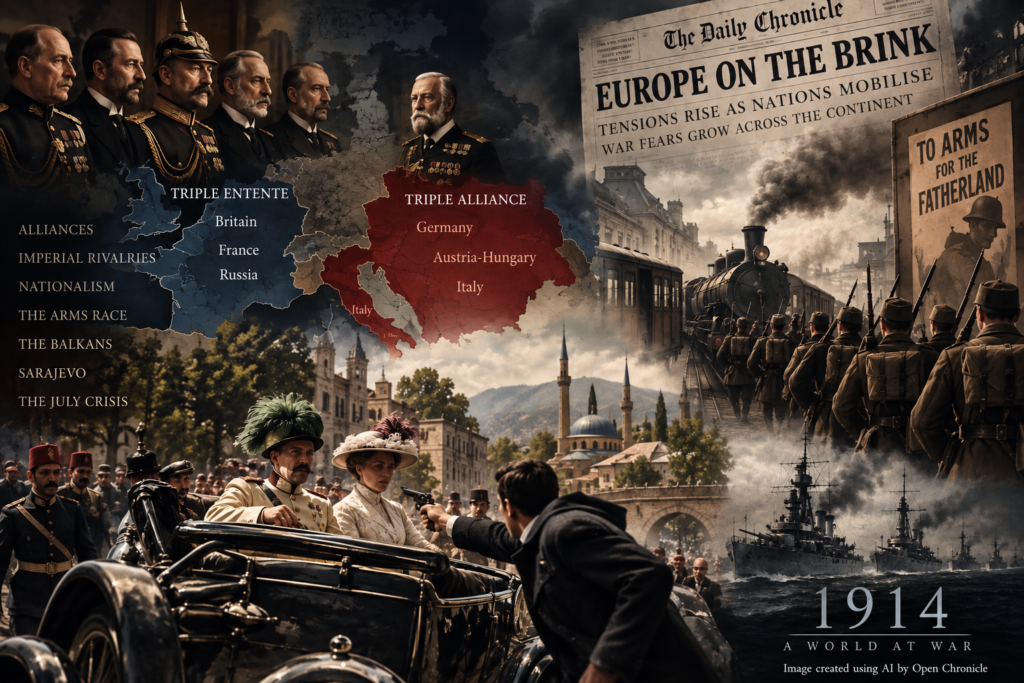
Germany, Austria-Hungary and Italy formed the Triple Alliance, although Italy did not enter the war alongside Germany and Austria-Hungary in 1914 and would eventually join their enemies in 1915.
Opposing them was the diplomatic alignment that became known as the Triple Entente, linking France, Russia and Britain.
These arrangements were not simply automatic mechanisms that guaranteed a general war. Their obligations differed, and governments retained choices during crises.
But the alliances profoundly influenced strategic calculations.
Germany feared the possibility of simultaneously confronting France in the west and Russia in the east. France regarded its relationship with Russia as an essential counterweight to German power. Russia increasingly considered Serbia important to its position in the Balkans. Britain worried about the European balance of power and, increasingly, Germany’s naval ambitions.
A confrontation involving one great power could therefore quickly become a matter of concern for several others.
That is precisely what happened in 1914.
Imperial Rivalries
European competition extended far beyond Europe.
Britain and France controlled enormous overseas empires. Russia pursued interests across Eastern Europe and Asia. Germany, which unified later than several of its competitors, sought greater international influence and developed its own colonial empire.
Imperial rivalry repeatedly produced diplomatic confrontations.
The Moroccan crises of 1905–06 and 1911, for example, demonstrated how disputes beyond Europe could intensify tensions between Germany and France while strengthening Anglo-French cooperation.
Colonial competition was therefore part of the wider deterioration of relations among the great powers.
Yet imperialism alone cannot explain 1914. Britain and France themselves had previously been colonial rivals and succeeded in resolving many of their differences diplomatically.
The danger came from the interaction of imperial ambitions with alliances, military planning, nationalism and fears about the changing balance of power.
The Arms Race
European governments were also spending enormous resources on their armed forces.
Large conscript armies meant that millions of men could potentially be mobilized. Railways allowed those armies to be transported towards national borders with unprecedented speed.
At sea, Britain and Germany became involved in a particularly visible naval competition.
The launch of HMS Dreadnought by Britain in 1906 transformed battleship design. Germany’s naval expansion challenged Britain’s traditional reliance upon naval superiority, contributing to deteriorating relations between the two countries.
Military strength increasingly became a measure of national power.
But the arms race created another problem: fear.
If a rival was expanding its army, building railways or constructing battleships, governments had to decide whether those measures were defensive or preparation for aggression.
Each side could interpret the other’s attempts to increase security as a threat.
The Problem of Military Planning
Mobilizing the enormous armies of early twentieth-century Europe was an extraordinarily complicated undertaking.
Millions of soldiers, horses, artillery pieces and supplies had to move according to detailed railway timetables.
Germany faced a particularly difficult strategic problem because it might have to fight France and Russia simultaneously.
German planning therefore developed around the idea of defeating France rapidly before turning substantial forces eastward against the more slowly mobilizing Russian Empire. The plans associated with Alfred von Schlieffen and subsequently modified by Helmuth von Moltke the Younger depended upon a major German offensive in the west.
This contributed to the decision to invade neutral Belgium in August 1914.
Military planning did not make war mechanically inevitable. Political leaders could still make decisions.
But once mobilizations began, governments came under increasing pressure from generals who feared that allowing an opponent to mobilize first could produce a catastrophic military disadvantage.
During the July Crisis, time itself became a strategic weapon.
Nationalism
Nationalism was another powerful force reshaping Europe.
In established nation-states, it could encourage competition, ideas of national prestige and popular enthusiasm for military power.
Inside multinational empires, however, nationalism could threaten the political order itself.
Nowhere was this problem more dangerous than in the Balkans.
The decline of Ottoman authority had encouraged the emergence and expansion of states including Serbia, Bulgaria, Greece and Montenegro. At the same time, Austria-Hungary ruled substantial South Slav populations.
Serbian nationalism increasingly collided with Austro-Hungarian interests.
Belgrade aspired to unite Serbs and, among some movements, other South Slavs beyond Serbia’s existing borders. For leaders in Vienna, these ambitions represented a potentially existential challenge to their multinational empire.
The Balkan Powder Keg
The Balkans had experienced repeated crises before 1914.
Austria-Hungary formally annexed Bosnia-Herzegovina in 1908, provoking anger in Serbia and Russia. The Balkan Wars of 1912–13 then dramatically altered the regional balance.
Serbia emerged from those wars larger and more confident.
Austria-Hungary became increasingly concerned about Serbian power and influence. Tensions over Albania brought Vienna and Belgrade close to confrontation in 1913; Austro-Hungarian leaders had repeatedly considered military action against Serbia before the Sarajevo assassination.
The Balkans were therefore not suddenly destabilized in June 1914.
Sarajevo occurred after years of confrontation.
Sarajevo — 28 June 1914
Archduke Franz Ferdinand, heir to the Austro-Hungarian throne, travelled to Sarajevo in Bosnia with his wife, Sophie, in June 1914.
On 28 June, conspirators prepared to assassinate him.
An initial bomb attack failed. Later that day, a change in the royal motorcade’s route was not properly communicated, and Franz Ferdinand’s vehicle stopped near Gavrilo Princip.
Princip shot Franz Ferdinand and Sophie at close range. Both died.
Princip was a Bosnian Serb nationalist. The assassination network had connections to figures associated with the Serbian nationalist organization commonly known as the Black Hand, including elements within Serbian military intelligence. The relationship between the conspirators and the Serbian state was more complicated than simply describing the assassination as an operation ordered by the Serbian government; scholarship distinguishes between involvement by nationalist and intelligence networks and direct government responsibility.
The murders shocked Europe.
But assassination did not automatically mean continental war.
What transformed Sarajevo into a global catastrophe were the decisions made during the following month.
Austria-Hungary Chooses Confrontation
For influential figures in Vienna, the assassination provided an opportunity to confront Serbia.
Austro-Hungarian Foreign Minister Leopold Berchtold came to support military action. But Austria-Hungary first wanted assurances from its most powerful ally.
Germany provided them.
In early July, Berlin gave Vienna what became known as the “blank cheque”: strong German backing for Austria-Hungary in its confrontation with Serbia, despite the possibility that Russia might intervene.
This was one of the most consequential decisions of the crisis.
German leaders hoped that the confrontation might remain localized or that Russia would back down. Instead, their support gave Austria-Hungary greater confidence to pursue a hard line.
The Ultimatum
Austria-Hungary waited several weeks before acting.
On 23 July, Vienna delivered a severe ultimatum to Serbia and allowed only 48 hours for a response.
Some demands were particularly difficult for a sovereign state to accept, including Austro-Hungarian participation in measures connected with suppressing anti-Habsburg activity and investigating the assassination.
Serbia accepted much of the ultimatum but did not accept every demand without qualification.
Austria-Hungary declared the response insufficient.
On 28 July 1914, exactly one month after the assassination, Austria-Hungary declared war on Serbia. The ultimatum had been drafted in a form that Austro-Hungarian leaders expected Serbia would be unable to accept fully.
The local war had begun.
Russia Moves
Russia could now either tolerate the defeat and possible humiliation of Serbia or intervene.
Russian leaders feared another retreat in the Balkans would damage their influence and credibility. They also viewed Austria-Hungary’s actions through the broader strategic relationship between Vienna and Berlin.
Russian military preparations began.
The distinction between diplomatic pressure, partial mobilization and general mobilization became increasingly difficult to maintain as the crisis accelerated. Russia took preparatory military measures before eventually ordering general mobilization. Historians continue to debate the significance of individual decisions during these crucial days and the degree of responsibility carried by each government.
For Germany, Russian mobilization represented an enormous strategic danger.
German war planning could not easily accommodate a prolonged diplomatic waiting game while Russia assembled its armies.
The European Chain Reaction
The crisis now moved with extraordinary speed.
28 July: Austria-Hungary declared war on Serbia.
30 July: Russia ordered general mobilization.
1 August: Germany declared war on Russia.
3 August: Germany declared war on France.
Germany’s strategy required its armies to move through Belgium as part of the western offensive against France.
Belgium was neutral.
When German troops crossed the Belgian frontier on 4 August, Britain declared war on Germany.
Within little more than a month of the assassination at Sarajevo, the principal European powers were at war.
What had begun as an Austro-Serbian confrontation had become a continental conflict.
It would soon become global.
Was the War Inevitable?
One of the most important lessons of the July Crisis is that the First World War was not simply the automatic consequence of the alliance system.
Governments made decisions.
Austria-Hungary chose to use the assassination to confront Serbia. Germany chose to support Vienna. Russia chose military measures in support of Serbia. France maintained its alliance with Russia. German leaders implemented a strategy involving war against France and the invasion of Belgium. Britain ultimately chose to intervene.
At several moments, alternative courses remained possible.
That does not mean every government carried equal responsibility or possessed equal freedom of action. The origins of the war have generated one of the longest historiographical debates in modern history precisely because responsibility was distributed across a complicated sequence of decisions, fears and strategic calculations.
But Sarajevo was the trigger, not a complete explanation.
A War Many Expected to Be Short
When armies mobilized in the summer of 1914, many military planners anticipated a relatively short conflict.
Europe was about to discover otherwise.
Industrialization had created armies with enormous firepower. Machine guns, quick-firing artillery, modern rifles, railways and vast systems of mobilization allowed states to place millions of soldiers in the field.
The offensive strategies designed before the war collided with the destructive capabilities of industrial warfare.
Within months, much of the Western Front would become a landscape of trenches.
The conflict would spread into Eastern Europe, the Balkans, the Middle East, Africa, Asia and the world’s oceans.
Empires would fall.
Millions would die.
Political systems would collapse.
And the consequences of the war would shape international politics for generations.
Understanding the Road to War
There was no single cause of the First World War.
The alliance system created strategic blocs but did not itself require war.
Imperial competition increased tensions but had previously been managed diplomatically.
Nationalism destabilized multinational empires, particularly in southeastern Europe.
The arms race increased military capability and suspicion.
War plans compressed the time available for diplomacy once mobilization began.
The Balkan crises brought Austria-Hungary, Serbia and Russia into increasingly dangerous confrontation.
Then came Sarajevo.
The assassination of Franz Ferdinand transformed these underlying tensions into an immediate political crisis. Austria-Hungary’s decision to confront Serbia, Germany’s backing, Russian mobilization and the subsequent choices of the great powers turned that crisis into war.
The catastrophe of 1914 was therefore neither a simple accident nor the inevitable result of one assassination.
It emerged from a European system that had become increasingly dangerous — and from decisions made by political and military leaders during a few extraordinary weeks when the opportunities for restraint progressively disappeared.
On 28 June 1914, Franz Ferdinand arrived in Sarajevo.
Thirty-seven days later, Britain declared war on Germany.
Europe had crossed the threshold.
The First World War had begun.