
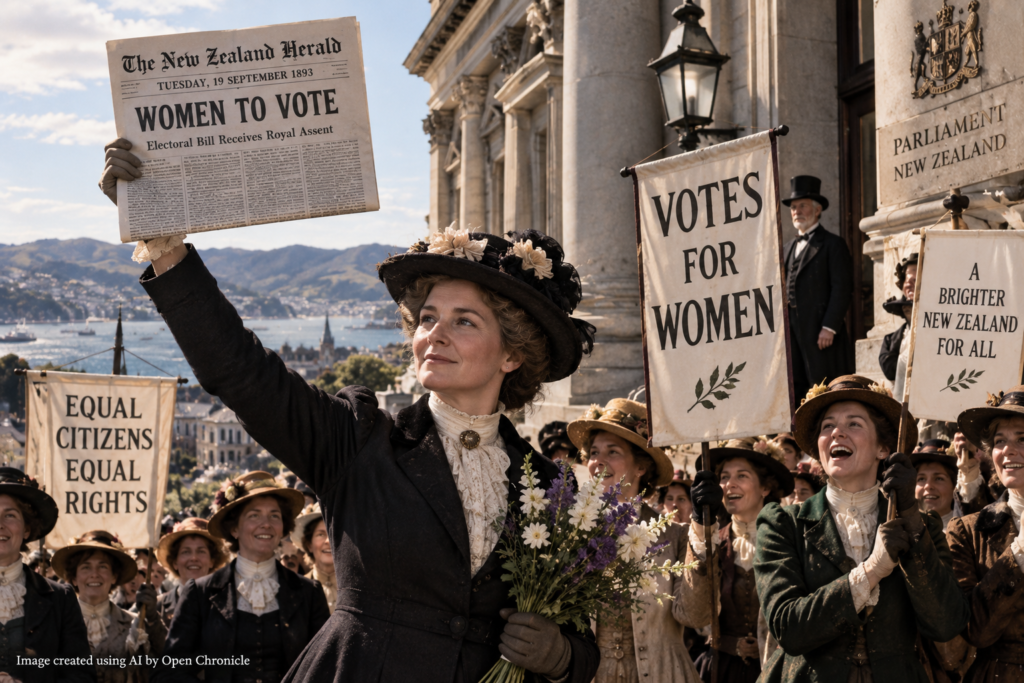
By Open Chronicle History Desk
On September 19, 1893, an act of legislation in a relatively small country on the edge of the Pacific transformed the history of democracy.
In New Zealand, Governor Lord Glasgow gave royal assent to a new Electoral Act.
Contained within it was a revolutionary political change.
Women could vote in parliamentary elections.
For decades, women had been excluded from the national electorate. Politics was overwhelmingly treated as a male domain, while prevailing social conventions insisted that women’s responsibilities belonged primarily within the home and family.
The suffrage campaign challenged that assumption directly.
Its activists organised petitions.
They wrote articles.
They addressed public meetings.
They lobbied politicians.
They established networks across towns and communities.
They endured ridicule and organised political opposition.
And they persisted.
At the centre of the movement stood Kate Sheppard, who became the most famous figure in New Zealand’s campaign for women’s suffrage.
When the legislation finally became law on September 19, New Zealand became the first self-governing country in the world in which women had the right to vote in national parliamentary elections.
The achievement reverberated far beyond New Zealand.
Women campaigning for political rights in Britain, Australia, the United States and elsewhere could now point to a functioning democracy in which women participated in national elections.
An argument that had previously been theoretical had become reality.
Women could vote.
A modern country had done it.
And democracy would never again be quite the same.
Democracy With Half the Population Missing
By the nineteenth century, representative political institutions were spreading through parts of Europe and the settler societies of the British Empire.
But democracy remained extraordinarily restricted by modern standards.
Voting rights were frequently limited by sex, property, race, wealth or social status.
Even where political reform expanded the male electorate, women were generally excluded.
This produced a striking contradiction.
Governments increasingly claimed legitimacy through representation.
Yet approximately half the adult population possessed no direct parliamentary vote.
For many nineteenth-century politicians, this did not appear contradictory at all.
They believed politics was naturally a male responsibility.
Suffragists would spend decades dismantling that assumption.
New Zealand Before 1893
New Zealand had become a British colony in 1840, following the signing of the Treaty of Waitangi and the expansion of British sovereignty and settlement.
Its nineteenth-century political history developed through complicated relationships between British settlers, the colonial government and Māori communities.
Representative institutions gradually emerged.
The New Zealand Constitution Act 1852, passed by the British Parliament, established a system of representative government.
But voting rights were not universal.
Political participation was shaped by gender and property qualifications.
Women could not vote in parliamentary elections.
That exclusion would increasingly be challenged.
Women and Colonial Society
Women played essential roles in nineteenth-century New Zealand society.
They worked on farms.
They ran households and businesses.
They taught in schools.
They participated in churches and voluntary organisations.
They contributed to the economic survival of families and communities.
Yet formal political authority remained overwhelmingly male.
A married woman’s legal and economic position could also be constrained by inherited British legal traditions.
Political exclusion was therefore part of a wider structure of gender inequality.
The suffrage campaign did not emerge from nowhere.
It grew from broader debates about women’s status in society.
An International Movement
New Zealand suffrage activists were part of an increasingly international movement.
Women in Britain and the United States had already organised campaigns demanding greater political and legal rights.
The Seneca Falls Convention in New York in 1848 became one famous landmark in the American women’s rights movement.
British activists developed their own organisations and petitions.
Books, newspapers, letters and travelling speakers carried ideas across borders.
The nineteenth-century world was becoming increasingly connected by steamships, telegraph networks and mass print culture.
Political ideas travelled with unprecedented speed.
Women’s suffrage became an international cause.
The Temperance Connection
One of the most important forces behind the New Zealand campaign was the Women’s Christian Temperance Union, commonly known as the WCTU.
The organisation initially focused strongly on alcohol.
Many women experienced the social consequences of excessive drinking within families while possessing little political power to influence licensing laws.
This created a strategic connection between temperance and suffrage.
If women could vote, reformers believed, they could influence laws governing alcohol and other social issues.
For opponents connected with the liquor trade, that possibility was alarming.
The suffrage battle therefore became connected to powerful economic interests as well as arguments about gender.
Kate Sheppard
The central figure in the movement was Katherine Wilson Sheppard, better known as Kate Sheppard.
Born in Liverpool, England, in 1847, she later emigrated with her family to New Zealand.
She became active in the Women’s Christian Temperance Union and emerged as one of the country’s most effective political organisers.
Sheppard understood something fundamental about political movements.
Ideas were not enough.
They needed organisation.
Campaigners had to reach people across the country.
Petitions had to gather signatures.
Arguments had to be repeated.
Politicians had to feel pressure.
Public opinion had to change.
Sheppard helped build the machinery capable of doing exactly that.
The Argument for Suffrage
Supporters of women’s suffrage used several arguments.
One was straightforward.
Women were citizens and therefore should possess political rights.
Another focused on taxation.
Women who owned property or earned income could be subject to laws and taxes while having no parliamentary vote.
Others argued that women’s participation would improve public policy.
Women were portrayed as having particular interests in education, family welfare, health and social reform.
Some of these arguments challenged traditional gender roles.
Others deliberately worked within them.
The movement was politically diverse.
Its unifying objective was the vote.
The Opposition
Opposition was considerable.
Some argued that women were naturally unsuited to politics.
Others claimed political participation would damage family life.
There were warnings that husbands and wives might vote differently, supposedly creating conflict inside households.
Some opponents suggested women would simply vote as their husbands instructed, making female suffrage unnecessary.
The contradiction was striking.
Women were simultaneously described as too independent for family stability and too dependent to possess meaningful political opinions.
Suffragists repeatedly exposed these inconsistencies.
The Liquor Industry
The alcohol question added another layer of opposition.
Because many suffrage activists were connected with temperance organisations, sections of the liquor industry feared that enfranchised women would support restrictions on alcohol.
Lobbying against women’s suffrage therefore came not only from ideological conservatives.
Commercial interests were involved.
Political rights could change legislation.
Legislation could affect profits.
The campaign demonstrated a recurring feature of democratic reform.
Arguments about principles frequently intersect with arguments about economic power.
The Petition Strategy
Petitions became one of the movement’s most powerful weapons.
Rather than simply declaring that women wanted the vote, campaigners demonstrated support through thousands of signatures.
Petitions were organised nationally.
Local activists gathered names.
Networks of volunteers coordinated the effort.
The scale grew rapidly.
In 1891, a women’s suffrage petition containing thousands of signatures reached Parliament.
Another followed in 1892.
Then came the extraordinary petition of 1893.
The 1893 Petition
The final campaign produced one of the most famous documents in New Zealand political history.
Approximately 32,000 signatures were collected across multiple petitions supporting women’s suffrage, with the principal petition containing more than 23,000 names.
The main petition was physically enormous.
When presented to Parliament, its length became part of the political spectacle.
Here was tangible evidence that the suffrage movement was not the obsession of a tiny radical minority.
Thousands of women were publicly demanding political participation.
The petition transformed individual signatures into collective political power.
Parliament
The battle now centred on Parliament.
Women’s suffrage proposals had been debated before.
Reform repeatedly came close to success.
Support existed among significant numbers of legislators.
But opposition, procedural manoeuvres and political calculation prevented earlier proposals from becoming law.
By 1893, pressure had become difficult to contain.
A new Electoral Bill included women’s suffrage.
The House of Representatives approved it.
The decisive confrontation moved to the Legislative Council, New Zealand’s upper chamber at the time.
Richard Seddon
Premier Richard Seddon occupies a complicated position in the history of the legislation.
He had previously expressed support for women’s suffrage in some contexts but became associated with attempts to obstruct or modify the 1893 measure.
His manoeuvring produced an unexpected consequence.
Two Legislative Councillors who had opposed the bill became angered by what they regarded as improper political interference.
They changed their votes.
The bill passed the Legislative Council on September 8, 1893, by 20 votes to 18.
A political attempt to defeat the legislation had helped secure its passage.
Waiting for the Governor
Passing Parliament was not the final constitutional step.
The legislation required the assent of the governor, David Boyle, 7th Earl of Glasgow.
Opponents attempted to prevent that outcome.
Petitions and representations urged the governor not to sign.
Suffragists responded.
Telegrams were sent.
Political pressure intensified.
For several days, uncertainty remained.
Would the governor refuse assent?
Would the victory in Parliament disappear at the final moment?
Then came September 19.
September 19, 1893
Lord Glasgow signed the Electoral Bill into law.
The Electoral Act 1893 became law.
Women in New Zealand now possessed the parliamentary franchise under the new electoral system.
News spread rapidly.
For Kate Sheppard and thousands of campaigners, years of organisation had succeeded.
But there was almost no time for celebration.
A general election was approaching.
Winning the legal right to vote was only the first challenge.
Women now had to register.
Ten Weeks
The election was scheduled for late November.
Campaigners had approximately ten weeks to ensure women were enrolled.
The organisational networks developed during the suffrage campaign immediately became voter registration networks.
Women registered in enormous numbers.
More than 100,000 women were placed on electoral rolls before the election, representing a very large majority of eligible adult women.
This was itself a remarkable logistical achievement.
Opponents who had suggested women were uninterested in politics were about to receive a clear answer.
November 28, 1893
On November 28, most of New Zealand held its general election.
Women went to polling places and cast parliamentary ballots.
Reports described large numbers participating.
Approximately 90,000 women voted, a turnout of roughly 82 percent among registered female electors.
The figures demonstrated that enfranchisement had produced substantial participation.
Women had not demanded the vote merely as an abstract principle.
They used it.
The political experiment opponents had feared had become ordinary democratic practice within a single election.
Māori Women
The story also included Māori women.
The 1893 reform enfranchised women within the country’s parliamentary electoral framework, including Māori women eligible to participate through the Māori electorates.
This made the achievement broader than a story limited entirely to women of European settler communities.
Yet the political position of Māori within colonial New Zealand remained shaped by dispossession, conflict, land loss and the unequal structures created through colonisation.
The expansion of voting rights did not erase those realities.
New Zealand’s democratic history contains both political innovation and colonial injustice.
Voting Was Not the Same as Standing for Parliament
There was another limitation.
Women gained the right to vote in parliamentary elections in 1893.
They did not immediately gain the right to stand as candidates for Parliament.
That change came later.
Women became eligible to stand for the House of Representatives in 1919.
The distinction is important.
Political citizenship developed incrementally.
The vote represented a revolutionary breakthrough.
Full equality within political institutions remained unfinished.
Elizabeth McCombs
It would take another forty years before a woman entered New Zealand’s Parliament.
In 1933, Elizabeth McCombs won a by-election and became the country’s first female Member of Parliament.
Her election occurred four decades after women first voted nationally.
That gap illustrates an important lesson.
Removing a legal barrier does not instantly remove social, economic and institutional barriers.
Representation develops differently from enfranchisement.
Women could vote from 1893.
Political institutions remained predominantly male for decades.
Was New Zealand Really First?
The claim requires careful wording.
Some territories and jurisdictions had allowed certain women to vote earlier.
Women had exercised limited voting rights in particular places and under specific property qualifications.
The Isle of Man, for example, had enfranchised some female property owners in 1881.
Some American territories had experimented with women’s suffrage.
But New Zealand’s achievement in 1893 was historically distinctive.
It became the first self-governing country to grant women the right to vote in national parliamentary elections on a broad basis.
That qualification matters.
Historical firsts are often more complicated than slogans suggest.
Australia Follows
New Zealand’s example strengthened suffrage campaigns elsewhere.
Australia became another early leader.
The newly established Commonwealth of Australia adopted federal women’s suffrage in 1902, while also allowing women to stand for federal Parliament.
But the legislation contained discriminatory exclusions affecting many Indigenous people.
South Australia had already granted women both voting rights and eligibility to stand for Parliament in 1894, with the law receiving assent in 1895.
The Australasian colonies had become a global laboratory for democratic reform.
Finland
In Europe, Finland became a landmark case in 1906.
Women gained both the right to vote and the right to stand for election to Parliament.
In 1907, Finnish women became among the world’s first female members of a national parliament.
The suffrage movement was spreading.
Every successful reform weakened the argument that women’s political participation was impossible.
New Zealand had provided an early demonstration.
Others would go further.
Britain
The country from which New Zealand’s colonial political institutions had largely developed moved more slowly.
British suffragists and suffragettes campaigned for decades.
The struggle intensified dramatically during the early twentieth century.
Some organisations used peaceful constitutional methods.
Others, particularly the Women’s Social and Political Union, adopted militant tactics.
In 1918, Britain enfranchised many women over thirty who met specified qualifications.
Full electoral equality with men came in 1928.
New Zealand had reached broad women’s parliamentary suffrage thirty-five years earlier.
The United States
In the United States, the struggle was similarly long.
Some western states and territories enfranchised women earlier.
Wyoming Territory had granted women’s suffrage in 1869.
But a nationwide constitutional guarantee did not arrive until the Nineteenth Amendment, ratified in 1920, prohibited denying or abridging the right to vote on account of sex.
Even then, discriminatory laws and practices continued preventing many Black women, Native American women and other citizens from exercising voting rights fully.
Legal enfranchisement and practical access were not always the same thing.
France
France, despite its revolutionary tradition and repeated declarations of universal political principles, enfranchised women much later.
French women obtained national voting rights in 1944 and first participated in national elections in 1945.
This demonstrates that economic development or revolutionary political traditions did not automatically produce women’s suffrage.
Political rights had to be fought for.
Different countries followed very different timelines.
Switzerland
Even more striking was Switzerland.
Although often associated with direct democracy, women did not gain the right to vote in Swiss federal elections until 1971.
Some cantons resisted even longer at the local level.
The contrast is extraordinary.
New Zealand women were voting nationally in 1893.
Swiss women gained federal voting rights seventy-eight years later.
The global history of democracy was never a simple linear progression.
Why New Zealand Moved Earlier
Historians have identified several factors that helped make New Zealand an early adopter.
Its political institutions were relatively young.
The society was undergoing rapid development.
Reform movements were energetic.
Temperance organisations created powerful networks among women.
The suffrage campaign developed effective national organisation.
Petitioning demonstrated mass support.
Political circumstances in Parliament also proved favourable at the crucial moment.
No single factor explains the victory.
It emerged from decades of activism interacting with a particular political opportunity.
Kate Sheppard Becomes an International Figure
After the victory, Kate Sheppard became internationally prominent.
Her experience was valuable to suffrage movements abroad.
New Zealand activists could now offer something other campaigners desperately needed.
Evidence.
Opponents elsewhere warned that female suffrage would destroy families, destabilise politics or produce social chaos.
New Zealand provided a simple response.
Women were voting.
Government continued functioning.
Families continued existing.
Society did not collapse.
The practical example was more powerful than any theoretical argument.
A Newspaper Revolution
Print culture had been essential to the campaign.
Pamphlets circulated arguments.
Newspapers carried debates.
Letters connected activists.
Sheppard edited and contributed to publications associated with women’s political organisation.
This was nineteenth-century political networking.
There was no internet.
No social media.
No instant mass communication.
Yet activists constructed national movements through newspapers, meetings, churches, correspondence and voluntary organisations.
The suffrage campaign demonstrates how effectively political networks could operate before electronic media.
The Bicycle and the New Woman
The 1890s also witnessed broader changes in women’s public lives.
Education expanded.
Employment opportunities slowly changed.
Women’s organisations multiplied.
Even technologies such as the bicycle acquired cultural significance because they increased physical mobility and challenged restrictive clothing conventions.
The figure of the “New Woman” emerged in international culture.
Women’s suffrage belonged to this larger transformation.
The debate was not simply about putting a ballot paper into a box.
It was about women’s place in modern society.
Democracy Changes Meaning
The political significance of September 19 extends beyond gender.
The event illustrates how the definition of democracy changes over time.
In earlier political systems, a government could describe itself as representative while excluding enormous sections of society.
Over generations, activists challenged those exclusions.
Workers demanded political rights.
Women demanded political rights.
Racial and ethnic minorities fought discriminatory barriers.
Indigenous peoples challenged colonial structures.
Democracy was not delivered complete.
It expanded through political struggle.
The Ballot as Power
Voting appears simple.
A person enters a polling place.
A choice is recorded.
A ballot is counted.
But behind that action lies political power.
The right to vote helps determine who makes laws.
Who raises taxes.
Who controls public expenditure.
Who appoints officials.
Who shapes education, welfare, labour regulation and foreign policy.
This is why suffrage campaigns generated such intense opposition.
The debate was never merely symbolic.
Enfranchisement redistributed political influence.
What Changed After 1893?
Women’s suffrage did not instantly transform every New Zealand law or eliminate gender inequality.
Political change rarely works that way.
Women remained underrepresented in political office.
Social expectations remained powerful.
Economic inequalities persisted.
But the fundamental principle had changed.
Politicians could no longer treat adult women simply as people outside the national electorate.
Women were voters.
Their opinions could affect elections.
Political parties and candidates had to respond.
Once that change occurred, reversing it became increasingly difficult.
The Long Road to Political Representation
During the twentieth century, women’s participation expanded further.
Women entered Parliament.
They became ministers.
They eventually reached the highest offices of government.
In 1997, Jenny Shipley became New Zealand’s first female prime minister.
She was followed by Helen Clark and later Jacinda Ardern.
These later developments should not be projected backwards onto 1893 as inevitable.
They became possible because generations of political barriers were gradually removed.
The ballot was one foundational step.
Kate Sheppard on the Banknote
Modern New Zealand commemorates Kate Sheppard in an unusually visible way.
Her portrait appears on the country’s ten-dollar banknote.
Millions of people therefore encounter the face of a suffrage activist during ordinary economic life.
It is an appropriate symbol.
Sheppard was not a monarch.
She was not a military commander.
She did not conquer territory.
Her historical power came from organisation, persuasion and persistence.
She helped change who counted as a political citizen.
The Petition Survives
The great 1893 suffrage petition also survives as a historical document.
Its thousands of signatures preserve something statistics cannot.
Individual names.
Each signature represents a person willing to attach her identity publicly to a political demand.
Taken individually, the names appear ordinary.
Together, they became politically extraordinary.
The petition demonstrates how collective action works.
One signature rarely changes a country.
Thousands can.
Beyond Great Individuals
Kate Sheppard deservedly became the movement’s most famous figure.
But women’s suffrage was not achieved by one person.
Local organisers gathered signatures.
Women attended meetings.
Writers produced arguments.
Supportive politicians introduced legislation.
Communities debated the issue.
Thousands of women placed their names on petitions.
Political movements often acquire a single symbolic leader because history is easier to remember through individuals.
But successful movements depend upon networks.
New Zealand’s suffrage victory belonged to thousands.
Māori Women’s Political Traditions
The conventional suffrage narrative can also obscure Māori women’s political activity.
Māori women participated in political movements concerning land, sovereignty and community authority.
Women were involved in Kotahitanga, the Māori parliament movement.
Meri Te Tai Mangakāhia famously addressed the Kotahitanga parliament in 1893 and argued for Māori women’s political participation.
Her intervention reminds us that debates about gender and political authority were occurring within Māori political life as well as within colonial parliamentary institutions.
New Zealand’s women’s political history therefore has multiple traditions.
Colonisation and Democracy
There is another contradiction.
New Zealand could pioneer women’s suffrage while remaining a colonial society shaped by dispossession of Māori land and unequal power relationships.
Progress in one dimension does not erase injustice in another.
This is important when interpreting historical achievements.
Societies are rarely simply progressive or reactionary.
The same political system can expand rights for one group while restricting another.
History becomes more accurate when both realities are visible.
A Global Signal
Internationally, New Zealand’s achievement carried disproportionate importance because of the country’s small population.
It proved scale was irrelevant to political innovation.
A society far from the traditional centres of European power had moved ahead of Britain, France, Germany and the United States in a fundamental area of democratic participation.
The political centre of the world did not necessarily have to be the centre of political change.
Sometimes reform emerged from the periphery.
The Domino Effect
Women’s suffrage did not spread automatically after 1893.
Every country had its own political struggles.
But precedents matter.
Once one national political system enfranchised women successfully, opponents elsewhere lost one argument.
They could no longer claim that women’s national suffrage was entirely untested.
New Zealand became evidence.
Australia followed.
Finland followed.
Norway followed.
Denmark followed.
Reforms accelerated during and after the First World War.
By the middle of the twentieth century, women’s suffrage had become increasingly recognised as a basic democratic principle.
Yet the Struggle Continued
Even where women formally gained voting rights, barriers remained.
Race could determine access.
Colonial status could determine access.
Registration requirements could restrict participation.
Authoritarian governments could make elections meaningless.
Women could vote yet remain almost absent from political leadership.
The history of suffrage therefore does not end with legislation.
The right must be usable.
Elections must matter.
Citizens must be able to participate freely.
Political equality on paper and political equality in practice are different achievements.
September 19 as a Historical Turning Point
This is what makes September 19, 1893 so significant.
The legislation did not create universal equality.
It did not eliminate discrimination.
It did not instantly produce equal representation.
But it broke a fundamental political barrier.
A national political system accepted that being a woman was not, by itself, a legitimate reason to deny an adult citizen the parliamentary vote.
That principle would eventually become normal across much of the world.
In 1893, it was revolutionary.
Why September 19 Matters
History often focuses on revolutions fought with weapons.
Governments collapse.
Armies march.
Palaces burn.
Borders change.
But some revolutions occur through petitions, meetings, newspapers and ballots.
New Zealand’s women’s suffrage movement was one of them.
Its activists organised for years.
They lost legislative battles.
They returned.
They gathered more signatures.
They expanded their networks.
They confronted political opposition.
And eventually Parliament changed the law.
The achievement demonstrated that democratic systems themselves could be transformed by people previously excluded from them.
September 19, 1893
Imagine Wellington that day.
There are no crowds storming government buildings.
No armies in the streets.
No declaration of independence.
No battlefield.
A governor places his assent upon legislation.
On paper, the moment looks almost administrative.
But across New Zealand, thousands of women understand what has happened.
For years they have signed petitions.
They have attended meetings.
They have written letters.
They have been told politics is not their concern.
They have been warned that voting would undermine society.
They have watched legislation fail.
They have organised again.
Now the law has changed.
For the first time in a self-governing country, women will participate broadly in a national parliamentary election.
Within weeks, more than one hundred thousand women will register.
In November, tens of thousands will walk into polling places.
They will receive ballot papers.
They will make choices.
And their votes will count.
The world will not collapse.
New Zealand’s government will continue.
Its democracy will simply contain more of its people than it did before.
Campaigners thousands of kilometres away will notice.
They will point towards New Zealand and say that it can be done.
Britain will eventually follow.
The United States will follow.
Many other countries will follow.
The struggle will take decades.
In some places, much longer.
But on September 19, 1893, one of the central arguments against women’s political equality suffered a permanent defeat.
It was no longer possible to say that national women’s suffrage was merely an idea.
New Zealand had turned it into reality.