
By Open Chronicle with agencies
Diesel prices in the United States have climbed to their highest level on record, creating a new source of pressure on households, businesses and President Donald Trump as Americans approach the November midterm elections amid renewed concerns about inflation and the cost of living.
The national average price of diesel reached $6.4476 per gallon on September 18, according to AAA, surpassing previous records. A year earlier, the national average stood at $3.7087, meaning diesel is now roughly 74 percent more expensive than at the same point in 2025. Regular gasoline has also risen sharply, reaching a national average of $4.4687 per gallon.
The increases are particularly significant because diesel is deeply embedded in the American economy. It powers much of the trucking industry, agricultural machinery, construction equipment and parts of the rail and industrial sectors. Unlike a rise confined to consumer gasoline, higher diesel costs can work their way through supply chains and eventually affect the prices of food and other goods.
The U.S. Energy Information Administration said Friday that elevated crude oil prices and tight global supplies of distillate fuels have been major contributors to the increase. Refining margins for diesel have also risen substantially.
North Carolina diesel reaches record territory
North Carolina illustrates the speed of the increase.
AAA data show that the state’s average diesel price reached $6.2322 per gallon on September 18, its highest recorded average. That compares with $5.8961 a week earlier, $5.3337 one month earlier and $3.4672 a year ago.
Prices are even higher in some metropolitan areas. In Charlotte, the average reached $6.2663 per gallon, while Raleigh stood at $6.2435.
For motorists who depend on diesel vehicles, and particularly for commercial drivers covering thousands of miles each month, the increases represent a substantial additional expense.
California remains considerably more expensive. AAA reported an average diesel price of $8.3945 per gallon there on September 18.
A global fuel squeeze reaches American pumps
The price surge cannot be attributed to a single factor.
The EIA says retail diesel prices reflect crude oil costs, refinery margins, distribution expenses, retail margins and taxes. At present, both elevated crude prices and unusually tight supplies of distillate fuels are contributing to the increase.
Reuters reported Friday that diesel has been particularly affected by disruptions to global refining capacity and energy supplies associated with conflicts in the Middle East and Ukraine. Damage to energy infrastructure and restrictions affecting Russian supplies have tightened the international market for refined products.
The renewed Middle East conflict has added another layer of uncertainty.
Brent crude was trading at about $103.89 per barrel on Friday, while U.S. West Texas Intermediate stood at $100.74. Energy markets have been responding to continuing instability involving Iran, attacks affecting Saudi infrastructure and uncertainty surrounding shipping through critical Middle Eastern waterways.
AAA has similarly pointed to crude oil prices and volatility around the Strait of Hormuz as important factors behind the recent rise in American pump prices.
Trump faces a difficult economic issue
The timing creates a political challenge for Trump, who has repeatedly emphasised lower energy costs as part of his economic agenda.
The United States holds its midterm elections on November 3, when control of Congress will be at stake. Early in-person voting has already begun in several states.
Fuel prices are only one of several economic issues confronting voters. Inflation, mortgage costs and interest rates are also contributing to affordability concerns ahead of the election.
The effect of any individual economic issue on voting behaviour cannot be determined in advance. Historically, however, energy shocks have coincided with periods of considerable political and economic pressure on U.S. administrations.
The oil shocks of the 1970s contributed to high inflation, fuel shortages and economic difficulties during Jimmy Carter’s presidency, although his defeat in 1980 resulted from multiple domestic and international factors.
George H.W. Bush similarly faced an economy weakened by recession during his unsuccessful 1992 re-election campaign. The Gulf War and movements in energy markets formed part of the broader economic environment, but they were not the sole explanation for the election result.
The historical lesson is therefore more nuanced than suggesting fuel prices alone determine American elections. What makes today’s diesel increase politically significant is its potential to reinforce an already prominent concern among voters: affordability.
Trump points to Ukraine and global disruptions
Trump has publicly linked the diesel shortage in part to Ukrainian attacks on Russian oil infrastructure.
During a visit to Ireland earlier this month, he urged Ukraine to stop striking Russian refineries, arguing that the attacks were contributing to pressure on global diesel supplies. The Financial Times reported that Trump sought to distance the increase from the Middle East conflict and emphasised disruption to Russian refining instead.
Energy analysts, however, identify several simultaneous causes.
Russia is an important supplier of refined petroleum products to global markets, meaning disruption to its refining and export capacity can affect international prices. At the same time, instability in the Middle East has raised crude prices and disrupted other parts of the global energy system.
U.S. diesel prices are therefore being shaped by a combination of crude costs, refinery capacity, inventories and international supply disruptions rather than by a single conflict or government decision.
Why diesel matters beyond the filling station
For the broader economy, the most important consequence may not be what individual motorists pay at the pump.
Diesel is a fundamental transportation fuel.
Trucks carry food, consumer products, industrial materials and manufactured goods across the country. Farms rely heavily on diesel-powered machinery. Construction companies use it for excavators, generators and other heavy equipment.
When those businesses spend more on fuel, they must either absorb the additional cost, reduce spending elsewhere or pass at least part of the increase through to customers.
Reuters analysis notes that diesel’s importance to transportation, agriculture and construction gives sustained price increases the potential to create broader inflationary pressure.
That possibility comes at a sensitive moment for monetary policy.
The Federal Reserve raised interest rates this week as inflation remained a concern, while financial markets have become increasingly focused on whether persistent energy costs could require additional tightening.
In that sense, the diesel crisis can potentially produce a feedback loop. Higher transportation costs can contribute to higher consumer prices, which can influence interest rates, borrowing costs and household spending.
Possible responses carry their own risks
The severity of the increase has already prompted discussion in Washington about possible government intervention.
Senate Majority Leader John Thune has indicated openness to considering restrictions on U.S. diesel exports as a way of increasing supplies available to American consumers.
But such a policy is controversial.
The United States is a major exporter of refined fuels, and analysts warn that restricting exports could distort refinery economics, reduce incentives for production and potentially tighten international supplies further.
There is therefore no simple mechanism for rapidly bringing diesel prices down.
Increasing refinery output can help, but refinery capacity cannot be expanded quickly. Lower crude prices would provide relief, but those prices are determined by global supply and demand as well as geopolitical developments beyond Washington’s direct control.
A reduction in international tensions affecting Russia and the Middle East could ease some pressure, but the timing and scale of any such effect remain uncertain.
Energy becomes part of the midterm economic debate
For the Trump administration, the political problem is straightforward even if the economic causes are complicated.
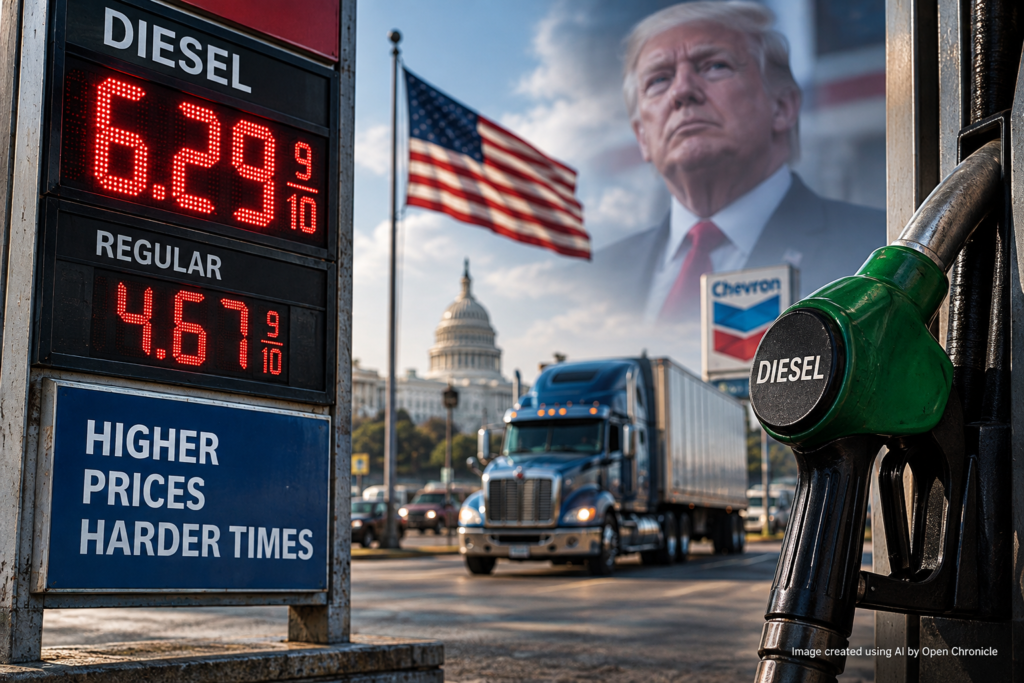
Americans encounter fuel prices directly. They see them displayed in large numbers beside roads and highways, and businesses encounter them repeatedly through transportation costs.
Diesel’s national average of nearly $6.45 per gallon is therefore more than an energy-market statistic. It represents a significant increase in the cost of moving goods through the world’s largest economy.
Whether that translates into a measurable change in voter behaviour will depend on many factors and cannot be known before the election.
But with diesel at a record high, gasoline averaging about $4.47 and crude oil remaining above $100 per barrel, energy costs have clearly returned to the centre of the American cost-of-living debate just weeks before voters decide the composition of the next Congress.