
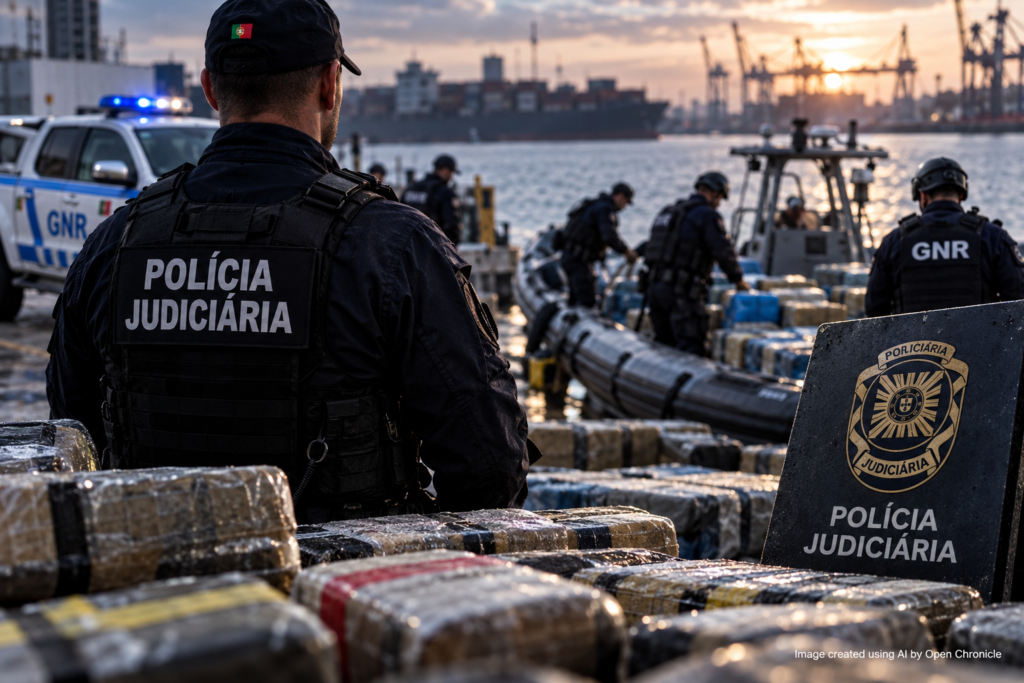
By Open Chronicle with agencies
Portugal’s Interior Minister Luís Neves has identified drug trafficking as the country’s leading internal security threat, warning that transnational criminal organisations are increasingly using Portuguese territory as a strategic gateway for cocaine entering the European market.
Speaking in parliament on Wednesday during a debate on Portugal’s 2025 Annual Internal Security Report, known as RASI, Neves said narcotics trafficking now stands at the top of the country’s domestic security concerns.
“Drug trafficking is today the number one threat to internal security in Portugal,” the minister told lawmakers, according to Portuguese news agency Lusa.
His assessment comes as the RASI records increases in drug-related reports, arrests and seizures during 2025. The official report also shows that quantities of hashish seized increased by 102.6 percent, while heroin seizures fell by 33.7 percent.
Portugal as a gateway for cocaine into Europe
Neves said Portugal, like several other European countries, is being exploited by international criminal networks as an entry point for cocaine destined for markets across the continent.
The minister linked the growing pressure on European trafficking routes to increasing cocaine production and the high profits available to criminal organisations selling the drug in Europe.
Portugal’s geographical position on Europe’s Atlantic coast and its connections with Latin America and other parts of the world have long made the country relevant to international trafficking routes.
The government’s latest assessment places the problem firmly within the broader challenge of transnational organised crime rather than treating it solely as a question of domestic drug consumption.
For Neves, the consequences are also increasingly visible at community level.
He argued that the drug economy contributes to theft, robbery, threats and assaults, as well as violence associated with consumption and competition over areas where drugs are sold.
Government points to impact on Portuguese cities
The minister also highlighted the effect of visible drug consumption on urban communities.
According to Neves, open drug use can contribute to the deterioration of public spaces, damage economic activity and quality of life, and increase residents’ perception of insecurity.
The government intends to respond by increasing police visibility and operations in areas where these problems are particularly acute.
Neves said the PSP, Portugal’s Public Security Police, and the GNR, the National Republican Guard, would reinforce their presence and operational activity in affected locations, with particular attention to Lisbon and Porto.
The announcement suggests that the government’s response will combine investigations into organised trafficking networks with more visible policing at street level.
Overall recorded crime increased 3.1 percent
The drug trafficking warning formed part of a broader parliamentary discussion about Portugal’s security situation.
According to the official RASI figures, overall recorded crime increased by 3.1 percent in 2025, while serious and violent crime decreased by 1.6 percent.
The government cautions against interpreting the 3.1 percent increase simply as evidence that Portugal became proportionately more dangerous.
Official figures indicate that part of the increase resulted from greater enforcement and police activity. The government specifically identified increases in offences associated with drink driving, driving without a valid licence, prohibited weapons, disobedience and illegal immigration enforcement.
“We are not simply talking about more crime, we are talking about more state action, greater police proactivity,” Neves told parliament, according to Lusa.
The distinction is important because crime statistics reflect both criminal activity and the capacity of authorities to detect and record offences.
The RASI also shows that crimes against property accounted for 50.5 percent of recorded crime in 2025, while crimes against people represented 25 percent. Theft remained the most commonly reported offence.
Violent crime falls, but rape reaches decade high
Although serious and violent crime declined overall, the report contains indicators that authorities say require particular attention.
Reported rape offences reached their highest level of the past decade in 2025, according to the government’s summary of the RASI.
Neves told lawmakers that the figures required “particular seriousness” from authorities.
The government intends to prioritise specialised training for security forces dealing with these crimes while improving coordination with the justice system in an effort to reduce response times for victims.
Domestic violence, by contrast, declined for a third consecutive year.
Authorities recorded 29,644 domestic violence reports in 2025, representing a 1.9 percent reduction. Women accounted for 69 percent of identified victims, while Lisbon, Porto and Setúbal recorded the highest incidence.
Organised crime increasingly shapes the security debate
Drug trafficking is not the only area in which Portugal’s security authorities recorded significant changes.
The RASI reported increases in cases, suspects and arrests related to assistance with illegal immigration. Arrests in this category increased by 225 percent, according to the government’s published summary.
Economic and financial crime investigations also increased, with the number of arrests rising by 154 percent.
At the same time, juvenile delinquency and group crime registered slight declines for the first time since the pandemic.
The combination illustrates the increasingly complex security environment confronting Portuguese authorities. Traditional street crime remains important, but organised networks involved in narcotics, financial crime and irregular migration are receiving greater attention from security services.
Drug trafficking is particularly significant because it can intersect with money laundering, corruption, weapons trafficking and other forms of organised crime.
Neves’s decision to describe narcotics trafficking as Portugal’s foremost internal security threat therefore places the issue at the centre of the government’s security agenda.
National victimisation survey planned
The Interior Minister also announced plans for a national victimisation survey coordinated with Portugal’s Internal Security System.
Such surveys can provide information that conventional police statistics cannot capture because many crimes are never reported to authorities.
Neves said the initiative should help produce a broader understanding of crime and insecurity beyond the offences formally registered by police.
The minister also said security forces are collecting information concerning detained foreign nationals, including distinctions between residents and non-residents. According to his parliamentary remarks, those data could become available in next year’s security report.
How those figures are presented will be important. Arrest statistics alone do not measure the crime rate of a population group unless they are interpreted alongside population size, residency status, offence type and other relevant factors.
Portugal remains broadly safe
Despite his warning over drug trafficking, Neves did not describe Portugal as facing a general security crisis.
The government’s official assessment accompanying the RASI states that Portugal remained “overall safe” in 2025, while acknowledging indicators requiring attention. Serious and violent crime represented around 4 percent of recorded criminality and declined by 1.6 percent during the year.
Prime Minister Luís Montenegro similarly said when the report was presented in March that Portugal remained one of the safer countries in Europe and internationally, while stressing that maintaining security requires continued action rather than complacency.
That distinction is central to the government’s message.
Portugal continues to record relatively stable overall security indicators, but authorities see the expansion of transnational narcotics networks, particularly the cocaine trade, as a threat capable of producing consequences far beyond the drugs themselves.
For the government, protecting Portugal’s reputation for safety will increasingly depend on disrupting those networks before their influence spreads further into local communities, criminal markets and the wider economy.