
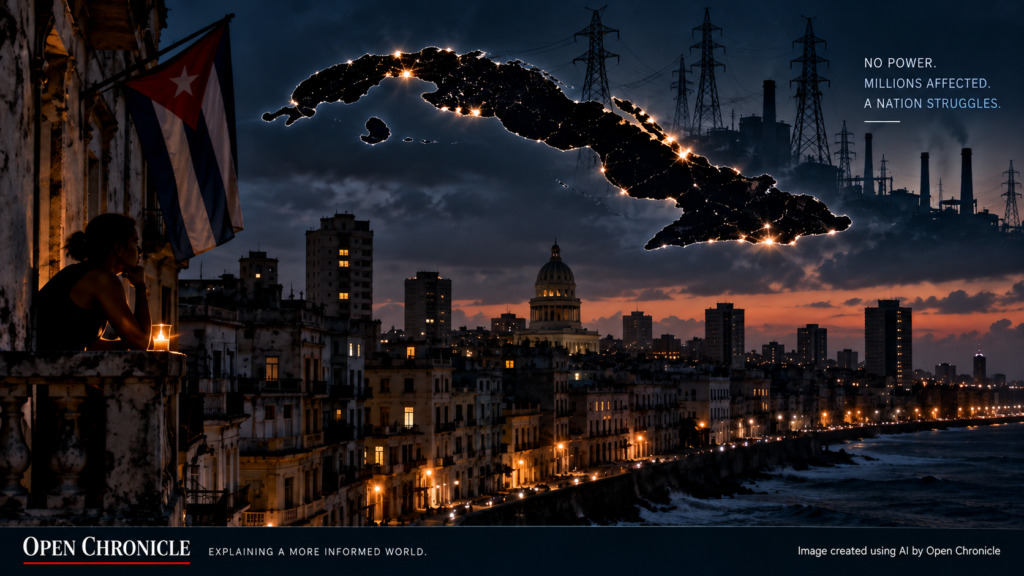
How ageing power stations, fuel shortages and a fragile electricity network can plunge an entire country into darkness.
By Open Chronicle Explained
Imagine an entire country suddenly losing electricity.
The lights go out in millions of homes. Refrigerators stop working. Water pumps fall silent. Traffic lights disappear. Hospitals switch to emergency generators, provided they have enough fuel to keep them running.
This is not simply a power cut affecting one neighbourhood. It is the failure of a national electrical system.
On 18 September 2026, Cuba experienced another nationwide blackout following a failure in its electricity transmission network. The collapse left millions of people without power, adding to a series of major outages that have affected the island.
But how can a problem in one part of an electricity network cause power to disappear across an entire country?
Why can electricity not simply be restored by restarting the power stations?
And why has Cuba become so vulnerable to repeated failures?
To understand the crisis, we first need to understand something most people rarely think about.
An electricity grid is not simply a collection of power stations and cables. It is a continuously balanced system in which thousands of components must work together every second.
1. How Does a National Electricity Grid Work?
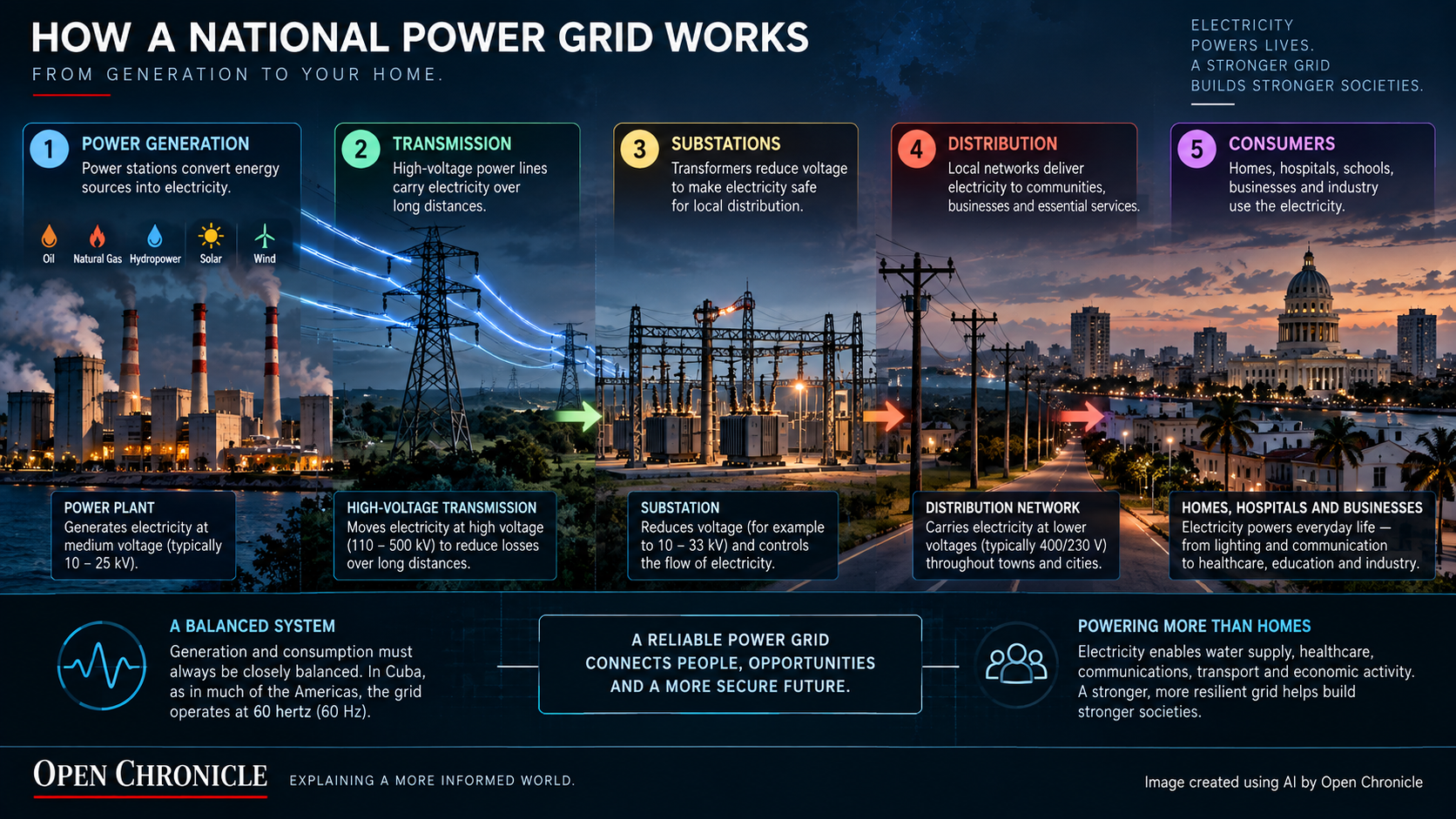
Electricity begins at a power station.
Depending on the country, that station might burn natural gas, coal or oil, use nuclear energy, harness flowing water or generate electricity from wind and sunlight.
The electricity then travels through high voltage transmission lines, substations and local distribution networks before reaching homes, hospitals, factories and businesses.
At first glance, the process appears straightforward.
But there is an important complication.
In a conventional alternating current electricity network, generation and consumption must remain closely balanced in real time.
If consumers suddenly demand more electricity than generators can provide, the system’s frequency begins to fall.
If generators produce more power than the network requires, frequency can rise.
Grid operators must continuously manage this balance.
In Cuba, as in much of the Americas, the electricity system operates at a nominal frequency of 60 hertz.
Keeping that frequency within acceptable limits is essential to maintaining a stable network.
2. Why Can One Failure Cause an Entire Grid to Collapse?
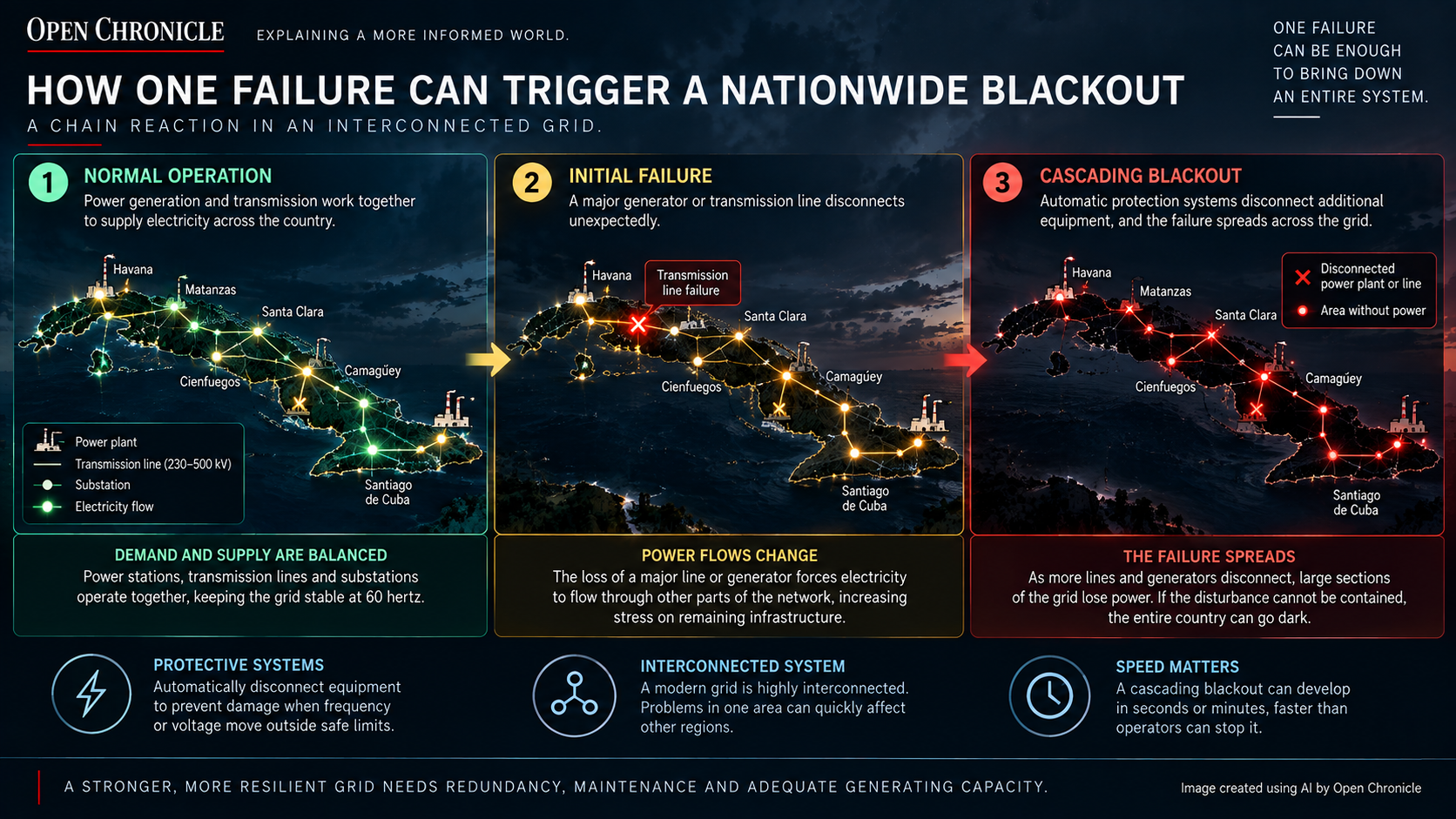
Imagine a country with several power stations connected through a national transmission network.
Each station supplies part of the electricity required by consumers.
Now imagine that one major power station suddenly disconnects.
The electricity it was producing disappears from the network.
The remaining generators must compensate for the lost supply, while the grid’s frequency and power flows begin to change.
If enough spare generating capacity is available, the system may absorb the disturbance.
But what happens if the remaining power stations are already operating close to their limits?
The system becomes vulnerable to a cascading failure.
When a major generator or transmission line disconnects, electricity flows redistribute through the remaining network.
Other transmission lines may become overloaded. Voltage or frequency may move outside acceptable limits.
Automatic protection systems can then disconnect additional equipment to prevent damage or unsafe operation.
Those disconnections may place even greater pressure on the remaining network.
If the disturbance spreads faster than operators and automatic control systems can contain it, large sections of the grid can lose electricity.
Eventually, the entire interconnected system may collapse.
The critical point is that protective systems are designed to prevent equipment from being damaged.
They are not necessarily evidence that a power station itself has broken down.
A functioning generator may disconnect automatically because the wider electrical system has become unstable.
This is the mechanism behind many large scale blackouts.
However, it is important to distinguish the general engineering explanation from the precise cause of a particular event.
In Cuba’s September 2026 blackout, authorities identified a transmission failure as the initial disturbance. A complete technical reconstruction would be needed to establish the exact sequence of subsequent disconnections.
3. Why Is Cuba’s Electricity System Particularly Vulnerable?
A modern electricity network needs more than enough generating capacity to meet normal demand.
It also needs reserves.
If a large generator unexpectedly fails, other power stations must be able to increase production, or the system must rapidly reduce demand.
This is one of the fundamental principles of electricity security.
Cuba has been operating under conditions in which generating capacity is frequently insufficient even before an unexpected failure occurs.
The island’s electricity system depends heavily on ageing thermal power stations, many of which have experienced repeated breakdowns, inadequate maintenance and shortages of replacement parts.
An engineering analysis published by IEEE Spectrum identified three longstanding structural problems: insufficient investment, problems associated with fuel quality and maintenance that has repeatedly been postponed.
This creates a difficult cycle.
A power station requires maintenance.
But taking it offline reduces the electricity available to the country.
If other generators cannot compensate, more consumers lose power.
Keeping the station running postpones the shortage but increases the risk of further mechanical deterioration.
Eventually, equipment may fail unexpectedly.
The result is a system in which routine maintenance becomes increasingly difficult and unplanned breakdowns become more disruptive.
4. Why Does Fuel Matter So Much?
Cuba’s electricity crisis is not simply a problem of ageing machinery.
Power stations also require energy to generate electricity.
Many Cuban generating units depend on petroleum derived fuels, while distributed generation facilities and emergency generators also require dependable fuel supplies.
Even a perfectly maintained power station cannot operate without the fuel it needs.
This makes the electricity network vulnerable to disruptions in imports, transport, financing and domestic fuel distribution.
In 2026, restrictions affecting oil shipments to Cuba significantly worsened an already serious energy shortage.
Reuters reported that US pressure on oil shipments had aggravated the island’s fuel shortages, adding to the difficulties facing its electricity system.
The consequences extend beyond the main power stations.
Diesel generators that might otherwise provide additional electricity also become harder to operate.
Backup systems at essential facilities face greater pressure.
Fuel shortages therefore affect both the normal electricity supply and some of the systems intended to compensate when that supply fails.
5. What Is the Difference Between a Rolling Blackout and a Grid Collapse?
Electricity demand changes throughout the day.
In the morning, homes and businesses begin using more power.
Industrial activity increases demand.
During the evening, households may simultaneously use lighting, refrigeration, cooking equipment, fans and air conditioning.
Grid operators must anticipate these changes and ensure that enough electricity is available.
When generating capacity cannot meet demand, authorities may disconnect parts of the network deliberately.
These are known as rolling blackouts or load shedding.
Their purpose is to reduce electricity consumption sufficiently to prevent the entire system from becoming unstable.
A rolling blackout is therefore a controlled interruption.
Electricity is deliberately disconnected from selected areas to reduce demand and preserve the stability of the remaining network.
A grid collapse is different.
It occurs when a disturbance spreads beyond the network’s ability to contain it, potentially disconnecting electricity across large regions or the entire country.
Cuba has experienced both.
Before the September collapse, rolling blackouts had already lasted more than 30 hours in some parts of the country, according to Reuters.
The difference is that a planned blackout attempts to preserve the rest of the network.
A nationwide collapse means the network itself has lost the ability to maintain normal operation.
6. Why Is Restoring Electricity So Difficult?
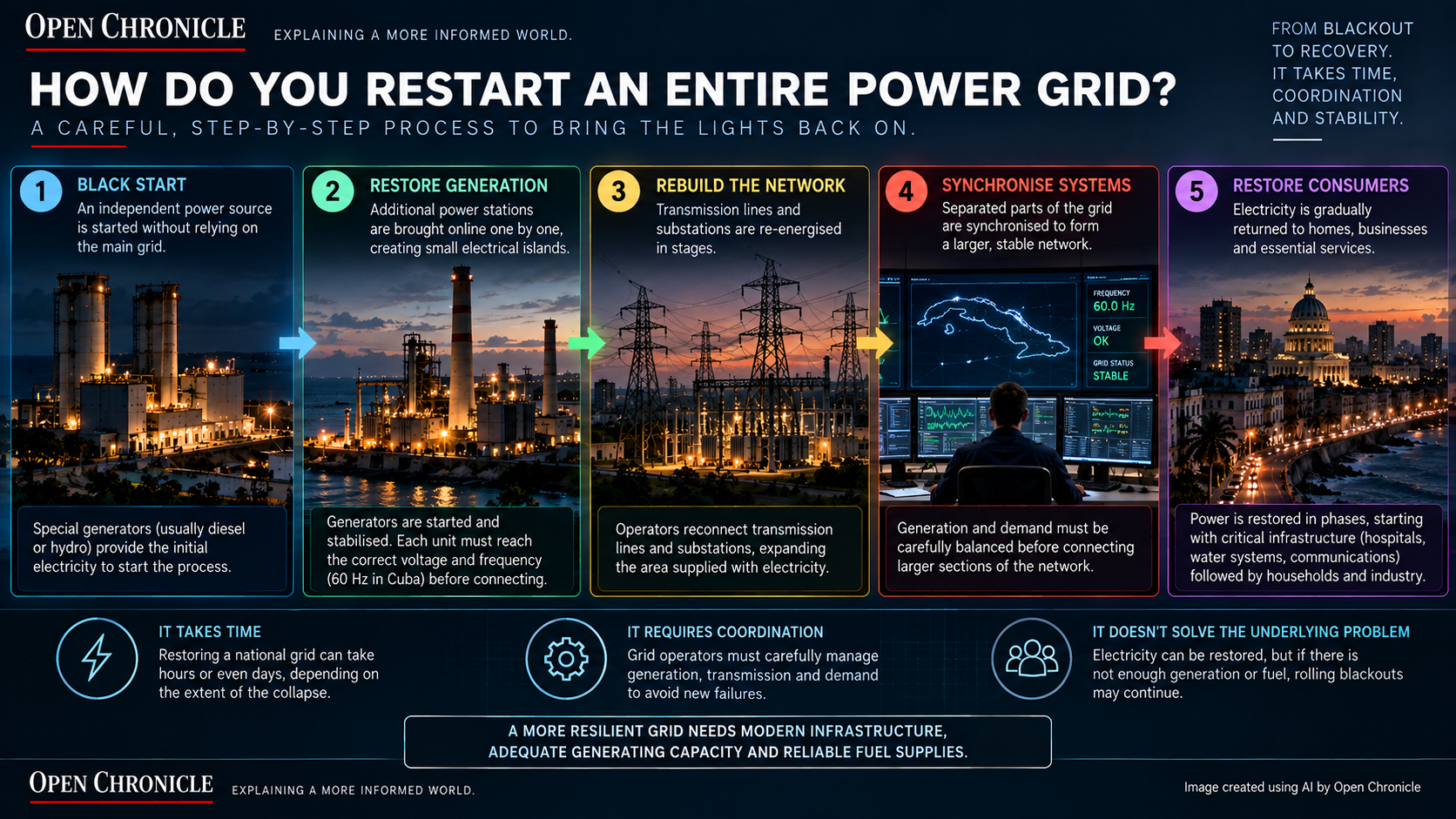
When electricity disappears from an entire country, the solution is not simply to switch the power stations back on.
Large thermal power stations require electricity to operate many of their own systems.
Pumps move water and fuel.
Fans support combustion.
Control equipment monitors the generating units.
Cooling and lubrication systems protect machinery.
If the entire network is without power, where does the electricity needed to restart the power stations come from?
This is known as the black start problem.
A black start is the process of restoring an electrical network without relying on an existing external electricity supply.
Some generating facilities are designed to start independently, using equipment such as dedicated diesel generators or other suitable power sources.
These initial generators can then supply electricity to additional facilities.
The restoration process normally begins by establishing an independent power source capable of energising a small section of the network.
That initial supply can help restart additional generating units.
As more generation becomes available, operators progressively reconnect transmission infrastructure and restore electricity to consumers.
The process requires careful coordination.
Connecting too much demand before sufficient generation is available can destabilise the recovering system.
Electrical islands also need compatible frequency, voltage and phase conditions before they can be safely synchronised.
Cuba has used small electrical islands during previous restoration efforts to supply essential facilities and progressively rebuild its national network.
But restoring the network does not solve the underlying shortage of electricity.
If the available generating capacity remains insufficient, rolling blackouts may continue even after the national system has been reconnected.
7. Why Can Solar Power Not Simply Solve the Problem?
Cuba has substantial solar energy potential.
Solar panels can generate electricity without burning imported oil, making them particularly relevant to a country facing severe fuel shortages.
But there is an important distinction between generating electricity and maintaining a stable national grid.
Conventional solar panels produce electricity when sunlight is available.
Their output changes with cloud cover and falls as the sun sets.
Yet electricity demand continues into the evening and throughout the night.
Without sufficient energy storage or other available generating capacity, solar production during the day cannot automatically supply electricity after dark.
There is also the question of grid stability.
Many conventional grid following solar inverters require an existing stable electrical network to operate.
They are not designed to restart a collapsed national grid independently.
Specialised grid forming inverters, appropriately designed battery systems and other suitable generating resources can provide additional capabilities, but they require investment and careful integration.
Solar energy can therefore reduce Cuba’s dependence on imported fuels.
However, installing solar panels alone does not eliminate the need for reliable transmission infrastructure, storage, maintenance and system wide coordination.
8. Why Does an Electricity Crisis Become a Humanitarian Crisis?
Electricity is an enabling system.
It supports other infrastructure that modern societies depend upon.
When electricity fails, the consequences extend well beyond lighting.
Water supplies can be interrupted because electric pumps are needed to move and distribute water.
Hospitals depend on electricity for medical equipment, refrigeration, lighting and essential services. Backup generators provide temporary protection but require fuel and maintenance.
Food preservation becomes more difficult as refrigeration fails during prolonged outages.
Mobile networks, internet infrastructure and broadcasting systems depend on electricity and functioning backup supplies.
Businesses lose working hours, production is interrupted and transport and payment systems may be affected.
These effects are already visible in Cuba.
Reports on the September blackout described disruptions to transport, water supplies, communications and essential services, while fuel shortages limited the ability of backup systems to compensate for the loss of grid electricity.
The longer an outage continues, the greater the pressure on households and public infrastructure.
For people already facing shortages of food, medicine and fuel, repeated blackouts create an additional layer of hardship.
9. Is Cuba’s Electricity Crisis Caused by US Sanctions or Domestic Problems?
The available evidence points to several interacting causes rather than a single explanation.
Cuba’s electricity infrastructure was experiencing serious reliability problems before the latest US restrictions on oil supplies.
Ageing generating equipment, postponed maintenance, limited investment and shortages of replacement parts have contributed to the system’s deterioration.
These structural problems are documented in technical assessments of the Cuban electricity network.
At the same time, US restrictions affecting oil shipments have reduced the fuel available to an already vulnerable system.
Cuban authorities attribute a substantial part of the worsening crisis to US economic pressure and restrictions on fuel imports.
The US administration attributes Cuba’s economic difficulties in substantial part to the country’s domestic economic management and political system.
These competing political explanations should not obscure the physical relationship between the problems.
A power station needs functioning machinery, suitable fuel, maintenance and a stable transmission network.
A shortage in any one of those areas can reduce electricity production.
When several problems occur simultaneously, the system becomes considerably more vulnerable.
The September 2026 blackout illustrates that interaction.
The reported initiating event was a transmission failure, but the wider electricity crisis has left Cuba with limited capacity to absorb major disturbances and recover from them.
10. What Would Cuba Need to Prevent Future Collapses?
Preventing repeated nationwide blackouts requires more than repairing the component that failed most recently.
It requires improving the resilience of the electricity system as a whole.
Existing power stations require maintenance, replacement components and, where appropriate, modernisation or replacement.
Thermal generating units need dependable supplies of suitable fuel, while a more diversified electricity mix could reduce exposure to disruptions affecting any single energy source.
Transmission infrastructure also needs maintenance, effective protection systems and sufficient redundancy to help contain disturbances before they spread across the country.
Energy storage and flexible generation could help manage fluctuations in electricity production and demand, provided they are correctly designed and integrated.
Reliable backup power for hospitals, water infrastructure and communications would reduce the human consequences of future outages.
None of these measures is an immediate solution.
Rebuilding an electricity system requires sustained investment, engineering capacity, equipment, fuel and time.
The difficulty for Cuba is that the country must attempt to improve its electricity infrastructure while continuing to operate a system that is already struggling to meet everyday demand.
11. Could the Same Thing Happen in Another Country?
Yes.
Large electricity networks are vulnerable to disturbances involving generation, transmission, extreme weather, equipment failures and operational errors.
The difference lies in how well those systems can withstand unexpected events.
A resilient electricity grid has enough resources and operational flexibility to absorb disturbances without allowing them to spread.
It also has effective protection systems, alternative transmission paths, adequate reserves and established recovery procedures.
Cuba’s experience demonstrates what can happen when several of these safeguards are weakened simultaneously.
An electricity shortage makes the network more difficult to operate.
A fragile network becomes more vulnerable to unexpected failures.
And repeated failures make it harder to maintain the equipment needed to prevent the next one.
The result can become a self reinforcing cycle.
What? How? Why?
What happened in Cuba?
A failure in the electricity transmission network on 18 September 2026 triggered a nationwide blackout, leaving millions of people without power.
How can an entire electricity grid collapse?
A major disturbance can destabilise the balance between electricity generation and consumption or disrupt power flows. If protective disconnections spread faster than the system can contain them, a cascading blackout can occur.
Why is Cuba particularly vulnerable?
Its electricity system combines ageing generating equipment, inadequate maintenance, fuel shortages and limited spare generating capacity.
Why can electricity not simply be switched back on?
A collapsed grid must be restarted progressively. Some generating equipment needs electricity to start, while operators must carefully balance generation and demand as the network is reconnected.
Could renewable energy prevent future blackouts?
Renewable generation can reduce fuel dependence, but reliable electricity also requires suitable storage, network infrastructure, operational flexibility and sufficient generating capacity when renewable output is low.
Why does this matter beyond Cuba?
The crisis demonstrates that electricity security depends on an entire interconnected system, not simply on having enough power stations.
The System Behind the Darkness
When an entire country loses electricity, the darkness is the visible consequence of a much larger failure.
Behind every light switch is a network of generators, transmission lines, substations, control systems, engineers and fuel supplies.
All of them must work together.
Cuba’s repeated blackouts reveal what happens when that system becomes increasingly difficult to maintain.
The immediate problem may be a transmission line or a generating unit.
But the deeper crisis concerns the reliability of the entire electricity network.
Restoring power after a blackout is therefore only the first step.
The much harder challenge is ensuring that the system can remain operational when the next unexpected failure occurs.
Because an electricity grid is not simply a machine that can be switched on and left running.
It is a national infrastructure system that must remain balanced, maintained and resilient every second of every day.
Related Reporting
Cuba’s Power Grid Collapses Again, Leaving Millions Without Electricity
Read the Open Chronicle report on the September 2026 blackout and the worsening electricity crisis affecting the island.
Read the Open Chronicle report
Open Chronicle Explained
What? How? Why?
Understanding the systems behind the headlines.
Understanding the systems behind the headlines.
Explore Open Chronicle Explained →