
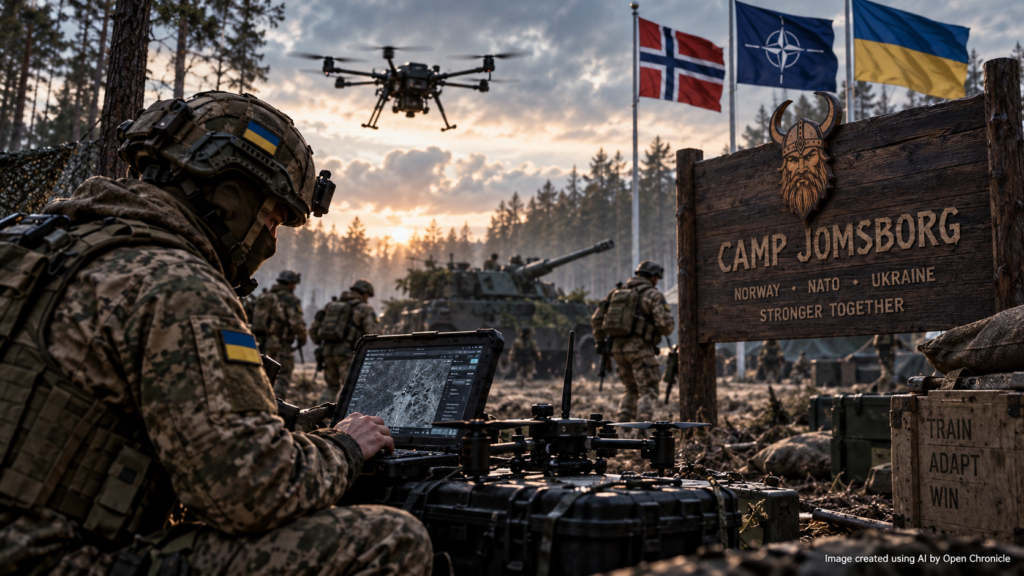
Ukrainian engineers can update drone software within days, while comparable changes in Western military systems can take months. At a Norwegian-built training camp in Poland, NATO personnel are learning how Ukraine’s battlefield experience is challenging traditional approaches to military procurement, training and technological adaptation.
By Open Chronicle with agencies | September 19, 2026
Deep inside a forest in eastern Poland, a military training camp built by Norway has become a meeting point between two very different approaches to modern warfare.
At Camp Jomsborg, Ukrainian soldiers receive training from military personnel drawn from several northern European countries. At the same time, they share lessons from the battlefield that are forcing their Western counterparts to reconsider how quickly their own armed forces can adapt to technological change.
The contrast is particularly evident in drone warfare, where Ukraine’s military has developed a rapid cycle of innovation in response to Russia’s evolving tactics and electronic warfare capabilities.
According to a report by Business Insider, Ukrainian engineers working near the front lines can modify drone software every few days, while comparable updates to Western military systems may require several months.
For NATO trainers in Poland, the difference illustrates a broader challenge: military organizations designed to operate under peacetime procedures must find ways to respond more quickly to the demands of modern warfare.
Two different approaches to military innovation
Russia’s full-scale invasion of Ukraine has forced the Ukrainian military to develop, purchase and deploy new technologies at a pace rarely experienced by Western armed forces.
The widespread use of drones, electronic warfare systems and rapidly evolving battlefield tactics has created an environment in which technological advantages can disappear within weeks.
A drone that performs effectively against enemy defenses today may require significant modifications after Russian forces introduce new jamming systems or countermeasures.
Ukrainian engineers have responded by working closely with frontline units, collecting operational feedback and introducing software modifications directly into systems used in combat.
This approach allows military personnel to identify problems, test potential solutions and implement improvements without waiting for lengthy procurement or development procedures.
Western armed forces, by contrast, frequently operate through established acquisition processes, formal testing requirements and contractual arrangements with defense manufacturers.
These procedures are intended to ensure reliability, safety and accountability, but they can also slow the introduction of technological changes.
The experience of Ukraine has therefore raised questions about whether NATO’s existing procurement and development systems can respond quickly enough to the technological demands of a major conflict.
Camp Jomsborg: Where wartime experience meets NATO training
Camp Jomsborg was constructed by Norway in a forest in eastern Poland within a matter of months.
The facility hosts Operation Legio, a multinational training initiative in which military personnel from northern European countries work with Ukrainian soldiers.
Although the camp provides training for Ukrainian forces, the exchange of knowledge is not limited to a traditional instructor and trainee relationship.
Ukrainian personnel bring direct experience of fighting Russian forces, including lessons concerning drone operations, electronic warfare and the rapid adaptation of military equipment.
Western trainers, meanwhile, provide instruction, resources and organizational support.
The camp’s operations officer, a major identified only as John, described the facility as occupying a position between the immediate demands of the war in Ukraine and the established military structures of Western countries.
The location has become a practical example of how NATO members are attempting to incorporate Ukraine’s battlefield experience into their own military planning.
A drone software update reveals the scale of the challenge
Brigadier General Atle Molde, who commands the task force operating at Camp Jomsborg, highlighted the difference between Ukrainian and Western approaches to technological development.
According to Molde, updating the software of a Western military drone can involve returning the equipment to its manufacturer or sending it to another country for modifications.
The process can take approximately six months.
In Ukraine, however, engineers working close to frontline units may introduce updates every two days or every two weeks, depending on operational requirements.
The difference reflects more than the speed of software development.
It also illustrates the organizational structures surrounding military technology.
Ukrainian engineers can receive immediate feedback from soldiers operating equipment under combat conditions, identify technical problems and introduce changes in response to new threats.
Western military systems often require additional authorization, testing and coordination between military organizations and private defense companies.
Molde said that greater initiative and innovation would be necessary within Western armed forces.
However, he acknowledged that achieving this would require substantial changes at several institutional levels, including legislation governing military procurement and technological development.
Ukraine’s battlefield experience is reshaping NATO discussions
Ukraine’s extensive use of drones has provided Western militaries with a growing body of operational experience concerning the role of unmanned systems in modern warfare.
Small reconnaissance drones, first-person-view attack drones and electronic warfare systems have become central elements of battlefield operations.
Their effectiveness depends not only on the capabilities of individual platforms but also on how quickly military units can adapt to enemy countermeasures.
A military exercise conducted in Estonia last winter reportedly demonstrated the potential consequences of this technological shift.
During the exercise, a Ukrainian drone team consisting of approximately 10 personnel simulated the destruction of two NATO battalions within a single day.
The result highlighted the potential vulnerability of conventional military formations when confronted with coordinated drone operations.
However, the exercise was a simulated engagement conducted under specific conditions, rather than evidence that a small drone unit could necessarily achieve the same result against two battalions in actual combat.
The broader lesson concerns the importance of adapting military doctrine, equipment and training to an environment in which relatively small units can employ unmanned systems to identify and engage larger formations.
For NATO, Ukraine’s experience provides an opportunity to examine how established military structures might need to change.
NATO faces pressure to accelerate defense production
The challenge extends beyond battlefield tactics and software development.
NATO Secretary General Mark Rutte has called for a major transformation of Western defense industries to improve their ability to respond to emerging security threats.
The war in Ukraine has demonstrated the importance of maintaining sufficient production capacity for ammunition, drones, air defense systems and other military equipment.
It has also exposed the difficulties associated with expanding production when industrial supply chains and procurement systems are designed around relatively predictable peacetime demand.
Ukraine’s military has been compelled to develop solutions under immediate operational pressure, often relying on direct cooperation between soldiers, engineers and domestic manufacturers.
Western defense industries operate under different financial, regulatory and institutional conditions.
Adapting those systems would require changes involving governments, armed forces and private companies.
The objective is not simply to produce more equipment, but to establish development and procurement processes capable of responding to technological changes within much shorter periods.
A different model for modern military readiness
The experience at Camp Jomsborg illustrates how the war in Ukraine is influencing discussions about military readiness across NATO.
Traditional military planning has often emphasized the acquisition of sophisticated equipment designed to remain operational for many years.
Ukraine’s experience demonstrates that modern warfare can also require continuous technological modification, particularly when opposing forces rapidly develop new countermeasures.
For Western armed forces, incorporating these lessons presents a complex challenge.
Military equipment must meet established safety, security and operational standards, while procurement systems must provide accountability for public expenditure.
At the same time, lengthy development cycles can leave military organizations struggling to respond to rapidly changing battlefield conditions.
The training initiative in Poland offers NATO personnel an opportunity to observe how Ukrainian forces balance these competing demands under wartime pressure.
It also provides Ukrainian soldiers with access to Western training resources and expertise.
As the conflict continues, the exchange of knowledge between Ukraine and its Western partners is becoming an increasingly important element of military cooperation.
Camp Jomsborg demonstrates that the lessons of the war are not confined to the Ukrainian battlefield.
They are also influencing how NATO members think about technological innovation, defense procurement and the organizational changes required to prepare their armed forces for future conflicts.
For the Western trainers working alongside Ukrainian soldiers in Poland, the central question is how to translate those lessons into military institutions that can adapt more rapidly without abandoning the standards and safeguards governing their operations.