
By Open Chronicle with agencies
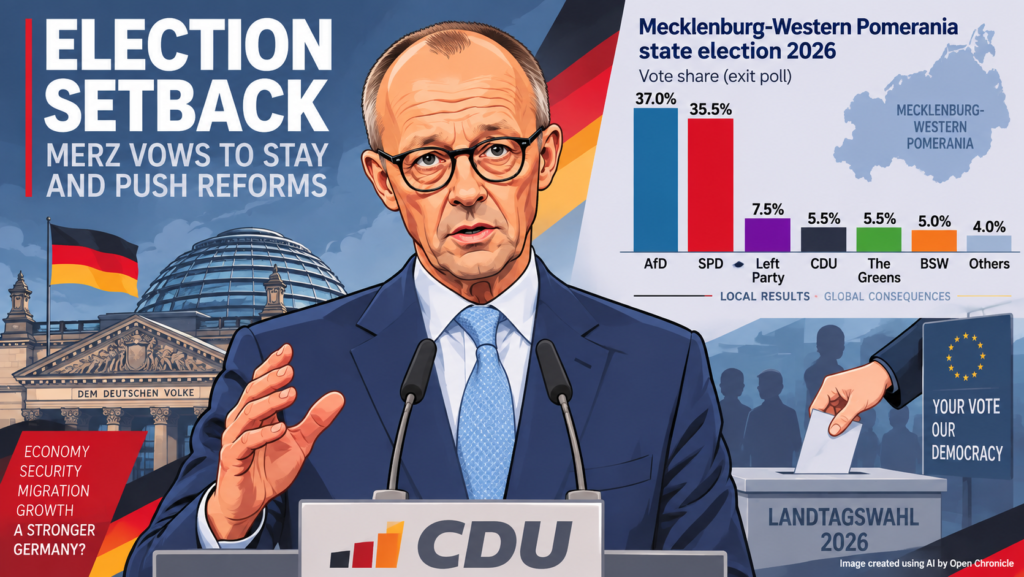
BERLIN, September 20, 2026. German Chancellor Friedrich Merz has pledged to remain in office and continue his government’s economic reform programme despite a series of electoral setbacks for his Christian Democratic Union (CDU), including a historically poor result in Mecklenburg Western Pomerania.
Speaking after Sunday’s state elections, Merz acknowledged the scale of his party’s losses but insisted that Germany’s economic and political challenges required his government to maintain its reform agenda rather than retreat from potentially unpopular decisions.
The chancellor said his administration would continue its work with determination, describing the need for political resilience as a matter of “backbone, steadfastness and patience.”
His remarks followed a difficult election night for the CDU, with preliminary projections indicating significant losses in two German states and further gains for parties outside the governing coalition.
CDU Suffers Historic Defeat in Mecklenburg Western Pomerania
According to exit polls released by public broadcaster ARD on Sunday evening, the CDU secured approximately 5% of the vote in Mecklenburg Western Pomerania, a result that would represent its lowest share in any German state election since the Second World War.
The Alternative for Germany (AfD), a party known for its opposition to immigration and its calls for a different approach to relations with Russia, made substantial gains in the eastern state.
The result followed another significant setback for the CDU in Saxony Anhalt on September 6, where the AfD finished ahead of Merz’s party.
In Berlin, the CDU was projected to finish second with approximately 20% of the vote, behind the Left Party, which was expected to secure around 24.5%, according to ARD’s exit poll.
The preliminary results underline the difficulties facing Germany’s established political parties as voters respond to economic uncertainty, immigration concerns and disagreements over the country’s domestic and foreign policy priorities.
Merz Rejects Calls to Abandon Economic Reforms
Despite the electoral setbacks, Merz has made clear that his government will not abandon its plans to restructure Europe’s largest economy.
The chancellor, who took office 16 months ago, entered government promising to revive economic growth after years of weak performance and mounting pressure on German industry.
His administration has faced the challenge of addressing structural economic problems while managing public concerns over living costs, industrial competitiveness and the future of Germany’s social welfare system.
Some of the proposed reforms could prove unpopular, particularly if they involve changes to public spending, social benefits or existing economic protections.
Merz nevertheless argued that Germany’s current difficulties make reform more urgent.
His decision to maintain the government’s economic programme comes as the CDU faces growing pressure to respond to voter dissatisfaction without abandoning the policies that formed the basis of its governing agenda.
AfD Gains Add to Pressure on Germany’s Political Establishment
The AfD’s electoral advances have intensified debate over the changing political landscape in Germany, particularly in the country’s eastern states.
The party has built support through its opposition to immigration, criticism of the federal government and calls for a reassessment of Germany’s approach to the war in Ukraine.
Its gains in Saxony Anhalt and Mecklenburg Western Pomerania have also renewed discussions about the ability of established parties to maintain their traditional electoral coalitions.
The AfD’s position on Russia and its opposition to aspects of Germany’s military and financial support for Ukraine remain important points of disagreement with the CDU and other mainstream parties.
Germany’s established political parties have generally maintained restrictions on formal cooperation with the AfD, although its growing electoral presence has complicated coalition negotiations and regional government formation.
The latest state election results are likely to intensify discussions within the CDU about how to respond to the party’s electoral losses while maintaining its existing political commitments.
Chancellor Faces Growing Pressure Within His Own Party
Merz’s leadership has come under increasing scrutiny following the CDU’s recent electoral defeats.
In the weeks leading up to Sunday’s elections, some party members publicly questioned whether the chancellor could restore support for the CDU and improve the government’s standing among voters.
However, senior figures within the party have not publicly called for his immediate departure, while others have warned that a leadership dispute could create further instability.
Merz has repeatedly stated that he intends to complete his term as chancellor.
His decision to cancel a planned visit to New York for the United Nations General Assembly reflects the importance of the domestic political situation facing his government.
The chancellor is expected to remain in Berlin as discussions continue over the election results, the government’s reform programme and the CDU’s political direction.
A Difficult Period for Germany’s Government
The latest election results come at a challenging moment for Germany, which is confronting economic stagnation, growing pressure on public finances and uncertainty over Europe’s security environment.
The war in Ukraine has also placed additional demands on Berlin, including increased defence spending and continued military and financial assistance to Kyiv.
At home, the government faces competing demands from businesses seeking greater economic competitiveness, households concerned about living costs and political parties advocating different approaches to immigration and public spending.
For Merz, the immediate challenge is to maintain support for his government’s reform programme while responding to the concerns expressed by voters in successive state elections.
Although Sunday’s results do not directly determine the composition of Germany’s federal government, they have intensified the political debate surrounding the chancellor’s leadership and the future direction of his administration.
Merz has made clear that he intends to continue governing and pursue his reform agenda, despite the electoral setbacks facing his party.
The coming months will bring further parliamentary negotiations, economic policy decisions and political discussions as Germany’s governing coalition seeks to implement its programme.