
By Open Chronicle News Desk | September 20, 2026
World News | International Affairs | Security | Economy | Diplomacy
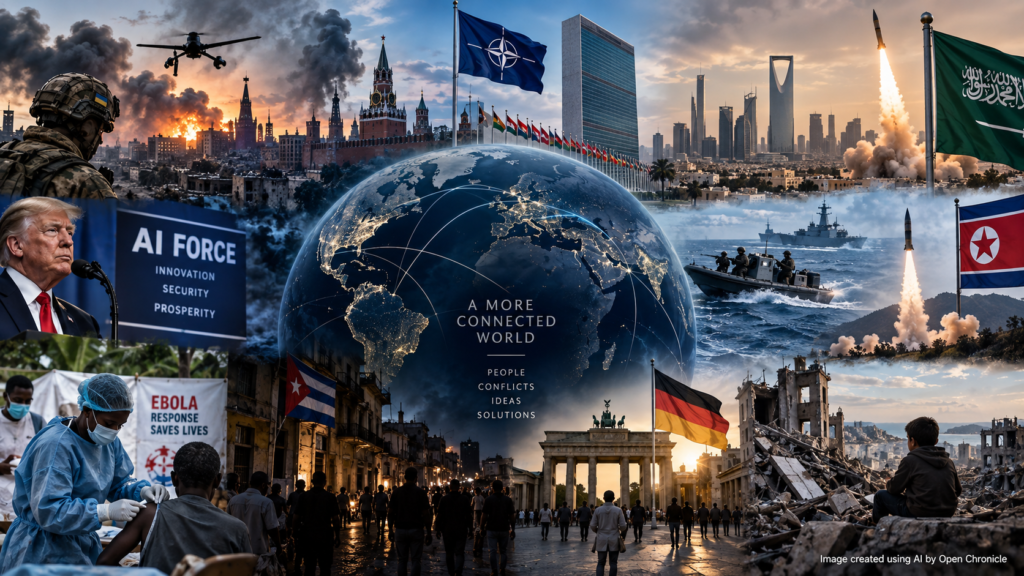
The world enters September 20 amid renewed military tensions in the Middle East, escalating drone warfare between Russia and Ukraine, and fresh security concerns on the Korean Peninsula. Saudi Arabia has reported an attempted ballistic missile attack on its capital, while Moscow has come under a major Ukrainian drone assault during the final day of Russia’s parliamentary elections.
In the United States, the administration of President Donald Trump faces renewed scrutiny over military operations in the Caribbean, restrictions on journalists covering the White House, and questions surrounding American casualties in the Iran war.
Elsewhere, Germany is holding regional elections, Cuba is struggling with another nationwide electricity collapse, and health authorities in the Democratic Republic of the Congo have begun vaccinating frontline workers against Ebola.
Here are the key developments across the world’s major regions on Sunday, September 20, 2026.
Europe
Ukraine launches major drone attack on Moscow as Russia concludes parliamentary elections
Russian officials reported that two people were killed during a large Ukrainian drone attack targeting Moscow and surrounding areas on Sunday.
Moscow’s mayor described the assault as the largest drone attack on the Russian capital since the beginning of the war. Reports also indicated that an oil refinery and logistics facilities were targeted, although the full extent of the damage remained unclear.
The attacks coincided with the final day of Russia’s three day parliamentary elections, the first such vote since Moscow launched its full scale invasion of Ukraine in February 2022.
Russian authorities also organised voting in Ukrainian territories under Moscow’s control, a process rejected by Kyiv.
Meanwhile, Ukrainian authorities reported further Russian attacks on the Kyiv region, with initial accounts indicating that four people had been killed, including three children.
The latest exchanges illustrate the expanding geographical reach of the conflict, with both countries continuing to target infrastructure and military facilities far beyond the immediate front lines.
Germany holds regional elections amid political uncertainty
Voters in Germany headed to the polls on Sunday in regional elections that could reshape the political environment facing Chancellor Friedrich Merz.
The contests come amid tensions within the governing coalition and growing competition from Alternative for Germany, particularly in eastern parts of the country.
The elections will determine representation and governing arrangements at the regional level rather than directly decide who serves as federal chancellor.
Nevertheless, the results will provide an indication of public support for the parties represented in Germany’s federal government.
Denmark welcomes progress on Greenland security agreement
Denmark and Greenland have welcomed progress toward a proposed security agreement with the United States that would expand the American military presence on the Arctic island while preserving its existing constitutional status.
The negotiations follow months of diplomatic tension over President Trump’s statements concerning American control of Greenland.
Danish and Greenlandic leaders have insisted that any agreement must respect the sovereignty of the Kingdom of Denmark and Greenland’s right to self determination.
The proposed arrangement is expected to be formalised during the United Nations General Assembly, although important details concerning the scope of American military operations have not yet been made public.
NATO examines its readiness amid growing security concerns
NATO officials have reiterated the alliance’s readiness to respond to potential Russian military escalation as the war in Ukraine continues.
At the same time, Western governments are examining how to strengthen Ukraine’s air defences, including efforts to identify additional Patriot interceptor missiles.
The discussions reflect continuing concerns about missile and drone attacks against Ukrainian cities and critical infrastructure.
Middle East
Saudi Arabia reports attempted Houthi missile attack on Riyadh
Saudi Arabia confirmed that Yemen’s Houthi movement attempted to strike its capital, Riyadh, with a ballistic missile, raising concerns about further regional escalation.
The Houthis also claimed missile and drone operations against targets in the Saudi capital. Reports described smoke and flames near Riyadh’s airport, although the precise circumstances and extent of any damage remained unclear.
Washington warned that the confrontation between Saudi Arabia and the Houthis could produce an unpredictable expansion of the wider Middle East conflict.
American diplomatic missions issued security alerts advising US citizens in the region to remain vigilant.
The United Nations and Gulf Cooperation Council officials condemned the reported attacks, while several regional governments expressed support for Saudi Arabia.
Iran sets conditions for renewed negotiations with Washington
Iran has outlined seven conditions for possible negotiations with the United States, insisting that Washington must accept its requirements before talks can proceed.
Iranian officials have also indicated that the future of shipping through the Strait of Hormuz remains connected to unresolved commitments involving the United States.
The diplomatic confrontation comes amid continuing regional hostilities and concerns about international energy supplies.
The Strait of Hormuz is a critical maritime passage for oil and liquefied natural gas exports, making any prolonged disruption a concern for energy markets and international shipping.
Questions emerge over American military casualties in Iran war
A report published by The Washington Post has raised questions about whether the Pentagon’s publicly disclosed death toll fully accounts for American service members who died during the Iran war.
According to the report, four additional US military personnel died beyond the number previously disclosed publicly by the Pentagon.
Defence Secretary Pete Hegseth has rejected accusations that the administration deliberately concealed military deaths.
The distinction between personnel killed directly in combat and those who died from other causes during military operations remains important when assessing the reported figures.
Gaza hospital suspends routine services amid fuel shortages
The Kuwait Specialty Hospital in Gaza has suspended routine medical services because of a shortage of fuel.
The interruption adds to the difficulties facing Gaza’s healthcare system, where medical facilities depend on electricity to operate essential equipment, preserve medicines and maintain emergency treatment.
Reports also indicated that Israeli fire killed four Palestinians in Gaza, including the son of a health official.
The incidents come as the humanitarian situation in the territory remains a major concern for international aid organisations.
North America
US military reports four deaths in Caribbean maritime strike
The United States military said it killed four people in an operation against a vessel suspected of involvement in drug trafficking in the Caribbean.
American officials described the operation as part of an expanded campaign against maritime narcotics networks.
The identities of those killed and the evidence supporting the allegations of drug trafficking were not immediately available in the information released.
The operation raises questions about the legal framework governing the use of military force against suspected criminal activity at sea.
White House denies access to journalists from three news organisations
Journalists working for CNN, MS NOW and Politico were reportedly denied access to the White House following President Trump’s announcement of restrictions against the three organisations.
Trump accused the outlets of publishing false information about his administration.
The affected news organisations have defended their reporting and their constitutional rights to cover the federal government.
The dispute adds to an ongoing confrontation over press access, government accreditation and the First Amendment.
Trump announces new artificial intelligence initiative
President Trump has announced plans to establish an AI Force and appoint a senior official to oversee the administration’s artificial intelligence agenda.
The initiative comes as competition over advanced computing, technological innovation and national security applications continues to shape relations between the United States and China.
Further details concerning the proposed organisation’s responsibilities, leadership and relationship with existing federal agencies have yet to be fully established.
Canada and France seek closer transatlantic cooperation
Canadian Prime Minister Mark Carney and French President Emmanuel Macron are meeting in Saint Pierre and Miquelon to discuss closer cooperation between Canada and Europe.
The discussions come amid changes in international trade relations and growing interest in strengthening economic and diplomatic partnerships across the Atlantic.
The meeting provides an opportunity to address bilateral cooperation as well as broader relations between Canada and the European Union.
Latin America and the Caribbean
Cuba suffers another nationwide electricity collapse
Millions of Cubans remain affected by a major electricity crisis after the country’s national power grid collapsed again.
The latest failure followed problems in the transmission network and left much of the island without electricity.
Authorities have been working to restore power in stages, prioritising hospitals and other essential services.
Cuba’s ageing electricity infrastructure, shortages of fuel and replacement parts, and wider economic difficulties have contributed to repeated nationwide blackouts.
American restrictions on fuel supplies have added further pressure to the island’s energy system.
The outages have disrupted public transport, water distribution, communications and everyday economic activity.
Asia and the Pacific
North Korea launches ballistic missile toward eastern waters
North Korea fired a short range ballistic missile toward the waters east of the Korean Peninsula on Sunday, according to South Korea’s military.
Japanese authorities also reported the launch.
The missile test followed changes to joint military exercises involving the United States and South Korea.
Pyongyang has repeatedly criticised allied military drills, describing them as a threat to its security, while Washington and Seoul maintain that their exercises are defensive.
The latest launch adds to concerns about North Korea’s missile development and the security environment in Northeast Asia.
China advances semiconductor production and space research
Chinese memory chip manufacturer CXMT has announced that a new semiconductor platform has entered mass production.
The development comes amid international competition over advanced computing technology and efforts by governments to strengthen domestic semiconductor supply chains.
Separately, China has reported progress in research related to its planned crewed lunar programme, including spacesuit development and studies intended to support future missions.
Beijing is pursuing a goal of landing Chinese astronauts on the Moon before 2030.
Japan supports elections in Solomon Islands
Japan has announced plans to provide grants worth up to $3.5 million to support electoral preparations in Solomon Islands.
The assistance forms part of Japan’s broader engagement with Pacific island countries, where infrastructure, economic development and regional security remain important areas of international cooperation.
Africa
Democratic Republic of the Congo begins Ebola vaccinations
Health authorities in the Democratic Republic of the Congo have begun vaccinating healthcare workers in the area at the centre of a new Ebola outbreak.
The vaccination campaign aims to protect medical personnel and reduce the risk of transmission as authorities work to contain the disease.
Ebola outbreaks place considerable pressure on local healthcare systems because of the need for specialised treatment, contact tracing and infection prevention measures.
The effectiveness of the response will depend on rapid identification of cases, access to affected communities and the availability of medical supplies.
Sudan’s economic crisis deepens as currency loses value
Sudan’s currency has continued to weaken as the country’s prolonged conflict disrupts commercial activity and access to essential goods.
Reports indicate that shortages of cash and deteriorating market conditions are placing additional pressure on households and businesses.
The conflict has damaged infrastructure, interrupted trade routes and displaced millions of people.
The latest currency developments add to the difficulties facing civilians already struggling with food insecurity and limited access to healthcare.
Tanzania investigates suspected poisoning of lions
Authorities in Tanzania are investigating the deaths of ten lions in the Ngorongoro Conservation Area following reports of suspected poisoning.
The circumstances surrounding the deaths remain under investigation.
The incident highlights the challenges facing wildlife conservation in areas where protected animal populations and human communities share the same environment.
Global Economy and International Diplomacy
Oil tanker shortage threatens international energy shipments
A shortage of available oil tankers is driving up maritime transport costs and creating additional pressure on international crude oil supply chains.
The disruption comes amid continuing instability in the Middle East and uncertainty surrounding important maritime routes.
Higher shipping costs can affect the final price of imported energy, adding to inflationary pressures for businesses and consumers.
United Nations prepares for General Assembly discussions
World leaders are preparing to gather in New York for the 81st session of the United Nations General Assembly.
The wars in Ukraine and the Middle East, artificial intelligence, international security and economic instability are expected to feature prominently in diplomatic discussions.
Turkish President Recep Tayyip Erdoğan is among the leaders expected to attend.
The gathering will provide an opportunity for bilateral meetings and negotiations at a time of heightened international tensions.
The World Today
September 20 brings several interconnected developments into focus. The confrontation between Saudi Arabia and the Houthis has renewed concerns about the geographical expansion of the Middle East conflict, while the latest drone attacks on Moscow and the Kyiv region demonstrate the continuing human and economic costs of the war between Russia and Ukraine.
In Asia, North Korea’s latest missile launch adds another security challenge, while competition over artificial intelligence and semiconductor technology continues to influence relations between major powers.
At the same time, Cuba’s electricity crisis, Sudan’s economic difficulties and the Ebola outbreak in the Democratic Republic of the Congo underline the importance of humanitarian emergencies that can receive less international attention than major geopolitical confrontations.
The approaching United Nations General Assembly will bring many of these issues into a common diplomatic forum, although the prospects for concrete agreements remain uncertain.
Open Chronicle will continue following these developments as further information becomes available.
Editorial note: This briefing is based on reports available on the morning of September 20, 2026. Casualty figures, operational details and diplomatic announcements may change as authorities release additional information.