
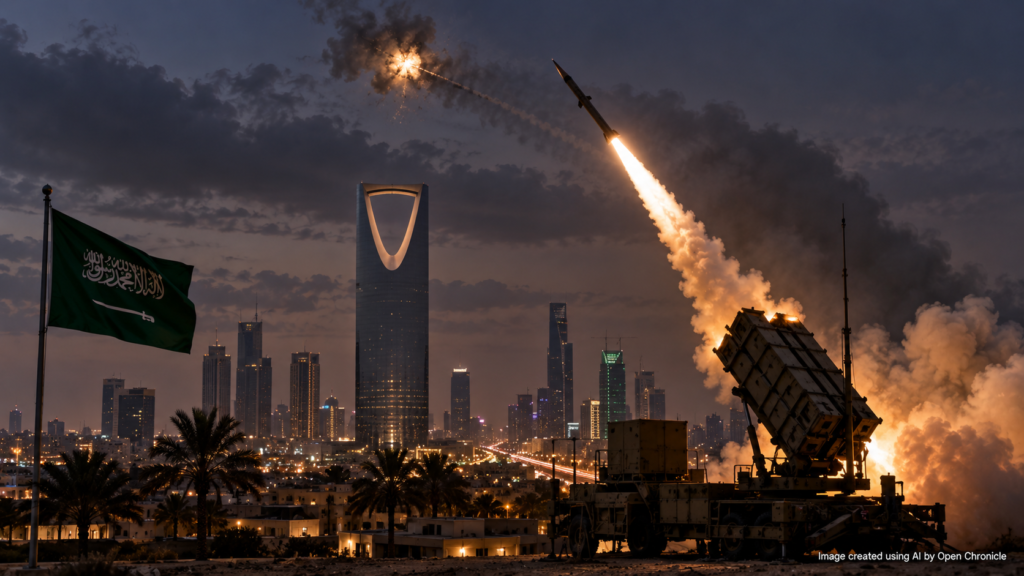
Saudi Arabia has confirmed that Yemen’s Houthi rebels attempted to strike its capital with a ballistic missile, marking a significant escalation in the fighting between the kingdom and the Iran-backed group. The attempted attack comes as renewed hostilities in Yemen threaten to destabilise the Red Sea region and place additional pressure on global shipping and energy markets.
By Open Chronicle with agencies | September 20, 2026
Saudi Arabia confirmed on Saturday that its air defence systems had intercepted a ballistic missile launched by Yemen’s Houthi rebels towards Riyadh, in the first reported attempt to target the Saudi capital since the latest escalation in fighting between the kingdom and the armed group.
The Saudi-led coalition fighting the Houthis said the missile was intercepted following an attempted attack at dawn. Residents in Riyadh reported hearing an explosion, while others later observed a plume of smoke near the capital’s airport.
There were no immediate reports of casualties or damage.
The attempted strike represents a further escalation in a conflict that has increasingly drawn Saudi Arabia into the wider regional confrontation involving Iran and its allies.
Multiple Saudi cities and oil facilities targeted
According to the Saudi-led coalition, the Houthis also attempted to strike civilian infrastructure in several other locations, including the Red Sea port city of Yanbu, Taif, Baysh and Farasan.
The coalition said the attacks had been thwarted but did not provide further details about the weapons used or the interception operations.
Yanbu is particularly important to Saudi Arabia’s energy infrastructure because it serves as the western terminal of a major pipeline transporting crude oil from the kingdom’s eastern oilfields to the Red Sea.
The Houthis, meanwhile, claimed responsibility for a series of attacks involving ballistic missiles, cruise missiles and drones.
Houthi military spokesperson Brigadier General Yahya Saree said the group had targeted sensitive sites in Riyadh and facilities belonging to Saudi oil giant Aramco in Yanbu.
The rebels claimed their strikes had caused major fires, although they provided no evidence to substantiate the assertion.
Saudi authorities reported that the attacks had been intercepted, and Aramco did not immediately respond to requests for comment.
The competing accounts could not be independently verified.
Growing pressure on Saudi air defences
The latest attempted missile strike follows several days of intensifying attacks against Saudi territory.
On Thursday, Saudi civil defence authorities reported that a Yemeni resident of the kingdom had been killed by debris from an intercepted Houthi drone, marking the first reported civilian fatality in the latest escalation.
A day earlier, Saudi Arabia accused the Houthis of attempting to attack Mecca, Islam’s holiest city, with a drone.
Saudi authorities said the aircraft had been intercepted and described the protection of Mecca as a matter of fundamental national and religious importance.
The Houthis denied responsibility for the alleged attack.
The growing frequency of missile and drone launches has also raised concerns about the sustainability of Saudi Arabia’s air defence operations.
Regional officials cited by the Associated Press said the kingdom was facing shortages of missile interceptors and had requested additional air defence assistance from France, Britain, Pakistan and Egypt.
The United States, a longstanding Saudi security partner, has indicated that it is not currently engaged in direct hostilities with the Houthis.
Yemen’s civil war returns to the forefront
The confrontation is unfolding alongside a renewed escalation in Yemen’s long-running civil war.
Fighting has intensified between Houthi forces and the internationally recognised Yemeni government, which is backed by Saudi Arabia.
Over the past week, Houthi fighters have advanced along Yemen’s Red Sea coastline, capturing the strategically important port city of Mokha and islands near the Bab el-Mandeb Strait.
The territorial gains have strengthened the group’s ability to monitor maritime traffic passing through one of the world’s most important shipping corridors.
The Houthis have said that their maritime operations are directed against Saudi vessels.
However, the renewed fighting has raised concerns about the security of commercial shipping in the Red Sea and the potential consequences for international trade.
The latest developments also threaten to undermine the relative calm that had prevailed in Yemen for approximately four years.
The country has endured more than a decade of conflict, leaving millions of people dependent on humanitarian assistance and damaging much of its essential infrastructure.
A sustained return to large-scale fighting could further complicate efforts to restore stability and address the humanitarian crisis.
Red Sea shipping and global energy markets face renewed uncertainty
The escalation comes at a particularly sensitive moment for international energy markets.
Saudi Arabia is one of the world’s largest oil exporters, while the Red Sea provides a critical maritime connection between the Indian Ocean and the Mediterranean through the Suez Canal.
The Bab el-Mandeb Strait, situated between Yemen and the Horn of Africa, is an essential passage for commercial vessels travelling between Asia, Europe and the Middle East.
Any prolonged disruption to shipping through the strait could force vessels to take longer routes around southern Africa, increasing transport costs and delivery times.
The attempted attacks on Yanbu also highlight the vulnerability of energy infrastructure located along Saudi Arabia’s western coastline.
The port and its associated pipeline infrastructure provide an alternative export route for Saudi crude oil, reducing the kingdom’s dependence on shipments through the Strait of Hormuz.
A significant disruption to facilities in Yanbu could therefore create additional challenges for Saudi oil exports at a time when regional instability is already placing pressure on energy supply chains.
A widening regional confrontation
The latest attacks illustrate how the conflict involving Iran and its regional adversaries is increasingly affecting neighbouring countries and critical economic infrastructure.
Saudi Arabia faces the challenge of protecting its cities, energy facilities and maritime interests while managing the risk of a broader military confrontation with the Houthis.
The rebels, for their part, have demonstrated their continued ability to launch missiles and drones against targets beyond Yemen’s borders.
With fighting intensifying inside Yemen and attacks against Saudi territory continuing, the immediate prospects for de-escalation remain uncertain.
The developments also underline the growing importance of regional diplomatic efforts to prevent the confrontation from spreading further across the Arabian Peninsula and the Red Sea.
For Yemen’s civilian population, renewed hostilities threaten to deepen an already severe humanitarian crisis, while neighbouring countries and international markets face the consequences of another expanding front in the wider Middle East conflict.