
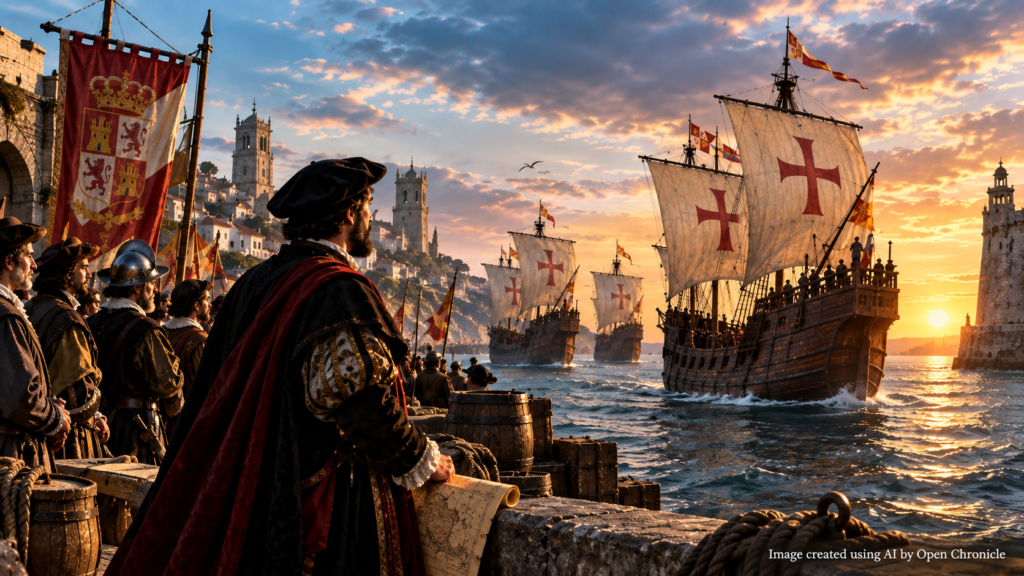
The voyage that transformed humanity’s understanding of the planet, opened a new route across the Pacific and revealed the extraordinary scale of the world’s oceans.
By Open Chronicle History Desk
On September 20, 1519, five ships sailed from the Spanish port of Sanlúcar de Barrameda on an expedition that would change the course of world history.
Their commander was a Portuguese navigator serving the Spanish Crown, Ferdinand Magellan.
His mission was to find a western maritime route to the Spice Islands, the valuable trading centres of Southeast Asia, without crossing waters claimed by Portugal.
The expedition was not originally conceived as an attempt to circumnavigate the Earth. Its purpose was commercial and geopolitical: to reach the source of some of the world’s most valuable commodities through a route that Spain could claim as its own.
Yet the voyage would achieve something far greater.
Three years later, a single surviving ship would return to Spain after completing the first recorded circumnavigation of the globe.
Magellan himself would not live to see that achievement.
He would die in the Philippines in 1521, leaving his surviving companions to complete one of the most extraordinary journeys in maritime history.
The expedition revealed the immense size of the Pacific Ocean, demonstrated the practical possibility of sailing around the Earth and helped transform European geographical knowledge.
It also marked an important stage in the expansion of European maritime empires into regions already inhabited by complex societies and connected through extensive commercial networks.
The voyage of 1519 was therefore more than a story of exploration.
It was a turning point in the history of navigation, global trade, imperial competition and humanity’s understanding of the world.
1. A World Divided Between Two Maritime Powers
At the beginning of the sixteenth century, Portugal and Spain were competing to control maritime routes linking Europe with Africa, Asia and the Americas.
Portuguese navigators had spent decades exploring the Atlantic coast of Africa.
In 1488, Bartolomeu Dias rounded the southern tip of the African continent, demonstrating that a maritime passage existed between the Atlantic and Indian Oceans.
Ten years later, Vasco da Gama reached India by sailing around Africa.
Portugal had established a direct maritime connection with the commercial networks of the Indian Ocean.
Spain, meanwhile, had sponsored Christopher Columbus’s westward voyage in 1492.
Columbus reached the Caribbean, opening the way for sustained Spanish expansion into the Americas.
The two kingdoms increasingly viewed overseas territories and maritime routes as sources of political influence and commercial wealth.
The Treaty of Tordesillas
In 1494, Portugal and Castile concluded the Treaty of Tordesillas, establishing a line of demarcation intended to divide their respective overseas spheres of expansion.
The treaty reflected the political ambitions of two European monarchies, rather than the interests or consent of the peoples already inhabiting the territories concerned.
It also left an important geographical problem unresolved.
Where exactly did the dividing line extend on the opposite side of the globe?
The uncertainty became especially significant in Southeast Asia, where the valuable Spice Islands attracted growing European interest.
Portugal had already established a maritime presence in the region.
Spain wanted access to the same markets.
Magellan believed that a westward route could provide the solution.
2. Ferdinand Magellan: The Portuguese Navigator Who Sailed for Spain
Magellan had served in Portuguese expeditions to the Indian Ocean and participated in military campaigns associated with Portugal’s expansion in Asia.
He possessed practical knowledge of long-distance navigation, maritime warfare and the commercial importance of Asian trade.
But his relationship with the Portuguese Crown deteriorated.
After failing to secure support from King Manuel I for his proposed western expedition, Magellan travelled to Spain.
There, he presented his project to the young King Charles I, who would later become Holy Roman Emperor Charles V.
Magellan argued that the Spice Islands could be reached by sailing west through the Atlantic and finding a passage around South America.
The proposal offered Spain an opportunity to challenge Portuguese commercial dominance without following the established route around Africa.
In March 1518, the Spanish Crown approved the expedition and granted Magellan and his associate Rui Faleiro significant privileges connected with the proposed discoveries and trade.
The preparations began.
The expedition assembled five vessels at Seville.
They were not enormous ships built for comfort or prolonged exploration. They were wooden sailing vessels adapted for a voyage whose duration and dangers could only be estimated.
The five ships of Magellan’s fleet
|
Trinidad |
Magellan’s flagship, which would later be captured by the Portuguese. |
|
San Antonio |
The largest vessel, which deserted the expedition and returned to Spain. |
|
Concepción |
Abandoned and burned in the Philippines after the expedition suffered heavy losses. |
|
Victoria |
The only ship to complete the circumnavigation. |
|
Santiago |
Wrecked while exploring the South American coast. |
Approximately 240 people joined the expedition, although historical reconstructions differ on the precise number.
The fleet carried food, drinking water, weapons, navigation equipment, trade goods and supplies for a voyage expected to last many months.
Its crews came from several European countries.
Portuguese, Spanish, Italian, French, Greek and other sailors served aboard the ships.
The multinational composition created a further challenge for Magellan, whose Portuguese origins generated suspicion among some Spanish officers.
The expedition would face not only storms and unknown coastlines but also internal political conflict.
4. September 20, 1519: Departure From Spain
The fleet departed Seville on August 10, 1519, sailing down the Guadalquivir River towards the Atlantic.
It remained at Sanlúcar de Barrameda for several weeks while completing its preparations.
On September 20, the ships finally sailed into the open ocean.
The expedition’s first destination was the Canary Islands.
From there, Magellan planned to cross the Atlantic towards South America.
The navigators possessed maps and geographical information gathered during earlier Portuguese and Spanish voyages, but important uncertainties remained.
No European expedition had yet demonstrated the existence of a navigable passage connecting the Atlantic with the Pacific at the southern end of South America.
Magellan believed such a route existed.
Finding it would become the central challenge of the expedition’s first year.
5. Across the Atlantic to South America
After leaving the Canary Islands, the fleet crossed the Atlantic and reached the coast of present-day Brazil in December 1519.
The ships entered the region of Guanabara Bay, near modern Rio de Janeiro, before continuing south.
Magellan searched for a passage through the South American continent.
The broad estuary of the Río de la Plata initially appeared promising.
Exploration demonstrated that it was not the desired connection to another ocean.
The fleet continued southward into increasingly cold and difficult waters.
The coastline offered few certainties.
Navigation became more dangerous.
Food supplies were under pressure.
The crews had no reliable knowledge of how much farther they would need to sail before finding a passage, if one existed at all.
6. Mutiny in Patagonia
In March 1520, the expedition reached Puerto San Julián, on the coast of present-day Argentina.
Magellan decided to spend the southern winter there.
The decision intensified dissatisfaction among officers who questioned his leadership and the feasibility of the expedition.
In April, a mutiny broke out involving officers aboard several ships.
Magellan responded decisively, regaining control of the fleet.
One captain was executed, another was killed during the confrontation, and other participants were punished or abandoned.
The episode exposed the fragility of authority aboard a fleet operating thousands of kilometres from Spain.
The expedition’s survival depended on maintaining discipline, but Magellan’s methods also revealed the violence and coercion that could accompany early modern maritime command.
The winter brought another setback.
The Santiago was wrecked during a reconnaissance voyage.
The fleet was reduced to four ships.
7. The Discovery of the Strait of Magellan
In October 1520, the remaining ships reached the entrance to a complex system of channels near the southern tip of South America.
The navigators began exploring the waterways.
The passage was difficult.
Strong currents, unpredictable winds, narrow channels and unfamiliar coastlines complicated the journey.
During the exploration, the San Antonio deserted and returned to Spain.
Magellan continued with three ships.
After weeks of navigation, the fleet emerged into the ocean west of South America in late November 1520.
The passage later became known as the Strait of Magellan.
It provided the first recorded navigable maritime connection used by a European expedition between the Atlantic and Pacific Oceans.
The achievement was extraordinary.
But the expedition had no idea how vast the next ocean would prove to be.
8. The Pacific Ocean: A Vastness Beyond Expectation
Magellan named the newly entered ocean the Mar Pacífico, or Pacific Sea, because the waters initially appeared comparatively calm.
The name concealed the scale of the challenge ahead.
The Pacific was vastly larger than the navigators had anticipated.
For approximately three months, the ships crossed immense stretches of open water without reaching a major inhabited landmass where they could replenish their supplies.
Food deteriorated.
Fresh water became scarce.
Scurvy and malnutrition weakened the crews.
Antonio Pigafetta, an Italian participant whose account became one of the most important sources for the voyage, described the desperate conditions aboard the ships.
The sailors consumed increasingly unsuitable food as their supplies ran out.
Men became sick and died.
The crossing revealed the enormous geographical distance separating the Americas from Asia.
European maps had substantially underestimated the scale of the Pacific.
The expedition’s experience would help correct that misunderstanding.
9. The Philippines and the Death of Magellan
In March 1521, the expedition reached the Mariana Islands and subsequently the Philippine archipelago.
The ships had finally crossed the Pacific.
Magellan established contact with local rulers, including Rajah Humabon of Cebu.
The encounters involved diplomacy, trade, religious conversion and political alliances.
Magellan increasingly involved himself in local political relationships.
This decision would prove fatal.
On April 27, 1521, he led an armed expedition against the forces of Lapulapu, a leader on the island of Mactan.
The confrontation ended in defeat for Magellan’s men.
Magellan was killed during the fighting.
His death demonstrated the limits of European military power in unfamiliar environments.
The expedition’s commander had crossed the Atlantic, discovered a passage around South America and navigated the Pacific.
He would never return to Spain.
Nor would he personally complete the circumnavigation of the Earth.
10. The Voyage Continues Without Magellan
Magellan’s death created a leadership crisis.
Further losses followed in the Philippines.
The surviving crews no longer possessed enough men to operate three ships effectively.
The Concepción was abandoned and burned.
Only the Trinidad and Victoria remained.
The expedition continued towards the Moluccas, the Spice Islands that had been its original commercial objective.
In November 1521, the surviving ships finally reached Tidore, in the Moluccas.
The crews acquired valuable spices, including cloves.
The expedition had reached the region it had set out to find.
But returning to Spain remained a formidable challenge.
11. Juan Sebastián Elcano and the Final Crossing
The Trinidad required repairs and remained behind in the Moluccas. Its subsequent attempt to cross the Pacific failed, and the vessel eventually fell into Portuguese hands.
The Victoria, under the command of Juan Sebastián Elcano, began the journey westward across the Indian Ocean.
This route was dangerous for political as well as geographical reasons.
Portuguese forces controlled important maritime positions along the route around Africa.
The Spanish expedition risked interception.
Elcano therefore attempted to avoid Portuguese-controlled ports while navigating across the Indian Ocean and around the Cape of Good Hope.
The voyage brought further hardship.
Food shortages, disease and exhaustion continued to kill crew members.
Nevertheless, the Victoria survived.
12. September 1522: One Ship Returns
On September 6, 1522, the Victoria reached Sanlúcar de Barrameda.
Two days later, it arrived at Seville.
Of the approximately 240 people who had originally joined the expedition, only 18 men returned aboard the Victoria.
Other participants survived by different routes or returned later, but the scale of the losses was immense.
The Victoria had completed the first recorded circumnavigation of the Earth.
The expedition had departed Spain in September 1519 and returned almost exactly three years later.
It had crossed the Atlantic, navigated around South America, traversed the Pacific, reached Southeast Asia and returned across the Indian and Atlantic Oceans.
The voyage had transformed geographical knowledge.
It had also demonstrated the enormous human cost of attempting to establish new maritime routes in an era before modern navigation, medicine and communications.
13. Did Magellan Really Circumnavigate the World?
The expedition is commonly described as Magellan’s circumnavigation, but the distinction between the commander and the achievement matters.
Magellan died before the voyage was completed.
The first recorded continuous circumnavigation by ship was completed by the Victoria under Elcano’s command.
There is also a historical debate concerning Magellan’s enslaved interpreter, Enrique, who had travelled from Southeast Asia to Europe before joining the expedition.
Because Enrique returned to the Philippines with Magellan, some historians have suggested that he may have completed a circumnavigation before the Victoria returned to Spain.
However, his precise birthplace, movements after Magellan’s death and eventual fate remain uncertain.
There is insufficient evidence to establish conclusively that he completed the journey.
The documented achievement belongs to the surviving expedition and the Victoria’s return in 1522.
15. The World Was Already Connected
The first circumnavigation is often presented as the moment when the world became connected.
That description requires qualification.
Long before Magellan’s expedition, extensive commercial networks linked Africa, Europe and Asia.
The Indian Ocean supported maritime trade between East Africa, Arabia, India, Southeast Asia and China.
The Silk Roads connected regions across Eurasia.
Indigenous societies in the Americas maintained their own networks of trade, diplomacy and cultural exchange.
The expedition did not create global connections from nothing.
Its historical importance lies in demonstrating a continuous maritime route around the Earth and helping integrate existing regional networks into an increasingly interconnected system of global commerce and imperial expansion.
That transformation would bring new opportunities for exchange, but also conquest, forced labour, exploitation and the spread of devastating diseases.
The consequences were global and profoundly unequal.
16. Why September 20 Matters
The departure of Magellan’s fleet on September 20, 1519, marked the beginning of a voyage that would fundamentally alter European understanding of the planet.
The expedition demonstrated that the world’s oceans were connected and that a continuous maritime circumnavigation was possible.
It also revealed the extraordinary distances separating the continents.
Magellan’s original commercial objective was only partially realised, and he did not survive to witness the expedition’s return.
Yet the achievement of his surviving companions, particularly those aboard the Victoria under Elcano, became one of the defining milestones in the history of navigation.
The voyage helped shape the emerging global maritime system of the sixteenth century.
Its legacy remains visible in modern geography, navigation, international trade and the history of European expansion.
September 20, 1519: A Voyage Into the Unknown
Imagine the harbour of Sanlúcar de Barrameda on the morning of September 20, 1519.
Five wooden ships prepare to depart.
Their sails rise above the water.
Sailors secure the rigging.
Barrels of food and water have been loaded.
Navigation instruments and charts are ready.
The crews know that they are sailing towards South America, where their commander believes a passage to another ocean may exist.
They do not know whether they will find it.
They do not know how vast the Pacific will prove to be.
They cannot imagine the storms, hunger, mutiny and disease that lie ahead.
They do not know that their commander will die in the Philippines.
Nor can they know that only one of their five ships will return to Spain after completing a journey around the entire Earth.
For those standing on the shore, the expedition is a commercial gamble backed by the Spanish Crown.
For the sailors, it is a voyage into dangerous and uncertain waters.
For later generations, it will become one of the most significant maritime expeditions in recorded history.
On September 20, 1519, the five ships leave Spain.
Three years later, the Victoria returns.
Between those two moments, humanity’s geographical understanding of the world has changed.
The oceans are no longer separate spaces at the edges of known maps.
They are part of one interconnected planet.
And a small wooden ship has sailed all the way around it.
Historical sources and further reading
For publication, these are useful primary sources and institutional references for verifying the expedition’s chronology and historical context.
Encyclopaedia Britannica: Ferdinand Magellan
Biography, expedition chronology, Pacific crossing and Magellan’s death.
Encyclopaedia Britannica: Juan Sebastián del Cano
Elcano’s role in completing the circumnavigation.
Antonio Pigafetta, The First Voyage Around the World
A contemporary account by a participant in the expedition, particularly valuable for the Pacific crossing and encounters in Southeast Asia.
Laurence Bergreen, Over the Edge of the World: Magellan’s Terrifying Circumnavigation of the Globe
A modern narrative history of the expedition, its leadership conflicts and the voyage’s wider consequences.