
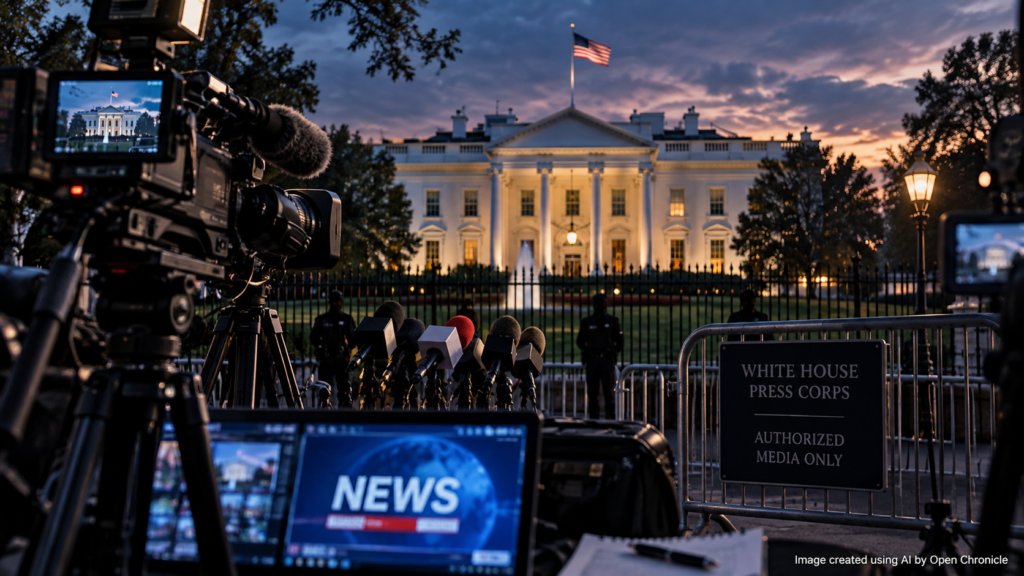
By Open Chronicle with agencies
CNN, MS NOW and Politico announced on Monday that they would take legal action against the Trump administration after their journalists were barred from the White House, escalating a dispute over press access and constitutional protections for news organisations in the United States.
The three outlets said in a joint statement that they were filing a lawsuit following President Donald Trump’s decision last week to exclude their reporters from the presidential complex.
The dispute raises questions about the limits of presidential authority over media access and the protections afforded to journalists under the First Amendment of the US Constitution.
News organisations challenge White House restrictions
The legal action follows Trump’s announcement on Friday that CNN, MS NOW and Politico would no longer be permitted to operate inside the White House.
The president accused the organisations of publishing false information about his administration and suggested that additional media outlets could face similar restrictions.
CNN, MS NOW and Politico have rejected the administration’s position and maintain that their journalists have a constitutional right to report on the federal government without interference based on the content of their coverage.
The dispute has also affected the White House press pool, the rotating group of journalists responsible for providing coverage of presidential activities to other news organisations.
CNN had been scheduled to serve as the White House television pool on Monday, an assignment that would have allowed its crew to record presidential events on behalf of other broadcasters.
However, updated White House media guidance issued late Sunday listed a backup television crew instead.
The change illustrates the immediate consequences of the restrictions for news organisations seeking to cover the administration.
Trump defends ban and intensifies criticism of the media
Trump defended his decision on Monday, arguing that the administration was not targeting press freedom but responding to what he described as deliberately misleading reporting.
In a social media post, the president accused certain news organisations of spreading false information and characterised their reporting as a threat to national security.
He described the media outlets he was targeting as a problem that had grown like cancer and called for action to stop what he considered misleading coverage.
Trump did not provide specific examples of reporting that prompted the restrictions or explain how the three organisations’ activities constituted a national security threat.
His comments followed Friday’s announcement, when he argued that news outlets should not be permitted to repeatedly publish what he described as fiction and lies about the president, his administration or the United States.
The president also warned that other media organisations could face similar restrictions, although he did not identify any additional outlets.
A longstanding confrontation with the American press
The latest dispute follows years of tensions between Trump and major US news organisations.
During his first administration, Trump repeatedly criticised journalists and media companies whose reporting challenged his statements or policies.
In 2017, he described certain news organisations as enemies of the American people, a characterisation that prompted criticism from press freedom advocates.
His administration also became involved in disputes over access to presidential events and the credentials issued to White House correspondents.
In November 2018, CNN journalist Jim Acosta had his White House press credentials restored following a legal challenge over the administration’s decision to revoke his access.
More recently, the Trump administration faced litigation over restrictions imposed on the Associated Press, raising additional questions about the government’s authority to determine which news organisations can attend presidential events.
The latest action against CNN, MS NOW and Politico extends that dispute to three major news organisations simultaneously.
Press freedom and presidential authority at the centre of legal battle
The lawsuit is expected to focus on whether the administration can exclude journalists from White House reporting activities because of the content of their coverage.
The First Amendment protects freedom of speech and the press, but access to particular government facilities and presidential events is also subject to security and administrative rules.
The central legal question is whether the restrictions constitute a permissible exercise of the administration’s authority over White House access or an unconstitutional response to reporting that the president considers unfavourable.
CNN and Politico have previously argued that government officials cannot use press credentials as a means of punishing journalists for their editorial decisions.
The administration, meanwhile, maintains that its actions are directed against what Trump considers inaccurate reporting rather than legitimate journalism.
The courts will now be asked to examine the legal basis for the restrictions and determine whether the administration’s decisions are consistent with constitutional protections.
A dispute with implications beyond the White House
The confrontation comes at a time when relations between the Trump administration and several major American news organisations remain strained.
For journalists covering the presidency, access to the White House is an important part of reporting on government decisions, public statements and presidential activities.
Restrictions on that access can affect the ability of news organisations to gather information directly and provide independent coverage of the administration.
The legal challenge brought by CNN, MS NOW and Politico could therefore have implications beyond the three organisations involved, particularly regarding the rules governing access to presidential events and the treatment of journalists whose reporting is criticised by government officials.
For now, the three outlets have indicated that they intend to continue covering the White House while pursuing their legal challenge.
The administration has not announced whether additional news organisations will face similar restrictions.
The outcome of the dispute will depend on the courts’ examination of the administration’s actions and the constitutional protections applicable to journalists covering the US presidency.