
By Open Chronicle with agencies
Switzerland’s Federal Intelligence Service (FIS) has largely addressed security shortcomings identified in its former cyber division following a series of investigations into alleged data leaks, unauthorised information transfers and the deletion of intelligence records.
The Swiss defence ministry said the incidents had been sufficiently clarified through internal and external investigations, while recommendations designed to prevent similar problems had generally been implemented.
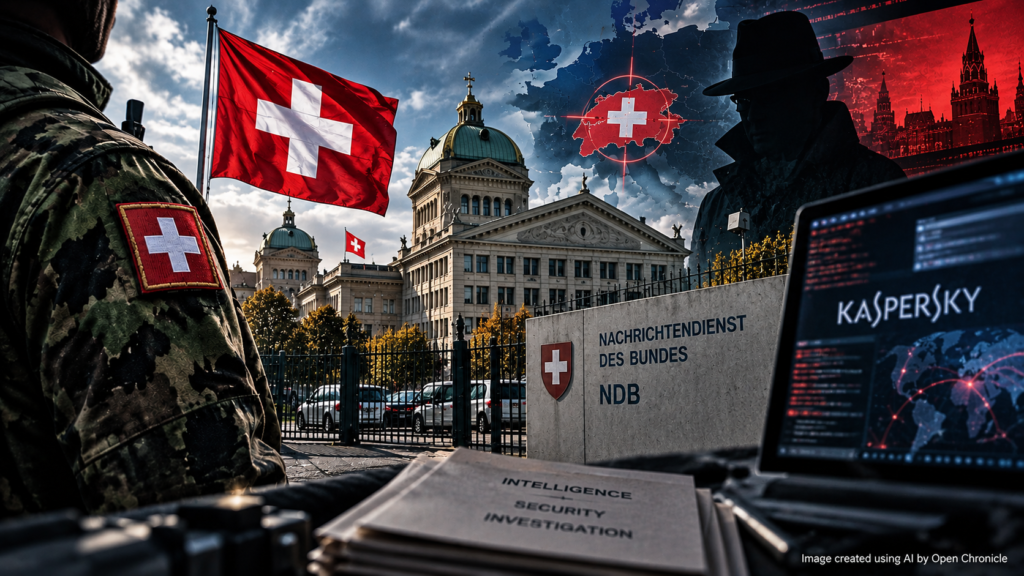
However, allegations involving possible transfers of sensitive intelligence data through the Russian cybersecurity company Kaspersky remain unresolved and are now the subject of a criminal investigation.
Investigations examine years of security concerns
The former cyber division of the Federal Intelligence Service had faced a series of incidents and allegations dating back to 2001, raising questions about the handling of sensitive information and the effectiveness of internal security procedures.
Among the most serious concerns were allegations that FIS data had been transferred illegally through Kaspersky to Russian intelligence services.
The division also faced accusations involving the deletion of intelligence records, prompting questions about whether information had been deliberately removed and whether existing safeguards were sufficient to protect sensitive material.
To establish what had happened, Swiss authorities conducted one internal investigation, two external inquiries and an additional audit by the intelligence supervisory authority.
According to the defence ministry, the investigations have now provided sufficient clarification of the incidents examined.
The authorities also reported that investigators found no evidence of large scale deletion of intelligence data.
That finding addresses one of the concerns raised during the investigations, although it does not resolve the separate allegations concerning possible unauthorised transfers of information.
Security recommendations largely implemented
Following the investigations, the Federal Intelligence Service introduced measures intended to address the weaknesses identified in its former cyber division.
The defence ministry said recommendations from previous reports had been implemented in principle, indicating that the intelligence service had made substantial progress in strengthening its internal procedures.
The measures are intended to reduce the risk of similar incidents occurring in the future and improve the protection of sensitive intelligence information.
However, the ministry’s assessment does not mean that every aspect of the case has been resolved.
While the administrative investigations have clarified the circumstances surrounding several incidents, the allegations involving potential cooperation with Russian intelligence remain subject to separate legal proceedings.
Alleged Kaspersky connection remains under criminal investigation
The most sensitive unresolved issue concerns allegations that intelligence data may have been transferred through Kaspersky to Russian intelligence services.
The claims have raised questions about the possible exposure of confidential Swiss intelligence information and the security risks associated with external cybersecurity providers.
Swiss authorities have referred the matter to the police, and the Office of the Attorney General is conducting an investigation.
The existence of the investigation does not establish that Kaspersky facilitated unlawful transfers or that Russian intelligence services received the information.
The allegations remain unproven, and the authorities have not announced a final determination concerning the suspected transfers.
The defence ministry’s latest assessment therefore distinguishes between the security and administrative issues that have been addressed and the allegations that remain under criminal investigation.
Intelligence security remains under scrutiny
The case highlights the challenges intelligence agencies face in protecting sensitive information while relying on increasingly complex digital systems and cybersecurity technologies.
For Switzerland, the investigations have also raised questions about internal oversight, the management of intelligence records and the safeguards governing the use of external technology providers.
The defence ministry’s announcement indicates that the Federal Intelligence Service has made progress in addressing the shortcomings identified by investigators.
Nevertheless, the unresolved allegations concerning possible data transfers to Russian intelligence services remain a separate issue.
The Office of the Attorney General’s investigation will be central to determining whether any criminal offences occurred and whether further legal action is warranted.
Until those proceedings are concluded, the full circumstances surrounding the alleged intelligence data transfers remain uncertain.
The Swiss authorities have not provided a timetable for the completion of the criminal investigation.