
By Open Chronicle with agencies
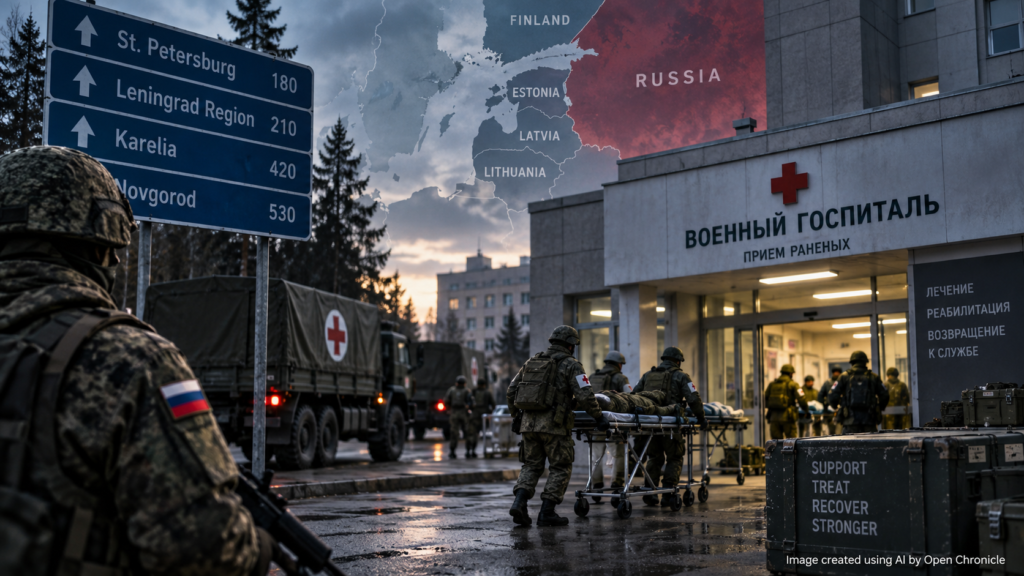
Russia is reportedly preparing to allocate between 16,000 and 20,000 additional hospital beds for wounded military personnel in civilian medical facilities during autumn 2026, with much of the expansion concentrated in the country’s northwestern regions near the Baltic states.
The reported plans, disclosed by the Russian Telegram channel Volya and detailed by the independent news project Vot Tak, would significantly increase the medical capacity available to Russia’s armed forces as the war in Ukraine continues to place pressure on military hospitals.
While some sources attribute the expansion to the growing number of wounded soldiers and the need to relieve overcrowded medical facilities, others suggest that the geographical concentration of the additional beds could reflect preparations for military operations beyond the current Ukrainian battlefield.
There is, however, no independently verified evidence that the hospital expansion represents a decision by Moscow to launch military operations against NATO members or the Baltic states.
Civilian hospitals to provide thousands of additional beds
According to Volya, Russia’s Ministry of Defence plans to increase the number of beds available for wounded military personnel by between 16,000 and 20,000 through the use of civilian healthcare infrastructure.
The expansion is expected to focus primarily on Karelia, St. Petersburg, the Leningrad region and the Novgorod region, all located within Russia’s Northwestern Federal District.
Additional capacity is also reportedly being prepared in the Moscow and Smolensk regions, which belong to the Central Federal District.
The reported expansion follows several years of increasing pressure on Russia’s military healthcare system, which has struggled to accommodate wounded personnel since the full-scale invasion of Ukraine in February 2022.
According to the sources cited by Volya, military authorities have increasingly relied on civilian hospitals, including maternity hospitals and specialised medical facilities, to treat injured service members.
Some civilian facilities have reportedly been converted entirely for military use. Others have allocated individual departments to wounded soldiers while continuing to provide medical care to civilian patients.
The planned expansion would represent a substantial increase in the number of hospital beds available to military personnel without requiring the construction of an equivalent number of dedicated military hospitals.
Military hospitals struggle with overcrowding
Russia’s existing military medical infrastructure has reportedly been operating under considerable pressure since the beginning of the war.
According to figures published by Vot Tak, Russia had 431 medical facilities serving military personnel in 2021, providing more than 52,000 hospital beds.
By 2026, the number of beds in military medical facilities had reportedly increased to at least 58,300.
Despite this expansion, available capacity has remained insufficient to meet demand.
The situation at the S. M. Kirov Military Medical Academy in St. Petersburg illustrates the reported scale of the problem.
An anaesthesiologist at the academy, speaking anonymously to Vot Tak, said that one department designed to accommodate 40 patients was treating as many as 86 simultaneously.
According to the medical worker, additional beds had been installed in corridors, while mattresses were being placed in hospital rooms to accommodate patients when conventional beds were unavailable.
The source also reported shortages of available beds at other hospitals in St. Petersburg and across Russia.
These accounts have not been independently verified, but they suggest that the reported expansion of civilian hospital capacity may be intended, at least in part, to address existing pressure on military healthcare services.
Planned expansion exceeds previous military hospital growth
The scale of the proposed expansion is notable when compared with the increase in dedicated military hospital capacity over the previous five years.
Between 2021 and 2026, Russia reportedly added approximately 6,300 beds to its military medical system.
The proposed allocation of between 16,000 and 20,000 beds in civilian hospitals would therefore represent approximately 2.5 to 3.2 times the number of additional beds introduced during that five-year period.
According to Volya, Russia also planned to complete six new military hospitals in 2026, four in the European part of the country and two in the Far East.
The channel reported that construction of all six facilities had been completed and that five were already operational.
Even with the additional hospitals, Russia’s military medical infrastructure reportedly remains under pressure from the continuing treatment and rehabilitation needs of wounded personnel.
The proposed use of civilian hospitals would allow the authorities to expand capacity more rapidly by relying on existing medical buildings, equipment and healthcare personnel.
Why is Russia concentrating additional capacity in the northwest?
The geographical distribution of the reported expansion has prompted differing interpretations among the sources cited by Volya.
One source argued that the choice of regions primarily reflects the availability of established medical infrastructure.
St. Petersburg is a major centre of Russian military medicine and has one of the country’s most developed civilian healthcare systems.
The source also noted that medical facilities in regions bordering Ukraine have already been placed under considerable pressure by the treatment of wounded military personnel.
According to this explanation, expanding capacity in St. Petersburg and other regions with established healthcare infrastructure would allow Russia to accommodate additional patients without relying exclusively on hospitals closer to the Ukrainian battlefield.
However, two other sources cited by the channel questioned whether healthcare capacity alone could explain the geographical distribution.
They suggested that the location of the additional beds might also reflect military planning considerations.
One source noted that wounded personnel are generally transported to the nearest accessible medical facilities, meaning that the positioning of medical infrastructure can provide information about the geographical areas in which military operations may be anticipated.
Under this interpretation, the concentration of additional hospital capacity in northwestern Russia could indicate preparations for contingencies beyond the current front lines in Ukraine.
These assessments remain speculative. The reported hospital expansion does not, by itself, establish that Russia intends to open another military front.
Proximity to the Baltic states raises questions
Several of the regions identified in the reported plans are situated near NATO territory.
The Leningrad region borders Estonia, while Karelia shares a border with Finland, which joined NATO in April 2023.
St. Petersburg is also located near the eastern Baltic Sea, an area of strategic importance to Russia and NATO.
The geographical proximity of the planned medical expansion to alliance territory has led some of the sources cited by Volya to question whether the additional capacity could support potential military operations in a new direction.
One Russian serviceman told the channel that information concerning the treatment of military personnel has been subject to strict secrecy since 2014 because medical infrastructure and casualty figures can reveal information about military planning.
The serviceman suggested that the conversion of civilian hospitals in western Russia could indicate preparations for operations outside the existing Ukrainian theatre.
However, medical infrastructure can serve several purposes, including the treatment of casualties from ongoing operations, long-term rehabilitation, emergency preparedness and the development of reserve capacity.
The location of additional hospital beds is therefore insufficient evidence to determine Russia’s operational intentions.
No independently verified information presented in the reports establishes a direct connection between the planned expansion and a specific Russian military operation against another country.
Medical preparations and the lessons of 2022
The expansion of military medical infrastructure can be an important component of preparations for large-scale military operations.
Before Russia’s full-scale invasion of Ukraine in February 2022, observers identified the deployment of field hospitals and the establishment of blood supplies among the logistical preparations accompanying the concentration of Russian forces near Ukraine.
Such preparations can indicate that military planners are anticipating the possibility of substantial casualties.
However, the circumstances surrounding the reported hospital expansion in 2026 differ from those preceding the invasion.
Russia is already engaged in a prolonged war that has generated substantial demand for medical treatment and rehabilitation.
An increase in hospital capacity may therefore reflect the requirements of the existing conflict rather than preparations for a separate offensive.
Establishing whether the expansion has a broader operational purpose would require additional evidence, including information about troop deployments, logistical movements, military exercises and other preparations.
The reported allocation of hospital beds should consequently be considered alongside wider military developments rather than treated as a standalone indicator of an imminent operation.
Growing pressure on Russia’s healthcare system
The continued use of civilian hospitals for military purposes also raises questions about the consequences for Russia’s civilian healthcare system.
Allocating thousands of additional beds to wounded soldiers could reduce the capacity available to civilian patients, particularly in regions where hospitals are already operating close to their limits.
The extent of any such impact would depend on how the additional beds are distributed, whether existing departments are converted for military use and whether hospitals receive additional personnel and resources.
The reports do not provide sufficient information to establish how many civilian patients could be affected by the proposed expansion.
Nevertheless, the reliance on civilian facilities illustrates the continuing medical demands associated with Russia’s war in Ukraine.
If implemented in full, the reported plan would significantly increase the capacity available to treat wounded military personnel across several western Russian regions.
Whether the expansion is intended primarily to relieve existing pressure on military hospitals, provide additional reserve capacity or support broader military contingency planning remains uncertain.
For now, the reported preparations offer an indication of the scale of Russia’s military medical requirements, while the strategic significance of their geographical distribution remains open to further investigation.