
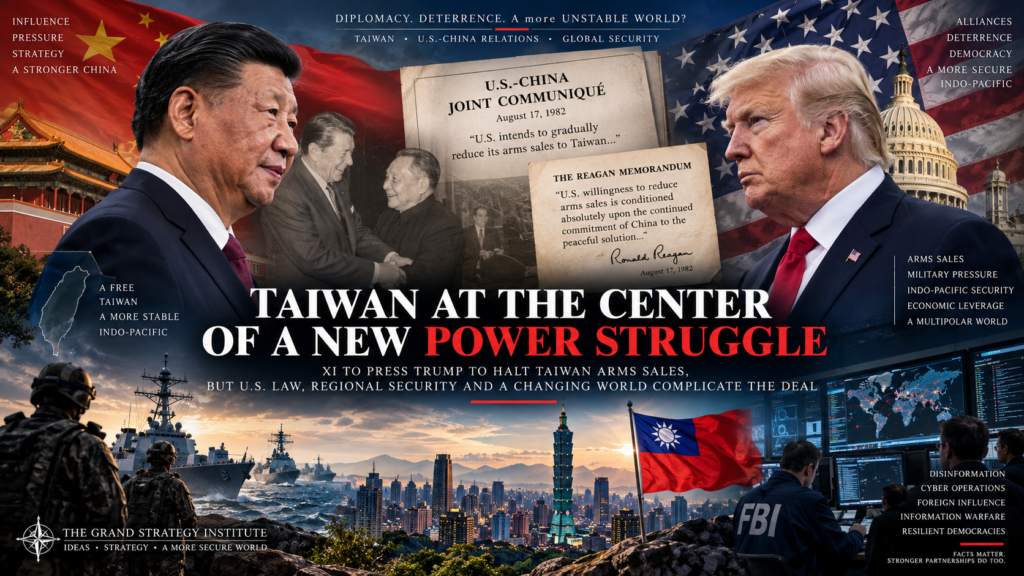
How Beijing is using diplomatic pressure, historical agreements and the wider US–China relationship to challenge Washington’s security commitments in the Indo-Pacific.
Grand Strategy Analysis | 22 September 2026
By The Grand Strategy Institute | Research Division
China’s efforts to influence American policy toward Taiwan are entering a new phase as President Xi Jinping prepares to meet US President Donald Trump in Washington. At the centre of the dispute is a question that extends beyond arms sales: who determines the security arrangements of the Taiwan Strait, and how much influence should Beijing have over Washington’s decisions concerning a democratic society of approximately 23 million people?
According to a Reuters report published on September 22, Chinese officials are expected to invoke a diplomatic agreement signed in 1982 to press Washington to halt arms sales to Taiwan. Beijing has reportedly also requested the suspension of deliveries of weapons already ordered by Taipei.
The reported Chinese position raises questions about the interpretation of American diplomatic commitments, the relationship between US law and presidential discretion, and the potential consequences of linking Taiwan’s security to negotiations over other international crises.
It also provides an opportunity to examine a broader issue: the distinction between legitimate diplomatic influence, strategic pressure and covert foreign interference.
China has a documented record of attempting to shape American political discourse, including through covert online influence operations. However, the reported negotiations over Taiwan concern overt diplomatic pressure. These are different activities, and understanding that distinction is essential to assessing Beijing’s conduct accurately.
The evidence establishes what China has requested, what American law provides and how the two governments interpret their historical agreements. It does not establish that Washington has accepted Beijing’s demands or that the outcome of the forthcoming summit has already been determined.
Xi Jinping’s visit to Washington places Taiwan alongside trade, artificial intelligence and the conflict involving Iran on the bilateral agenda.
Reuters reported on September 22 that three sources familiar with preparations for the summit expect Beijing to raise the August 17, 1982, joint communiqué on arms sales to Taiwan.
According to those sources, China wants the United States to stop approving new arms sales and suspend deliveries of equipment already purchased by Taiwan. The report also indicates that Beijing could offer cooperation on Iran as part of the wider diplomatic discussions.
These reported proposals should be distinguished from an agreement. They describe negotiating positions attributed to sources familiar with the preparations, not a confirmed bilateral settlement.
The central disagreement concerns the relationship between American arms sales and China’s stated commitment to resolving its differences with Taiwan peacefully.
Beijing regards Taiwan as part of Chinese territory and opposes foreign military support for the island. Taiwan maintains its own elected government and armed forces and rejects Beijing’s claim to govern it.
For the United States, the dispute involves both its diplomatic relationship with Beijing and its domestic legal framework governing relations with Taiwan.
The summit therefore brings together three separate questions: China’s sovereignty claim, Taiwan’s security and the authority of the American government to determine its own defence relationships.
2. The 1982 agreement: what China is asking America to accept
The agreement at the centre of the dispute was signed on August 17, 1982, during Ronald Reagan’s presidency.
Known as the Third Joint Communiqué, it addressed the unresolved issue of American arms sales to Taiwan following the establishment of formal diplomatic relations between Washington and Beijing in 1979.
The United States stated that it did not seek a permanent policy of arms sales to Taiwan and intended gradually to reduce those sales over time.
However, the agreement must be read alongside the American government’s contemporaneous interpretation of its commitments.
The Reagan memorandum
In a presidential memorandum dated August 17, 1982, Reagan clarified that American willingness to reduce arms sales depended on China’s continued commitment to resolving its differences with Taiwan peacefully.
The memorandum also established that the quality and quantity of American weapons supplied to Taiwan would be determined by the threat posed by China.
This qualification is central to the present dispute.
Beijing can invoke the communiqué’s language concerning the gradual reduction of arms sales. Washington can point to the accompanying presidential interpretation, which explicitly linked any reduction to peaceful conditions in the Taiwan Strait.
The two documents cannot be treated as though they establish an unconditional American commitment to terminate Taiwan’s access to defensive weapons.
The Six Assurances
The Reagan administration also provided Taiwan with six assurances in 1982.
Among them, Washington stated that it had not agreed to establish a date for ending arms sales, had not agreed to consult Beijing before making such sales and had not agreed to revise the Taiwan Relations Act.
The assurances also stated that the United States would not pressure Taiwan to negotiate with Beijing.
These commitments help explain why the 1982 communiqué remains contested.
China’s interpretation emphasizes the language concerning reductions in arms sales. The American interpretation incorporates the conditions attached to those reductions and the assurances provided to Taiwan.
The historical record does not support treating the 1982 communiqué as an unconditional American promise to terminate arms sales to Taiwan.
3. American law: what the Taiwan Relations Act actually requires
Section 3302 of Title 22 of the United States Code provides that the United States will make available defence articles and services in quantities necessary for Taiwan to maintain sufficient self-defence capability.
The legislation also assigns responsibility for determining Taiwan’s defence requirements to the president and Congress, based on their assessment of Taiwan’s needs.
This framework is important for understanding the distinction between diplomatic negotiations and American legal obligations.
The president has authority over foreign policy and individual arms sales decisions, subject to applicable law. However, the Taiwan Relations Act remains part of American domestic law.
A diplomatic understanding with Beijing would not, by itself, repeal that legislation.
Nor does the Act require the approval of every proposed weapons package. It establishes a continuing framework for supporting Taiwan’s self-defence, while leaving individual determinations subject to American legal and governmental procedures.
The distinction matters because delaying a particular sale, reducing certain deliveries and abandoning the statutory framework for Taiwan’s defence are not legally identical actions.
4. The arms sales dispute: confirmed decisions and reported negotiations
The scale of the current dispute can be seen in the weapons packages discussed ahead of the summit.
Reuters reports that the Trump administration approved an approximately $11 billion arms package for Taiwan in December 2025, while another package valued at approximately $14 billion has remained on hold.
According to the report, Trump previously described the delayed package as a negotiating instrument in discussions with Beijing.
The distinction between an approved sale and an actual delivery is essential.
Approval establishes that a proposed transaction has passed the relevant authorization process. It does not necessarily mean that every weapon has been manufactured, transferred or deployed.
A delayed package may affect future procurement plans, while the suspension of deliveries under existing contracts could affect equipment already ordered by Taiwan.
The two measures therefore have different operational and legal implications.
The Reuters report indicates that Beijing is seeking restrictions affecting both categories.
Whether Washington will accept either request remains unresolved as of September 22.
5. Military pressure and diplomacy: the Taiwan Strait security environment
The diplomatic dispute is taking place against a background of increased Chinese military activity around Taiwan.
Beijing has conducted major military exercises involving naval forces, aircraft and missile systems in the vicinity of the island. Chinese military operations around Taiwan have also become a frequent feature of the regional security environment.
China presents its military activities as measures connected to sovereignty, territorial integrity and opposition to Taiwanese independence.
Taiwan regards the activities as threats to its security and has continued developing its defensive capabilities.
In September 2026, Taiwan conducted military exercises integrating attack drones with conventional weapons, including missile systems, as part of its defence modernization programme.
These developments matter to the interpretation of the 1982 agreement.
Reagan’s memorandum linked American arms sales to the threat facing Taiwan and China’s continued commitment to peaceful resolution.
Consequently, assessments of the present military environment are directly relevant to determining how Washington interprets its historical commitments.
The existence of Chinese military exercises does not establish that an invasion has been ordered or that war is inevitable. It does, however, provide concrete evidence of the military conditions under which current diplomatic negotiations are taking place.
6. The Iran connection: linking separate strategic negotiations
One of the most significant elements of the Reuters report concerns the possibility that China could offer cooperation over Iran while seeking American concessions on Taiwan.
According to sources cited by the news agency, Beijing has proposed assistance in applying pressure on Iran amid the ongoing Middle Eastern conflict.
This reported linkage introduces an additional dimension to the negotiations.
China maintains important economic and diplomatic interests in the Middle East, while the United States has security commitments and military deployments across the region.
Both governments have reasons to discuss regional stability, energy supplies and the consequences of military escalation.
However, cooperation concerning Iran and restrictions on Taiwan’s defensive capabilities are separate policy questions.
An agreement on one issue would not automatically establish a legal or diplomatic obligation concerning the other.
From a strategic perspective, the reported Chinese proposal illustrates how governments can connect negotiations across different regions to increase their bargaining options.
It does not establish that Beijing has successfully secured American concessions, nor does it prove that China controls the outcome of American policy toward Iran.
The practical question is whether any eventual agreement would preserve the existing legal and diplomatic distinctions between these issues.
7. China’s documented influence operations inside the United States
The Taiwan negotiations are an example of overt diplomatic pressure. They should not be confused with covert interference.
Nevertheless, American intelligence assessments provide documented evidence of separate Chinese efforts to influence political discourse inside the United States.
The US intelligence community’s 2024 Annual Threat Assessment reported that Beijing was expanding its covert influence activities to support the objectives of the Chinese Communist Party.
The assessment identified efforts to promote narratives favourable to Beijing, challenge American policy positions and shape public discussion of issues including Taiwan, Hong Kong, Tibet and Xinjiang.
It also described Chinese efforts to exploit existing divisions within American society through online activity.
The report noted that accounts associated with a Chinese propaganda organization had targeted candidates from both major American political parties during the 2022 midterm election cycle.
These findings establish that Chinese influence activity has extended beyond traditional diplomacy.
They do not establish that Beijing controls American voters, that every political position favourable to China results from foreign interference or that the outcome of a particular election was determined by Chinese operations.
Covert online influence
A July 2024 election security assessment by the Office of the Director of National Intelligence reported that Chinese government entities had collaborated with a China-based technology company to improve covert online influence operations.
The reported objective included creating content that could connect more effectively with local audiences.
This demonstrates a specific method of foreign influence: producing or distributing political content while concealing the role of the foreign actor.
The distinction between covert influence and ordinary public debate is important.
An American citizen can independently support closer relations with China, oppose arms sales to Taiwan or criticize American foreign policy without acting on behalf of Beijing.
Evidence of foreign interference requires more than agreement with a foreign government’s preferred position. It requires evidence concerning conduct, coordination, direction, funding, concealment or other relevant links.
Influence does not mean control
The intelligence assessments establish the existence of Chinese influence operations and identify their reported objectives.
They do not establish that those operations have achieved all their intended results.
Nor do they demonstrate that a particular American presidential decision is the product of Chinese covert activity.
In the present case, Reuters describes diplomatic negotiations between two governments. No evidence in the cited reporting establishes that Trump’s decisions concerning Taiwan have been directed through a covert Chinese influence operation.
Maintaining this distinction is necessary for an evidence-based understanding of foreign interference.
8. Taiwan’s position: a third party with its own interests
The relationship between Washington and Beijing is not the only relevant consideration.
Taiwan has its own elected government, defence institutions, economic interests and political priorities.
Although the United States does not maintain formal diplomatic relations with Taipei, it continues to maintain unofficial relations and provide defensive equipment under the Taiwan Relations Act.
Taiwan’s government rejects Beijing’s claim to exercise sovereignty over the island and maintains that its future should not be determined unilaterally by China.
Beijing, by contrast, considers Taiwan a sovereignty issue and opposes international actions it regards as supporting Taiwanese independence.
These positions explain why arms sales are more than a commercial transaction.
For Taipei, they concern military preparedness and the ability to respond to potential threats.
For Beijing, they concern sovereignty and foreign involvement in a territory it claims.
For Washington, they concern domestic law, regional security and relations with both sides.
A bilateral agreement between the United States and China would therefore have implications for a population whose government is not a party to the Washington summit.
That fact is relevant to assessing both the diplomatic legitimacy and the practical consequences of any eventual arrangement.
9. The wider strategic question: American commitments and regional security
The Taiwan dispute also has implications for the wider security environment in the Indo-Pacific.
American relations with Japan, South Korea, Australia and the Philippines involve distinct security arrangements and commitments.
Taiwan’s relationship with Washington differs from those formal treaty alliances.
Nevertheless, decisions concerning Taiwan can influence how regional governments interpret American security policy, particularly when those decisions occur during negotiations with China.
The implications depend on the substance of any agreement, the explanations provided by Washington and the responses of the governments concerned.
It would be speculative to conclude that delaying one arms package necessarily means the United States is abandoning its regional commitments.
It would be equally premature to assume that the forthcoming summit will leave every aspect of American policy unchanged.
The relevant evidence will be found in actual decisions, official statements, legislative actions and changes to military cooperation or weapons deliveries.
The broader strategic issue is how Washington balances relations with Beijing against its existing commitments and the security interests of other regional governments.
10. What the evidence establishes
The available evidence supports several conclusions about the present dispute.
First, China is seeking changes to American arms sales policy toward Taiwan, according to Reuters reporting based on sources familiar with preparations for the September 2026 summit.
Second, the 1982 communiqué includes language concerning reductions in arms sales, but the Reagan administration expressly conditioned those reductions on China’s continued commitment to peaceful resolution.
Third, the Taiwan Relations Act remains part of American law and establishes a framework for providing Taiwan with defensive equipment and services.
Fourth, American intelligence assessments have documented Chinese covert influence operations targeting US political discourse. Those findings concern a separate category of activity from the overt diplomatic negotiations now taking place in Washington.
Finally, the available reporting does not establish that China has secured the concessions it seeks or that an agreement on Taiwan has been reached.
These distinctions are necessary to understand both the extent of Chinese influence and the limits of what the current evidence demonstrates.
Strategic assessment: the boundary between diplomacy and foreign interference
The central question raised by the forthcoming summit is not whether China is entitled to express its position on Taiwan. Governments routinely seek to influence one another through diplomacy.
The more consequential questions concern the methods employed, the legal commitments involved and the consequences of any negotiated agreement.
Beijing’s reported requests are identifiable diplomatic positions. Its historical interpretation of the 1982 communiqué can be examined against the original document and the Reagan administration’s accompanying statements.
Its separate covert influence activities can be assessed using the findings of American intelligence agencies.
These are different forms of state conduct and should be evaluated using the evidence appropriate to each.
For the United States, the Taiwan dispute involves decisions that must be made within its own legal framework and in light of its diplomatic and security commitments.
For Taiwan, the consequences concern its defensive capabilities and its relationship with two major powers.
For China, the issue remains central to its sovereignty claims and its relationship with Washington.
The September summit will provide an opportunity to observe how these competing positions are addressed. Until concrete decisions are announced, claims about the outcome remain premature.
The fundamental distinction is between China’s documented efforts to influence American policy and the separate question of whether American institutions ultimately adopt the policies Beijing is seeking.
Understanding that distinction allows the public to evaluate the evidence without confusing diplomatic negotiation, covert interference and independent American political decision-making.
The Grand Strategy Institute
Continue Exploring Strategic Analysis
Return to The Grand Strategy Institute for strategic assessments, long-form analysis and research examining geopolitics, military affairs, international security, emerging technologies and the changing international order.
← Back to The Grand Strategy Institute