
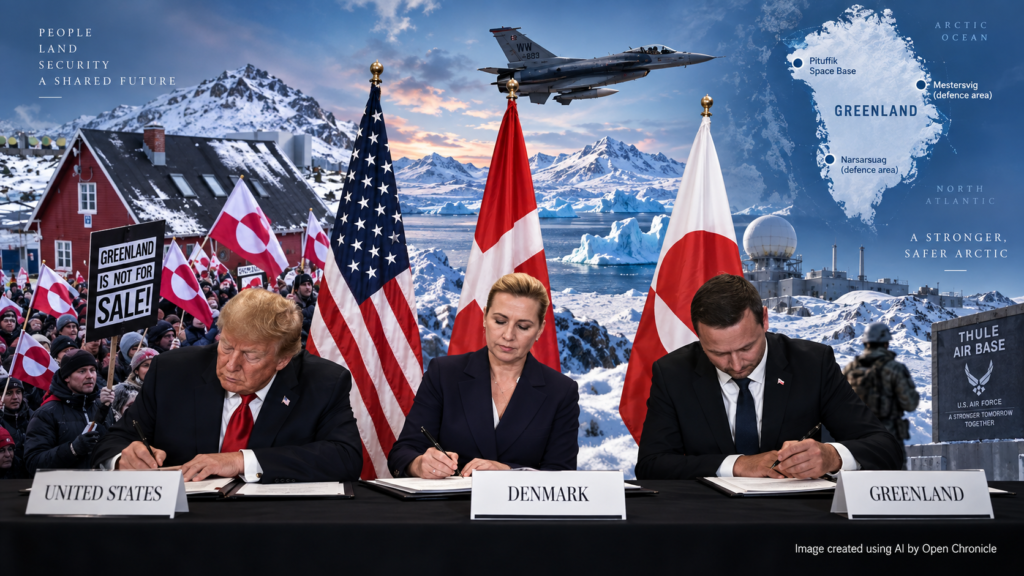
The agreement, signed on the sidelines of the United Nations General Assembly, allows the United States to expand its military facilities in Greenland while maintaining Danish sovereignty over the territory. The accord also establishes security arrangements that would remain in place if Greenland eventually chooses independence.
By Open Chronicle with agencies
NEW YORK, September 22, 2026. US President Donald Trump signed a security agreement with Denmark and Greenland on Tuesday aimed at strengthening American military capabilities in the Arctic and North Atlantic, following months of diplomatic tensions over his repeated calls for the United States to acquire the strategically important island.
The agreement, signed on the sidelines of the United Nations General Assembly in New York, provides for an expanded American military presence in Greenland while maintaining the territory’s existing constitutional relationship with Denmark.
The accord follows months of negotiations between Washington, Copenhagen and Nuuk, during which officials sought to reconcile American security concerns with Greenland’s right to self-determination and Denmark’s sovereignty.
Speaking shortly before the signing ceremony, Trump welcomed the agreement as a significant development for transatlantic security.
“This is tremendous for Europe and for the United States and for everybody,” the president said. “And for Greenland, it’s going to be incredible.”
The agreement comes after a prolonged diplomatic dispute that unsettled relations between Washington and several European allies.
Although the new arrangement addresses American military requirements without transferring Greenland to US control, Trump did not respond to questions about whether he had definitively abandoned his ambition to acquire the island.
An agreement designed to strengthen Arctic security
Under the terms of the accord, the United States will be permitted to modernise and expand its existing military activities at Pituffik Space Base in northwestern Greenland.
The agreement also allows Washington to establish additional defence areas at Narsarsuaq in southern Greenland and Mestersvig in the east.
Further military facilities may be developed under the framework established by the three governments.
Addressing the United Nations General Assembly before the signing ceremony, Trump announced plans to expand American military infrastructure on the island.
He said the United States would immediately begin developing a larger military presence at appropriate locations, including the construction of two major military bases.
The agreement provides for extensive American military mobility across Greenland, including access to its surrounding waters and undersea areas.
The signatories identify the defence of Greenland, the wider NATO area and the North American continent as shared security objectives.
The accord also refers to the potential role of Greenland in Golden Dome, the missile defence system proposed by the Trump administration.
Danish Prime Minister Mette Frederiksen said that no final decisions had been made concerning Greenland’s specific participation in the proposed system.
Greenland’s strategic importance in a changing Arctic
Greenland occupies a geographically significant position between North America and Europe, making it an important location for military surveillance, missile warning and transatlantic defence.
Approximately two-thirds of the island lies within the Arctic Circle.
Its location provides access to the North Atlantic and Arctic regions, where changing environmental conditions and the reduction of sea ice are increasing interest in maritime routes and natural resources.
Greenland also possesses significant mineral deposits, adding an economic dimension to international interest in the territory.
For the United States, the island has long been an important component of its northern defence arrangements.
American military forces have maintained a presence in Greenland for decades, although the scale of that presence has declined considerably since the end of the Second World War.
In 1945, the United States maintained thousands of military personnel across 17 bases and installations on the island.
Today, approximately 200 American military personnel are stationed at Pituffik Space Base.
The installation supports missile warning, missile defence and space surveillance operations for the United States and NATO.
The new agreement provides a framework for expanding that presence in response to evolving security requirements in the Arctic.
Months of tensions over Trump’s Greenland ambitions
The signing follows a period of significant diplomatic tension between Washington and Copenhagen.
Trump first publicly expressed interest in acquiring Greenland during his initial presidential term in 2019.
After returning to the White House, he renewed his calls for American control of the island, arguing that Greenland was essential to US national security.
His statements included threats to take control of the territory, prompting concern among Danish officials and Greenland’s political leadership.
Frederiksen warned that an American takeover of Greenland would have serious consequences for NATO, given that Denmark and the United States are both members of the alliance.
The dispute also raised concerns among Greenland’s approximately 56,000 inhabitants, many of whom feared that decisions about the territory’s future could be made without their consent.
European governments expressed support for Denmark and Greenland, while increasing security cooperation and military exercises in the Arctic region.
The diplomatic negotiations that followed sought to address American security objectives without changing Greenland’s sovereignty.
The resulting agreement establishes a framework for military cooperation rather than territorial acquisition.
New American defence facilities in Greenland
The accord permits the United States to modernise and expand its operations at Pituffik while establishing additional defence areas elsewhere on the island.
Narsarsuaq, in southern Greenland, and Mestersvig, in the east, are specifically identified as potential locations for American military facilities.
The agreement also allows additional defence areas to be established in the future.
These provisions give Washington greater flexibility to develop military infrastructure across Greenland, subject to the arrangements established by the three governments.
The accord includes economic provisions intended to ensure that Greenland benefits from the expansion of American military activities.
Washington is expected to award contracts for goods and services associated with the establishment, maintenance and dismantling of military facilities to Greenlandic suppliers to the maximum extent possible.
The provision is intended to create opportunities for local businesses and workers as American military infrastructure expands.
The agreement also establishes restrictions on the military presence of countries outside NATO.
Non-NATO states will not be permitted to establish manned or unmanned military installations in Greenland or maintain a persistent military presence without the agreement of the signatories.
The restrictions reflect concerns among NATO members about the strategic activities of Russia and China in the Arctic.
The agreement will remain in force if Greenland becomes independent
One of the most significant provisions concerns Greenland’s possible future independence from Denmark.
Greenland is currently a self-governing territory within the Kingdom of Denmark, with its own government and parliament.
The island has gradually acquired greater autonomy, and the question of eventual independence remains an important issue in Greenlandic politics.
The new security agreement explicitly addresses that possibility.
According to the terms released by the three governments, the accord has no fixed expiration date and would remain in effect if Greenland eventually becomes an independent state.
Under the agreement, an independent Greenland would undertake to remain within NATO and assume Denmark’s rights and obligations under the security arrangement.
This provision is intended to preserve the continuity of American military access and transatlantic defence cooperation regardless of Greenland’s future constitutional status.
It also gives Greenland a more prominent role in determining its own security arrangements.
Denmark and Greenland welcome the accord
Frederiksen welcomed the agreement, describing it as a durable framework for cooperation between the three governments.
She said the arrangement served the interests of the United States, Greenland, Denmark and NATO.
Addressing Trump during the signing ceremony, the Danish prime minister acknowledged the importance of preventing potential adversaries from establishing a military presence close to NATO territory.
“Mr. President, you have been very clear: You don’t want adversaries to come too close,” she said. “I fully agree.”
Greenland’s Prime Minister Jens-Frederik Nielsen also welcomed the agreement, describing it as beneficial to all three parties.
“Your security is our security,” Nielsen said, “and our security is your security.”
His remarks reflected Greenland’s growing role in international discussions concerning its territory and strategic importance.
NATO Secretary-General Mark Rutte, who had been involved in efforts to ease tensions between Washington and Copenhagen earlier in the year, also welcomed the signing.
In a message published on X, Rutte said the agreement and NATO’s growing role in Arctic security would strengthen collective defence and contribute to regional stability.
Greenland’s political representatives acknowledge lingering concerns
Despite the positive reception from government leaders, the diplomatic dispute over Greenland’s future has left lasting concerns among the island’s population.
Naaja Nathanielsen, one of Greenland’s two representatives in the Danish parliament and a former government minister in Nuuk, told The Associated Press that the confrontation had tested trust between the parties.
“A lot of trust has been tested, I would say,” she said.
Nathanielsen described the uncertainty experienced by Greenlanders during the dispute, including concerns about the possible loss of their country and the consequences for their livelihoods.
Nevertheless, she welcomed the new agreement as an important development in Greenland’s relationship with international partners.
She described it as the first binding agreement Greenland had signed as a country and a significant step towards greater autonomy and a more substantial role in decisions affecting its future.
The accord gives Greenland a formal place alongside Denmark and the United States in the new security framework.
For Greenland’s political leadership, that recognition represents an important development in the territory’s pursuit of greater international participation.
Arctic security becomes an increasingly important NATO priority
The agreement comes as NATO members devote greater attention to the security of the Arctic and North Atlantic.
Russia maintains substantial military capabilities in its Arctic territories, including naval installations, air bases and strategic infrastructure.
China has also expressed interest in Arctic shipping routes, scientific research and economic opportunities.
These developments have increased the strategic importance of Greenland’s location between North America and Europe.
For the United States, expanding military facilities on the island would strengthen surveillance capabilities and provide additional infrastructure for operations in the northern Atlantic and Arctic regions.
For Denmark and Greenland, the agreement establishes a framework for increased American defence cooperation while preserving the territory’s existing political status.
The arrangement also reflects a broader effort within NATO to strengthen its northern defence capabilities.
A diplomatic settlement after months of uncertainty
The signing marks a significant development in relations between Washington, Copenhagen and Nuuk following months of disagreement over Greenland’s future.
The agreement provides the United States with expanded military access while maintaining Danish sovereignty and recognising Greenland’s role in decisions concerning its territory.
It also establishes a framework intended to remain in place if Greenland eventually chooses independence.
However, questions remain about the scale, location and timetable of future American military construction, as well as the precise arrangements governing Greenland’s potential participation in the Golden Dome missile defence system.
The implementation of the agreement will require continued cooperation between the three governments.
Following the signing ceremony, Frederiksen expressed relief that the negotiations had produced an agreement acceptable to all parties.
“The kingdom of Denmark is in a better place than we were yesterday,” she said.
The accord closes an important chapter in the recent diplomatic dispute while establishing a new framework for American military operations in one of the world’s most strategically significant regions.
For Greenland, it also marks a further step towards a more direct role in shaping its own international security relationships.