
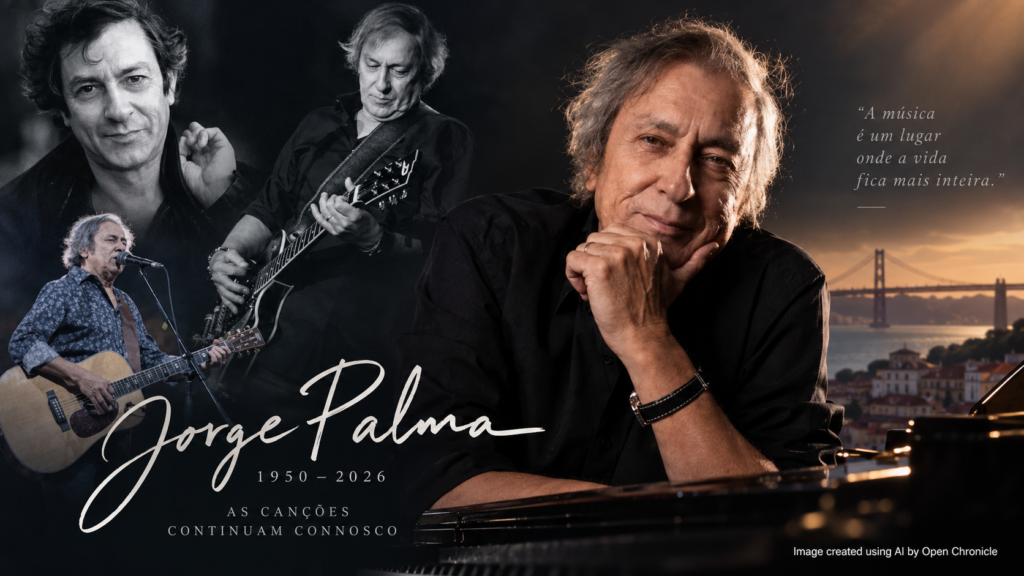
The acclaimed musician, whose songs became part of Portugal’s cultural identity, leaves behind a musical legacy spanning more than five decades.
By Open Chronicle with agencies
Portuguese singer-songwriter Jorge Palma, one of the most influential figures in contemporary Portuguese music, died on Monday night, September 21, at the age of 76, bringing to an end a career that shaped the musical landscape of Portugal for more than half a century.
His family and representatives announced his death shortly after midnight on Tuesday, confirming that the musician had suffered a cardiorespiratory arrest.
In a statement, Palma’s wife, Rita Tomé, his sons Vicente and Francisco Palma, and his representatives André Sebastião and Tiago Branco asked that he be remembered through the music and words that defined his life.
They described an artist whose musical legacy had become part of Portugal’s history and whose generosity and talent had earned him friends and admirers around the world.
For generations of Portuguese listeners, Palma was more than a celebrated songwriter. His distinctive voice, poetic lyrics and piano compositions accompanied moments of personal reflection, love and social change, establishing him as one of the country’s most recognisable musical figures.
From classical piano to Portuguese rock
Born in Lisbon in 1950, Jorge Palma demonstrated an early aptitude for music. He began studying at the age of six and entered the Lisbon Conservatory four years later, receiving a classical musical education that would remain an important influence throughout his career.
As a teenager, however, he became increasingly attracted to pop and rock, gradually moving away from the traditional classical repertoire.
His first steps into the Portuguese music scene came through several groups, including Sindicato, which performed at the inaugural Vilar de Mouros festival in 1971, an event that would become a landmark in the history of Portuguese rock music.
In 1972, Palma released his first solo single, The Nine Billion Names of God, marking the beginning of a recording career that would eventually span more than five decades.
His early life was also shaped by Portugal’s political circumstances. After being called up for military service, he left the country for Denmark, returning following the Carnation Revolution of April 25, 1974, which brought an end to decades of dictatorship.
The following year, he released his debut album, Como uma viagem na palma da mão, establishing himself as a distinctive voice in Portugal’s evolving musical landscape.
Songs that became part of Portugal’s collective memory
Over the course of his career, Palma released 14 albums of original material, developing a musical identity that combined rock, blues, folk and classical influences with deeply personal songwriting.
His compositions frequently explored love, loneliness, freedom and the contradictions of everyday life, resonating with audiences across different generations.
Among his most celebrated songs are Frágil, Bairro do Amor, Estrela do Mar, Na Terra dos Sonhos and Deixa-me Rir.
These compositions became enduring references in Portuguese popular music, helping establish Palma as a songwriter whose work transcended changing musical trends.
One of the defining moments of his career came in 1991 with the release of Só, an album in which he revisited earlier compositions accompanied only by piano.
The stripped-back arrangements placed his voice, lyrics and piano playing at the centre of the recordings, demonstrating the strength of his songwriting and his ability to communicate emotion through musical simplicity.
The album became one of the most celebrated works in his extensive discography.
Collaborations and a career of constant reinvention
Although Palma established himself primarily as a solo artist, collaboration remained an important part of his musical journey.
He formed Palma’s Gang alongside musicians associated with two influential Portuguese rock bands, Xutos & Pontapés and Rádio Macau.
The project allowed him to explore a more energetic rock sound while maintaining the distinctive songwriting style that characterised his solo recordings.
He was also a member of Rio Grande, the Portuguese supergroup that brought together several prominent musicians and songwriters.
These collaborations reflected Palma’s versatility and his ability to move between different musical environments without losing his artistic identity.
His later solo career continued to produce significant recordings, including Norte in 2004, Voo Nocturno in 2007 and Com Todo o Respeito in 2011.
In 2023, he released Vida, his final studio album, demonstrating that his commitment to songwriting remained strong well into his seventies.
A lifetime of recognition
Jorge Palma’s contribution to Portuguese music was recognised through numerous awards and official honours.
In 2002, he received the José Afonso Prize, an award recognising significant achievements in Portuguese music.
Lisbon City Council awarded him its Cultural Merit Medal in 2020, acknowledging his contribution to the cultural life of the Portuguese capital and the country as a whole.
That same year, then-President Marcelo Rebelo de Sousa appointed him a Commander of the Order of Prince Henry, one of Portugal’s national honours.
Earlier in 2026, Palma received the Career Award at the PLAY Portuguese Music Awards, recognising his decades of artistic achievement and his influence on the Portuguese music industry.
The distinction celebrated a career that had connected successive generations of musicians and listeners through songs that continued to be performed, recorded and rediscovered.
Portugal pays tribute to a musical icon
News of Palma’s death prompted tributes from across Portugal, including from political leaders and figures in the country’s cultural community.
Prime Minister Luís Montenegro was among the first to honour the musician, emphasising the lasting place of his work in Portuguese society.
Montenegro said Palma’s music would remain “in the words, the melodies and the memory of several generations”.
The tribute reflected the position Palma occupied in Portugal’s cultural life, where his compositions became familiar to audiences far beyond those who followed his recording career.
His songs accompanied several decades of Portuguese history, from the cultural transformation that followed the 1974 revolution to the emergence of new generations of musicians who drew inspiration from his work.
A musical legacy that will endure
Jorge Palma leaves behind a body of work that occupies a distinctive place in the history of Portuguese popular music.
His ability to combine the intimacy of piano-led compositions with the energy of rock music, together with his poetic approach to songwriting, helped establish a musical language that remained recognisable throughout his career.
From his earliest recordings in the 1970s to his final studio album in 2023, Palma continued to explore the relationship between music, words and personal experience.
For his family, friends and admirers, his legacy is preserved not only in the honours he received or the albums he recorded, but in the songs that continue to accompany the lives of those who listen to them.
More than five decades after the beginning of his career, Jorge Palma’s music remains an enduring part of Portugal’s cultural heritage.