
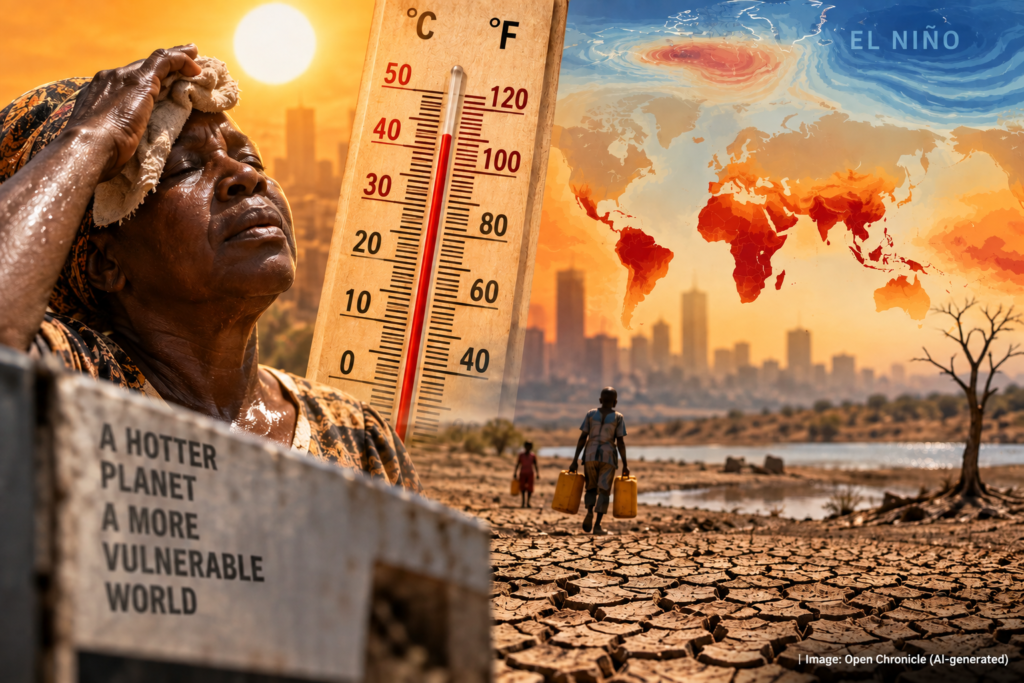
A new report from the Climate Impact Lab projects that extreme temperatures associated with the 2026 El Niño could contribute to as many as 451,000 additional deaths worldwide by February 2027, with poorer countries in Africa, Asia and Latin America expected to bear the heaviest burden.
By Open Chronicle with agencies
September 23, 2026
A powerful El Niño event, combined with rising global temperatures driven by climate change, could cause nearly half a million additional heat-related deaths worldwide by the end of February 2027, according to a research report released on Wednesday by the University of Chicago-based Climate Impact Lab.
The study estimates that as many as 451,000 additional deaths could occur between June 2026 and February 2027 as a result of unusually high temperatures associated with the climate phenomenon.
The projection compares expected heat-related mortality during the current El Niño with mortality under temperatures similar to those experienced over the previous three decades.
Researchers warn that the greatest impact is likely to be felt in developing countries, where extreme heat is compounded by limited access to air conditioning, unreliable water supplies, inadequate healthcare infrastructure and existing economic pressures.
The findings come as several regions experience severe droughts, wildfires and shrinking water resources, while the economic consequences of the war in Iran have contributed to higher energy costs and increased pressure on vulnerable populations.
Although the projected death toll represents a scenario rather than an observed number of fatalities, researchers say the findings demonstrate the potential human consequences of extreme heat and the importance of preparing before temperatures reach dangerous levels.
A global heat emergency with unequal consequences
The Climate Impact Lab’s analysis suggests that the effects of the current El Niño will be distributed unevenly across the world.
Countries already experiencing high temperatures and widespread poverty face particularly serious risks.
Michael Greenstone, a co-founder of the Climate Impact Lab and a co-author of the study, explained that additional warming can have substantially greater consequences in regions where populations are already exposed to extreme heat.
“If you’re already in a hot place, the extra couple of degrees are going to be much more dangerous,” Greenstone said.
The report highlights the importance of economic resources in determining how effectively communities can protect themselves from dangerous temperatures.
Wealthier countries generally have greater access to air conditioning, reliable electricity, clean water and healthcare services capable of responding to heat-related emergencies.
In poorer regions, many people work outdoors or live in homes that provide limited protection from high temperatures.
Agricultural workers, construction workers and people employed in informal economic activities may face prolonged exposure to dangerous heat without adequate opportunities to rest or access drinking water.
Older people, young children and individuals with existing health conditions are also particularly vulnerable.
The researchers warn that these inequalities could translate into substantial differences in mortality between countries experiencing similar temperature increases.
How researchers calculated the projected death toll
The Climate Impact Lab combined seasonal temperature forecasts with detailed estimates of how exposure to high temperatures affects mortality in more than 24,000 regions worldwide.
The researchers examined the relationship between local temperature conditions and mortality, accounting for differences in climate, economic circumstances and the ability of populations to adapt to heat.
They then compared expected deaths under the unusually high temperatures associated with the current El Niño against a baseline reflecting temperature conditions over the previous three decades.
The resulting estimate suggests that up to 451,000 additional heat-related deaths could occur globally during the nine-month period extending from June 2026 through February 2027.
The figure represents projected excess mortality associated with elevated temperatures, rather than a confirmed count of deaths directly attributed to El Niño.
It is also not a projection of all deaths that could result from droughts, wildfires, food shortages or other consequences of the climate phenomenon.
The actual number of fatalities will depend on the temperatures experienced, population exposure, public health interventions and the effectiveness of measures adopted by governments and local authorities.
The researchers emphasise that the projections can help identify regions where preventive action could reduce the human cost of extreme heat.
Africa’s Sahel region faces the greatest projected mortality
The study identifies the Sahel, the semiarid region extending across Africa along the southern edge of the Sahara Desert, as the area expected to experience the largest additional death toll.
Researchers project approximately 66,800 additional heat-related deaths in the region during the current El Niño period.
The Sahel includes countries facing overlapping challenges involving high temperatures, water scarcity, food insecurity and limited healthcare resources.
In many communities, livelihoods depend heavily on agriculture and livestock, making households particularly sensitive to changes in rainfall and temperature.
Prolonged heat can increase the risk of dehydration and heat-related illness while reducing agricultural productivity and placing additional pressure on water supplies.
The report suggests that these conditions, combined with limited access to cooling and healthcare, could make the region particularly vulnerable to the current climate event.
The projected mortality figure reflects the expected impact of extreme temperatures across the region and does not represent deaths that have already occurred.
South and Southeast Asia among the major heat hotspots
The researchers also identify South and Southeast Asia as regions facing substantial additional mortality from extreme heat.
High population densities, extensive outdoor employment and limited access to cooling in some communities contribute to the risks.
The report projects approximately 19,400 additional heat-related deaths across the Philippines, Vietnam, Thailand and Cambodia.
Indonesia is expected to experience approximately 19,300 additional deaths, while the projected figure for India is around 15,800.
In many parts of South and Southeast Asia, high temperatures can coincide with elevated humidity, making it more difficult for the human body to regulate its internal temperature through sweating.
These conditions can become particularly dangerous for people working outdoors or living in poorly ventilated buildings.
The risks are also influenced by access to electricity, water, medical treatment and reliable public information about extreme heat.
The researchers argue that targeted public health measures could substantially reduce the consequences of unusually high temperatures.
Brazil and Latin America also face elevated risks
Latin America is another region where the study anticipates significant additional heat-related mortality.
Brazil is projected to experience approximately 13,300 additional deaths during the current El Niño period.
The country’s geographical diversity means that the effects of extreme heat can vary considerably between regions.
Urban populations may experience particularly high temperatures because of the urban heat island effect, in which buildings, roads and other infrastructure absorb and retain heat.
In rural areas, agricultural workers and communities with limited access to healthcare may face different forms of exposure.
The study also identifies other parts of Latin America as potential hotspots, although the supplied findings do not provide detailed mortality projections for every country.
The researchers emphasise that local conditions, including economic development and access to protective infrastructure, play an important role in determining the consequences of unusually high temperatures.
Heat warnings and cooling centres could prevent thousands of deaths
Despite the scale of the projected mortality, the Climate Impact Lab argues that governments have opportunities to reduce the risks through preventive measures.
The report recommends strengthening heat-warning systems so that communities receive timely information before dangerous temperatures arrive.
It also calls for the establishment of cooling centres where people without access to air conditioning can seek temporary protection.
Other recommended measures include providing public hydration stations, improving access to drinking water, expanding hospital capacity and introducing additional protections for outdoor workers.
Targeted assistance for older people and individuals with existing health conditions is also identified as an important component of effective heat response plans.
The researchers emphasise that public health measures should be adapted to local circumstances, particularly in regions where financial resources and infrastructure are limited.
Measures identified in the report
Practical interventions that can help reduce exposure and heat-related mortality.
Early warning systems
Provide timely alerts about dangerous temperatures and guidance on protective measures.
Cooling centres and drinking water
Establish accessible public spaces where vulnerable residents can escape extreme heat and obtain safe drinking water.
Protections for outdoor workers
Introduce appropriate rest periods, access to shade and hydration during dangerous heat.
Healthcare preparedness
Expand emergency treatment capacity and provide targeted assistance to older people and other vulnerable groups.
Governments urged to act before temperatures peak
The report also calls for anticipatory financing, an approach that makes financial resources available before a forecast extreme weather event reaches its most dangerous stage.
Rather than waiting for heat-related emergencies to overwhelm hospitals and public services, governments could use seasonal forecasts to prepare healthcare facilities, establish cooling infrastructure and support vulnerable communities.
The approach is particularly important in developing countries, where emergency funding may be limited and administrative delays can prevent assistance from reaching communities in time.
Abhiyant Tiwari, a heat expert at NRDC India who was not involved in the study, said the projections should encourage governments to strengthen their response rather than simply generate further alarm.
He noted that India has developed heat action plans, but implementing them effectively and securing the necessary financial resources remain significant challenges.
“The real measure of our preparedness is not how many heat warnings we issue, but how effectively we protect people and reduce preventable deaths,” Tiwari said.
His remarks highlight the difference between establishing emergency procedures and ensuring that those measures reach the people most exposed to extreme temperatures.
Climate change is amplifying El Niño’s effects
El Niño is a naturally occurring climate phenomenon characterised by unusually warm sea surface temperatures in the central and eastern tropical Pacific Ocean.
The warming alters atmospheric circulation and can influence rainfall, temperature and weather patterns across large parts of the world.
Its effects vary by region, with some areas experiencing drought and unusually high temperatures while others receive increased rainfall.
The current El Niño is occurring against the background of a planet already warmed by human activities, particularly greenhouse gas emissions.
According to the Climate Impact Lab, global land temperatures during this El Niño could be approximately 1.2°C higher than the reference conditions used in its analysis.
The researchers also project that the event could produce 44% more extremely hot days than in a typical year.
These estimates suggest that the current climate event could expose populations to temperature conditions substantially different from those experienced during previous decades.
The report argues that the combination of natural climate variability and human-caused warming is an important factor in understanding the scale of the projected health risks.
El Niño itself is not caused by climate change, but its effects can occur on top of the long-term warming trend.
A possible preview of the climate conditions of the 2040s
One of the report’s central conclusions is that the unusually high temperatures associated with the current El Niño could resemble conditions that longer-term climate change may make more common in approximately 20 years.
This comparison suggests that the event could provide an indication of the challenges communities may face as global temperatures continue to rise.
The researchers argue that the present situation offers an opportunity to identify which regions are most vulnerable and which public health measures can reduce mortality.
However, the report does not establish that every region will experience identical temperature patterns or mortality outcomes two decades from now.
Future conditions will depend on greenhouse gas emissions, local climate changes, population growth, economic development and investments in adaptation.
The comparison instead highlights the importance of preparing for more frequent exposure to dangerous heat.
The danger could persist beyond February 2027
Although the current El Niño is expected to end by February 2027, researchers warn that its consequences may continue beyond the conclusion of the climate event.
Greenstone said the elevated heat risk could persist into the following summer.
Changes in ocean temperatures and atmospheric circulation can influence weather patterns after an El Niño begins to weaken.
The effects of drought, water shortages and agricultural disruption can also continue after the initial climate conditions have changed.
For vulnerable communities, these longer-term consequences may create additional economic and public health pressures.
The report therefore encourages governments to consider not only immediate emergency responses but also longer-term investments in climate adaptation and public health resilience.
A warning that could help prevent avoidable deaths
The Climate Impact Lab’s projections present a substantial public health challenge, particularly for countries already facing economic hardship, food insecurity and limited access to essential services.
The estimate of up to 451,000 additional heat-related deaths illustrates the potential consequences of unusually high temperatures during the current El Niño period.
Yet the researchers emphasise that the projected toll is not inevitable.
Effective warning systems, accessible cooling facilities, reliable drinking water, healthcare preparedness and financial support for vulnerable communities could reduce the number of deaths.
The findings also highlight the importance of addressing the unequal capacity of countries to respond to extreme heat.
As global temperatures continue to rise, investments in climate adaptation and public health infrastructure will become increasingly important for protecting populations exposed to dangerous weather conditions.
For governments confronting the current El Niño, the immediate priority identified by the report is to translate seasonal forecasts into practical measures before the most dangerous temperatures arrive.
The researchers argue that acting now could prevent tens of thousands of deaths while providing valuable lessons for managing the health consequences of a warming planet.