
OPEN CHRONICLE LIFESTYLE MAGAZINE · FEATURED STORY
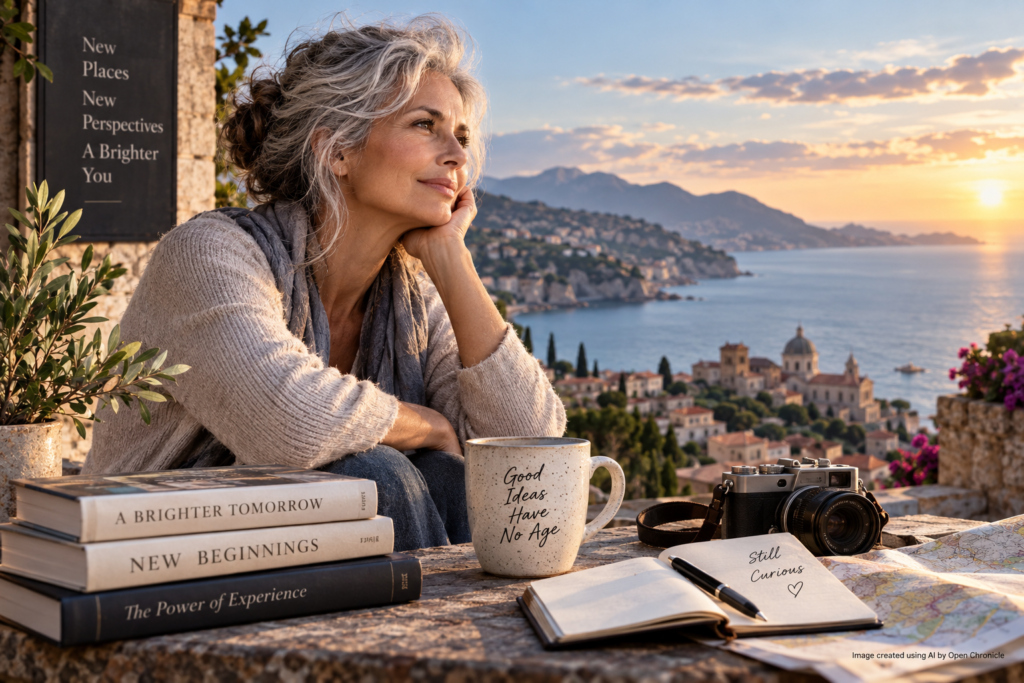
From changing beauty standards and second careers to longer lives and new definitions of success, a growing conversation about aging is challenging the idea that our most meaningful years must belong to our youth.
By Open Chronicle Lifestyle Magazine
There is a moment in life when the future begins to look different.
For some, it arrives with a milestone birthday. For others, it follows a career change, the departure of grown children, the end of a long relationship or the unexpected discovery of a new passion.
The familiar routines that once defined everyday life begin to shift. Questions that seemed settled return with new urgency. What do I want from the years ahead? What have I postponed? Who am I becoming?
For generations, growing older has often been portrayed as a gradual narrowing of possibilities. Youth was associated with discovery, ambition, beauty and adventure, while later life was frequently presented as a period of withdrawal.
That narrative is increasingly being questioned.
Longer life expectancy, changing social expectations and evolving attitudes towards work, beauty and personal identity are creating new possibilities for people in their fifties, sixties, seventies and beyond.
A growing number of public figures are challenging traditional assumptions about when careers should peak, how older people should look and what later life can contain.
Yet the changing experience of aging is about much more than celebrity success or the pursuit of eternal youth.
It is about the possibility that growing older can bring new forms of freedom, creativity, confidence and personal discovery.
It is also about recognising that the opportunities of later life are not distributed equally, and that living longer is meaningful only when societies create conditions in which people can continue to participate, contribute and live with dignity.
The new age of aging is not a promise that every decade will be better than the last.
It is an invitation to reconsider what the passing years can mean.
1. The World Is Growing Older, but Our Ideas About Aging Are Changing
The transformation of aging is not simply a cultural trend. It is also a demographic reality.
According to the World Health Organization, by 2030, one in six people worldwide will be aged 60 or older. The global population in this age group is projected to increase from approximately one billion in 2020 to 1.4 billion in 2030.
By 2050, the number of people aged 60 and over is expected to reach 2.1 billion.
The WHO also projects that the population aged 80 and over will triple between 2020 and 2050, reaching approximately 426 million.
These figures represent one of the most significant demographic transformations of the modern era.
For much of human history, reaching old age was considerably less common than it is in many societies today. Improvements in public health, sanitation, nutrition and medical care have contributed to longer lives, although substantial inequalities remain between countries and population groups.
The consequences extend far beyond healthcare and retirement systems.
An aging population changes the composition of the workforce, the structure of families, housing needs, consumer markets and the cultural expectations surrounding different stages of life.
It also challenges the assumption that adulthood follows a fixed sequence: education, employment, family formation, retirement and gradual withdrawal from public life.
For someone reaching 60 today, the years ahead may include continued employment, education, travel, caregiving, community participation or entirely new personal ambitions.
But chronological age alone tells us relatively little about a person’s capabilities, interests or circumstances.
Two people of the same age may have profoundly different experiences of health, financial security, family relationships and independence.
The WHO’s approach to healthy aging emphasises functional ability, the capacity to meet basic needs, learn, make decisions, maintain relationships and contribute to society.
This broader perspective moves the conversation beyond the number of years someone has lived.
The important question is not simply how long people can live, but what opportunities remain available to them as they grow older.
2. The End of the Invisible Woman?
Few aspects of aging reveal society’s contradictory expectations as clearly as the treatment of older women.
For decades, fashion, advertising, film and popular culture have frequently associated female beauty with youth.
Wrinkles, grey hair and other visible signs of aging have often been presented as imperfections to conceal rather than natural characteristics of a changing face.
Women have faced particular pressure to maintain a youthful appearance while simultaneously being expected to age gracefully.
The contradiction is difficult to escape: remain young, but do not appear to be trying too hard.
Today, a number of prominent women are challenging these expectations by making different choices about their appearance and public identity.
American actress Andie MacDowell has become a recognisable figure in conversations about aging and beauty.
Her decision to embrace her natural grey hair attracted considerable attention, particularly after her appearance at the 2021 Cannes Film Festival.
Rather than treating the change as something to hide, MacDowell has spoken about feeling comfortable with her appearance and rejecting the expectation that women must preserve a youthful image indefinitely.
Her example is significant not because every woman should make the same choice, but because it illustrates the importance of having that choice.
For some women, embracing grey hair represents freedom from social expectations. For others, colouring their hair, experimenting with fashion or pursuing cosmetic treatments may be equally valid expressions of personal identity.
The issue is not whether one appearance is more authentic than another.
It is whether women can make decisions about their bodies without being judged against a narrow definition of what aging should look like.
The broader cultural conversation is also about visibility.
Older women have often been underrepresented in industries that shape public perceptions of beauty, desirability and success.
When women in their sixties, seventies and beyond remain visible as artists, professionals, public figures and individuals with their own ambitions, they challenge the idea that female identity must diminish with age.
Growing older does not require becoming invisible.
Nor does it require looking younger than one’s years to remain relevant.
3. Reinvention Has No Expiration Date
The idea that people must establish their identity and professional direction early in adulthood has long influenced how success is understood.
Education is expected to lead to a career. A career is expected to progress along a relatively predictable path. By middle age, a person’s professional and personal identity is often assumed to be firmly established.
But lives rarely follow such a simple trajectory.
Economic changes, technological developments, family responsibilities and personal circumstances can reshape careers and ambitions at almost any age.
For some people, later life offers an opportunity to pursue interests that were previously constrained by financial obligations or caregiving responsibilities.
Others find themselves needing to adapt because of redundancy, illness, divorce or changes in the labour market.
Reinvention can therefore be both an opportunity and a necessity.
One of the most recognisable examples of late career transformation is American fashion designer Vera Wang.
Before establishing her bridal fashion business, Wang worked as a fashion editor at Vogue and later as a design director at Ralph Lauren.
She opened her first bridal boutique in New York in 1990, when she was 40 years old.
Her subsequent career demonstrates that professional achievement does not have to follow a single timetable.
Of course, Wang’s circumstances, industry connections and access to resources distinguish her experience from that of many people considering a career change.
Her story should not be interpreted as proof that anyone can achieve similar success simply by starting again.
Instead, it illustrates a more modest but important point: a person’s professional identity does not necessarily become fixed at a particular age.
The same principle applies beyond high-profile careers.
Someone might return to education after raising children, develop a small business after retirement or discover a creative interest that becomes an important part of daily life.
Others may choose to reduce professional commitments rather than expand them.
Reinvention does not always mean achieving more.
Sometimes, it means deciding that the ambitions which once defined us no longer reflect the lives we want to lead.
4. The Hidden Barriers to Starting Again
Stories of successful reinvention can be inspiring, but they rarely capture the full complexity of growing older.
Not everyone has the financial security to leave an unsatisfying job, return to university or establish a business.
For some, later life brings increased responsibilities rather than greater freedom. Caring for an aging parent, supporting adult children or managing a chronic health condition can significantly limit the time and resources available for personal ambitions.
Age discrimination can also restrict professional opportunities.
The World Health Organization defines ageism as stereotypes, prejudice and discrimination directed towards people because of their age.
Its 2021 Global Report on Ageism found that age-related discrimination can affect employment, healthcare, social participation and individual wellbeing.
These barriers are particularly important when discussing the possibility of changing careers later in life.
An experienced professional may possess decades of valuable knowledge but still encounter assumptions about adaptability, technological competence or willingness to learn.
The OECD’s Employment Outlook 2025 identifies lifelong learning, age-inclusive recruitment and access to professional development as important elements of supporting older workers.
Its analysis found that, across the countries covered, approximately one-third of adults aged 60 to 65 participated in training in 2023, compared with more than half of those aged 25 to 44.
The figures demonstrate why the conversation about reinvention must extend beyond individual motivation.
People need access to education, appropriate working conditions, financial security and opportunities to develop new skills throughout their lives.
The possibility of a new beginning should not depend entirely on exceptional wealth, professional connections or extraordinary personal circumstances.
A society that celebrates successful older entrepreneurs while excluding other older adults from employment and education has not fully embraced the potential of longer lives.
The new age of aging requires more than inspirational stories.
It requires institutions and communities that recognise the continuing abilities, aspirations and contributions of people at different stages of life.
5. Beauty Beyond Youth: A New Relationship With the Mirror
Growing older changes the body.
Skin loses some of its elasticity, hair may turn grey, physical capabilities can change and familiar features gradually acquire new characteristics.
These changes are natural, although their timing and extent vary considerably between individuals.
Yet modern beauty culture frequently treats the visible signs of aging as problems to solve.
Advertisements promise to reverse time, restore youth or eliminate the evidence of passing years.
Social media adds another dimension, allowing images to be filtered, retouched and presented according to increasingly narrow visual standards.
For people comparing themselves with these images, the distinction between natural appearance and digital alteration can become difficult to maintain.
The challenge is not that individuals should stop caring about how they look.
Personal appearance can be an important expression of creativity, identity and confidence throughout life.
The question is whether beauty must remain permanently associated with looking younger.
British actress Helen Mirren has maintained a prominent public career across several decades, appearing in major film and television productions while challenging conventional expectations about the visibility of older women in entertainment.
Her continued presence illustrates how experience, personal style and professional achievement can remain culturally relevant beyond the ages traditionally emphasised in fashion and popular media.
The wider conversation also concerns the language we use.
Complimenting an older person for looking younger than their age may seem harmless, but it can reinforce the assumption that youth is the standard against which appearance should be judged.
Similarly, describing someone as aging well solely because they show few visible signs of age reduces a complex human experience to a question of appearance.
A more inclusive understanding of beauty would recognise that people can remain attractive, stylish and expressive without appearing younger than they are.
It would also acknowledge that people should not have to maintain a particular appearance to deserve respect or visibility.
Aging does not erase individuality.
The face that looks back at us in later life carries the history of our experiences, relationships and choices.
Those changes need not be understood only as evidence of something lost.
They can also be part of the identity we continue to develop.
6. The Second Act: When Experience Becomes an Advantage
Youth offers possibilities associated with discovery, experimentation and the freedom to explore unfamiliar paths.
Later life can offer a different set of resources.
Professional experience, accumulated knowledge, established relationships and a clearer understanding of personal priorities may help some people make decisions that would have been more difficult earlier in adulthood.
These advantages are not automatic.
Experience does not eliminate uncertainty, and growing older does not guarantee wisdom or confidence.
Nevertheless, the accumulation of knowledge and the opportunity to reconsider earlier choices can provide a foundation for new ambitions.
A person who spent decades working in finance may discover an interest in photography.
A former teacher may become involved in community theatre.
Someone who devoted much of adulthood to family responsibilities may finally find time to pursue an academic qualification or develop a creative project.
Such changes need not result in public recognition or financial success to be meaningful.
Sometimes, the value of a second act lies in the opportunity to explore a different part of one’s identity.
This is particularly relevant in a world where traditional career structures are changing.
Longer working lives, technological developments and shifting economic conditions mean that learning and adaptation increasingly extend beyond the early stages of adulthood.
The OECD’s 2025 analysis of older workers highlights the importance of continued skills development and employment practices that allow people to adapt as labour markets evolve.
But the concept of a second act should not be limited to paid employment.
Retirement can provide opportunities for volunteering, mentoring, creative work, family relationships and participation in community life.
For some, the most meaningful transition is not towards another professional achievement but away from the expectation that personal worth must be measured by productivity.
A new beginning may involve doing something extraordinary.
It may also involve finally having the freedom to enjoy an ordinary life on one’s own terms.
7. Friendship, Love and the Importance of Staying Connected
The social landscape of later life can change significantly.
Children may leave home. Professional relationships may become less frequent after retirement. Friends and relatives may move away, experience illness or die.
These transitions can create new opportunities for independence, but they can also bring loneliness and uncertainty.
Maintaining meaningful relationships is therefore an important dimension of aging.
The US National Institute on Aging identifies social isolation and loneliness as factors associated with increased risks of several health problems, including depression, cardiovascular disease and cognitive decline.
It also emphasises the importance of maintaining social connections through family relationships, friendships and participation in community activities.
These findings should not be interpreted as suggesting that everyone needs a large social network.
Some people enjoy extensive social lives, while others prefer a smaller number of close relationships.
The quality of those connections matters.
A trusted friend, a supportive neighbour or regular contact with family can provide companionship and a sense of belonging.
Later life can also create opportunities for new relationships.
Friendships may develop through shared interests, educational courses, volunteering, cultural activities or local organisations.
Romantic relationships can begin or evolve at any age.
For people who have experienced divorce, separation or bereavement, the possibility of companionship may take on new meaning.
Yet the assumption that everyone must remain socially active or pursue a romantic relationship can create another unnecessary expectation.
Some people find genuine satisfaction in living alone while maintaining selected relationships and activities.
Others may need practical assistance to overcome barriers such as limited mobility, inaccessible transport or financial constraints.
The goal is not to prescribe a single model of social life.
It is to recognise that emotional connection, companionship and personal choice remain important throughout adulthood.
Growing older does not remove the human desire to be understood, appreciated or loved.
8. Living Longer Is Not the Same as Living Better
The prospect of longer lives has transformed discussions about medicine, nutrition, exercise and preventive healthcare.
Scientific research continues to examine the biological processes associated with aging and the factors that influence health in later life.
But the growing commercial interest in longevity can create unrealistic expectations.
Expensive supplements, elaborate wellness programmes and products promising to slow biological aging are increasingly marketed to people seeking to preserve their health and appearance.
Not every claim is supported by robust scientific evidence.
The distinction between extending lifespan and maintaining health and independence is particularly important.
The World Health Organization describes healthy aging in terms of developing and maintaining the functional ability that enables wellbeing in older age.
This includes the capacity to meet basic needs, move around, maintain relationships, learn, make decisions and contribute to society.
A meaningful approach to longevity therefore extends beyond the pursuit of additional years.
It includes access to healthcare, appropriate nutrition, opportunities for physical activity, social participation and environments that support independence.
For some people, maintaining mobility may be a central priority.
For others, managing a chronic condition, remaining socially connected or preserving the ability to participate in familiar activities may be more important.
The National Institute on Aging identifies physical activity, healthy habits and meaningful social engagement as important components of healthy aging.
However, health is influenced by more than personal behaviour.
Income, housing, working conditions, education, environmental factors and access to medical services all shape the opportunities available to people as they grow older.
Aging well should not become another standard used to judge those experiencing illness, disability or financial hardship.
Nor should independence be treated as the only acceptable outcome of later life.
People who require assistance or long-term care can continue to experience meaningful relationships, personal autonomy and a sense of purpose.
The value of a life does not diminish when physical capabilities change.
A more humane understanding of longevity recognises that dignity, choice and participation matter at every stage of aging.
9. The Freedom to Become Someone New
One of the most interesting possibilities of later life is the opportunity to reconsider the identities we have carried for decades.
During early adulthood, decisions are often shaped by practical necessities.
Education, employment, financial security and family responsibilities can leave limited room for experimentation.
As circumstances change, some people discover that they no longer need to organise their lives around the same expectations.
A person who once prioritised professional advancement may become more interested in relationships, creativity or community involvement.
Someone who spent years caring for others may begin exploring personal interests that were previously postponed.
Others may discover that their existing routines remain deeply satisfying and have no desire for dramatic change.
There is no obligation to reinvent oneself.
The freedom to remain who we are can be just as meaningful as the freedom to become someone different.
What matters is recognising that age does not automatically determine which ambitions, experiences or relationships remain appropriate.
Learning a new language at 65 is not an attempt to recover lost youth.
Travelling alone at 70 does not need to be described as an extraordinary act of courage.
Beginning a romantic relationship at 80 is not inherently more remarkable than doing so at 30.
These experiences are expressions of human curiosity, affection and individuality.
They become unusual only when society assumes that certain possibilities belong exclusively to younger people.
The WHO’s work on ageism highlights how age-based stereotypes can limit opportunities and influence the way people perceive themselves and others.
Challenging those assumptions does not require denying the realities of aging.
It means recognising that physical change and personal growth can occur simultaneously.
We can acknowledge the difficulties of later life without assuming that they define every older person’s experience.
We can celebrate longevity without demanding perpetual youth.
And we can recognise that the years ahead may contain experiences that we have not yet imagined.
10. A New Beginning, Not a Return to Youth
The changing conversation about aging raises a question that extends beyond individual lifestyles.
What would society look like if growing older were understood as a continuing stage of human development rather than a gradual departure from relevance?
Workplaces might place greater value on experience while ensuring that employees of different ages have opportunities to learn.
Fashion and entertainment could represent older people without requiring them to appear unusually youthful.
Cities and communities could create environments that support mobility, accessibility and participation across generations.
Healthcare systems could place greater emphasis on maintaining quality of life alongside the treatment of illness.
Families might become more attentive to the aspirations of older relatives rather than assuming that their personal ambitions have come to an end.
These changes would benefit more than the people who are already old.
A society that recognises the value of different stages of life offers younger generations a less restrictive understanding of their own futures.
It allows people to imagine adulthood not as a race towards a single moment of success, but as a continuing process of learning, adapting and discovering what matters.
The new age of aging is not about pretending that time can be reversed.
It is about questioning why the passing of time should automatically reduce the possibilities we imagine for ourselves.
There will be difficulties. Health may change, relationships may be lost and circumstances may limit our choices.
But later life can also contain affection, creativity, discovery, friendship and moments of unexpected happiness.
The challenge is to build a culture that acknowledges both realities.
Growing older should not require becoming a younger version of ourselves.
It should allow us to become more fully the people we are, with the experience of the years behind us and the freedom to consider what we might still become.
Perhaps the most important lesson of the new age of aging is that a meaningful life does not have to reach its final chapter when youth ends.
Sometimes, the next chapter is only beginning.
Open Chronicle Lifestyle Magazine
Sources and Further Reading
Explore the research, demographic evidence
and institutional publications informing
this feature on aging, longevity and
personal reinvention.
01 | Demography and Healthy Aging
World Health Organization
1 October 2025
Ageing and Health
Global population projections, the changing
age structure of societies and the importance
of maintaining functional ability in later life.
02 | Age Discrimination
World Health Organization
18 March 2021
Global Report on Ageism
A comprehensive examination of age-based
stereotypes, discrimination, their
consequences and approaches to creating
more inclusive societies.
03 | Careers and Lifelong Learning
Organisation for Economic
Co-operation and Development
2025
OECD Employment Outlook 2025
Research examining the changing labour
market, older workers, lifelong learning
and the economic implications of
population aging.
04 | Health and Social Connection
US National Institute on Aging
Healthy Aging Tips for the Older
Adults in Your Life
Guidance on maintaining healthy habits,
social connections, physical activity
and quality of life during older adulthood.
Editorial Transparency
This feature combines demographic research,
institutional reports, documented public
career examples and original lifestyle
commentary. The illustrative personal
scenarios are not presented as interviews
or verified individual case studies.
Population projections describe expected
demographic trends rather than guaranteed
outcomes for individuals.
Discover More Lifestyle Stories
Explore inspiring stories about contemporary living, remarkable people, travel, style, wellbeing and the experiences that shape our everyday lives.
← Back to Open Chronicle Lifestyle