
By Open Chronicle Sports
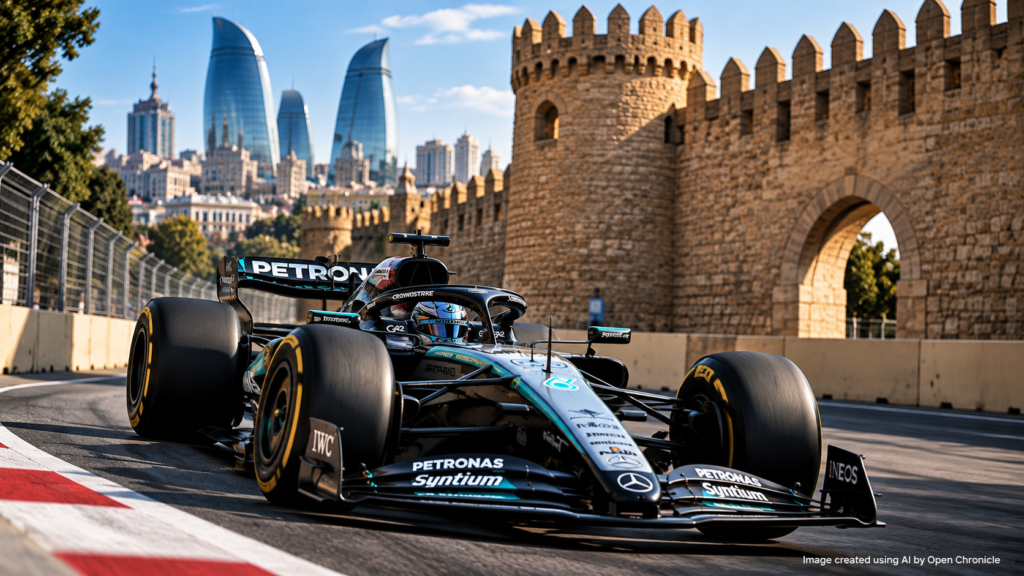
George Russell completed a commanding opening day at the 2026 Azerbaijan Grand Prix, leading both Thursday practice sessions and heading a Mercedes one-two in Free Practice 2 at the Baku City Circuit.
The British driver set the fastest lap of the afternoon with a 1:43.347, finishing 0.552 seconds ahead of teammate Kimi Antonelli, who recovered from a hydraulic problem that had disrupted his morning programme.
Max Verstappen secured third place for Red Bull Racing, while Charles Leclerc and Lewis Hamilton completed the top five for Ferrari.
The session was interrupted by a heavy accident involving Racing Bulls driver Arvid Lindblad near the castle section, while Oliver Bearman suffered an engine problem and Lewis Hamilton was involved in an incident with Liam Lawson that was referred to the stewards.
With qualifying scheduled for Friday, Mercedes ended the opening day with a promising performance, although the narrow streets of Baku and the contrasting characteristics of its high speed sections leave plenty of room for further developments.
Russell Establishes Mercedes as the Early Benchmark
Russell arrived at the second practice session having already topped the morning timesheets, but his afternoon performance provided a clearer indication of Mercedes’ potential around the demanding Baku City Circuit.
The British driver began by establishing an early reference time of 1:46.300 before Verstappen briefly moved ahead with a 1:45.933.
As track conditions improved and teams began to explore their qualifying configurations, Russell gradually increased his pace.
A lap of 1:44.537 returned him to the top of the order before he improved to 1:43.759 following the red flag interruption.
His final qualifying simulation produced a 1:43.347, a time that remained unbeaten for the rest of the session.
The result completed an encouraging Thursday for Mercedes, with Russell leading both practice sessions and demonstrating consistent performance as the team prepared for Friday’s qualifying.
However, his advantage over Antonelli also highlighted the different preparation programmes experienced by the two drivers.
Antonelli Recovers from Hydraulic Problems
Kimi Antonelli’s opening day in Azerbaijan was far from straightforward.
The Italian had been forced to abandon the first practice session after reporting a hydraulic problem, leaving Mercedes with extensive repair work before the afternoon running began.
The team was still working on his car as FP2 got underway, making the recovery of lost track time a priority.
Despite the disruption, Antonelli gradually improved his pace throughout the session and eventually produced a 1:43.899 to secure second place.
His final lap completed a Mercedes one-two and provided valuable encouragement after a difficult start to the weekend.
The 0.552 second gap to Russell nevertheless leaves Antonelli with work to do before qualifying, particularly around a circuit where confidence under braking and precision through the narrow corners are essential.
Verstappen Keeps Red Bull in Contention
Max Verstappen finished third with a best lap of 1:44.174, placing Red Bull Racing behind both Mercedes drivers but ahead of the Ferrari pairing.
The Dutchman had briefly led the session during the opening exchanges before Russell began improving his times.
Verstappen’s performance suggested that Red Bull remained competitive around Baku, although the team was unable to match Mercedes’ ultimate pace during the qualifying simulations.
His teammate Isack Hadjar also experienced a complicated opening day.
The French driver, returning to the championship after missing three races because of a wrist injury, had completed very little running during FP1 following an engine problem.
Red Bull carried out significant work on his car between sessions, allowing Hadjar to return to the circuit and begin recovering the lost mileage.
He eventually finished ninth with a 1:44.868, completing an important afternoon of preparation ahead of qualifying.
Ferrari Remains Within Reach of the Leading Teams
Ferrari completed the second practice session with both cars inside the top five.
Charles Leclerc finished fourth with a 1:44.473, while Lewis Hamilton followed in fifth, recording a 1:44.665.
Leclerc’s best lap placed him 1.126 seconds behind Russell, while Hamilton finished 1.318 seconds off the leading Mercedes.
Although Ferrari was unable to challenge for the top positions, the team remained ahead of both McLaren drivers in the final classification.
Hamilton’s afternoon was also marked by an incident involving Liam Lawson.
The Ferrari driver was reported to have impeded Lawson in a high speed section near Turn 19, with the two cars coming dangerously close.
Race control announced that the incident would be investigated by the stewards after the session.
Any potential consequences will depend on the stewards’ assessment of the circumstances.
Lindblad Crash Brings Out the Red Flag
The most significant interruption of FP2 came when Arvid Lindblad crashed his Racing Bulls near Baku’s castle section.
The British driver approached the narrow section at speed before making contact with the wall, causing substantial damage to the side of his car.
Race control immediately deployed the red flag, allowing marshals to recover the damaged Racing Bulls and clear the circuit.
The interruption lasted approximately ten minutes, reducing the time available for teams to complete their planned qualifying and race simulations.
Because the session clock continues running during red flag periods in free practice, the accident represented a significant disruption to several teams’ programmes.
Once the circuit reopened, most drivers returned to the track on soft tyres to complete their remaining qualifying simulations.
Lindblad finished eighteenth, with a best lap of 1:46.391.
Bearman Suffers Engine Problem as Haas Loses Track Time
Oliver Bearman also experienced a difficult afternoon after an engine problem brought his Haas to a halt in the escape area at Turn 2.
The mechanical issue prevented the British driver from completing his planned programme and added to the reliability concerns that had already affected several teams during the opening practice session.
Bearman finished twentieth with a 1:46.801.
His teammate Esteban Ocon enjoyed a more productive session, securing tenth place with a 1:45.290 and giving Haas a position inside the top ten.
The team will now need to assess Bearman’s mechanical problem before qualifying.
Audi Continues Technical Evaluation as Bortoleto Finishes Fourteenth
Audi used the second practice session to continue evaluating its latest development package, running different car specifications to gather comparative data.
Gabriel Bortoleto, who had tested the updated package during FP1, returned to the previous specification for the afternoon session.
Nico Hülkenberg took over the evaluation of the new components, allowing Audi to compare the performance of the two configurations under similar track conditions.
Bortoleto’s programme included aerodynamic measurements and controlled speed runs along Baku’s long straight.
The Brazilian briefly climbed into the top ten during the early stages before improving his best lap to 1:45.794.
He also experienced a moment at Turn 3, running into the escape area and temporarily triggering a yellow flag. However, he was able to manoeuvre his Audi back onto the circuit and continue the session.
Bortoleto eventually finished fourteenth, just 0.060 seconds ahead of Hülkenberg, who placed fifteenth with a 1:45.854.
The close times between the two drivers provided Audi with further information as the team assessed which specification to use for the remainder of the weekend.
With qualifying approaching, the priority will be to translate the development work into a competitive setup for Baku’s combination of long straights, heavy braking zones and narrow technical corners.
McLaren Searches for Additional Pace
McLaren completed the afternoon with Lando Norris in sixth and Oscar Piastri in eighth.
Norris briefly moved to the top of the timesheets during the early stages with a 1:45.184, but was unable to maintain that position as Mercedes, Red Bull and Ferrari improved their qualifying simulations.
His final time of 1:44.831 placed him 1.484 seconds behind Russell.
Piastri, meanwhile, continued recovering the mileage lost during the opening practice session, when McLaren had been forced to investigate problems affecting its cars.
The Australian finished eighth with a 1:44.857, only 0.026 seconds behind his teammate.
With both drivers closely matched, McLaren will be looking to extract additional performance from its package before Friday’s qualifying session.
Gasly Delivers Encouraging Result for Alpine
Pierre Gasly was among the drivers to produce a competitive lap during the final qualifying simulations.
The Frenchman recorded a 1:44.843 to finish seventh, narrowly behind Norris and ahead of Piastri.
His teammate Franco Colapinto finished eleventh with a 1:45.479, giving Alpine two cars close to the top ten.
Sergio Pérez also delivered an encouraging result for Cadillac, placing thirteenth with a 1:45.760, ahead of both Audi drivers.
Williams endured a more difficult afternoon, with Alexander Albon and Carlos Sainz finishing sixteenth and seventeenth respectively.
Aston Martin occupied the final two positions, with Lance Stroll twenty-first and Fernando Alonso twenty-second.
Mercedes Heads into Qualifying with Momentum
Russell’s performance across both Thursday practice sessions established Mercedes as the early benchmark in Azerbaijan, but the final classification also highlighted the uncertainty surrounding the competitive order.
Antonelli recovered from a disrupted morning to complete the Mercedes one-two, Verstappen remained within a second of Russell, and Ferrari placed both cars ahead of McLaren.
However, the interruptions, mechanical problems and differing technical programmes mean that the practice times alone cannot provide a definitive picture of the teams’ qualifying potential.
Baku’s combination of long straights and unforgiving barriers leaves little margin for error, while the circuit’s evolving track conditions can significantly influence lap times.
For Mercedes, the immediate objective will be to convert its encouraging Thursday performance into a competitive qualifying result.
For its rivals, Friday presents another opportunity to refine their cars and close the gap before the battle for pole position begins.