
By Open Chronicle with agencies
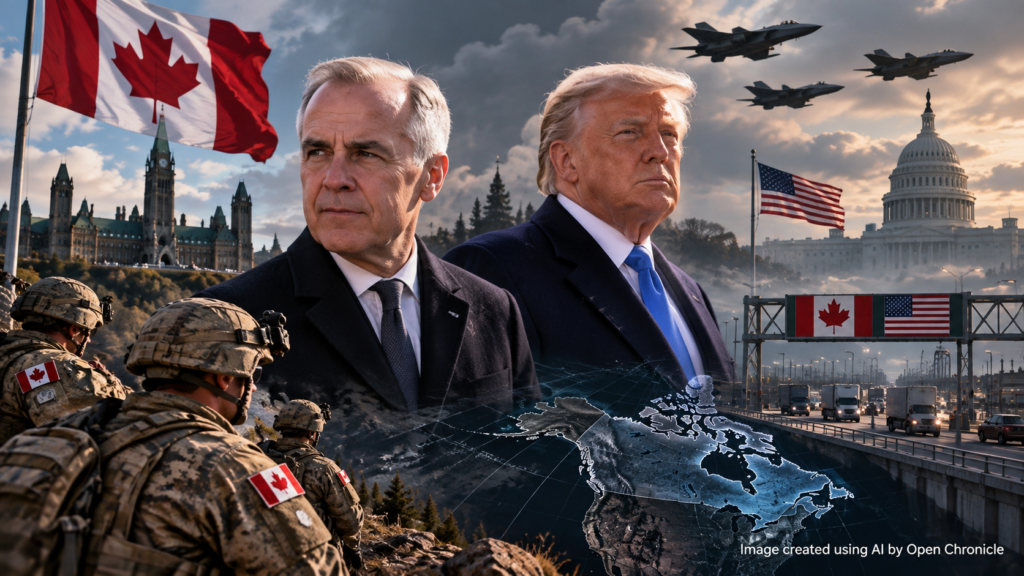
Canadian Prime Minister Mark Carney has acknowledged that his government has examined the possibility of US military action against Canada as part of its national security planning, while stressing that such a scenario is not considered a likely outcome.
In an interview with The New York Times published on Wednesday, September 23, Carney said political leaders have a responsibility to prepare for exceptional risks, particularly as relations between Ottawa and Washington have become increasingly strained under US President Donald Trump.
“I think you have a responsibility in these roles to look at extreme tail risk,” Carney said.
He explained that examining the possibility of military action was a matter of risk management rather than an indication that Canada expects an armed confrontation with its southern neighbour.
“That’s just risk management. That’s not a base case, but it would be irresponsible not to prepare,” he added.
The remarks come after months of tensions between the two countries over trade, economic sovereignty and Trump’s repeated suggestions that Canada should become the 51st US state.
Although Trump previously ruled out using military force to annex Canada, he has suggested that economic pressure could be used to encourage closer political integration.
Carney’s comments highlight the extent to which Ottawa is reassessing its economic and security relationship with Washington while seeking to preserve cooperation between the two longstanding allies.
Canada seeks to reduce its strategic dependence on the United States
Carney described Canada as a middle power whose economic strength and international influence depend on maintaining reliable partnerships while developing greater strategic independence.
The prime minister pointed to the deeply integrated North American automotive industry as an example of the economic relationship between Canada and the United States.
Manufacturing operations, supply chains and employment in both countries are closely connected, making significant disruptions potentially costly for businesses and consumers on either side of the border.
Canada also supplies the United States with essential resources, including energy and potash, a mineral used in fertiliser production.
These exports play an important role in North American agriculture, industrial production and energy security.
Despite the deterioration in bilateral relations, Carney said Canada should remain a dependable supplier rather than immediately using its natural resources as leverage in trade disputes.
“If you’re a reliable partner and you supply energy or food to somebody it keeps running, it’s a very, very, very high threshold to change that,” he said.
While declining to rule out future restrictions entirely, the prime minister indicated that maintaining Canada’s reputation as a reliable trading partner remained a central consideration.
Trade tensions accelerate Canada’s economic diversification
The Canadian government is seeking to expand its commercial relationships beyond the United States as it reassesses the risks associated with relying heavily on a single economic partner.
Carney said the breakdown of bilateral trade negotiations in August, followed by additional tariffs, had reinforced the importance of diversifying Canada’s international economic relationships.
He also discussed the possibility of strengthening commercial ties with China as part of a broader adjustment in global trade.
According to Carney, countries are increasingly examining their exposure to the US dollar and considering whether alternative financial arrangements could reduce their vulnerability to economic pressure.
However, he acknowledged that China’s currency would face significant obstacles to becoming a major international reserve currency without further liberalisation of the country’s financial system.
Carney suggested that the use of economic integration as a source of political leverage could encourage governments and businesses to reconsider longstanding financial arrangements.
“Once you see that, then you start to think, how do I diversify away?” he said.
The prime minister’s comments reflect a wider Canadian effort to maintain access to the American market while developing additional economic partnerships.
Ottawa reviews F-35 procurement and satellite communications
Canada’s reassessment of its relationship with Washington extends beyond trade into defence procurement and critical technology.
Carney confirmed that his government is considering alternatives to purchasing the full planned fleet of American F-35 fighter jets.
Canada’s programme to acquire new stealth aircraft remains under federal review, with officials examining procurement options and the country’s long-term defence requirements.
The F-35 programme represents a major component of Canada’s planned military modernisation, particularly as the country seeks to strengthen its air defence capabilities and fulfil its commitments within NATO and the North American Aerospace Defense Command.
Carney also indicated that Ottawa intends to reduce its dependence on SpaceX’s Starlink satellite broadband network.
“Starlink, we will diversify away from, no question,” he said.
The prime minister acknowledged that alternative satellite communications networks currently face limitations in capability and resilience.
Nevertheless, he suggested that cooperation with European countries, South Korea and other international partners could help Canada develop more diversified communications infrastructure.
Such arrangements could allow Ottawa to reduce its reliance on a single American provider while maintaining access to satellite services needed for civilian communications and defence operations.
Carney says dialogue with Trump remains open
Despite the growing disagreements between Ottawa and Washington, Carney emphasised that direct communication with the US president continues.
He told The New York Times that he speaks with Trump frequently and that the two leaders have held several conversations since bilateral trade negotiations collapsed in August.
Carney described their working relationship as direct, allowing both governments to communicate their positions without unnecessary diplomatic complications.
“From my perspective, we have a good relationship in the sense of we can pick up the phone and talk to each other about issues,” he said.
The Canadian prime minister maintained that a mutually beneficial trade agreement between the two countries remains possible.
His remarks suggest that Ottawa is pursuing two parallel objectives: preserving its economic and security relationship with Washington while reducing vulnerabilities associated with excessive dependence on the United States.
For Canada, the challenge is to maintain cooperation with its largest trading partner and principal defence ally while ensuring that its national interests remain protected in an increasingly uncertain international environment.
The examination of extreme security scenarios forms part of that broader reassessment, although Carney made clear that military confrontation with the United States is not the Canadian government’s expected outcome.