
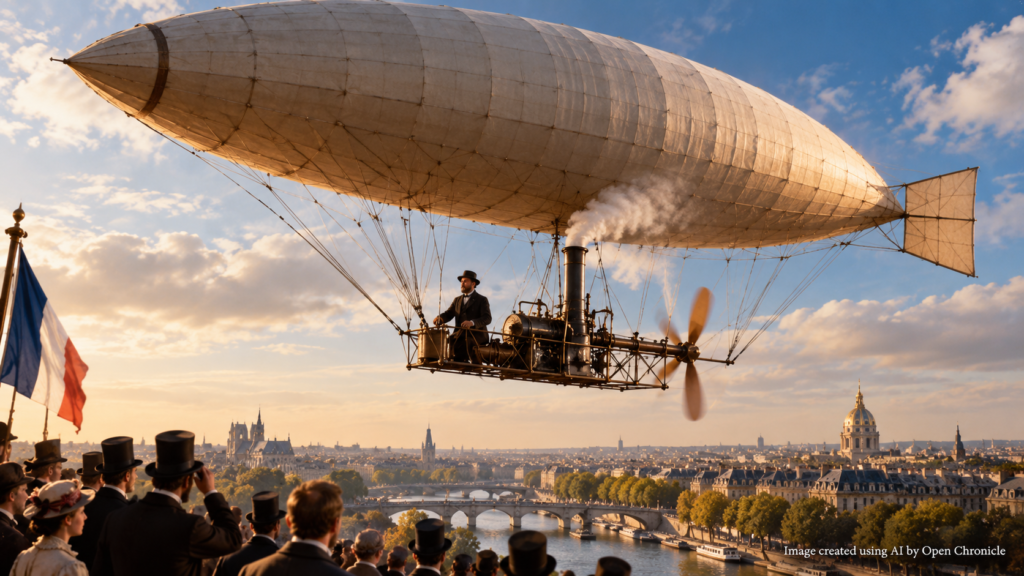
More than fifty years before the Wright brothers achieved powered airplane flight, French engineer Henri Giffard demonstrated that a steam-powered aircraft could travel through the sky under mechanical propulsion.
By Open Chronicle History Desk
On September 24, 1852, a French engineer named Henri Giffard climbed aboard an extraordinary flying machine and departed from Paris on a journey that would help transform the history of aviation.
His aircraft was not an airplane.
It was an elongated, hydrogen-filled balloon equipped with a steam engine, a propeller and a rudder.
Unlike conventional balloons, which depended primarily on the wind to determine their direction, Giffard’s machine possessed its own mechanical propulsion system.
The engineer had designed an aircraft capable of moving through the air under power.
On that September afternoon, Giffard departed from the area of the Paris Hippodrome and travelled towards Trappes, approximately 27 kilometres away.
The journey demonstrated that mechanical propulsion could be applied successfully to a lighter-than-air aircraft.
Although the engine was too weak to overcome strong winds and the machine’s directional control remained limited, the flight represented a significant achievement.
It is widely recognised as the first successful flight of a powered airship.
The event took place more than half a century before the Wright brothers achieved sustained, controlled, powered flight in a heavier-than-air aircraft in December 1903.
Giffard’s experiment belonged to a different branch of aviation, but it addressed a fundamental challenge shared by generations of inventors.
How could human beings build a flying machine that did not simply follow the wind, but could move through the sky using its own power?
On September 24, 1852, Henri Giffard demonstrated an important part of the answer.
1. Before Powered Flight: The Age of Balloons
The history of human flight entered a new era during the eighteenth century.
In 1783, the French brothers Joseph-Michel and Jacques-Étienne Montgolfier demonstrated the practical possibilities of hot-air balloons.
Their experiments culminated in the first recorded untethered human flight in a hot-air balloon, undertaken by Jean-François Pilâtre de Rozier and François Laurent d’Arlandes on November 21, 1783.
The achievement was extraordinary.
For the first time, human beings could rise into the atmosphere and travel above the ground in a flying machine.
Other inventors developed hydrogen balloons, which used a gas lighter than the surrounding air to generate lift.
Hydrogen balloons could remain airborne without continuously heating the air inside their envelopes.
Yet both types of balloon shared a fundamental limitation.
They could ascend and descend, but their horizontal movement was largely determined by the wind.
Pilots could sometimes exploit different wind directions at different altitudes, but they could not reliably choose their destination.
The problem of steering balloons became one of the central challenges of early aviation.
2. The Dream of a Navigable Balloon
During the late eighteenth and early nineteenth centuries, inventors proposed numerous methods for controlling the direction of balloons.
Some designs incorporated sails.
Others used paddles, oars or manually operated propellers.
The French inventor Jean-Pierre Blanchard experimented with mechanical devices intended to provide propulsion and steering.
In 1784, he flew a balloon equipped with a hand-operated propeller and other control mechanisms.
These experiments demonstrated the growing interest in making balloons navigable.
However, human muscle power could not provide sufficient propulsion for reliable flight against the wind.
The challenge required a more powerful source of energy.
During the nineteenth century, the rapid development of steam technology offered a possible solution.
Steam engines were already transforming transportation on land and water.
Could they also power an aircraft?
Henri Giffard believed they could.
3. Henri Giffard: The Engineer Behind the Experiment
Henri Giffard was born on January 8, 1825, in Paris.
He developed an early interest in mechanical engineering and the emerging technologies of the Industrial Revolution.
Steam power was transforming European industry.
Railways were expanding.
Steamships were improving maritime transportation.
Factories increasingly relied on mechanical power.
Giffard recognised that the same technological principles might be adapted to aviation.
But designing an engine for an aircraft presented difficulties that did not exist in conventional transportation.
The machinery had to be sufficiently powerful to drive a propeller while remaining light enough to be carried by a balloon.
Its operation also had to be compatible with the use of hydrogen, a highly flammable gas.
Giffard therefore needed to solve problems involving weight, propulsion, stability and fire safety.
His solution was an elongated hydrogen balloon fitted with a specially designed steam engine.
4. The Design of the First Powered Airship
Giffard’s aircraft differed considerably from the familiar spherical balloons of the eighteenth century.
Its envelope was elongated, creating a streamlined shape intended to reduce resistance as the machine moved through the air.
The balloon was approximately 44 metres long and had a maximum diameter of about 12 metres.
It contained roughly 2,500 cubic metres of hydrogen.
Beneath the envelope, a suspended structure supported the pilot, engine and propulsion equipment.
A three-bladed propeller was connected to a lightweight steam engine.
The aircraft also incorporated a triangular rudder intended to influence its direction.
The Giffard Airship: Technical specifications
|
First flight |
September 24, 1852 |
|
Designer and pilot |
Henri Giffard |
|
Aircraft type |
Powered, lighter-than-air dirigible |
|
Envelope length |
Approximately 44 metres |
|
Maximum diameter |
Approximately 12 metres |
|
Lifting gas |
Hydrogen |
|
Engine |
Steam engine, approximately 3 horsepower |
|
Propulsion |
Three-bladed propeller |
|
Reported airspeed |
Approximately 6 to 10 km/h |
|
Flight distance |
Approximately 27 kilometres |
Historical accounts provide slightly different figures for the aircraft’s dimensions and performance. The values shown are approximate.
The machine was designed to achieve more than simple ascent.
Its purpose was to demonstrate that a powered aircraft could move through the atmosphere independently of the passive drift of a conventional balloon.
5. The Challenge of Steam Power in the Sky
Steam engines were among the most important technological developments of the Industrial Revolution.
They converted thermal energy into mechanical motion, allowing machines to operate without relying on human or animal muscle power.
However, conventional steam engines were heavy.
Their boilers, cylinders, pistons and fuel supplies created significant weight.
For an aircraft, every additional kilogram reduced the useful lifting capacity.
Giffard developed a relatively lightweight steam engine producing approximately three horsepower.
It was connected to a large propeller that generated thrust.
The engine was suspended beneath the balloon, with precautions intended to reduce the danger of igniting the hydrogen inside the envelope.
The risk was serious.
Hydrogen is highly flammable, and a steam engine required a heat source.
Giffard’s design therefore represented not only an experiment in propulsion but also an attempt to integrate a combustion-powered mechanical system into a hydrogen-lifting aircraft.
The machine’s engine was modest by modern standards.
Nevertheless, it supplied the mechanical power needed to demonstrate the basic principle of powered airship flight.
6. September 24, 1852: The Historic Flight
On September 24, 1852, Giffard prepared his airship for flight in Paris.
The aircraft departed from the area of the Paris Hippodrome, near the site of the present-day Place de l’Étoile.
The engineer operated the steam engine, driving the propeller and generating forward thrust.
The elongated balloon rose above the surrounding landscape.
Unlike an ordinary balloon, it possessed a mechanical system capable of producing movement relative to the surrounding air.
Giffard attempted to control its course using the rudder and propulsion system.
The aircraft travelled towards Trappes, west of Paris, covering approximately 27 kilometres.
The journey took several hours.
Contemporary accounts describe Giffard’s ability to produce controlled movements of the aircraft, although the engine was not powerful enough to overcome the prevailing wind and return to his starting point.
The experiment therefore did not establish fully practical, reliable navigation in all wind conditions.
But it demonstrated that a lighter-than-air aircraft could be propelled by an onboard engine.
That distinction made the flight historically significant.
7. What Made the Flight Different From Earlier Balloon Experiments?
The central innovation was mechanical propulsion.
Earlier balloons had demonstrated that human beings could rise into the atmosphere and remain airborne.
Some inventors had experimented with steering devices and human-powered mechanisms.
Giffard’s aircraft introduced a steam engine capable of driving a propeller while the machine was in flight.
The engine produced thrust independently of the pilot’s physical effort.
This allowed the aircraft to move relative to the surrounding air.
The distinction between airspeed and ground speed is important.
An aircraft may generate forward motion through the air while still being carried backwards or sideways over the ground by a stronger wind.
Giffard’s engine was too weak to guarantee movement in a chosen direction under all conditions.
Nevertheless, the flight established that powered propulsion was technically possible.
The next challenge was to develop engines and control systems capable of making airships more reliable and manoeuvrable.
8. The Birth of the Dirigible
The word dirigible derives from a term meaning steerable or directable.
In aviation, it came to describe a lighter-than-air aircraft equipped with propulsion and steering systems.
Unlike a conventional free balloon, a dirigible is designed to travel under its own power and control its direction.
Giffard’s machine represented an important early example of this aircraft category.
It was a non-rigid airship.
The shape of its envelope depended largely upon the pressure of the lifting gas rather than a rigid internal framework.
Later airships would incorporate more advanced propulsion systems, improved control surfaces and different structural arrangements.
Some would use non-rigid envelopes.
Others would employ semi-rigid or fully rigid structures.
The underlying objective remained the same.
To combine buoyant lift with mechanical propulsion and directional control.
9. The Next Generation of Airship Pioneers
Giffard’s experiment inspired further efforts to develop practical airships.
One of the most important later achievements occurred in France in 1884.
Charles Renard and Arthur Constantin Krebs developed an electrically powered airship known as La France.
On August 9, 1884, the aircraft completed a controlled flight that returned to its starting point.
The journey demonstrated a level of navigational capability that Giffard’s earlier machine had been unable to achieve.
The airship travelled approximately 7.6 kilometres and completed the circuit in about 23 minutes.
Its electric motor, propeller and steering system represented significant advances in lighter-than-air aviation.
The achievement helped establish that powered airships could become genuinely navigable aircraft rather than experimental balloons with limited directional control.
10. Alberto Santos-Dumont and the Airship Revolution
At the turn of the twentieth century, Brazilian aviation pioneer Alberto Santos-Dumont became one of the most prominent figures in airship development.
Working in France, he designed and flew a series of small powered dirigibles.
His aircraft incorporated lightweight engines and increasingly sophisticated control systems.
In October 1901, Santos-Dumont completed a flight around the Eiffel Tower and returned to his starting point in his airship No. 6.
The achievement brought international attention to powered airship navigation.
Santos-Dumont’s experiments demonstrated the growing practicality of lighter-than-air aircraft.
They also helped popularise aviation among the wider public.
His later work would extend to heavier-than-air aircraft, including the 14-bis airplane.
The development of aviation was no longer confined to balloons and airships.
A new era of powered flight was approaching.
11. The Wright Brothers and the Development of the Airplane
On December 17, 1903, Orville and Wilbur Wright achieved sustained, controlled, powered flight in a heavier-than-air aircraft at Kitty Hawk, North Carolina.
Their achievement differed fundamentally from Giffard’s experiment.
Giffard’s airship relied on hydrogen to generate buoyant lift.
The Wright Flyer relied on aerodynamic lift produced by its wings.
The Wright brothers also developed a practical system of three-axis control, allowing the aircraft to be controlled in pitch, roll and yaw.
The two achievements therefore belonged to distinct branches of aviation history.
Giffard demonstrated powered propulsion in a lighter-than-air aircraft in 1852.
The Wright brothers demonstrated sustained, controlled, powered flight in a heavier-than-air aircraft in 1903.
Both milestones contributed to the development of modern aviation.
Neither should be confused with the other.
12. The Rise of the Zeppelin
During the late nineteenth and early twentieth centuries, German engineer Ferdinand von Zeppelin developed large rigid airships.
Unlike Giffard’s non-rigid balloon, Zeppelin’s aircraft incorporated an internal structural framework supporting the outer envelope.
The rigid design allowed the construction of much larger aircraft with multiple gas cells, engines and passenger or cargo compartments.
Zeppelin airships became prominent symbols of early twentieth-century aviation.
Some were used for military purposes during the First World War.
Others were developed for commercial passenger transportation.
The Graf Zeppelin, launched in 1928, completed long-distance journeys and demonstrated the potential of airships for international travel.
In 1929, it undertook a celebrated journey around the world.
These achievements represented a remarkable development from Giffard’s experimental machine of 1852.
The basic concept of combining buoyant lift with mechanical propulsion had evolved into a form of long-distance air transportation.
13. The Hindenburg Disaster and the Decline of Passenger Airships
The history of airships also included serious accidents.
On May 6, 1937, the German passenger airship Hindenburg caught fire while attempting to land at Lakehurst, New Jersey.
The disaster killed 36 people, including one member of the ground crew.
The destruction of the Hindenburg became one of the most widely documented aviation disasters of the twentieth century.
The accident damaged public confidence in large passenger airships.
However, the decline of commercial airship transportation cannot be attributed to the Hindenburg disaster alone.
Advances in conventional airplanes, changing economic conditions, operational limitations and the cost of maintaining large airships also influenced the industry’s development.
By the middle of the twentieth century, airplanes had become the dominant technology for long-distance passenger aviation.
Airships continued to be used for specialised purposes, but their role in commercial transportation became much more limited.
14. Airships in the Modern World
Airships have not disappeared.
Modern lighter-than-air aircraft are used for advertising, aerial observation, research and other specialised activities.
Engineers have also investigated whether new airship designs could provide alternatives for transporting cargo to remote regions.
Potential applications include operations in areas with limited road infrastructure or where conventional airports are unavailable.
However, modern airships still face important engineering and operational challenges.
Their large size makes them sensitive to wind and weather conditions.
Ground handling requires specialised procedures.
The cost, speed and reliability of airship operations must also be considered when comparing them with conventional aircraft.
Nevertheless, advances in materials, propulsion and flight-control systems have renewed interest in lighter-than-air technology.
The concept first demonstrated by Giffard remains relevant to contemporary aerospace engineering.
15. Henri Giffard’s Other Engineering Achievements
Giffard’s contributions extended beyond aviation.
He also developed important innovations in steam engineering.
One of his most notable inventions was a steam-powered injector designed to feed water into boilers.
The device used a jet of steam to force water into a pressurised boiler.
This represented a significant improvement in boiler technology and found applications in steam locomotives and other industrial systems.
Giffard’s work illustrates the close relationship between nineteenth-century industrial engineering and early aviation.
The technologies that powered factories, railways and ships also provided the mechanical foundations for experiments in flight.
His career reflected an era in which inventors increasingly sought to apply scientific principles and mechanical innovation to problems that had previously appeared impossible to solve.
16. Why September 24 Matters
The flight of September 24, 1852, was an important turning point in the history of aviation.
It demonstrated that a lighter-than-air aircraft could carry an onboard engine and use mechanical propulsion to move through the atmosphere.
The experiment did not solve every problem associated with controlled flight.
Giffard’s machine remained vulnerable to strong winds.
Its engine lacked the power required for reliable navigation in all conditions.
Its practical range and operational capabilities were limited.
Nevertheless, the aircraft established a principle that later engineers would develop into increasingly sophisticated airship technology.
The flight also illustrates how major technological breakthroughs often emerge through a series of experiments rather than a single invention.
The Montgolfier brothers had demonstrated human balloon flight in 1783.
Giffard demonstrated steam-powered airship propulsion in 1852.
Renard and Krebs achieved a controlled return flight in 1884.
The Wright brothers achieved sustained, controlled, powered airplane flight in 1903.
Each achievement addressed a different technical challenge.
Together, they contributed to the development of modern aviation.
September 24, 1852: The Day a Steam Engine Took to the Sky
Imagine Paris on the afternoon of September 24, 1852.
The city is experiencing the technological transformation of the Industrial Revolution.
Steam engines power locomotives and factories.
Railways are changing the way people travel.
Mechanical innovation is reshaping everyday life.
Above the city, an extraordinary aircraft prepares to depart.
Its elongated hydrogen envelope stretches approximately 44 metres.
A small steam engine hangs beneath it.
A propeller is ready to turn.
Henri Giffard takes his position aboard the machine.
He is attempting something that generations of balloonists have imagined.
He wants to fly using mechanical power.
The aircraft rises.
The engine operates.
The propeller begins generating thrust.
The machine moves through the air.
Giffard attempts to control its direction as it travels westward from Paris.
The wind remains stronger than his engine.
He cannot return to his starting point.
But he reaches Trappes after a journey of approximately 27 kilometres.
The experiment has demonstrated that powered airship flight is possible.
The machine is far from a practical modern aircraft.
Its speed is modest.
Its control is limited.
Its propulsion system is experimental.
Yet the principle has been established.
An aircraft can carry its own engine and use mechanical power to move through the sky.
On September 24, 1852, Henri Giffard adds a new chapter to the history of human flight.
The age of powered aviation has taken an important step forward.