
By Open Chronicle History Desk
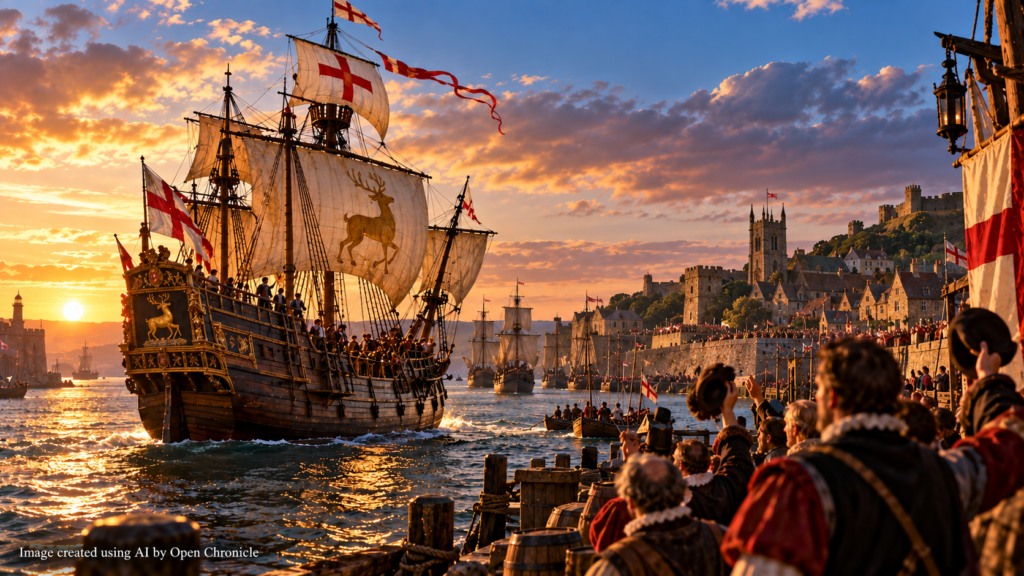
On September 26, 1580, a battered English sailing ship entered Plymouth harbour after nearly three years at sea.
The vessel was the Golden Hind, commanded by Francis Drake.
When Drake had left England in December 1577, he commanded a small fleet heading into waters dominated by the great Iberian maritime empires. When he returned, only the Golden Hind had completed the extraordinary journey.
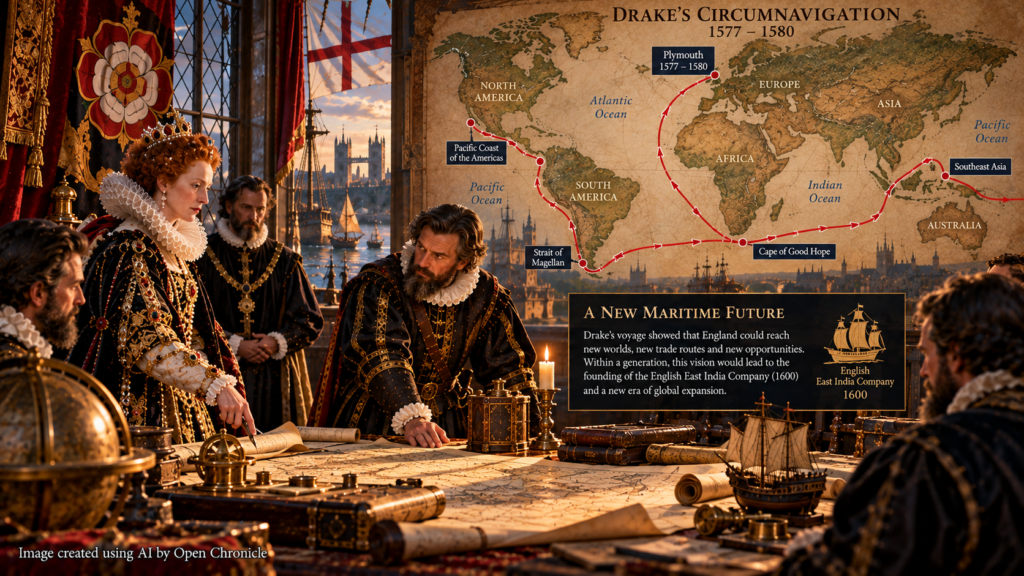
The ship had crossed the Atlantic, navigated the Strait of Magellan, entered the Pacific Ocean, sailed along the western coast of the Americas, crossed the vast Pacific, reached Southeast Asia, traversed the Indian Ocean, rounded southern Africa and finally crossed the Atlantic once more.
Drake and his surviving crew had completed the second recorded circumnavigation of the Earth, following the expedition begun by Ferdinand Magellan in 1519 and completed under Juan Sebastián Elcano in 1522.
Drake became the first English commander to complete such a voyage.
But the expedition was far more complicated than a story of exploration.
It was also a privateering campaign carried out during a period of increasing rivalry between England and the Spanish Empire. Drake attacked Spanish settlements and shipping, seized enormous quantities of treasure and gathered valuable geographical and navigational information.
His voyage belonged simultaneously to the histories of exploration, warfare, empire, commerce and maritime raiding.
When the Golden Hind reached Plymouth on September 26, 1580, it represented something larger than the survival of one ship.
It demonstrated that England could operate across the world’s oceans.
1. The World of the Great Ocean Voyages
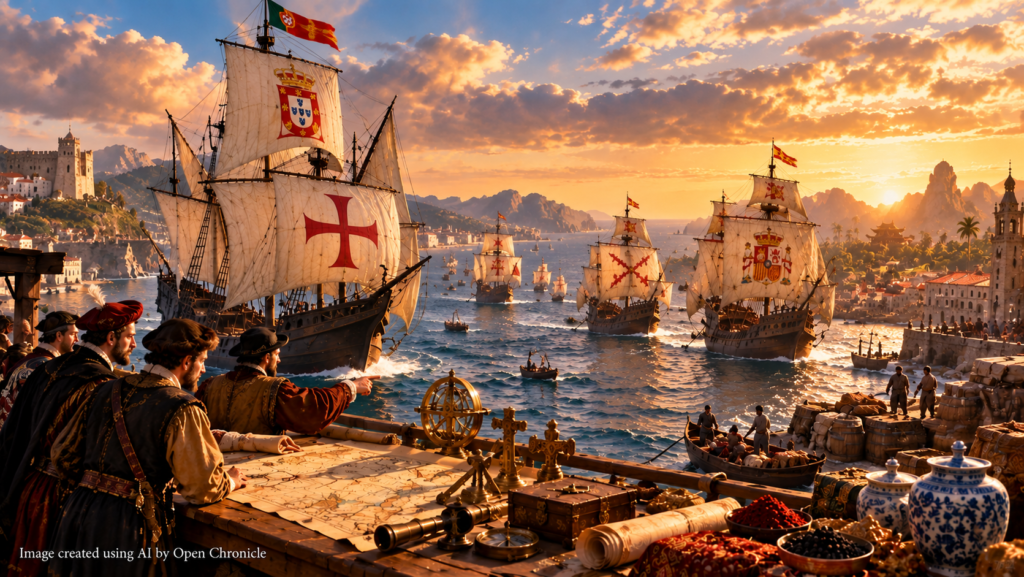
By the late sixteenth century, the oceans had become increasingly important arenas of imperial competition.
Portugal had established maritime routes connecting Europe with Africa, India, Southeast Asia and China.
Spain had constructed an enormous empire in the Americas following the voyages of Christopher Columbus and the subsequent conquests of Mexico and Peru.
Spanish ships carried silver and other commodities across the Atlantic, while another major commercial system was developing across the Pacific.
Beginning in the sixteenth century, the Manila galleons connected the Philippines with New Spain, linking Asian markets with the Americas and ultimately Europe.
For European governments, control of maritime routes increasingly meant access to wealth, military power and overseas influence.
England remained a much smaller maritime power than Spain or Portugal.
Yet English merchants, navigators and privateers were becoming increasingly ambitious.
They wanted access to overseas markets that the Iberian powers considered their exclusive domains.
Francis Drake emerged from this expanding world of maritime competition.
2. Who Was Francis Drake?
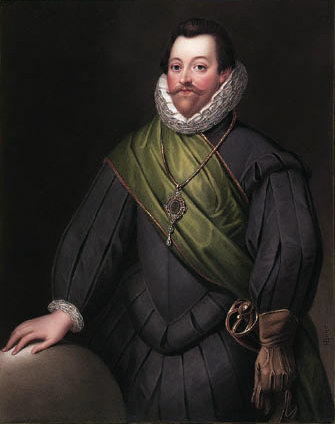
Image Credit
Henry Bone,
Sir Francis Drake wearing the Drake Jewel (1829).
Public Domain, via
Wikimedia Commons
.
Christie’s, LotFinder, entry 1475646.
Francis Drake was born in Devon, probably around 1540.
He went to sea at a young age and became associated with the Hawkins family, one of the most important English maritime families of the period.
During the 1560s, Drake participated in voyages connected with John Hawkins and the Atlantic slave trade.
These expeditions transported enslaved Africans across the Atlantic and attempted to sell them in Spanish-controlled territories in the Americas.
This part of Drake’s career is essential to understanding him historically.
The later image of Drake as an explorer and national hero represents only one dimension of a much more complicated life.
He was also a privateer, military commander, colonial participant and beneficiary of the violent systems associated with European maritime expansion.
His hostility toward Spain intensified following English encounters with Spanish forces in the Caribbean.
During the following years, Drake conducted increasingly ambitious attacks against Spanish interests.
By the 1570s, he had become one of England’s most experienced maritime raiders.
3. England and Spain Move Toward Confrontation
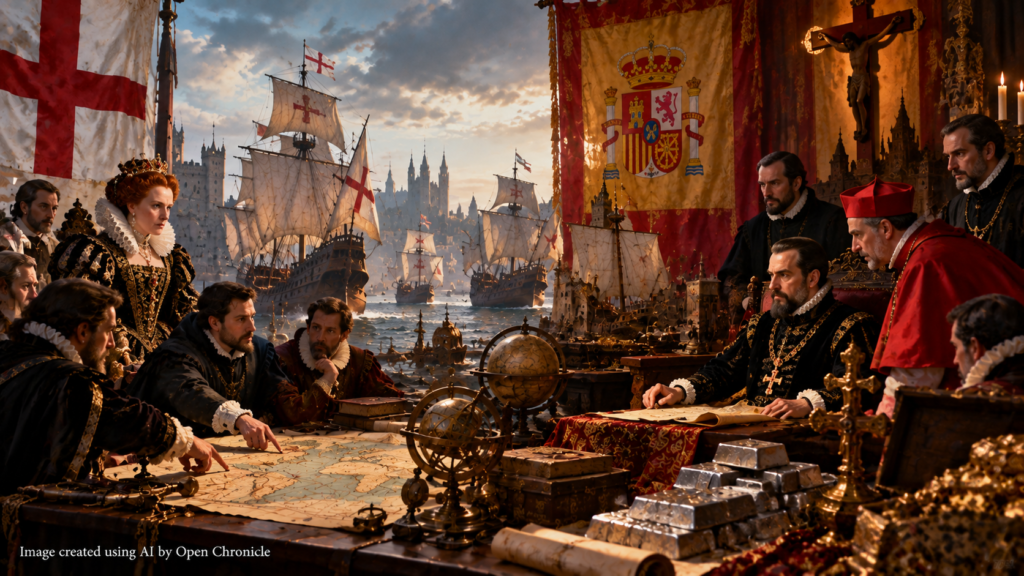
England and Spain were not formally at war when Drake began his circumnavigation.
Nevertheless, relations between the two kingdoms were deteriorating.
Religion was one important factor.
England had become Protestant following the Reformation, while Philip II’s Spain was one of Europe’s most powerful Catholic monarchies.
Political rivalry was another.
England increasingly supported Protestant opponents of Spanish power in Europe.
Commerce added another source of tension.
Spain attempted to maintain tight control over trade with its American territories. Foreign merchants were generally excluded from direct participation in this system.
English merchants wanted access.
Privateering provided one way of challenging Spanish power without immediately beginning a formal war.
Governments could authorize private vessels to attack enemy shipping while maintaining a degree of political distance from their activities.
The distinction between privateer and pirate therefore depended heavily upon perspective.
To England, Drake could be a valuable maritime commander.
To Spain, he was a dangerous raider.
4. December 1577: The Expedition Begins
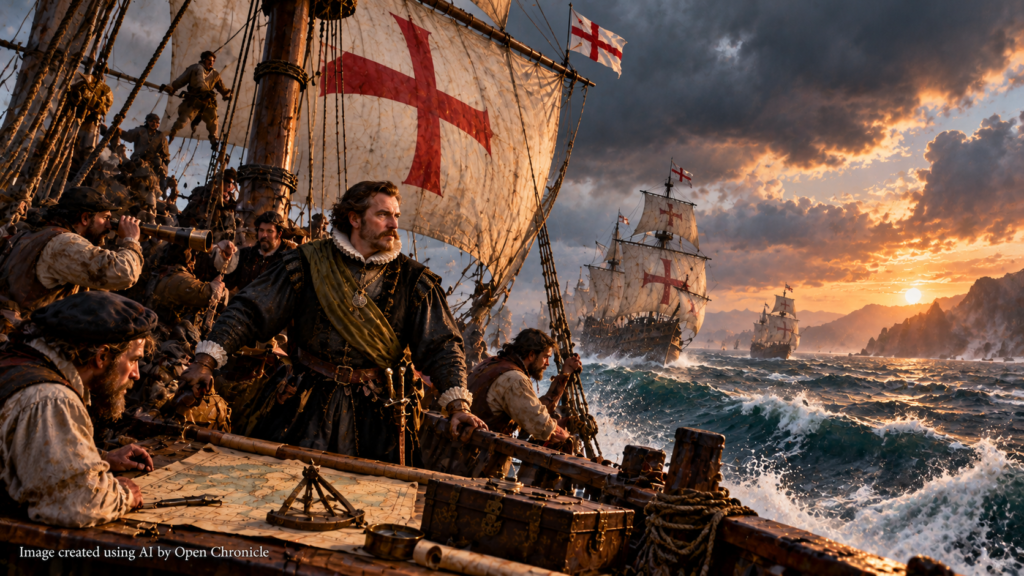
Drake departed Plymouth in December 1577.
He commanded a fleet of several ships.
His flagship was initially called the Pelican.
The expedition’s precise objectives were deliberately obscured.
Secrecy was important during sixteenth-century maritime expeditions. Information about routes, commercial opportunities, foreign defenses and potential targets possessed enormous strategic value.
Drake sailed south into the Atlantic.
The fleet eventually crossed toward South America.
As the expedition moved farther from England, the difficulties multiplied.
Storms threatened the ships.
Food and water had to be carefully managed.
Diseases could spread through cramped crews.
Ships required constant maintenance.
Navigational errors could prove fatal.
Internal disputes also threatened the expedition.
The voyage was already becoming a test not simply of navigation but of command.
5. Toward the Strait of Magellan
The expedition continued south along the Atlantic coast of South America.
Ahead lay one of the most difficult passages known to European sailors.
The Strait of Magellan cuts through the southern extremity of South America, connecting the Atlantic and Pacific Oceans.
Ferdinand Magellan’s expedition had navigated the passage in 1520.
But knowledge of the region remained limited.
Sailors faced strong currents, unpredictable winds, narrow channels, cold conditions and complicated coastlines.
In 1578, Drake’s expedition entered the strait.
Successfully passing through it represented a major navigational achievement.
Beyond the western entrance lay the Pacific Ocean.
But the expedition’s difficulties were far from over.
6. Into the Pacific
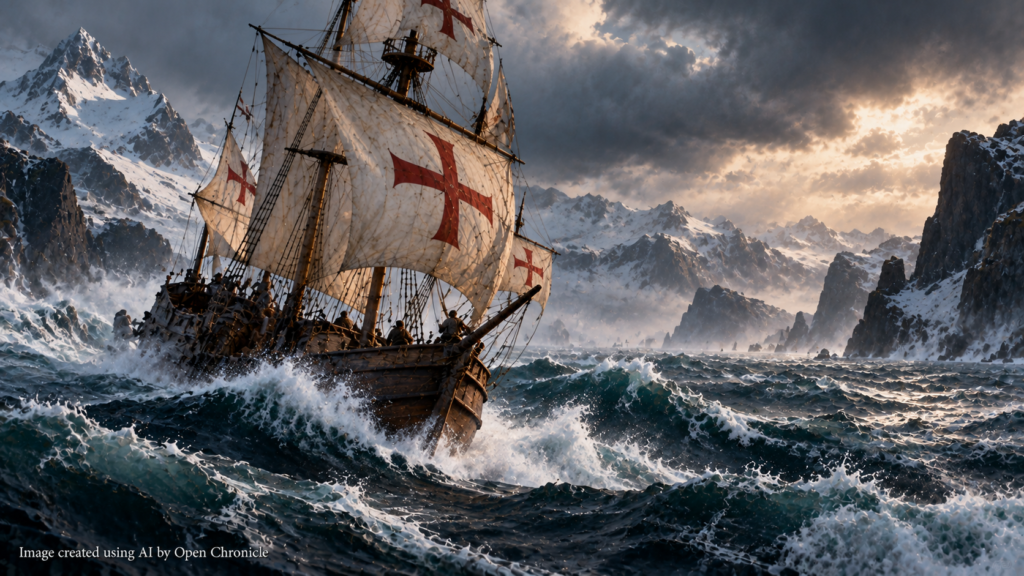
After emerging from the Strait of Magellan, Drake encountered severe weather.
The ships were scattered.
Some became separated permanently from the expedition.
The storms also contributed to European geographical understanding of the region around southern South America.
Drake’s experience suggested that the lands south of the Strait of Magellan were not necessarily part of an enormous southern continent connected indefinitely toward Antarctica, as some geographical theories had suggested.
Eventually, the expedition was effectively reduced to the ship commanded by Drake.
The voyage that had begun as a fleet expedition was becoming the story of a single vessel.
7. The Pelican Becomes the Golden Hind
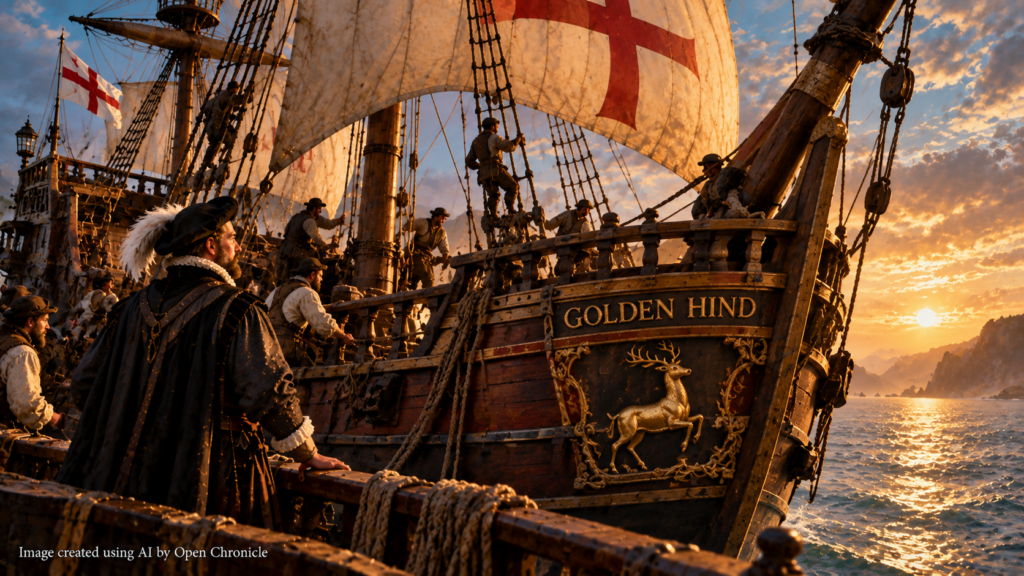
During the voyage, Drake renamed his flagship.
The Pelican became the Golden Hind.
The name is generally associated with Sir Christopher Hatton, an influential supporter of Drake whose heraldic emblem included a golden hind.
The vessel itself was relatively modest compared with the enormous ships that would later dominate popular images of global exploration.
Like other ocean-going ships of its era, it depended upon sails, wooden construction, human labor and continuous maintenance.
Every major ocean crossing placed enormous stress on the hull, rigging and crew.
There were no modern communications.
No rescue services.
No accurate global weather forecasts.
Once the Golden Hind entered the Pacific, England was effectively on the other side of the world.
8. The Spanish Pacific
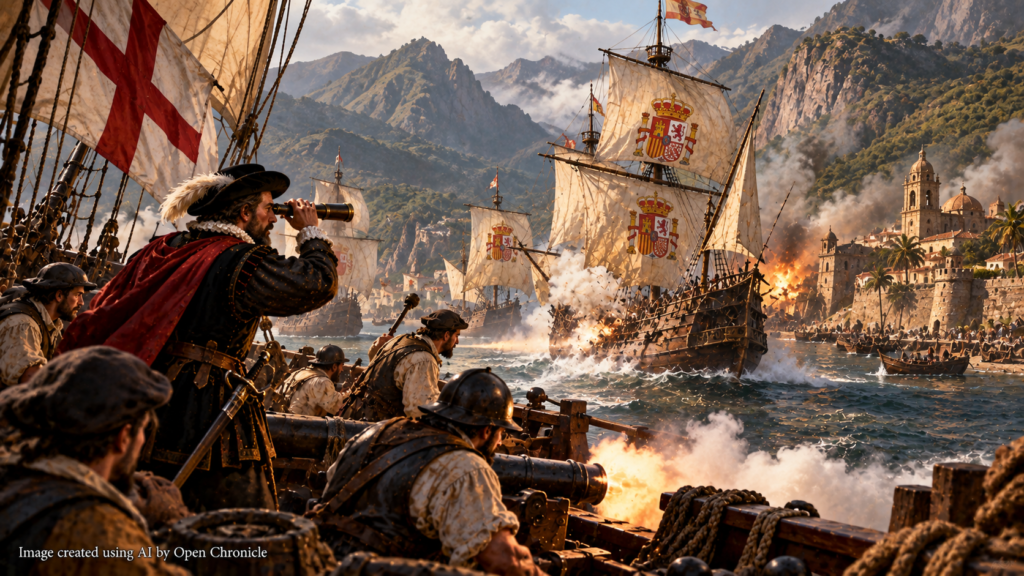
Drake turned north along the western coast of South America.
These waters were dominated by Spain.
The Spanish Empire transported enormous quantities of silver and other valuable commodities through its Pacific ports.
Because the Pacific had long been considered relatively secure from rival European naval forces, Spanish shipping there could sometimes operate with fewer defensive precautions than vessels crossing the Atlantic.
Drake exploited this vulnerability.
He attacked Spanish settlements and captured ships.
His expedition was no longer simply exploring unfamiliar waters.
It was conducting an organized campaign against Spanish maritime interests.
9. The Capture of the Cacafuego
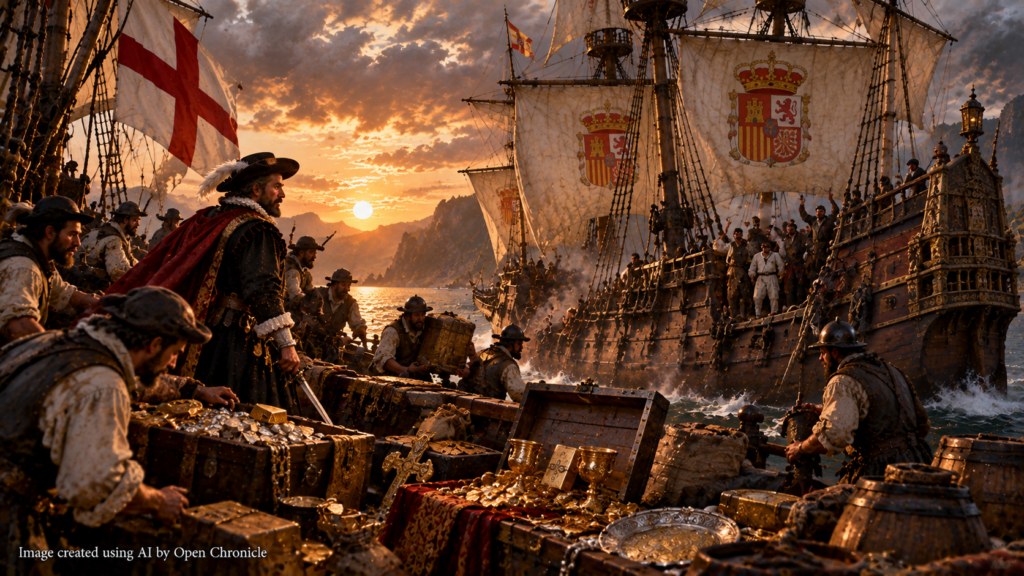
One of Drake’s most famous prizes was a Spanish treasure ship commonly known as the Cacafuego.
Drake pursued the vessel along the Pacific coast.
When the English finally intercepted it in 1579, they discovered a valuable cargo.
The captured goods included precious metals and other commodities.
The seizure became one of the most celebrated episodes of Drake’s voyage in England and one of the most notorious from the Spanish perspective.
But the capture created a serious strategic problem.
Drake was now carrying substantial treasure aboard his ship.
Spanish authorities would have every reason to search for him.
Returning through the Strait of Magellan could expose the Golden Hind to interception.
Drake needed another route home.
10. North Along the American Coast
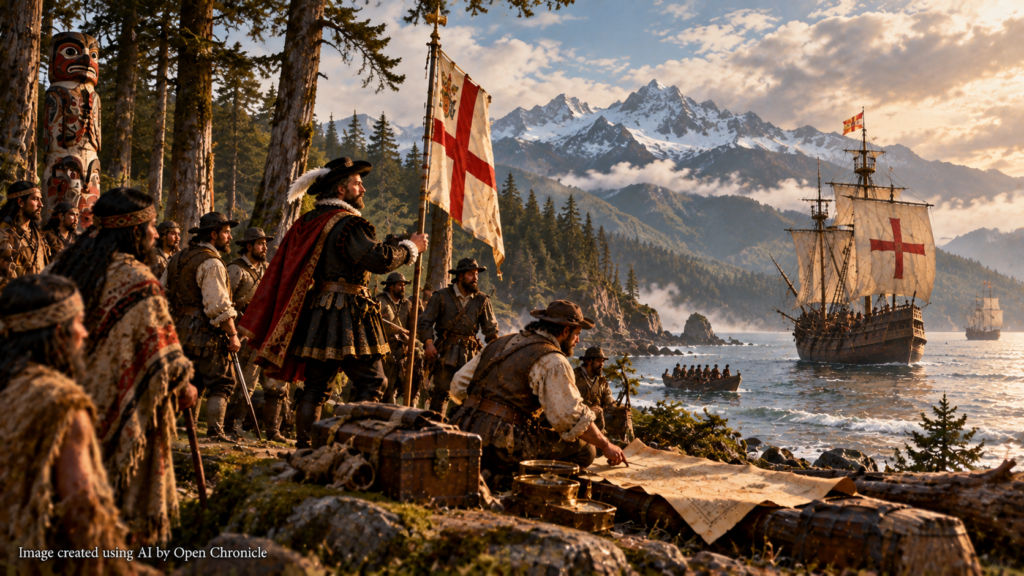
Drake continued northward along the Pacific coast of the Americas.
One possible objective was the search for a navigable passage across North America that could connect the Pacific with the Atlantic.
European cartographers still possessed incomplete knowledge of the continent.
A northern maritime passage would have provided an extraordinary commercial shortcut.
Drake found no such route.
In 1579, he landed somewhere along the Pacific coast of North America.
The precise location remains debated by historians.
Drake called the region Nova Albion, or New Albion.
He claimed the territory for Queen Elizabeth I.
Such declarations reflected European imperial practices rather than the political reality of the land itself.
Indigenous peoples had inhabited these regions for thousands of years and possessed their own communities, territories and political relationships.
The concept of European “discovery” therefore describes a particular European historical perspective, not the beginning of human knowledge or occupation of these lands.
11. Turning West Across the Pacific
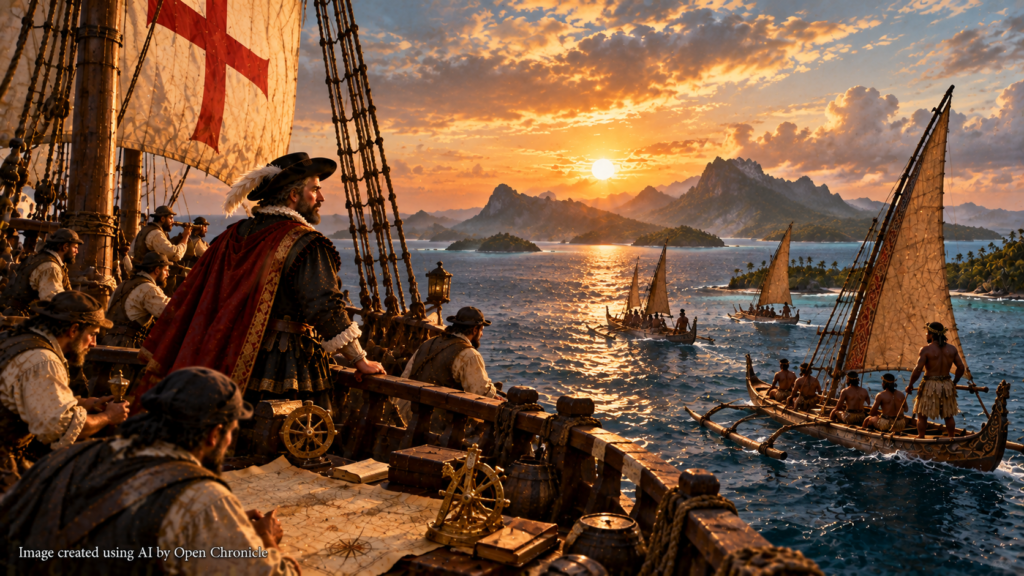
Drake eventually abandoned the search for a northern route back to the Atlantic.
Instead, the Golden Hind turned west.
Ahead stretched the largest ocean on Earth.
Crossing the Pacific represented an enormous navigational challenge.
The distances involved were difficult for European sailors to calculate accurately.
Fresh water and food had to last for extended periods.
Navigation depended upon astronomical observations, dead reckoning and accumulated maritime experience.
Yet Europeans were not entering an empty ocean.
Pacific peoples had developed sophisticated traditions of navigation long before European arrival.
Polynesian and other Austronesian navigators had crossed enormous distances using knowledge of stars, winds, ocean swells, birds and environmental patterns.
The Pacific was already a world of migration, commerce and cultural exchange.
Drake’s voyage entered this much older maritime landscape.
12. Southeast Asia and the Spice Trade
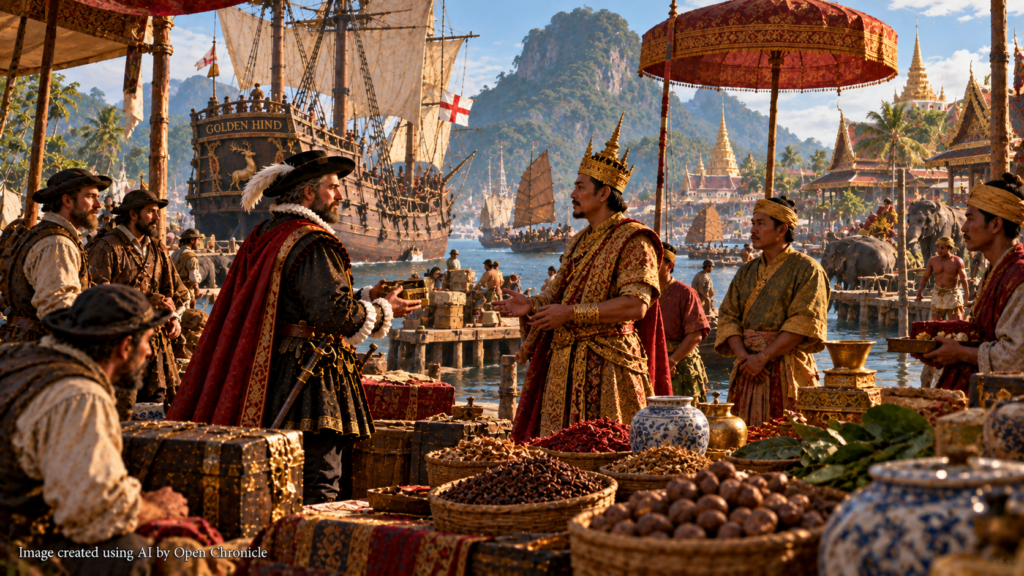
The Golden Hind eventually reached Southeast Asia.
This region occupied a central place in the commercial ambitions of European maritime powers.
Spices such as cloves, nutmeg and mace were extraordinarily valuable in European markets.
Portugal had established an extensive trading network in the Indian Ocean and Southeast Asia during the sixteenth century.
Spain had established itself in the Philippines.
Drake attempted to establish relationships that might provide England with access to these commercial networks.
The implications were significant.
England was beginning to imagine itself as a participant in Asian maritime trade.
Those ambitions would grow dramatically during the following century.
13. Disaster on a Reef
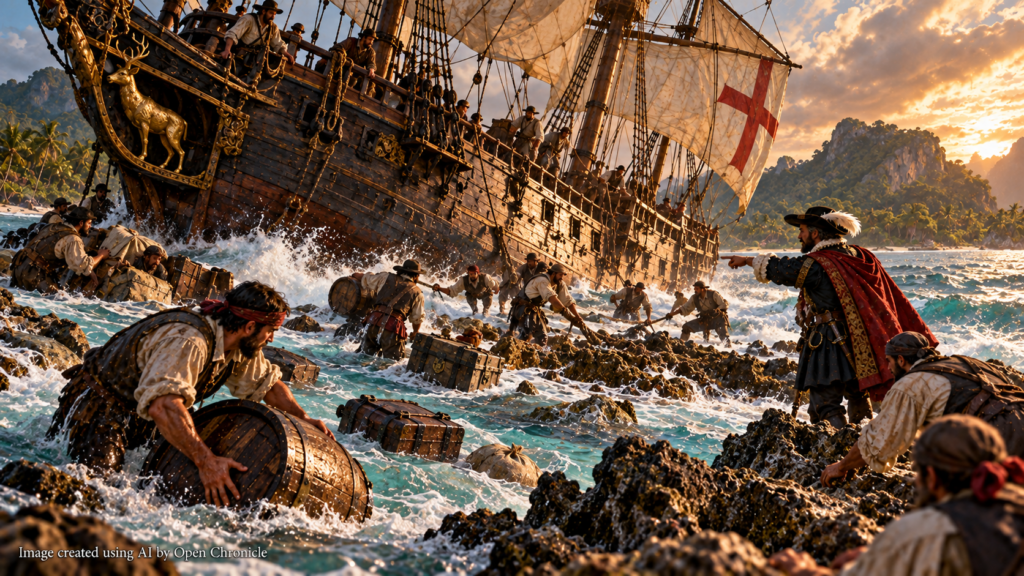
The voyage nearly ended in Southeast Asia.
The Golden Hind struck a reef.
For a wooden sailing ship thousands of kilometres from England, such an accident could easily have been fatal.
The crew worked desperately to free the vessel.
Weight had to be reduced.
Supplies and cargo could be sacrificed when survival required it.
Eventually, the Golden Hind escaped.
The incident illustrates the extraordinary fragility of early modern global navigation.
A single navigational error could destroy years of effort.
A storm could scatter an entire fleet.
A damaged mast could leave a vessel helpless.
Disease could kill large numbers of sailors.
Food could spoil.
Fresh water could become contaminated.
The fact that any sixteenth-century expedition successfully circumnavigated the planet was an exceptional achievement of endurance and seamanship.
14. Across the Indian Ocean
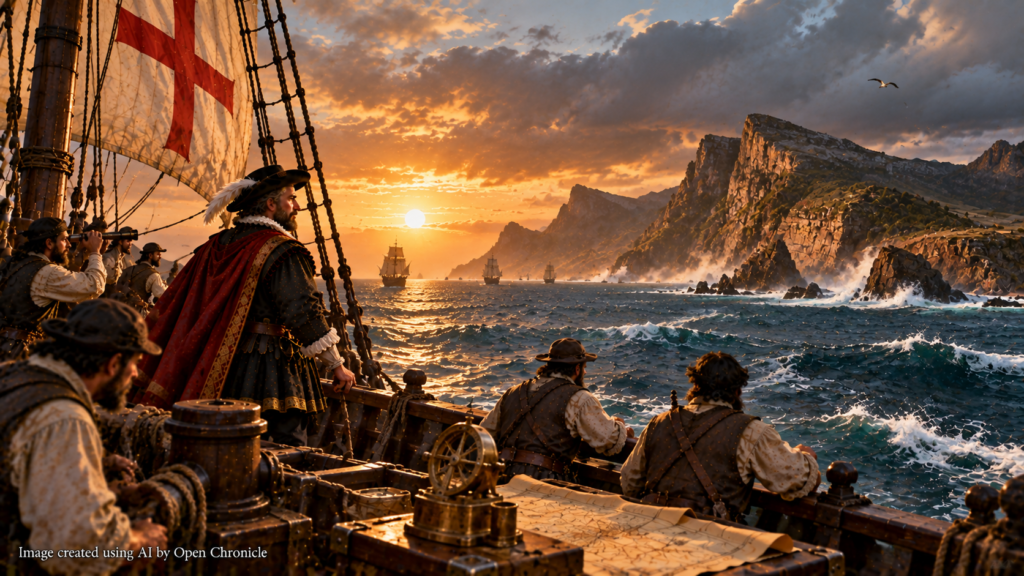
Drake continued west through the Indian Ocean.
The Golden Hind crossed waters that Portuguese navigators had been sailing for decades.
The expedition eventually approached southern Africa.
Ahead stood another famous maritime landmark: the Cape of Good Hope.
Rounding the Cape brought Drake back toward the Atlantic world.
For the surviving crew, England was still thousands of kilometres away.
But the most geographically unfamiliar portions of the journey were behind them.
The Golden Hind turned north through the Atlantic.
The final stage of the circumnavigation had begun.
15. September 26, 1580: Plymouth
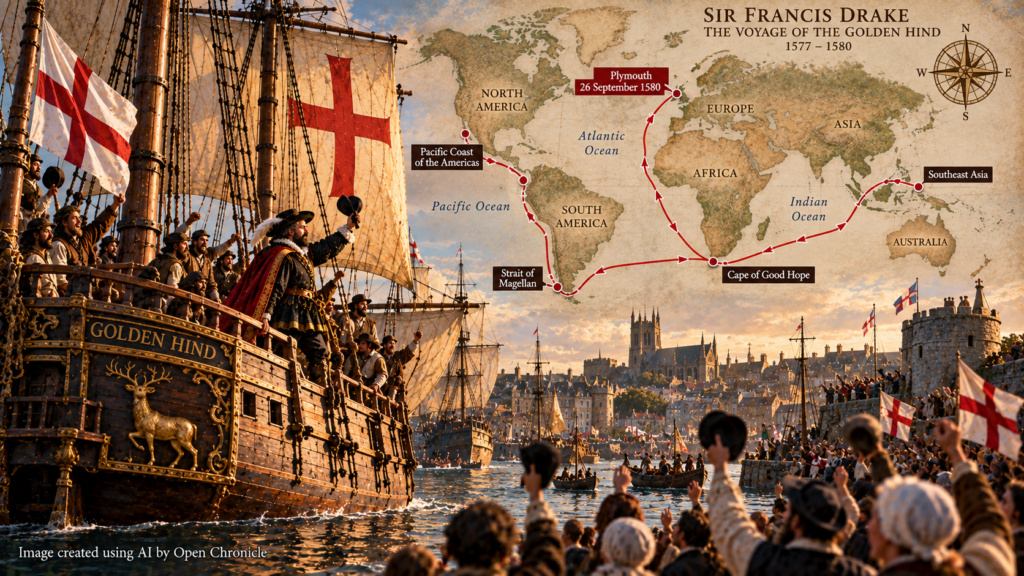
On September 26, 1580, the Golden Hind finally entered Plymouth.
Nearly three years had passed since Drake’s departure.
The ship that returned was the survivor of an expedition that had crossed the major oceans of the world.
Its crew had sailed through the Strait of Magellan.
They had travelled along the Pacific coast of the Americas.
They had crossed the Pacific.
They had reached Southeast Asia.
They had traversed the Indian Ocean.
They had rounded southern Africa.
And they had crossed the Atlantic back to England.
The voyage had become the second recorded circumnavigation of the globe.
For England, the implications were enormous.
16. Drake and Magellan
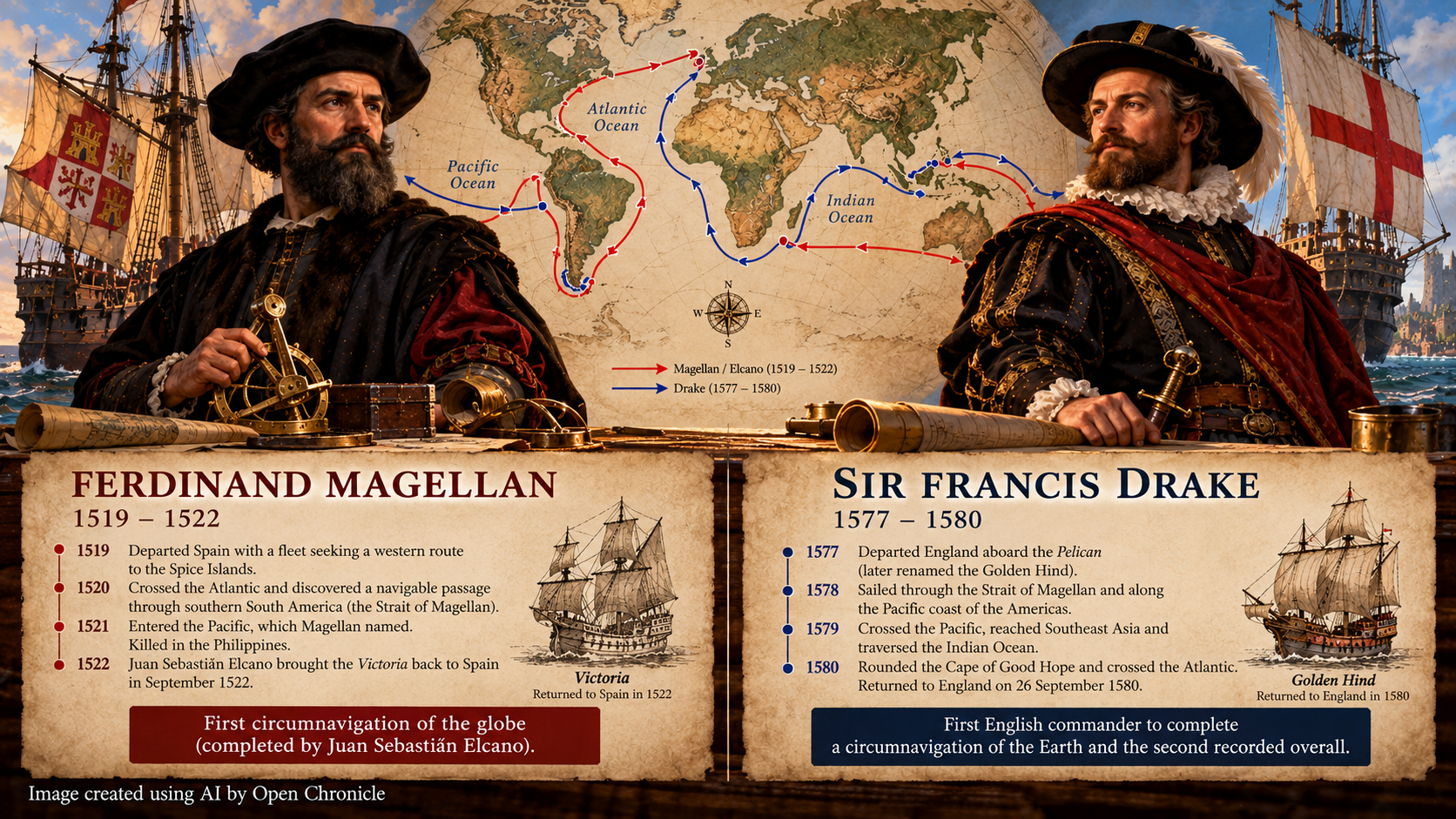
Drake was not the first commander associated with a voyage around the world.
That achievement had begun with Ferdinand Magellan.
Magellan departed Spain in 1519 with a fleet seeking a western route to the Spice Islands.
His expedition crossed the Atlantic and discovered a navigable passage through southern South America.
After entering the ocean that Magellan named the Pacific, the expedition crossed toward Asia.
Magellan was killed in the Philippines in 1521.
He therefore never completed the circumnavigation himself.
Command eventually passed to other officers, including Juan Sebastián Elcano.
Elcano brought the Victoria back to Spain in September 1522.
Only a fraction of the original expedition survived.
Drake’s circumnavigation occurred approximately six decades later.
Unlike Magellan, Drake survived the entire journey and returned to England aboard the Golden Hind.
He became the first English commander to complete a circumnavigation of the Earth.
17. Treasure and Intelligence
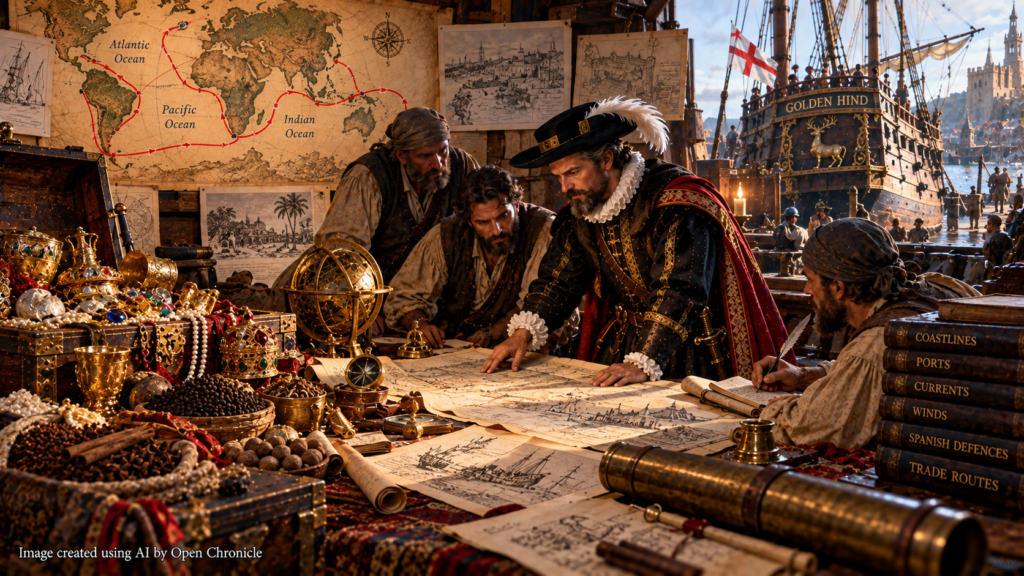
The Golden Hind returned carrying more than memories.
The expedition had accumulated considerable wealth through captured Spanish cargo and trade.
Precise estimates of the financial value vary, but the profits were substantial.
Yet another form of treasure may have been equally important.
Information.
Drake and his crew returned with knowledge of coastlines, currents, winds, ports, Spanish defenses and trading networks.
During the sixteenth century, geographical information possessed strategic value.
Maps could be state secrets.
Knowledge of safe harbours could determine whether an expedition survived.
Understanding prevailing winds could transform maritime routes.
Information about foreign defenses could shape future military operations.
Drake had effectively conducted a reconnaissance mission around much of the planet.
18. Queen Elizabeth I and the Golden Hind
Drake’s return created a diplomatic dilemma.
Spain regarded his attacks as criminal acts.
The English Crown had reason to avoid openly admitting responsibility for every aspect of the expedition.
At the same time, Drake had returned with enormous wealth and prestige.
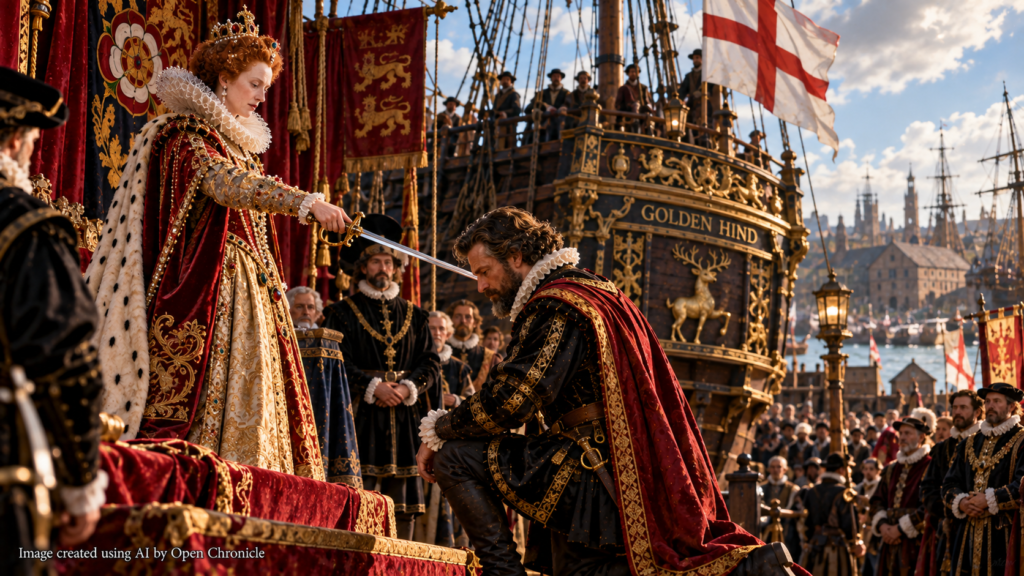
Queen Elizabeth I ultimately chose to honor him.
In April 1581, Drake was knighted aboard the Golden Hind at Deptford.
The ceremony transformed the voyage into something approaching a national achievement.
The ship itself became a symbol.
Rather than immediately disappearing into ordinary commercial service, the Golden Hind was preserved for a time as a memorial to the circumnavigation.
The vessel had become part of the political mythology of Elizabethan England.
19. Explorer, Privateer and Imperial Figure
Francis Drake became one of the most celebrated figures in English maritime history.
But modern historical understanding requires a broader perspective.
Drake was an exceptional navigator.
He was also a privateer.
He attacked settlements and ships.
He seized property.
He participated earlier in his career in voyages connected with the enslavement and trafficking of Africans.
His expeditions were connected to the beginnings of English imperial expansion.
None of these realities cancels the navigational achievement of the circumnavigation.
Nor does the navigational achievement erase the violence associated with his career.
Both belong to the same history.
The Age of Exploration was simultaneously an era of geographical discovery, commercial expansion, cultural encounters, conquest, slavery, warfare and empire.
Drake’s life embodied many of those contradictions.
20. England Looks Toward the Oceans
The circumnavigation did not immediately make England the world’s dominant maritime power.
Spain remained extraordinarily powerful.
Portugal maintained extensive overseas networks.
English commercial penetration of Asia remained limited.
But Drake’s voyage demonstrated what might be possible.
An English ship had crossed the Pacific.
It had reached Southeast Asia.
It had navigated through waters dominated by Spain and Portugal.
It had returned with treasure and information.
The psychological effect was significant.
England could imagine a maritime future extending far beyond the North Atlantic.
Within a generation, English merchants would establish organizations dedicated to long-distance overseas commerce.
The most famous would become the English East India Company, founded in 1600.
A new phase of English global expansion was beginning.
21. From Circumnavigation to the Spanish Armada
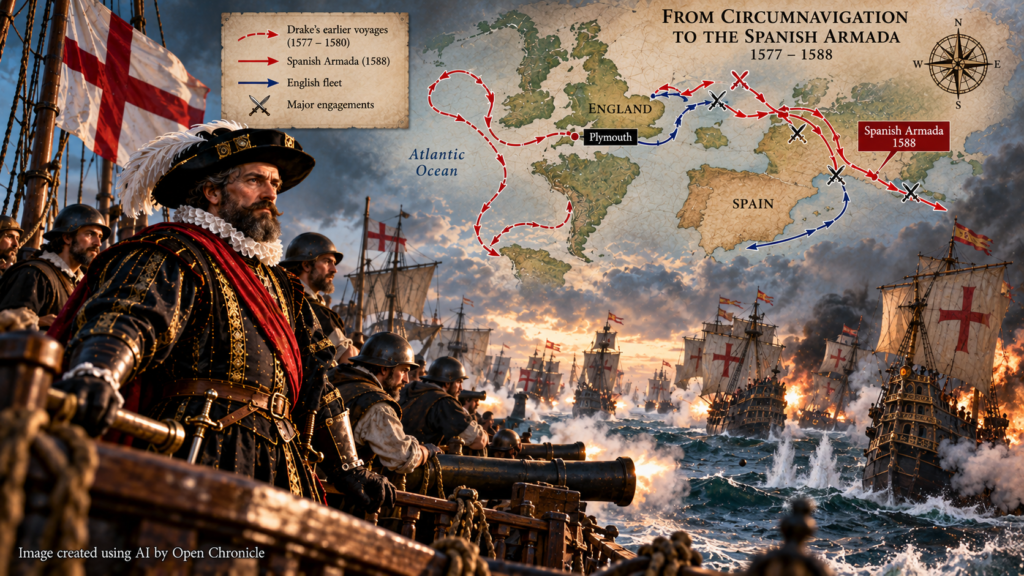
Relations between England and Spain continued to deteriorate during the years following Drake’s return.
By the middle of the 1580s, the conflict had developed into open warfare.
Drake continued attacking Spanish interests.
Then, in 1588, Philip II sent the Spanish Armada toward England.
Drake served among the senior English naval commanders involved in resisting the invasion.
The confrontation became one of the most famous naval campaigns in European history.
The navigator who had returned to Plymouth in 1580 had become one of England’s most important maritime commanders.
His knowledge of Atlantic navigation and naval warfare made him a central figure in the conflict.
22. A Planet Connected by Oceans
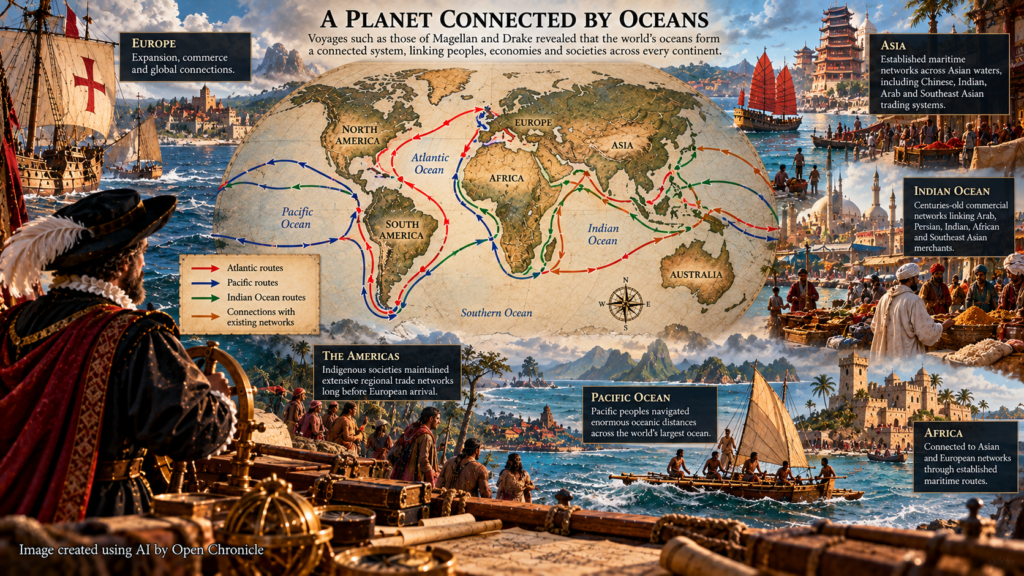
The deeper importance of voyages such as Drake’s lies in the transformation of geographical understanding.
Magellan’s expedition had demonstrated that ships could sail around the planet.
Drake demonstrated that the achievement could be repeated.
The oceans were not isolated bodies of water.
They formed a connected global system.
The Atlantic led toward the Pacific.
The Pacific connected the Americas with Asia.
Asian waters connected with the Indian Ocean.
The Indian Ocean opened toward Africa.
And Africa led back into the Atlantic.
For sailors, merchants and governments, the planet was increasingly being understood as a network of maritime routes.
But these connections did not begin with Europeans.
The Indian Ocean had supported vast commercial networks for centuries.
Arab, Persian, Indian, African and Southeast Asian merchants had created sophisticated systems of exchange.
Chinese fleets had travelled across Asian waters.
Pacific peoples had navigated enormous oceanic distances.
Indigenous American societies maintained extensive regional trade networks.
European oceanic expansion increasingly connected these existing systems into a global commercial network, often through coercion, conquest and colonial domination.
23. The Golden Hind as a Historical Symbol
Few ships from the sixteenth century have acquired the cultural status of the Golden Hind.
Its original hull did not survive permanently.
But its name endured.
Replicas were eventually constructed.
Images of the ship appeared in books, museums and historical reconstructions.
For generations, it represented the romantic image of Elizabethan exploration.
Yet the real history is more interesting than the legend.
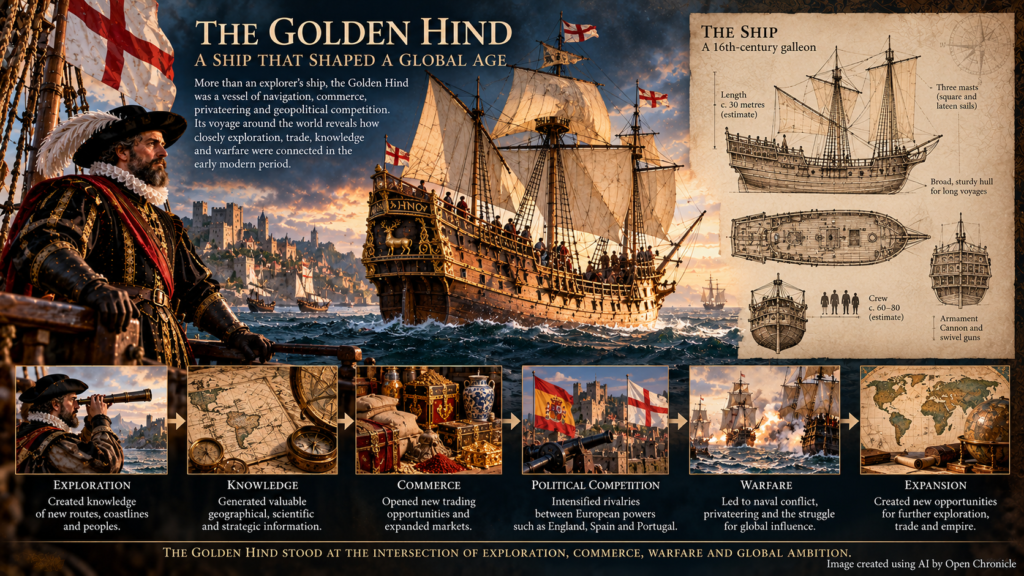
The Golden Hind was not simply an explorer’s ship.
It was simultaneously a vessel of navigation, commerce, privateering and geopolitical competition.
Its voyage reveals how closely these activities were connected during the early modern period.
Exploration created knowledge.
Knowledge created commercial opportunities.
Commerce encouraged political competition.
Political competition produced warfare.
And maritime warfare created new opportunities for expansion.
The Golden Hind existed at the intersection of all these forces.
24. Why September 26 Matters
September 26, 1580 marked the conclusion of one of the defining maritime expeditions of the sixteenth century.
Francis Drake had not proved for the first time that the world could be circumnavigated.
The expedition of Magellan and Elcano had already accomplished that extraordinary feat.
Drake’s achievement was different.
He demonstrated that another European maritime power could penetrate the Pacific, operate within distant commercial networks and return home by completing a global circuit.
The voyage expanded English geographical knowledge.
It exposed vulnerabilities in Spain’s maritime empire.
It encouraged English ambitions in long-distance commerce.
It strengthened the reputation of English oceanic navigation.
And it provided an early glimpse of the maritime competition that would shape the following centuries.
On September 26, 1580, the Golden Hind sailed into Plymouth after nearly three years away.
Its hull had crossed the Atlantic, Pacific and Indian Oceans.
Its crew had survived storms, conflict, enormous distances and the constant possibility of disaster.
Its cargo represented the wealth and violence of sixteenth-century maritime competition.
And its return signaled that England was beginning to look beyond European waters toward a much larger arena.
The world’s oceans were becoming increasingly connected.
And England intended to participate in the struggle over who would navigate, trade across and ultimately control them.
Open Chronicle History
Historical Sources and Further Reading
Selected institutional resources and historical scholarship for further exploration of Francis Drake, the Golden Hind, Elizabethan maritime history and early modern circumnavigation.
01 · Maritime History
Royal Museums Greenwich
Sir Francis Drake and the Golden Hind
Historical resources exploring Drake’s maritime career, his circumnavigation, the Golden Hind and England’s expanding naval ambitions during the Elizabethan period.
02 · Biography & Exploration
Encyclopaedia Britannica
Sir Francis Drake
A biographical overview of Drake’s career, including his early voyages, circumnavigation of the globe, privateering campaigns and later role in the conflict with Spain.
03 · Primary Sources & Collections
British Library
Elizabethan Exploration and the Maritime World
Manuscripts, maps, printed works and historical collections providing wider context for exploration, navigation, overseas commerce and England’s developing maritime ambitions.
04 · Historical Scholarship
Early Modern Maritime History
Exploration, Privateering and Global Expansion
Specialist scholarship on Elizabethan seafaring provides broader historical context for Drake’s circumnavigation, Anglo-Spanish rivalry, privateering, global commerce and the emergence of English overseas expansion.
Editorial Note
Open Chronicle History draws upon institutional collections, historical reference works and specialist scholarship. The history of early modern exploration is presented within its wider context, including maritime competition, privateering, colonial expansion, slavery, Indigenous societies and the development of global commercial networks.