
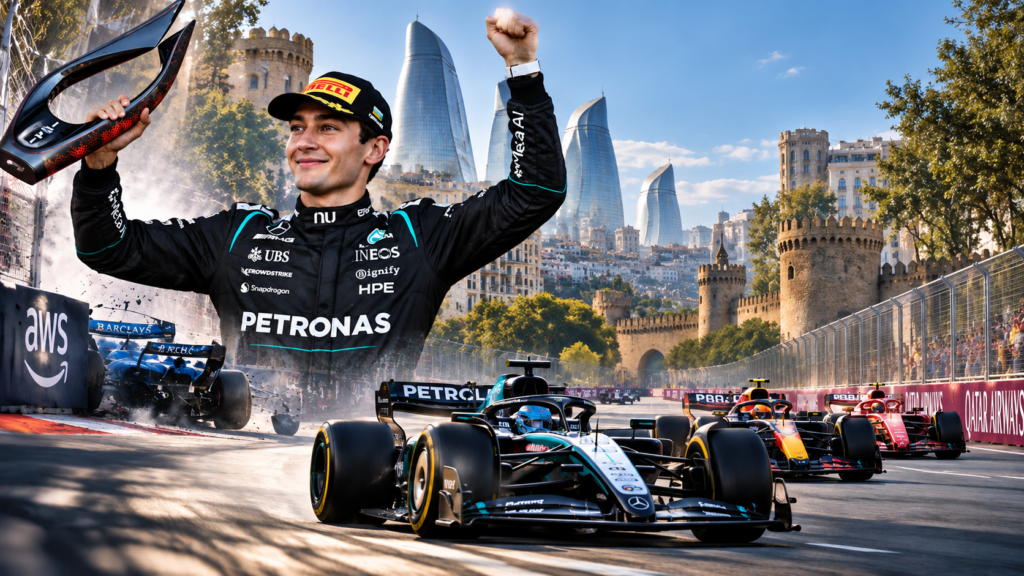
George Russell’s Azerbaijan Grand Prix victory was built on exceptional qualifying speed, controlled tyre management and precise execution under pressure. But Baku also revealed a resurgent Red Bull, an increasingly complicated championship fight and a Ferrari package that could not reproduce its qualifying position across the full race distance.
By Open Chronicle Formula One Magazine
George Russell left Baku with much more than another Grand Prix victory.
Across one of Formula One’s most demanding street circuits, the Mercedes driver produced one of the most complete weekends of his 2026 season. He established the pace during practice, delivered an extraordinary qualifying lap, controlled the opening phase of the Grand Prix and then survived a completely different challenge when Safety Car periods erased the advantage he had spent much of the race building.
Max Verstappen ultimately crossed the line only 0.196 seconds behind Russell, while Isack Hadjar completed a double Red Bull podium. Charles Leclerc finished fourth for Ferrari and championship leader Kimi Antonelli recovered from 16th on the grid to fifth.
The final classification, however, tells only part of the story.
Baku exposed several important trends in the 2026 competitive order.
Qualifying Pace
Russell finds a level the rest cannot match
Before Q3, Azerbaijan qualifying looked remarkably open.
Mercedes, Ferrari, McLaren and Red Bull had all shown enough performance to suggest that pole position could be contested by several drivers. That expectation disappeared when Russell completed his final qualifying lap.
His 1:42.526 gave Mercedes pole by an extraordinary 0.837 seconds over Charles Leclerc.
Behind Russell, the field was dramatically compressed. Leclerc recorded 1:43.363 and Oscar Piastri 1:43.364, a difference of only 0.001 seconds. Isack Hadjar followed with 1:43.500, with Lando Norris fifth on 1:43.672.
That distinction matters.
Baku did not necessarily demonstrate a general Mercedes advantage approaching a second per lap. Instead, it demonstrated an exceptional Russell performance within a leading group where several cars remained closely matched.
Russell had already provided evidence of his confidence in the Mercedes during practice.
He topped FP1 with 1:45.687 and improved to 1:43.347 to lead FP2. Verstappen responded in FP3, recording 1:43.922, but Russell remained only 0.099 seconds behind.
The pattern suggested that Mercedes had found a strong operating window around Baku before qualifying even began.
Then Russell elevated the performance further.
The margin to Leclerc was enormous by modern Formula One standards, particularly when the Ferrari and McLaren immediately behind were separated by only one thousandth of a second.
Antonelli demonstrated the danger on the opposite side of the Mercedes garage.
The championship leader had underlying speed but crashed at Turn 1 during Q1, damaging the front left suspension. His earlier time was sufficient to progress, but the car could not return and he was left 16th on the grid.
The championship consequences had begun before the race even started.
Tyre Degradation
Baku became a contest between preserving performance and retaining track position
Pirelli brought the C3 Hard, C4 Medium and C5 Soft compounds to Azerbaijan.
Baku creates an unusual tyre challenge.
The slow corners demand traction and mechanical grip, but the exceptionally long full throttle sections do not generate the same continuous lateral loads found at more conventional circuits. Drivers also need confidence under braking because locking a tyre can quickly turn into a trip down an escape road or contact with the barriers.
Russell and Verstappen started the Grand Prix on the Medium compound.
Leclerc, Piastri, Hadjar, Hamilton, Bearman, Lawson, Albon, Ocon, Alonso and Stroll chose the Soft.
That immediately created different strategic approaches among the leading cars.
Leclerc had the theoretical early grip advantage of the Soft but could not transform it into control of the race. Piastri moved ahead, while the Red Bulls gradually became increasingly significant factors in the fight at the front.
Hadjar extracted considerably more from the Soft strategy.
Russell’s opening Medium stint was crucial to the eventual result. He could maintain enough speed to protect track position while also extending the useful life of the tyre.
Verstappen experienced a different trajectory on the same compound.
He complained about the behaviour of his Medium tyres during the opening phase, while Hadjar remained sufficiently competitive on the Soft to create an interesting strategic situation inside Red Bull.
The race interruptions subsequently transformed the tyre picture.
Fresh rubber became increasingly valuable as the field compressed, and Verstappen eventually switched to Soft tyres for the decisive final phase.
By then, the central tyre question was no longer simply degradation.
It was whether Russell could retain enough traction and performance to defend against a Red Bull that had become increasingly threatening.
He could.
But only just.
Strategy
Safety Cars destroyed Russell’s carefully constructed advantage
For much of the opening part of the Grand Prix, Mercedes had exactly the race it wanted.
Russell had clean air, track position and enough pace to control proceedings without exposing himself unnecessarily.
Behind him, the strategic picture was much more complicated.
Verstappen began working his way forward from eighth. He passed Hamilton, then Norris, Leclerc and Hadjar as the Red Bull became an increasingly serious threat.
Antonelli was conducting a very different race.
Starting 16th after his qualifying accident, the Mercedes driver progressively moved through the midfield. He passed Sainz, Ocon, Albon, Lawson and Bearman during his recovery.
Then the complexion of the Grand Prix changed.
Alexander Albon went straight into the barriers on Lap 31, triggering a Safety Car.
The neutralisation was strategically significant because Russell and several of the leaders had already passed the pit entry. They therefore had to wait before making their stops.
The gaps Russell had spent much of the race constructing effectively disappeared.
Verstappen switched to Soft tyres for the final phase, creating a direct performance threat to the Mercedes.
The restart turned the race into something fundamentally different.
The first part of the Grand Prix had been about controlling pace, protecting tyres and building a margin.
The final part became a sprint.
Russell no longer possessed the strategic protection of a large gap.
He had track position.
And he had Verstappen behind him.
That is why the final margin of 0.196 seconds requires context. Russell had demonstrated a more comfortable advantage earlier in the Grand Prix. The Safety Car converted that advantage back into little more than the right to lead the restart.
Mercedes therefore effectively had to win the same Grand Prix twice.
First through pace and management.
Then through defence and execution.
Driver Execution
Russell adapts to every version of the race
Russell faced several different challenges across the Azerbaijan weekend.
First came outright speed.
He delivered it in qualifying.
Then came race management.
He controlled the opening phase without unnecessarily compromising his tyres.
Finally came pressure.
Once the race had been compressed, the Mercedes driver had almost no margin for error.
Verstappen’s recovery was relentless.
Starting eighth, he passed Hamilton before moving ahead of Norris. He then overtook Leclerc and Hadjar, progressively turning what initially looked like a recovery drive into a genuine challenge for victory.
The final laps placed Russell under significant pressure.
His fastest lap of 1:44.916 on Lap 49 illustrates how hard Mercedes was pushing late in the race. Verstappen was operating at a similarly intense level as the Red Bull closed towards the leader.
Russell nevertheless kept the Mercedes ahead and crossed the line less than two tenths clear.
Hadjar’s performance deserves similar attention.
Fourth on the grid became third at the finish. More importantly, his pace was sufficient for Red Bull to manage two competitive cars near the front rather than relying exclusively on Verstappen.
Antonelli produced perhaps the most important recovery drive of the afternoon.
His mistake had occurred on Saturday.
His response came on Sunday.
From 16th, he methodically climbed through the field and eventually reached fifth place. The recovery could not prevent Russell from taking a significant number of championship points from him, but it prevented the qualifying accident from becoming a championship disaster.
Baku therefore illustrated two very different forms of title contention inside Mercedes.
Russell maximised his opportunity.
Antonelli minimised the damage.
Technical Development
Mercedes succeeds through execution while Red Bull emerges as a growing threat
The technical picture in Baku was particularly interesting because outright development alone did not explain the competitive order.
Mercedes arrived with a package that immediately appeared comfortable around the unusual characteristics of the circuit.
Baku requires a difficult compromise.
Teams need enough aerodynamic and mechanical performance to negotiate the slow corners of the old city section, but excessive drag can be heavily punished on the long run towards the start and finish line.
Straight line efficiency therefore matters enormously.
So does braking stability.
And because the circuit contains several low speed acceleration zones, rear traction becomes another critical performance variable.
Mercedes appeared to find an effective compromise.
Russell could attack the braking zones while maintaining enough efficiency through the high speed sections. The car also appeared capable of keeping its tyres inside a useful operating window over both qualifying runs and longer race stints.
Red Bull’s performance was equally significant.
Verstappen was only eighth in qualifying, partly because yellow flags disrupted his session, but the race exposed considerably greater potential.
The Red Bull was effective enough in race trim for Verstappen to pass several leading cars and eventually challenge Russell for victory.
Hadjar’s third place reinforced the impression that the underlying package was competitive rather than Verstappen simply producing an isolated result.
That matters for the remaining races.
If Red Bull can regularly place both cars near the front, it can influence not only individual victories but also the Mercedes championship battle.
McLaren produced a different picture.
Piastri qualified third, only 0.001 seconds behind Leclerc, demonstrating substantial one lap performance.
The race was less convincing.
Piastri experienced rear tyre difficulties and gradually lost contact with the decisive fight. Norris also failed to translate McLaren’s underlying pace into a major result.
Ferrari faced a similar disconnect.
Leclerc qualified second but finished fourth. Hamilton started sixth and finished sixth.
The Ferrari therefore demonstrated enough qualifying performance to occupy the front row, but not enough sustained race performance to fight Russell and the recovering Red Bulls for victory.
That distinction between peak performance and repeatable race pace could become increasingly important during the closing stages of the season.
Championship Impact
Russell reduces the deficit from 81 points to 66
Baku did not overturn the championship.
It changed its direction.
Antonelli arrived in Azerbaijan with an 81 point advantage over Russell.
He left with 66 points.
The swing was created by two very different weekends inside the same team.
Russell qualified first.
Antonelli effectively started 16th after his accident.
Russell won.
Antonelli recovered to fifth.
The result gave Russell a significant championship gain without fundamentally removing Antonelli’s control of the title race.
Antonelli now has 302 points.
Russell has 236.
Lewis Hamilton sits on 199, Lando Norris on 186, Charles Leclerc on 179 and Verstappen on 163.
Antonelli therefore remains in an extremely strong position.
A 66 point advantage provides strategic flexibility. He does not need to beat Russell at every remaining Grand Prix. Consistency can still be enough.
But Baku demonstrated how quickly the equation can change.
One qualifying mistake placed Antonelli deep in the field.
One exceptional qualifying lap placed Russell on pole.
Twenty four hours later, the difference between those Saturdays had become a major championship swing.
The constructors’ picture is even more favourable for Mercedes.
Mercedes leaves Baku with 538 points, while Ferrari has 378.
That creates a 160 point advantage.
McLaren remains on 306, while Red Bull’s Azerbaijan performance strengthens its position behind the leading three and suggests the competitive order may become more complicated during the final rounds.
For Ferrari, the concern extends beyond the points deficit.
Baku suggested that the car can still produce formidable one lap performance. Leclerc’s front row start demonstrated that.
The larger question is whether Ferrari can sustain that performance across a complete Grand Prix.
Mercedes could.
Red Bull increasingly could.
Ferrari could not in Azerbaijan.
The Bigger Picture
Baku may ultimately prove to be one of the defining races of the second half of the 2026 season.
Russell demonstrated that Mercedes has two drivers capable of controlling a Grand Prix weekend.
Verstappen demonstrated that Red Bull can again threaten for victories.
Hadjar showed that the second Red Bull can play an important strategic role at the front.
Ferrari retained strong qualifying potential but exposed concerns over sustained race pace.
McLaren showed flashes of speed without converting them into the result its qualifying performance suggested was possible.
And Antonelli discovered the value of a large championship advantage.
His qualifying accident could have produced a disastrous weekend.
Instead, he recovered to fifth.
Russell therefore leaves Azerbaijan with the trophy and momentum.
Antonelli leaves with the championship lead.
The difference between them is now 66 points.
With seven rounds remaining, Baku has not decided the 2026 World Championship.
It has made the fight considerably more consequential.