
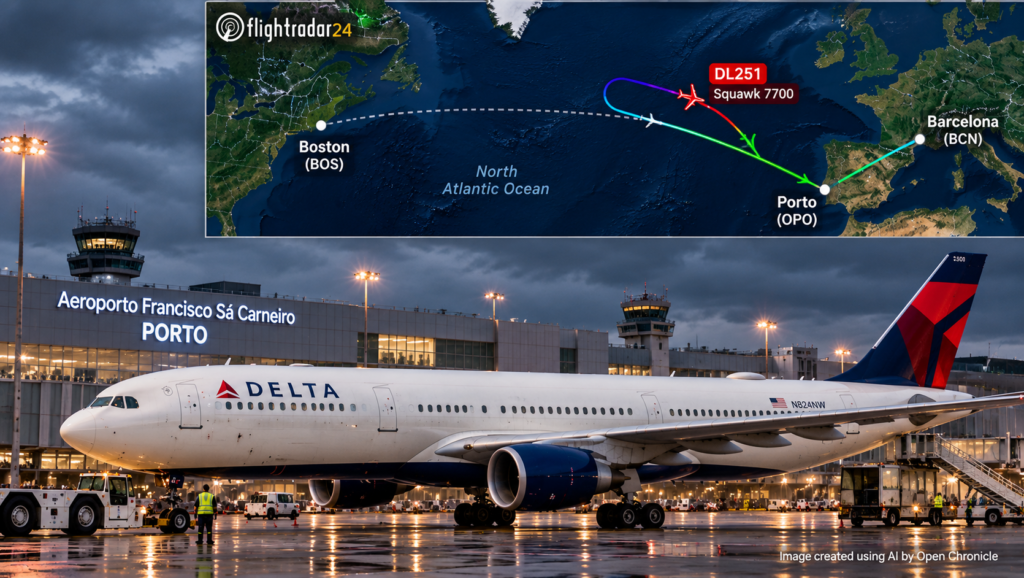
Delta Air Lines flight DL251 was forced to abandon its transatlantic crossing and divert to northern Portugal after a medical emergency developed on board, with the Airbus A330 landing safely at Porto following a general emergency declaration.
By Open Chronicle | September 27, 2026
PORTO, Portugal — A Delta Air Lines flight travelling from Barcelona to Boston was forced to turn back over the Atlantic Ocean on Sunday after a medical emergency developed in the cabin, prompting the crew to declare a general emergency and divert to Porto.
Delta flight DL251 had departed Josep Tarradellas Barcelona El Prat Airport shortly after 3:00 PM local time for its scheduled transatlantic journey to Boston.
The service was being operated by an Airbus A330 300, registration N824NW, an aircraft approximately 11 years old.
After departure from Barcelona, the aircraft climbed to an initial altitude of 33,000 feet while crossing mainland Spain before settling at approximately 32,000 feet for the oceanic portion of the flight.
The journey initially proceeded west towards the Atlantic.
Approximately two hours after departure, however, the situation changed.
Medical emergency forces crew to abandon Atlantic crossing
While flying west over the Atlantic Ocean, the crew was confronted with an unfolding medical situation involving someone aboard the aircraft.
The pilots decided that continuing towards Boston was no longer appropriate and initiated a diversion.
The aircraft turned back towards Europe as the crew requested an immediate diversion to the nearest suitable airport.
During the emergency, the pilots transmitted Squawk 7700, the transponder code internationally used by aircraft to indicate a general emergency.
The declaration gives air traffic controllers immediate awareness that an aircraft requires priority handling and allows them to coordinate an appropriate response.
DL251 turns towards Porto
Air traffic controllers directed the wide body Airbus towards Francisco de Sá Carneiro Airport in Porto.
Porto offered a suitable airport for the A330 and allowed the crew to bring the aircraft back onto the ground without continuing the much longer crossing to the United States.
The diversion represented a significant reversal for the flight.
DL251 had already spent roughly two hours travelling towards North America when the crew abandoned the crossing and headed towards Portugal.
The Airbus subsequently approached Porto and landed safely on Runway 35.
The landing occurred a little more than three hours after the aircraft had departed Barcelona.
There was no indication of a technical problem involving the aircraft itself.
The diversion was prompted by the medical situation in the cabin.
Safe landing ends emergency phase
Once DL251 landed in Porto, the immediate airborne emergency was over.
For passengers expecting to arrive in Boston, however, the diversion created a substantially different journey.
Instead of crossing the Atlantic and landing in Massachusetts, passengers found themselves unexpectedly in northern Portugal while Delta reorganised the continuation of the service.
The airline rescheduled the Porto to Boston continuation for 1:00 PM local time on September 28.
Passengers therefore faced an overnight interruption before the transatlantic journey could resume.
Diversion creates wider disruption for Delta
The consequences extended beyond DL251 itself.
International airline schedules depend heavily on aircraft and crews arriving at specific airports at planned times. A major diversion can therefore affect subsequent services when an aircraft and its operating crew are no longer where the airline expected them to be.
That appears to have happened following the Porto diversion.
With the Airbus and crew out of their planned operating sequence, Delta confirmed that flights DL276 and DL277 were cancelled.
Passengers affected by those cancellations were being transferred to alternative routes or provided with accommodation while arrangements were made.
The incident demonstrates how a single medical emergency aboard a long haul flight can generate operational consequences across an airline network.
Why Squawk 7700 matters
One of the most significant moments during the incident was the transmission of Squawk 7700.
Aircraft transponders send identifying and operational information to air traffic control systems. Specific numerical codes can also communicate particular situations.
Code 7700 indicates a general emergency.
Using it does not reveal the precise nature of the problem. Instead, it immediately alerts controllers that the aircraft requires emergency handling.
In the case of DL251, the declaration accompanied the crew’s request to abandon the transatlantic crossing and divert.
Air traffic controllers could then prioritise the aircraft and coordinate its route towards Porto.
Medical emergencies pose particular challenges over the Atlantic
Medical incidents aboard long haul flights present crews with difficult decisions, particularly after an aircraft has begun an oceanic crossing.
Unlike flights over densely populated continental regions, transatlantic aircraft can spend long periods far from major airports.
When a serious medical problem occurs, pilots must consider the aircraft’s position, the time required to reach potential diversion airports and the suitability of those airports for a large wide body aircraft.
DL251 was still in a position from which returning towards Portugal provided the crew with an appropriate alternative.
The decision ultimately brought the Airbus safely onto the ground at Porto.
An unexpected transatlantic stop in Portugal
For Francisco de Sá Carneiro Airport, the emergency brought an unscheduled Delta wide body aircraft to Porto during what should have been a direct Barcelona to Boston operation.
For the passengers aboard DL251, the priority shifted from reaching Boston on schedule to safely resolving the medical emergency.
The flight’s continuation has now been moved to the following day.
The safe landing also illustrates the contingency planning built into international aviation. Even on long oceanic routes, crews continuously assess where an aircraft could divert should circumstances make continuing to the planned destination impossible.
On Sunday, that planning transformed Porto from an airport beneath the broader European route network into the unexpected destination of a Boston bound Airbus crossing the Atlantic.