
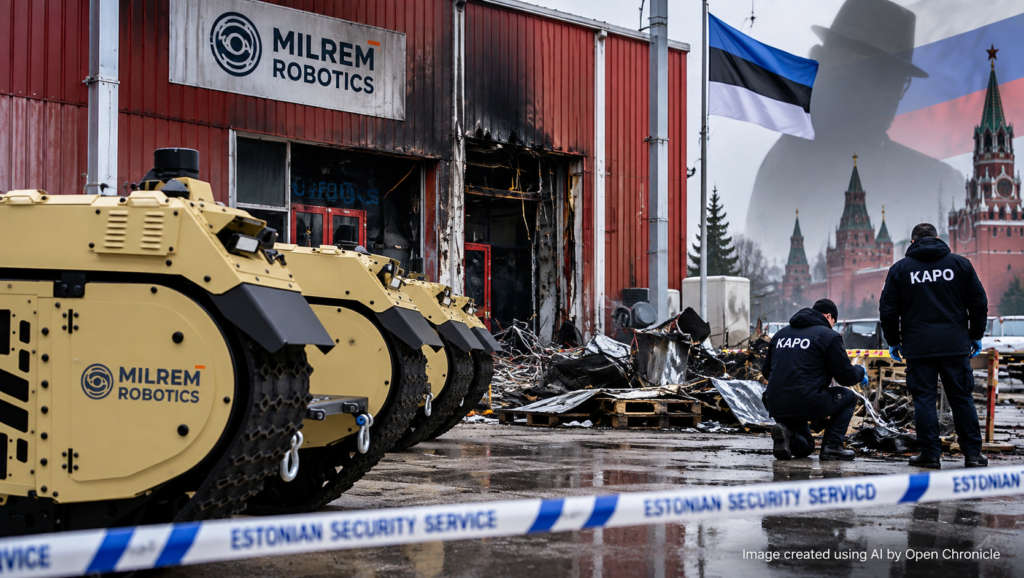
Estonian authorities say Russian intelligence services ordered an arson attack against a Tallinn facility belonging to defence technology company Milrem Robotics, describing the incident as part of a wider campaign of sabotage intended to intimidate European countries supporting Ukraine. The Kremlin has rejected the accusation as unfounded.
By Open Chronicle with agencies | September 29, 2026
TALLINN — Estonia has publicly accused Russian intelligence services of ordering an arson attack against a building belonging to Milrem Robotics, an Estonian defence technology company that manufactures unmanned military ground vehicles used by Ukraine.
Estonian Foreign Minister Margus Tsahkna and the country’s Internal Security Service, known as KAPO, announced the findings on Tuesday following an investigation into the fire, which occurred in Tallinn during the night of August 14.
Three Latvian citizens suspected of carrying out the attack were subsequently detained in Latvia and extradited to Estonia.
No one was injured in the fire, and Milrem Robotics said the incident did not disrupt its production or deliveries.
Estonia calls attack an act of sabotage
Tsahkna said information collected by KAPO had allowed Estonian authorities to conclude that the fire was deliberately ordered by Russian intelligence services.
“Based on the information collected by the Estonian Internal Security Service we can conclude with certainty that the arson attack on Milrem Robotics premises that took place on the night of 14 to 15 August in Tallinn was an act of sabotage ordered by the special services of the Russian Federation,” Tsahkna said.
The accusation represents a significant escalation from the position taken by the Estonian government immediately following the incident.
Prime Minister Kristen Michal had previously said investigators were examining whether Russia could have been involved.
Estonian authorities are now publicly attributing responsibility to Russian intelligence.
Milrem Robotics develops military unmanned vehicles
Milrem Robotics is one of Estonia’s most prominent defence technology companies and specialises in unmanned ground vehicles and robotic military systems.
Some of the company’s systems are being used in Ukraine.
That connection has become particularly significant in Estonia’s assessment of the suspected motive behind the attack.
Tallinn has been one of Ukraine’s strongest supporters since Russia launched its full scale invasion in February 2022, providing military assistance while advocating stronger European pressure on Moscow.
The attack against a company involved in supplying military technology therefore carries implications extending beyond an ordinary case of arson.
Fire broke out during night of August 14
The fire occurred at the Milrem Robotics facility in Tallinn during the night of August 14 into August 15.
Emergency services responded to the incident, and no casualties were reported.
Milrem Robotics later said that the damage had not affected its ability to continue production or fulfil deliveries.
The investigation nevertheless quickly attracted national security attention.
Authorities began examining whether the attack could have been connected to foreign intelligence activity, particularly because of Milrem Robotics’ role in the European defence industry and its connection to Ukraine.
Three Latvian citizens detained
Three people suspected of carrying out the arson were later detained in neighbouring Latvia.
The suspects were identified as Latvian citizens and subsequently extradited to Estonia.
Estonian investigators have continued examining the circumstances surrounding the attack, including who allegedly directed the suspects and the wider network potentially involved.
The public attribution announced on September 29 shifts the focus from the individuals accused of physically carrying out the attack to those Estonia says ordered it.
Tallinn sees attack as part of wider campaign
Tsahkna placed the incident within what Estonia describes as a broader Russian campaign targeting European countries.
“This act of sabotage is part of Russia’s broader campaign across Europe, aimed at intimidating us and weakening our support for Ukraine,” the foreign minister said.
He indicated that Estonia would respond by moving in the opposite direction.
“Our response will be the opposite. We will increase both our support for Ukraine and the pressure on Russia to end its aggression,” Tsahkna said.
The statement frames the Milrem Robotics incident not as an isolated criminal act, but as part of a wider confrontation involving espionage, sabotage and other activities below the threshold of conventional warfare.
Hybrid threats increasingly concern European governments
European governments have become increasingly concerned about alleged sabotage and covert operations targeting infrastructure, defence industries and other strategically important facilities.
Such incidents occupy a difficult space between conventional espionage, criminal activity and direct military action.
Authorities across Europe have increasingly used the term hybrid warfare to describe operations involving sabotage, cyberattacks, disinformation, interference with infrastructure and the use of intermediaries to carry out covert activities.
Estonia’s attribution of the Milrem Robotics fire adds another case to that wider security debate.
For governments bordering Russia, including Estonia, Latvia and Lithuania, the issue has particular urgency because of their geographical position and strong military support for Ukraine.
Defence companies present attractive targets
The attack also highlights the security challenges confronting Europe’s rapidly expanding defence industry.
As European governments increase military spending and accelerate weapons production, factories and technology companies connected with defence programmes are becoming increasingly important components of national security.
Milrem Robotics occupies a particularly sensitive position because it develops autonomous and remotely operated ground vehicles with military applications.
The use of some of those systems in Ukraine further increases the strategic importance of the company.
An attack that does not stop production can still impose security costs, force companies to strengthen protection and generate uncertainty among employees and suppliers.
Estonia says intimidation will not change Ukraine policy
Estonia has made clear that the alleged attack will not reduce its support for Kyiv.
Instead, Tsahkna said Tallinn intends to increase assistance to Ukraine and intensify pressure on Moscow.
That response reflects Estonia’s broader position toward Russia since the beginning of the war.
As a NATO member sharing a border with Russia, Estonia has consistently argued that European security depends on preventing Moscow from achieving its objectives through military force or coercion.
The Milrem Robotics investigation now adds an internal security dimension to that policy.
Kremlin rejects Estonia’s allegations
Moscow has rejected the accusation.
Kremlin spokesman Dmitry Peskov described Estonia’s allegations as “unfounded” and “ill considered.”
Russia has therefore denied responsibility for the incident, creating a direct dispute between Tallinn and Moscow over attribution.
The opposing statements are significant because assigning responsibility for covert operations can be difficult, particularly when authorities believe intelligence services have worked through intermediaries rather than conducting an operation directly.
Estonia, however, says its Internal Security Service has gathered sufficient information to attribute the attack to Russian special services.
Investigation carries wider European implications
The Milrem Robotics case is likely to attract attention beyond Estonia because it combines several of Europe’s most pressing security concerns: support for Ukraine, protection of defence industries, alleged Russian covert operations and the growing threat of sabotage inside NATO countries.
Three suspected perpetrators are in Estonian custody, while Tallinn has now publicly identified who it believes ultimately ordered the operation.
The fire caused no injuries and did not stop Milrem Robotics from continuing production.
Its political consequences could prove considerably larger.
By describing the attack as part of a Russian campaign intended to intimidate Europe and weaken support for Ukraine, Estonia has placed the incident within the broader security confrontation between Moscow and the West.
The Kremlin rejects that interpretation.
The investigation will now be closely watched for further evidence about how the alleged operation was organised, how the suspects were recruited and whether authorities identify connections with other suspected sabotage operations elsewhere in Europe.