
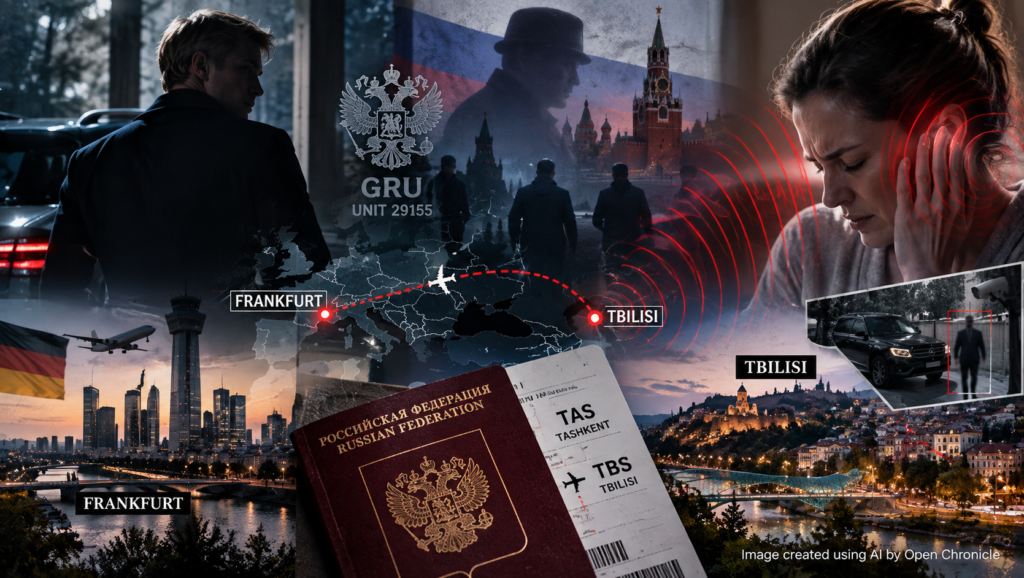
A yearlong investigation by The Insider, 60 Minutes and Der Spiegel has uncovered evidence suggesting that members of Russia’s GRU Unit 29155 may have been connected to some of the unexplained health incidents known as Havana Syndrome. The findings include travel records, communications data and the reported presence of suspected Russian operatives near incidents involving American officials and their families. The evidence raises serious questions, but does not by itself establish publicly verified proof that Russia caused the incidents or identify a specific weapon.
By Open Chronicle with agencies | September 29, 2026
WASHINGTON — A multinational investigation has presented new evidence potentially connecting members of a Russian military intelligence unit associated with overseas sabotage operations to mysterious health incidents reported by American diplomats, intelligence personnel and their families.
The investigation, conducted over a year by The Insider in collaboration with 60 Minutes and Der Spiegel, focuses on Unit 29155 of Russia’s GRU military intelligence service.
Investigators examined travel records, telephone data, witness accounts and the movements of suspected members of the unit around locations where Americans reported sudden and unexplained neurological symptoms.
The incidents have become widely known as Havana Syndrome, although US authorities generally refer to them as anomalous health incidents.
The investigation suggests that directed energy technology could potentially have been involved. However, the precise cause of the incidents remains disputed, and the material presented does not establish definitive public proof that a particular weapon was used.
One of the most striking cases examined by the investigation occurred in Tbilisi, Georgia, in October 2021.
A sudden attack in Tbilisi
On October 7, 2021, an American nurse living in an upscale residential area of Tbilisi experienced what she described as an extraordinary and sudden physical event inside her home.
The woman, identified by the pseudonym Joy to protect her identity, was married to a Justice Department attaché working at the US Embassy.
She had been removing laundry from a dryer on the second floor when she was suddenly overwhelmed by an intense ringing sensation.
“It just pierced my ears, came in my left side, felt like it came through the window, into my left ear,” she recalled.
Joy said she immediately experienced pressure inside her head and an intense headache.
She left the laundry room and entered a bathroom adjoining the main bedroom, where she vomited.
The symptoms resembled those described by other American government personnel who have reported anomalous health incidents in different countries.
A suspicious vehicle outside the house
Joy and her husband had moved to Georgia in February 2020, shortly before the beginning of the COVID 19 lockdown.
As the spouse of an American official posted overseas, she had received security training that instructed her to leave a location if she believed something unusual or threatening was occurring.
After experiencing the sudden symptoms, she checked the security camera covering the front of the property.
A black Mercedes crossover was parked outside the gate, directly opposite the room where she had experienced the incident.
Joy went outside.
There, she saw a tall, thin, young man with blond hair.
She raised her telephone to photograph him.
“It was like he locked eyes with me. He knew what I was doing,” she recalled.
The man entered the Mercedes and the vehicle drove away.
Joy photographed the car and its licence plate as it departed.
Witness later identifies suspected Russian operative
Three years later, investigators showed Joy a photograph of Albert Averyanov, whom the investigation identifies as an operative associated with GRU Unit 29155.
Joy said she believed Averyanov was the man she had seen outside her home.
That identification is a witness account rather than independent proof that Averyanov was present or responsible for what happened.
The investigation nevertheless uncovered travel and communications information that it says places Averyanov outside Russia during the relevant period and potentially in Georgia.
Albert Averyanov is the son of Andrey Averyanov, who has been identified as a senior figure associated with Unit 29155.
Unit 29155 comes under scrutiny
Unit 29155 has previously been associated by Western governments and investigative organizations with covert Russian operations abroad.
The new investigation examines whether individuals connected with the unit could also have been involved in anomalous health incidents affecting American government personnel.
According to the investigation, Albert Averyanov had been developing connections with the unit from a young age.
Investigators say he trained in Geneva under the supervision of Col. Egor Gordienko, who was stationed there under diplomatic cover as Russia’s second trade representative at the World Trade Organization.
Communications data obtained by the investigating organizations reportedly shows Averyanov maintaining frequent contact with known members of Unit 29155.
Travel records also reportedly show journeys alongside individuals connected with the unit.
A journey beginning eight days before the incident
The travel records surrounding the Tbilisi case are particularly significant to the investigation.
Albert and Andrey Averyanov left Moscow on September 30, 2021.
That was eight days before Joy reported the incident at her home.
The father and son flew to Tashkent, Uzbekistan.
They returned to Moscow on October 10.
Investigators, however, say evidence suggests Uzbekistan was not necessarily their final destination.
Andrey Averyanov reportedly switched off his telephone in Moscow before travelling and did not reactivate it until his return on October 10.
Albert Averyanov kept his telephone active somewhat longer.
At 8:04 a.m. on October 1, investigators say his device received a call from an unidentified Uzbek number.
His telephone was then switched off.
Thirty six minutes later, a flight departed Tashkent for Tbilisi.
At the time, there were no direct commercial flights between Russia and Georgia because of political tensions between the countries.
Ten days without conventional location data
Averyanov’s telephone remained switched off during the following ten days, preventing investigators from obtaining normal geolocation information for that period.
The available telecommunications information nevertheless indicated that the device was roaming.
On the evening of October 9, Averyanov apparently switched the telephone on again.
According to the investigation, he then received an automated message from mobile operator Beeline welcoming him to Uzbekistan.
Investigators interpret that message as evidence that the telephone had previously been outside Uzbekistan and had returned to the country before Averyanov’s flight back to Moscow.
The sequence does not independently prove that Averyanov travelled to Tbilisi, but investigators argue that it is consistent with such a journey.
Averyanov questioned by investigators
The Insider later contacted Albert Averyanov by telephone and asked whether he had been in Tbilisi when American personnel and their relatives experienced the suspected incidents.
According to the investigation, Averyanov initially demanded to know who was calling.
After being told that the caller was The Insider’s editor in chief, he ended the conversation.
No substantive response to the allegation was provided during that exchange.
The mystery predates Havana
Although the phenomenon became internationally known as Havana Syndrome after cases involving US personnel in Cuba, the investigation points to possible earlier incidents.
One of the most significant locations is Frankfurt, Germany.
According to multiple sources cited by the investigating organizations, two incidents occurred there in November 2014.
If connected to the later cases, the Frankfurt incidents would substantially predate the episodes in Cuba that eventually gave the phenomenon its name.
US official describes 2014 Frankfurt cases
Mark Lenzi, a US State Department official, told investigators that the Frankfurt incidents should have received greater attention.
Lenzi later experienced health problems with his own family while posted in Guangzhou, China.
He, his wife, his son and his daughter were medically evacuated from China in June 2018 after failing tests related to brain injuries, according to his account.
Lenzi said his family subsequently received more than $1 million through a combination of civil litigation settlements and payments under the Havana Act because of diagnosed traumatic brain injuries.
“The 2014 Frankfurt attacks were always key in that they came before the Cuba and China hits and should have received the most attention from the US Government,” Lenzi said.
Sudden pressure, nausea and a high pitched sound
One of the Frankfurt victims was a US government employee at the American consulate, identified by investigators using the pseudonym Taylor.
According to the account provided to the investigating organizations, Taylor initially experienced an intense sensation of pressure.
The feeling reportedly began in the torso before moving toward the head and neck.
Nausea followed.
Then came what Taylor described as a high pitched squeal.
Taylor rushed to a bathroom, vomited and subsequently lost consciousness.
German doctors at a nearby hospital diagnosed vestibular neuronitis on November 4, 2014.
The condition can involve sudden vertigo, nausea and vomiting.
After returning to the United States, Taylor was diagnosed with a traumatic brain injury, according to the investigation.
Directed energy theory returns to the debate
The investigation raises again the possibility that some anomalous health incidents could have involved directed energy.
Victims have described combinations of unusual sounds or sensations followed by headaches, dizziness, nausea, balance problems, cognitive difficulties and other neurological symptoms.
The new reporting argues that the movements of individuals associated with Unit 29155 around some suspected incidents deserve further investigation.
However, establishing the presence of an operative near a location would not by itself demonstrate that a directed energy device was deployed.
The mechanism responsible for the reported injuries remains one of the central unresolved questions surrounding Havana Syndrome.
Questions remain over what Washington knows
The investigation is likely to intensify questions from affected US officials and their families about what American intelligence and government agencies know about the incidents.
For years, victims have sought explanations for symptoms that in some cases altered their careers and lives.
The possibility of deliberate foreign involvement would have major diplomatic, intelligence and security consequences.
It would also raise questions about whether American personnel serving abroad were deliberately targeted and, if so, how such operations were conducted without being detected.
Evidence builds a case, but not a final answer
The investigation brings together several categories of evidence: witness testimony, telecommunications records, travel information and links between individuals and a Russian military intelligence unit associated with covert activity.
The Tbilisi case is particularly striking because the reported movements of Albert and Andrey Averyanov overlap with the period surrounding Joy’s experience.
Joy’s later identification of Albert Averyanov adds another element to that timeline.
But important evidentiary gaps remain.
The available material does not publicly establish exactly where Averyanov was during every part of the relevant period. Nor does it demonstrate that he possessed or operated a directed energy device.
The investigation therefore strengthens a particular theory about the origins of at least some anomalous health incidents without resolving the Havana Syndrome mystery conclusively.
What it does provide is a new line of inquiry into one of the most controversial unexplained security issues affecting American personnel overseas.
More than a decade after the reported Frankfurt incidents, the central questions remain unresolved: what caused the injuries, whether the cases share a common origin, and whether some American officials and their families were deliberately targeted by a foreign intelligence service.