
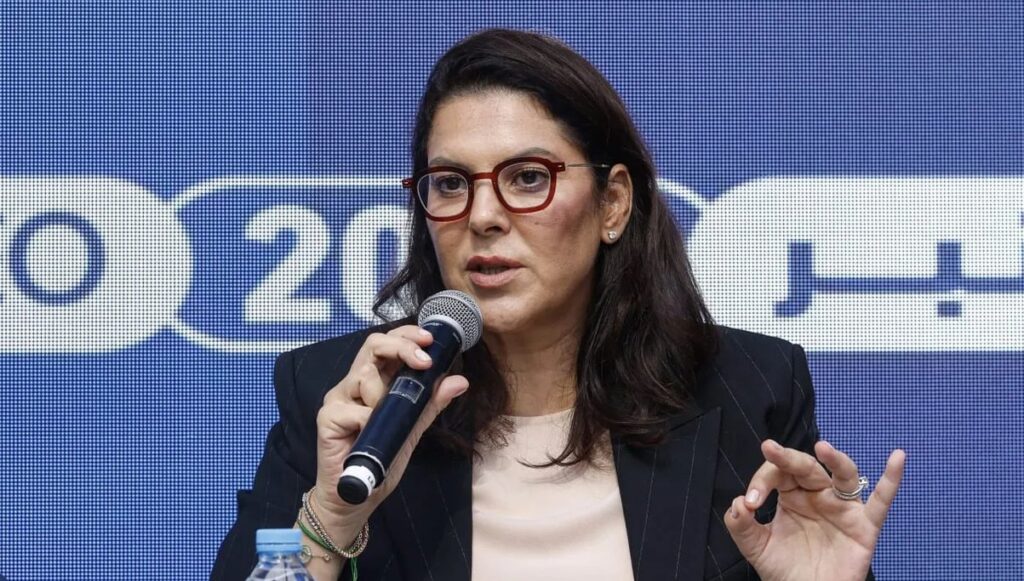
Image: from john l X @Maeestro
King Mohammed VI has appointed Fatima Ezzahra El Mansouri to serve as Morocco’s head of government, making the senior Authenticity and Modernity Party figure the first woman named to the position. El Mansouri has been tasked with forming a government at a pivotal moment for the kingdom.
By Open Chronicle with agencies | September 29, 2026
RABAT — Morocco’s King Mohammed VI has appointed Fatima Ezzahra El Mansouri as head of government, marking a historic first for women in the country’s political leadership.
El Mansouri, one of the most prominent figures in the Authenticity and Modernity Party, known as PAM, has been tasked with forming a new government.
Her appointment brings to the premiership a politician whose career has combined law, municipal government, parliament, cabinet responsibilities and senior party leadership.
It also places her at the centre of a demanding political period in which the government faces pressure over living standards, housing, social policy, regional inequalities and major infrastructure development ahead of Morocco’s role as a co host of the 2030 FIFA World Cup.
The appointment represents a milestone in Moroccan politics, where El Mansouri had already broken significant barriers during her rise through local and national government.
From Marrakech to national leadership
El Mansouri was born in Marrakech on January 3, 1976, into a family originating from the Rehamna region.
Her upbringing brought her into close contact with public administration and political life.
Her father, Abderrahmane El Mansouri, held senior public responsibilities, including service in Marrakech and as Morocco’s ambassador to the United Arab Emirates, according to the supplied account.
That environment helped shape her early interest in law, administration and public service.
She attended French schools in Marrakech and completed her baccalaureate at Lycée Victor Hugo.
Her education would later take her beyond Morocco as she pursued legal studies in Europe and the United States.
Legal education across three countries
El Mansouri studied law in France and obtained a postgraduate qualification in business contract law from the University of Montpellier.
She also studied Anglo American business law at New York University and earned a degree in private law from Mohammed V University in Rabat, according to the supplied account.
Her legal education prepared her for a professional career before she entered frontline politics.
After completing her studies, El Mansouri established a law practice in Marrakech specialising in property and commercial transactions.
Her background as a lawyer would subsequently become an important part of her political profile, particularly as she assumed responsibilities involving urban development, housing and territorial planning. Her education and legal career are also documented in PAM biographical material.
The rise of PAM
El Mansouri joined the Authenticity and Modernity Party when it was founded in 2008.
Her political rise was rapid.
Only a year later, at the age of 33, she was elected mayor of Marrakech.
The victory made her the first woman to lead the municipal council of one of Morocco’s most internationally recognised cities.
Her election was particularly significant in a political environment in which women remained underrepresented in senior executive positions.
The Marrakech mayoralty also provided El Mansouri with a highly visible platform from which to build a national political career.
A return to Marrakech leadership
El Mansouri subsequently served in parliament and remained an important figure within PAM.
In September 2021, she returned to the leadership of Marrakech after a political alliance backed her for the presidency of the city council.
Her responsibilities expanded further the following month.
King Mohammed VI appointed her minister responsible for national territory planning, urban planning, housing and city policy in the government formed in October 2021.
That portfolio placed her in charge of policy areas directly connected with some of Morocco’s most significant long term challenges.
Rapid urbanisation, housing availability, infrastructure development and inequalities between different parts of the country have all become increasingly important questions for Moroccan governments.
Rising influence inside PAM
El Mansouri also consolidated her position within the Authenticity and Modernity Party.
She became coordinator of PAM’s collective leadership in 2024, strengthening her influence within one of Morocco’s major political forces.
By 2026, she was publicly setting out the party’s positions ahead of the September elections while emphasising the institutional process through which the composition of the next government would be determined. Pam
Her progression from municipal government to cabinet office and senior party leadership made her one of Morocco’s most prominent political figures before her appointment as head of government.
A historic first for Moroccan women
El Mansouri’s appointment carries particular symbolic significance because no woman had previously been named head of government in Morocco.
Women have gradually assumed increasingly prominent roles within Moroccan political institutions, government departments and local administrations.
El Mansouri herself has been part of that transformation for more than a decade.
Her election as mayor of Marrakech in 2009 was already regarded as a breakthrough.
Her subsequent ministerial career and rise within PAM expanded that political profile nationally.
Her appointment to form a government now represents another milestone.
Social pressures await the new government
The historic nature of the appointment does not diminish the scale of the challenges confronting the incoming administration.
Questions surrounding living standards, employment, housing and access to public services remain important issues for Moroccan households.
Regional inequality represents another major challenge.
Morocco has invested heavily in modernising cities, transportation networks and other infrastructure, but development remains uneven between major urban centres and less developed areas.
El Mansouri’s experience in territorial planning and housing could therefore become particularly relevant as her government develops its domestic programme.
Her previous ministerial responsibilities included urban development, housing policy, territorial planning and support for rural areas.
Morocco prepares for the 2030 World Cup
Another defining challenge will be Morocco’s preparations for the 2030 FIFA World Cup.
Morocco will co host the tournament with Portugal and Spain, placing the country at the centre of one of the world’s largest sporting events.
The preparations involve far more than football stadiums.
Transport infrastructure, airports, accommodation, urban development, public spaces and tourism capacity are all expected to play important roles in delivering the tournament.
For the incoming government, the World Cup represents both an international opportunity and a major domestic development programme.
The challenge will be balancing investment connected with the tournament against broader public expectations for improvements in housing, healthcare, education, employment and local infrastructure.
Forming the government becomes the immediate priority
El Mansouri’s first major political task is now forming an administration capable of navigating those competing priorities.
Cabinet appointments will provide the first indication of the political and policy direction of her government.
The composition of the new administration will also reveal how political alliances are reflected within the executive and which areas are likely to receive the greatest attention during the coming term.
Once the government is established, attention will turn quickly toward its economic and social programme.
A new chapter in Moroccan politics
Fatima Ezzahra El Mansouri enters the position with experience spanning municipal administration, parliamentary politics, national government, law and party leadership.
Her political career began with a breakthrough in Marrakech and has now reached the highest position in Morocco’s government.
The significance of becoming the first woman appointed to the office will inevitably form part of her political legacy.
The more immediate test, however, will come from governing.
Morocco is approaching a period of accelerated infrastructure investment and heightened international visibility while confronting domestic demands for improved living standards and more evenly distributed development.
El Mansouri has now been given responsibility for assembling the government that will confront those challenges.