
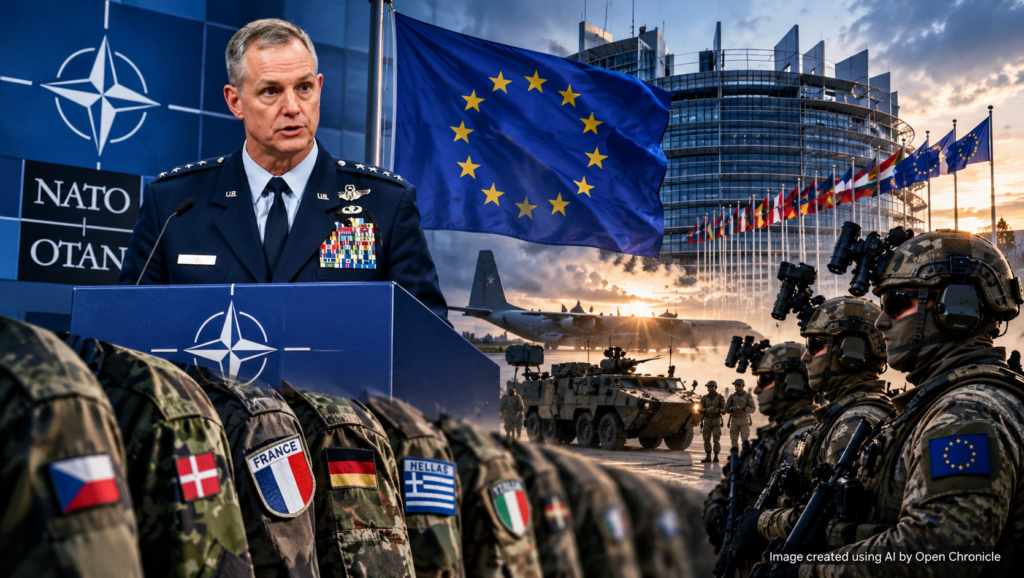
NATO’s top military commander in Europe has warned that European Union defence initiatives should reinforce the alliance rather than create parallel military structures, arguing that duplication would increase costs, consume scarce resources and potentially weaken collective defence.
By Open Chronicle with agencies | September 29, 2026
BRUSSELS — NATO Supreme Allied Commander Europe Gen. Alexus Grynkewich has urged the European Union to ensure that its expanding defence ambitions complement NATO rather than develop into a competing security structure.
Speaking at the European Parliament on Monday, Grynkewich said he had discussed proposals for a European defence union with several European leaders and stressed that closer European military cooperation could be valuable if it remained compatible with NATO’s established command structure and capabilities.
His comments come as European governments seek to strengthen their military capacity, expand defence production and assume greater responsibility for the continent’s security.
For NATO’s senior military leadership, however, the central challenge is ensuring that Europe’s defence expansion strengthens existing capabilities rather than creating a second system competing for the same personnel, equipment and financial resources.
Warning against parallel defence structures
Grynkewich argued that establishing separate NATO and EU military structures could unnecessarily duplicate capabilities and expertise.
“Whatever it is that the EU does with its member states and how it structures, should not be in competition with NATO,” he said.
The general’s argument focuses on the practical consequences of maintaining parallel systems.
NATO already possesses an extensive command structure, military planning mechanisms and established procedures for coordinating forces from different allied countries.
Creating separate structures capable of performing many of the same functions could require additional personnel, infrastructure and funding at a time when European governments are already attempting to address shortages across their armed forces.
For Grynkewich, European defence initiatives should therefore add capabilities rather than reproduce structures that already exist within NATO.
European defence ambitions are expanding
The debate has become increasingly important as the European Union seeks a larger role in defence and security.
European countries are increasing military expenditure, expanding weapons production and examining ways to coordinate procurement more effectively.
The EU can play a particularly important role through financing, industrial policy and regulation.
NATO, meanwhile, maintains the established military command system and defines many of the operational requirements necessary for collective defence.
Grynkewich said the two institutions should combine those respective strengths.
Defence industry becomes central to cooperation
Military procurement and industrial production were prominent elements of Grynkewich’s remarks.
The NATO commander called for stronger coordination between the alliance and the European Union as governments increase orders for ammunition, aircraft, air defence systems and other military equipment.
The question of where equipment should be manufactured has become particularly important as Europe seeks to expand its domestic defence industrial base.
Procurement decisions can have consequences for defence companies based outside the European Union but within NATO countries, particularly the United States, Canada, the United Kingdom, Norway and Türkiye.
Those countries contribute significant military technology and industrial capacity to the alliance.
Performance should come before country of origin
Grynkewich cautioned against procurement policies that place excessive emphasis on where weapons are manufactured rather than how effectively they perform.
“A focus on where something is made rather than how well it performs in combat, how it performs on the battlefield, only benefits our adversaries,” he said.
His comments highlight a potential tension between European industrial policy and NATO’s operational requirements.
European governments increasingly want defence spending to strengthen domestic industries and reduce strategic dependencies.
NATO commanders, however, must also consider interoperability, battlefield effectiveness and the ability to rapidly acquire equipment capable of meeting military requirements.
Grynkewich’s position suggests that industrial considerations should not override those operational priorities.
NATO’s broader industrial network
The alliance incorporates defence industries extending well beyond the European Union.
American companies remain major suppliers of aircraft, missiles and other military systems used across Europe.
Britain maintains one of Europe’s largest defence industries despite no longer belonging to the EU.
Türkiye has rapidly expanded its defence manufacturing sector, particularly in unmanned systems, missiles, armoured vehicles and aerospace.
Canada and Norway also contribute industrial and technological capabilities.
A European procurement framework that significantly restricted access for companies from those NATO countries could therefore complicate alliance wide defence planning.
Ankara forum produces agreements worth more than €50 billion
Grynkewich pointed to a recent NATO defence industry forum in Ankara as an example of cooperation across the alliance.
Hundreds of companies participated in the gathering, where agreements worth more than €50 billion, approximately $57 billion, were announced.
The agreements included projects involving strategic airlift as well as high altitude intelligence, surveillance and reconnaissance capabilities.
The scale of the agreements demonstrated the increasing importance of industrial cooperation as NATO members rebuild military inventories and prepare for longer term security requirements.
It also illustrated the multinational nature of modern defence production, where complex military systems frequently depend on components, technology and manufacturing capacity distributed across several allied countries.
Strategic airlift remains essential
Strategic airlift represents one of the capabilities highlighted by the Ankara agreements.
The ability to rapidly transport troops, vehicles, equipment and supplies over long distances is fundamental to NATO’s capacity to reinforce different parts of the alliance during a crisis.
For European countries, strengthening airlift capabilities could become increasingly important as military planning places greater emphasis on rapidly moving forces across the continent.
Transport capacity is therefore not simply a logistical issue. It forms part of the alliance’s broader deterrence posture.
Intelligence and surveillance capabilities expand
High altitude intelligence, surveillance and reconnaissance capabilities were another area highlighted by Grynkewich.
Such systems allow military commanders to observe large geographical areas, monitor potential threats and gather information necessary for operational planning.
Modern conflicts have demonstrated the growing importance of persistent surveillance combined with rapid processing and distribution of intelligence.
Investment in these capabilities can therefore benefit both European defence initiatives and NATO’s broader military planning.
EU brings financial and regulatory power
Grynkewich acknowledged that the European Union possesses capabilities that NATO does not.
The EU can mobilise financial resources, coordinate industrial investment and establish regulatory frameworks affecting defence production.
Those mechanisms could help European countries expand manufacturing capacity and accelerate procurement.
They could also encourage greater cooperation among national defence industries that have historically operated through fragmented procurement systems.
NATO, by contrast, brings military expertise, operational planning and established mechanisms for defining what forces and equipment are required.
Combining those strengths could allow Europe to increase its military capacity without duplicating institutional structures.
NATO defines military requirements
One of NATO’s principal roles is establishing the military requirements necessary for collective defence.
Those requirements influence the number and types of forces allies need, the weapons they should acquire and the infrastructure necessary to support military operations.
EU financing and industrial programmes could help countries meet those requirements more rapidly.
This creates a potential division of responsibilities in which NATO identifies operational needs while the EU helps provide the economic and industrial mechanisms necessary to fulfil them.
Such coordination could become increasingly important as European governments embark on some of their largest defence investment programmes in decades.
Interoperability remains critical
Another concern surrounding parallel defence structures is interoperability.
NATO forces are expected to operate together during military operations regardless of nationality.
Aircraft, communications networks, air defence systems, logistics units and ground forces therefore need compatible procedures and technology.
European defence initiatives that develop separately from NATO standards could complicate that interoperability.
Conversely, procurement and industrial programmes aligned with NATO requirements could strengthen the ability of European forces to operate together.
This is one reason Grynkewich is advocating coordination rather than institutional competition.
Europe seeks greater responsibility for its security
The discussion comes amid a broader reassessment of Europe’s security architecture.
European governments are investing more heavily in their armed forces and examining how the continent could assume greater responsibility for its own defence.
That process does not necessarily require replacing NATO.
Instead, the emerging debate concerns how stronger European military capabilities can operate within the alliance while also giving European countries greater capacity to respond to regional security challenges.
Grynkewich’s comments suggest NATO’s military leadership sees substantial potential in European defence investment, provided it strengthens the alliance’s overall capabilities.
One defence effort rather than two competing systems
The NATO commander’s central message was that Europe does not need to choose between stronger EU defence cooperation and a strong NATO.
The two can reinforce each other if their responsibilities and investments remain coordinated.
Duplicating military headquarters, procurement systems or capabilities would consume resources that could instead be directed towards forces, weapons, logistics and infrastructure.
The objective should therefore be to expand Europe’s military capacity while maintaining the alliance structures already responsible for collective defence.
“NATO and the EU are exponentially stronger when working together,” Grynkewich said.
As European governments embark on a major period of defence investment, that relationship is likely to become increasingly important.
The challenge will be building a stronger European pillar of defence without creating barriers between the institutions, industries and armed forces responsible for protecting the wider NATO alliance.