
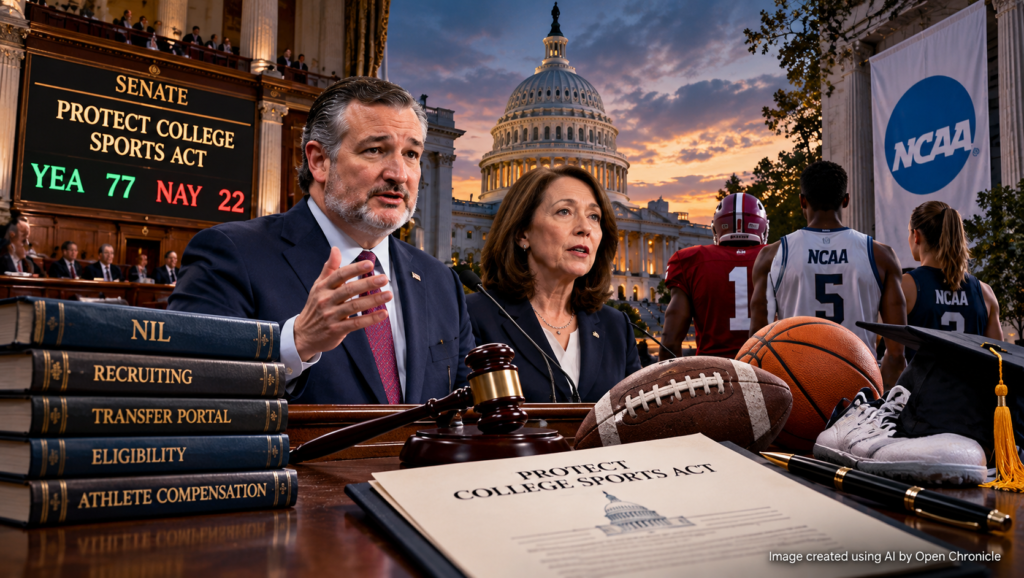
The US Senate has approved the Protect College Sports Act by a 77 to 22 vote, advancing legislation designed to establish nationwide rules governing athlete compensation, Name, Image and Likeness agreements, transfers, recruiting and eligibility across college athletics. The measure now moves to the House of Representatives.
By Open Chronicle Sports with agencies | September 29, 2026
WASHINGTON — The US Senate passed the Protect College Sports Act on Monday night with overwhelming bipartisan support, advancing one of the most significant attempts by Congress to establish a national regulatory framework for college athletics.
The legislation passed by a vote of 77 to 22.
Led by Republican Senator Ted Cruz of Texas and Democratic Senator Maria Cantwell of Washington, the bill seeks to address years of uncertainty surrounding athlete compensation and the rapidly changing economic structure of American college sports.
If enacted, the legislation would establish federal standards covering Name, Image and Likeness compensation, commonly known as NIL, revenue sharing, athlete eligibility, recruiting practices and transfers.
It would also provide the collegiate governing body with greater protection from antitrust litigation.
Bipartisan support delivers decisive Senate victory
The 77 to 22 vote demonstrated substantial support from senators in both parties for establishing federal rules governing college athletics.
Lawmakers have spent years debating how Congress should respond to the transformation of college sports following the expansion of NIL opportunities for student athletes.
The NCAA allowed athletes to begin financially benefiting from their names, images and likenesses in 2021.
That decision transformed college athletics, but it also produced different rules across states and institutions while raising questions about recruiting, transfers, compensation and the relationship between athletes and universities.
The Protect College Sports Act represents an attempt to replace that fragmented environment with a national framework.
Trump urges Congress to act
President Donald Trump has publicly urged Congress to approve the legislation.
Trump called for lawmakers to reach a bipartisan agreement and send the bill to his desk.
“I’m urging the House and the Senate to come together, bipartisan if possible and it looks like they have done, to send the bill to my desk and I will sign it,” Trump said while hosting members of Team USA from the Winter Olympic and Paralympic Games.
“We have to get that done,” he added.
Trump argued that leaving the existing system unresolved would create further uncertainty for athletes and college sports.
“We’re in Never Never Land,” the president said while describing the current regulatory environment.
The Senate vote moves the legislation closer to the White House, although it must still pass the House of Representatives before Trump can sign it into law.
Thune says current system needs reform
Senate Majority Leader John Thune of South Dakota backed congressional action ahead of the vote.
“I think most people acknowledge that the current landscape of college sports is a mess,” Thune said.
“It needs to be addressed.”
Supporters of the legislation argue that the absence of a consistent national framework has created uncertainty for universities, athletes, conferences and governing bodies.
Different state laws have also complicated attempts to establish uniform standards across college sports.
The legislation seeks to replace that patchwork with federal rules applying across the country.
National standard for NIL agreements
One of the most significant elements of the legislation concerns NIL compensation.
College athletes can now receive money from commercial agreements connected with their names, images and likenesses.
That change created major new economic opportunities for athletes, particularly those competing in high profile sports such as football and basketball.
However, the expansion of NIL also blurred the distinction between commercial endorsement agreements and recruiting incentives.
The Protect College Sports Act would establish a federal standard governing NIL arrangements rather than allowing the regulatory environment to depend heavily on individual state laws.
Supporters argue that national rules would provide greater predictability for athletes and institutions.
Revenue sharing cap would be established
The bill would also establish a cap governing revenue sharing between universities and athletes.
Revenue sharing represents another major transformation in the economics of college athletics.
For decades, universities, conferences and broadcasters generated substantial revenues from college sports while strict amateurism rules limited direct compensation for athletes.
That model has changed dramatically.
The proposed federal framework attempts to establish boundaries around the emerging system while preserving opportunities for athletes to receive compensation.
Transfer portal restrictions
The legislation would introduce broader restrictions governing the transfer portal.
The portal has dramatically changed how athletes move between colleges.
Players can now transfer between programmes with considerably greater flexibility than under the previous system, creating opportunities for athletes but also making roster management increasingly difficult for coaches and universities.
The Protect College Sports Act would seek to establish clearer national rules governing when and how athletes can transfer.
Five year eligibility framework
The bill would establish a uniform five year eligibility framework for college athletes.
A national standard would provide universities and athletes with clearer expectations regarding how long players can participate in collegiate competition.
Eligibility rules have become increasingly complicated as transfers and other regulatory changes reshape athlete careers.
Supporters of the bill argue that federal standards could reduce uncertainty and simplify enforcement.
Recruiting and tampering rules
Recruiting represents another major area addressed by the legislation.
The bill would establish guardrails defining when schools, representatives and agents are permitted to contact athletes.
The objective is to reduce tampering and prevent programmes from improperly recruiting athletes who are already committed to other institutions.
Specified recruiting periods would establish clearer boundaries around those contacts.
The rules would operate alongside the legislation’s provisions governing transfers and NIL agreements.
Cruz calls current system the Wild West
Cruz has been one of the most prominent advocates for congressional intervention since the transformation of NIL rules.
Speaking during a news conference on Monday, he argued that federal antitrust law and repeated litigation had contributed to dismantling the regulatory structure that previously governed college sports.
“Some have asked why should Congress get in the middle of this? The answer is simple: because Congress screwed it up in the first place,” Cruz said.
“It has been the federal antitrust laws applied in litigation after litigation after litigation that have had the effect of tearing down essentially all the rules,” he continued.
“So right now it is the Wild West.”
The legislation attempts to address that issue partly by providing greater antitrust protections for the governing structure of college athletics.
Antitrust protections become major point of contention
The proposed antitrust protections are also among the most controversial provisions in the legislation.
Supporters argue that governing bodies need sufficient legal protection to establish uniform rules without facing continuous litigation.
Opponents warn that such exemptions could give universities and governing organisations excessive power over athletes.
That disagreement reflects a broader debate about whether college athletes should primarily be treated as students participating in an educational system or as economic participants in an industry generating billions of dollars.
The transformation of NIL and revenue sharing has made that distinction increasingly difficult to maintain.
Murphy warns about athlete bargaining power
Democratic Senator Chris Murphy of Connecticut has emerged as one of the bill’s prominent critics.
Murphy argues that the legislation could reduce the bargaining power athletes have gained during the transformation of college sports while providing schools with significant exemptions from antitrust law.
He has challenged the characterization of the existing system as simply chaotic.
“The ‘chaos’ is that mostly Black athletes now have bargaining power and White coaches and sports industry execs hate it,” Murphy wrote on X earlier this month.
His criticism highlights one of the central disagreements surrounding the legislation.
While supporters see national regulation as necessary to restore stability, opponents are concerned that stability could come at the expense of athletes’ economic rights.
Women’s sports amendment addressed
The legislation also became part of the continuing political debate over transgender participation in women’s sports.
Republican Senator Josh Hawley of Missouri, together with Senators Jim Banks of Indiana and Tommy Tuberville of Alabama, filed an amendment in August intended to prevent the federal legislation from overriding state laws restricting transgender women from competing in women’s sports.
The senators argued that the original legislation could potentially interfere with laws already adopted in their states.
Hawley later said his concerns had been addressed and that the legislation had been amended to his satisfaction before he voted to advance it.
House vote will have to wait
Despite the decisive Senate vote, the legislation still faces another major step before reaching Trump’s desk.
The House of Representatives is currently in recess until after the midterm elections.
That means a House vote on the Protect College Sports Act will have to wait.
If the House approves the same legislation, the measure could then be presented to Trump for his signature.
The president has already indicated that he intends to sign the bill if Congress sends it to him.
College athletics approaches another major transformation
The Senate vote represents an important moment in the continuing transformation of American college sports.
The introduction of NIL compensation changed a system that had operated for decades under strict limits on athlete earnings.
The transfer portal further transformed the relationship between athletes and universities.
Revenue sharing is creating another major economic shift.
Congress is now attempting to place those changes within a single national regulatory structure.
The Protect College Sports Act would establish federal standards covering many of the most contentious issues confronting college athletics while giving governing institutions additional legal protection.
Whether that framework ultimately becomes law now depends on the House of Representatives.
But the 77 to 22 Senate vote demonstrates that a substantial bipartisan majority believes the current system requires federal intervention.