
OPEN CHRONICLE LIFESTYLE MAGAZINE · LUXURY & CRAFTSMANSHIP
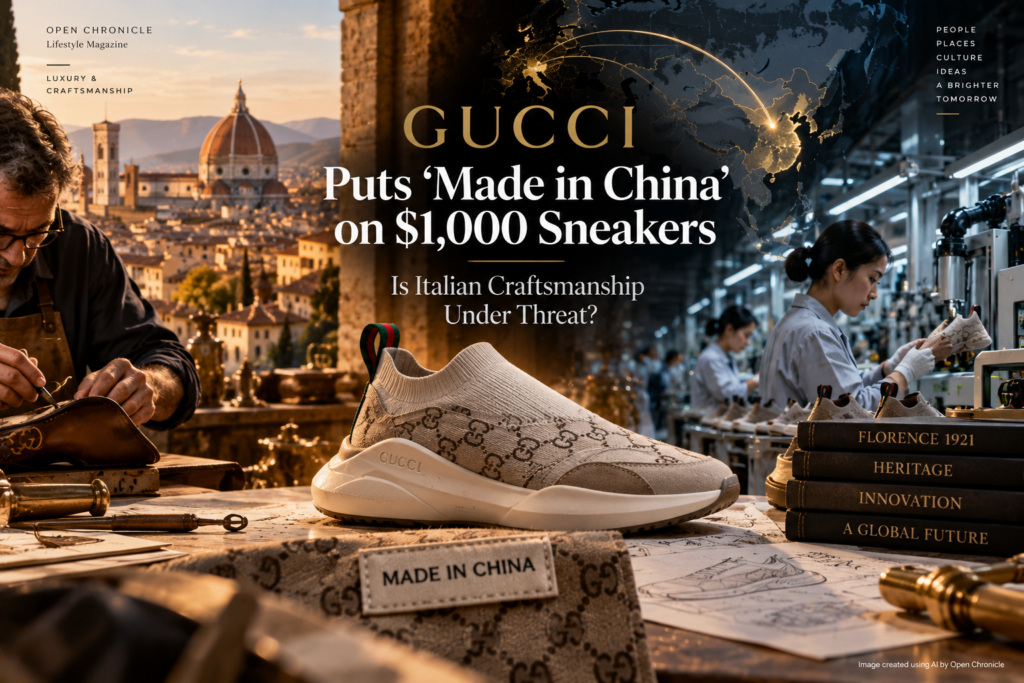
Gucci’s new Drip sneaker carries a label rarely associated with the Florentine luxury house. The decision raises a bigger question for the industry: in modern luxury, how much of a product’s value still comes from where it is made?
By Open Chronicle Lifestyle Magazine
For more than a century, two words have carried extraordinary power in the luxury industry.
Made in Italy.
They evoke Florence and Milan, leather workshops and specialist factories, generations of artisans and a manufacturing culture in which geography itself became part of the product.
For Gucci, that association is particularly powerful.
The house was founded in Florence in 1921, when Guccio Gucci opened an artisanal luggage business on Via della Vigna Nuova. Gucci itself continues to describe its heritage through Italian craftsmanship, creativity and innovation.
Now, one of the most recognisable names in Italian luxury is testing the boundaries of what that heritage means.
Select new Gucci sneakers are being manufactured in China.
Among them is the Drip, the first Gucci sneaker designed under Demna, whose arrival has become central to the house’s attempt to restore cultural energy and commercial momentum.
Gucci’s own product listings identify versions of the Drip as “Made in China”. The same is true of selected new slip on footwear.
The change is limited. Gucci says Italy remains at the heart of its manufacturing identity and there are no plans for a broader transfer of production away from the country.
The company’s explanation is also significant.
It says the Chinese manufacturer was selected because of its technological expertise and its ability to achieve the performance and quality required by the design, rather than simply as a means of reducing manufacturing costs.
That distinction goes to the heart of a much larger debate.
China is no longer merely the factory of inexpensive mass production imagined by an older Western stereotype. Its manufacturing ecosystem now contains highly sophisticated suppliers capable of producing technically complex products at enormous scale.
If the best manufacturer for a particular luxury sneaker is in China, should a luxury house use it?
Or does moving production outside the country associated with a brand’s heritage weaken something that cannot be measured purely in technical quality?
For Gucci, a pair of sneakers has suddenly become a test of what luxury means in the twenty first century.
1. A Small Label With a Large Meaning
The Drip does not look like the traditional image of Florentine shoemaking.
It is deliberately contemporary.
Gucci describes the model as a mid high top sneaker combining an ultra minimal basketball shoe with the ease of a loafer. Depending on the version, the upper incorporates materials including suede, nylon and GG canvas, while elastic inserts replace conventional lacing and a rubber sole completes the silhouette.
The design belongs unmistakably to the world of modern luxury sneakers rather than traditional Italian leather shoes.
But one detail on the product page changes the conversation.
“Made in China.”
On Gucci’s official European online store, a GG canvas Drip is currently listed at €890. In Japan, another version is priced at ¥159,500 including tax, while a runway variation reaches ¥172,700.
These are unmistakably luxury prices.
That makes the manufacturing label significant.
Consumers are not simply purchasing nylon, canvas, suede and rubber.
They are purchasing Gucci.
And Gucci is selling more than physical materials.
It is selling design, history, cultural relevance, scarcity, retail experience and the symbolic value accumulated by a house founded in Florence more than a century ago.
Luxury has always operated within this mixture of tangible and intangible value.
The question raised by the Drip is how much geography contributes to that equation.
2. Why ‘Made in Italy’ Matters So Much
To understand why a Chinese made Gucci sneaker attracts attention, it is necessary to understand what Italy represents within the luxury system.
Italian manufacturing is not simply a marketing invention.
Regions across the country contain dense networks of specialised suppliers, craftspeople and workshops producing leather goods, footwear, textiles, jewellery and other luxury products.
Skills are often concentrated geographically and transmitted through businesses and communities over generations.
For Gucci, Tuscany is part of that story.
The company’s history begins with Guccio Gucci establishing his luggage atelier in Florence in 1921, combining Tuscan materials and craftsmanship with influences he had encountered while working at London’s Savoy hotel.
Over the following century, those Florentine origins became inseparable from the mythology of the brand.
A Gucci object therefore carries multiple identities.
It is a designed object.
It is a commercial product.
It is a status symbol.
But it is also presented as part of a cultural tradition.
That is why country of origin matters more in luxury than it does in many other industries.
When someone purchases an Italian luxury bag or shoe, the location of production can form part of what the consumer believes they are buying.
The place becomes part of the story.
And in luxury, stories have economic value.
3. But Craftsmanship Does Not Belong to One Country
There is another side to the argument.
Excellent manufacturing is not exclusively European.
China has spent decades building one of the world’s largest and most sophisticated manufacturing ecosystems. In footwear, electronics, textiles and advanced materials, Chinese suppliers can possess equipment, technical knowledge and production capabilities unavailable elsewhere at comparable scale.
The idea that a product made in China must automatically be inferior is increasingly difficult to defend.
Country of manufacture and quality are not synonyms.
A poorly specified product can be made in Italy.
An exceptionally engineered product can be made in China.
Quality depends on materials, design, technical requirements, manufacturing processes, workforce skills, quality control and the standards demanded by the company commissioning production.
Gucci’s explanation for the Drip rests precisely on this distinction.
The house says it selected its Chinese manufacturing partner because that supplier possessed the technological know how and capabilities most appropriate to the product.
The company has compared the arrangement with its existing use of specialist manufacturing expertise in countries such as Switzerland and Japan for certain product categories.
Viewed this way, the decision can be interpreted not as a rejection of craftsmanship, but as a broader definition of it.
If craftsmanship means exceptional knowledge of how to make something, the passport of the craftsperson should not determine the quality of the work.
But luxury branding complicates that logic.
Because consumers do not buy craftsmanship in the abstract.
They buy stories about craftsmanship.
And those stories are often rooted in place.
4. The Drip Arrives at a Difficult Moment for Gucci
The debate would probably look different if Gucci were enjoying one of the strongest commercial periods in its history.
It is not.
The house has experienced a severe decline in revenue over recent years.
Gucci generated €10.487 billion in revenue in 2022.
That fell to €9.873 billion in 2023.
Revenue then dropped to €7.650 billion in 2024 and €5.992 billion in 2025.
In three years, Gucci therefore lost more than €4 billion in annual revenue.
The decline has placed enormous pressure on parent company Kering to rebuild its most important fashion house.
| Year | Gucci Revenue | Annual Change |
|---|---|---|
| 2022 | €10.487 billion | +8% |
| 2023 | €9.873 billion | minus 6% |
| 2024 | €7.650 billion | minus 23% |
| 2025 | €5.992 billion | minus 22% |
The situation began showing signs of stabilisation during 2026.
Gucci recorded revenue of €1.347 billion in the first quarter, down 8 percent on a comparable basis.
In the second quarter, revenue reached €1.410 billion, with the comparable decline narrowing to 2 percent.
For the first half as a whole, Gucci generated €2.757 billion, down 5 percent on a comparable basis.
Kering itself returned to comparable growth of 2 percent in the second quarter.
That distinction matters.
Gucci had not yet returned to growth, but the pace of decline had slowed substantially.
Kering also continued reducing the size of its store network. After 75 net closures during 2025, another 84 net closures had been completed during the first half of 2026, against a full year target of 100.
Gucci is therefore not making decisions in a period of comfortable stability.
It is trying to rebuild desirability while Kering simultaneously reduces costs, rationalises distribution and searches for renewed growth.
That makes every major product decision more closely scrutinised.
5. Demna and the Reinvention of Gucci
At the centre of that reconstruction is Demna.
The designer was appointed to lead Gucci creatively in 2025 after a decade at Balenciaga, where he became one of the most influential and polarising designers in contemporary fashion.
His work has frequently challenged conventional distinctions between luxury and everyday objects.
Streetwear, oversized silhouettes, distressed garments, sneakers and references to popular culture became part of a design vocabulary capable of generating both enormous commercial attention and intense debate.
At Gucci, the challenge is different.
The house already possesses more than a century of history.
Its archive contains powerful codes, including the Horsebit, the Jackie, the Bamboo bag, the Flora motif, the GG monogram and the green and red Web.
Demna does not need to invent a heritage.
He needs to decide what to do with one.
The Drip offers an early indication.
Rather than recreating a traditional Italian sneaker, it adopts a technologically oriented, laceless construction that Gucci describes as combining basketball footwear and loafer functionality.
Its production location therefore fits the logic of the design.
The creative idea came first.
The manufacturing capability followed.
That may be entirely rational from a product development perspective.
But luxury is one of the few industries in which rational production decisions can collide directly with emotional brand value.
6. The $1,000 Question
Imagine two sneakers.
They use comparable materials.
They are designed by the same creative team.
They meet the same quality standards.
They carry the same Gucci logo.
One is manufactured in Italy.
The other is manufactured in China.
Should they have the same value?
There is no objective answer because luxury pricing has never been based exclusively on production cost.
A luxury product’s price reflects design, marketing, retail infrastructure, brand equity, distribution, perceived scarcity, cultural relevance and the enormous cost of maintaining a global luxury organisation.
Craftsmanship matters.
But craftsmanship is only one component.
This is precisely why the Drip creates such an interesting problem.
If consumers believe they are paying partly for Italian manufacture, changing the manufacturing origin without significantly changing the luxury price may alter their perception of value.
Analysts at Berenberg, cited in reporting on the change, identified the possibility of tension between the place of manufacture and the luxury image Gucci is attempting to restore.
That does not establish that consumers will reject the product.
They may not care.
Younger luxury customers may place greater value on design, cultural relevance and brand identity than on the nationality of the factory.
Sneaker consumers may also understand that technical footwear manufacturing operates differently from traditional leather craftsmanship.
The Drip may sell extremely well.
But the experiment matters because it tests which parts of the luxury proposition consumers consider essential.
7. Is ‘Made in China’ Still the Problem, or Is Perception the Problem?
The phrase “Made in China” carries decades of cultural baggage.
For many Western consumers, it became associated with inexpensive mass production during the enormous expansion of global manufacturing that followed the late twentieth century.
That image is increasingly outdated.
China manufactures products across an extraordinary range of quality levels, from extremely inexpensive consumer goods to highly advanced electronics, electric vehicles, precision components and premium products.
The relevant question is therefore not whether China can manufacture a luxury sneaker.
Clearly it can.
The more interesting question is whether luxury consumers are prepared to separate craftsmanship from traditional luxury geography.
There is an important distinction here.
Italian craftsmanship should not be diminished simply because Chinese manufacturing capabilities have advanced.
Both propositions can be true.
Italy can possess exceptional artisanal ecosystems that deserve preservation.
China can possess exceptional manufacturing expertise capable of producing technically sophisticated luxury products.
The future of luxury may depend on understanding the difference between heritage and capability.
Heritage asks where the knowledge came from.
Capability asks who can execute the product best today.
Sometimes the answers will be the same.
Sometimes they will not.
8. The Risk to Italian Craftsmanship Is Larger Than One Sneaker
The most important question is not whether a single Gucci sneaker is made in China.
It is what happens if luxury production gradually becomes detached from the ecosystems that created the brands themselves.
Craftsmanship survives through repetition.
A specialist leather worker develops expertise by working with leather.
A shoemaker preserves knowledge by making shoes.
A workshop passes skills to younger workers because there is sufficient demand to employ and train them.
If production disappears, knowledge can disappear with it.
This is why manufacturing heritage cannot be preserved purely through advertising.
A luxury house cannot indefinitely celebrate artisanship that it no longer supports economically.
Gucci itself has previously acknowledged this challenge.
Its sustainability and impact reporting has described craft skills, experience and knowledge accumulated across generations in Italy as a heritage requiring investment, training and support.
That makes the Drip debate more nuanced.
Producing a technically specialised sneaker in China does not mean Gucci is abandoning Italian craftsmanship.
There is currently no evidence of such a wholesale shift.
But the principle matters.
If luxury groups increasingly select manufacturing locations purely according to efficiency, technical capability or cost, the industrial ecosystems behind European luxury could eventually weaken.
Once specialist knowledge disappears, recreating it is extraordinarily difficult.
Luxury therefore has an unusual responsibility.
Its heritage is not only something inherited from the past.
It must be financed in the present.
9. Japan Shows Why Origin Still Matters
Japan offers an especially interesting market in which to watch the experiment.
Japanese luxury consumers have historically demonstrated a sophisticated awareness of materials, provenance, construction and brand heritage.
The market is also commercially important to Kering.
Japan represented 8 percent of Kering revenue in the first quarter of 2025, although subsequent performance was affected by changing tourist spending and currency dynamics.
Gucci’s official Japanese store makes the manufacturing origin unusually transparent.
A Drip sneaker priced at ¥159,500 is explicitly described as manufactured in China.
Another runway version is listed at ¥172,700 and carries the same origin.
This means the customer is not being asked to discover the manufacturing location through investigative reporting.
Gucci states it.
That transparency is important.
Luxury consumers should be able to know where the products they purchase are manufactured.
What they decide that information is worth is another matter.
Some may see Chinese production and question why a sneaker commands a luxury price.
Others may conclude that the manufacturer’s nationality is irrelevant if the design, materials, construction and quality meet Gucci standards.
The market will ultimately reveal how much provenance influences desirability.
10. What Are We Really Paying for When We Buy Luxury?
The Drip leads to a question that extends far beyond Gucci.
What exactly are we buying when we buy luxury?
Materials?
Craftsmanship?
Design?
Heritage?
Exclusivity?
Status?
The store experience?
The logo?
The story?
The answer is probably all of them, but in different proportions for different consumers.
Someone buying a hand stitched leather bag may care deeply about the workshop in which it was produced.
Someone buying an avant garde sneaker may care more about the designer who conceived it.
A watch collector may consider the movement’s origin essential.
A fashion customer may prioritise silhouette and cultural relevance.
Luxury is not one category of value.
It is a collection of values layered onto an object.
The danger arises when the story told by the brand and the reality of the product move too far apart.
If a company builds its identity entirely around local craftsmanship while progressively manufacturing elsewhere, consumers may eventually notice the contradiction.
But that is not yet what Gucci’s limited Chinese footwear production demonstrates.
For now, it represents something more specific.
A global luxury house has decided that the technical expertise required for particular contemporary footwear exists outside its traditional manufacturing geography.
That may prove controversial.
It may also prove entirely normal.
11. From ‘Made in Italy’ to ‘Made by the Best’?
Luxury manufacturing has never been as geographically pure as its mythology sometimes suggests.
Swiss expertise dominates important areas of watchmaking.
Japan possesses extraordinary textile, denim and eyewear traditions.
France maintains specialist networks across couture, leather goods and jewellery.
Italy remains central to luxury leather goods, footwear and fashion manufacturing.
And China increasingly possesses advanced capabilities across categories once automatically associated with Western manufacturing.
The future may therefore involve a more complicated map of luxury.
A brand might preserve Italian manufacturing for products whose value depends on traditional leatherworking while turning to specialised Asian suppliers for technically demanding footwear, eyewear or materials.
If that happens, luxury houses will need to communicate much more clearly about why products are made where they are.
“Made in China” cannot simply mean cheaper.
“Made in Italy” cannot simply function as a marketing incantation.
Both labels should tell consumers something meaningful about the knowledge, process and people behind the object.
That could ultimately make luxury more interesting.
Instead of asking only where something was made, consumers might begin asking how it was made, by whom, with what expertise and under what conditions.
Those are more demanding questions.
They are also better ones.
12. Italian Craftsmanship Is Not Under Threat From a Sneaker
The arrival of a Chinese made Gucci sneaker does not mean Italian craftsmanship is disappearing.
The evidence does not support such a conclusion.
Gucci says Italy remains central to its production model and identity, and the overwhelming context of the house remains rooted in its Florentine heritage.
But the Drip is symbolically important.
It reveals a tension that will increasingly shape luxury.
Brands want heritage and innovation.
They want artisanal credibility and technological capability.
They want exclusivity while operating as global businesses.
They want consumers to value where they came from while allowing production networks to evolve according to what contemporary products require.
Those objectives can coexist.
But only if the relationship between heritage and manufacturing remains credible.
The greatest threat to Italian craftsmanship would not be a sneaker produced in China.
It would be a luxury industry that continued using the language of craftsmanship after deciding that maintaining the crafts themselves no longer mattered.
There is no evidence that Gucci has reached that point.
The Drip instead poses a more provocative possibility.
Perhaps craftsmanship in the twenty first century will become less about defending a particular country and more about recognising exceptional expertise wherever it exists.
But for houses whose names were built in Florence, Milan and Paris, geography will never become irrelevant.
Because luxury objects are not valued solely for what they are.
They are valued for what they represent.
And sometimes a tiny label inside a shoe can change that story.
Open Chronicle Lifestyle Magazine · Luxury & Craftsmanship
Sources and Further Reading
Official product documentation, company history,
financial reporting and independent journalism
informing this examination of Gucci, manufacturing
provenance and the changing meaning of craftsmanship
in contemporary luxury.
01 | Product Documentation
Gucci
Official Source
Men’s Drip Sneaker
Official Gucci product documentation confirming
the Drip design, materials, construction details
and Chinese manufacturing origin.
02 | Heritage & Craftsmanship
Gucci
Official Source
History of Gucci
The house’s official history, tracing its origins
to Guccio Gucci’s Florentine luggage atelier in
1921 and documenting the role of Tuscan craftsmanship
in the development of the brand.
03 | Financial Performance
Kering
Official Financial Results
2026 First Half Results
Official financial reporting covering Gucci revenue,
sequential performance, Kering’s return to comparable
growth during the second quarter and the continuing
optimisation of the group’s retail network.
04 | Financial Context
Kering
Official Financial Results
2025 Financial Results
Official financial documentation recording Gucci
revenue of €5.992 billion in 2025 and providing
the historical basis for assessing the scale of
the house’s recent contraction.
05 | Independent Industry Reporting
Reuters
Independent Reporting
Gucci’s New ‘Made in China’ Sneaker Models
Break With Italian Tradition
Reporting on Gucci’s manufacturing decision,
the company’s explanation concerning Chinese
technical expertise and industry analysis of
the potential implications for brand perception.
Source Context
This source provides independent reporting
and analyst commentary. Interpretations about
possible effects on Gucci’s luxury positioning
should be distinguished from confirmed statements
made by the company.
06 | Japan Market
Gucci Japan
Official Product Source
Drip Men’s Sneaker
Official Japanese product listing confirming
a ¥159,500 price for one Drip version and its
Chinese manufacturing origin.
Editorial Transparency
This article distinguishes confirmed manufacturing
information from analysis about its possible
implications for luxury branding. Gucci has stated
that its use of Chinese production applies to a
limited selection of footwear and that it has no
broader plan to move overall production away from
Italy. The question in the headline is therefore
examined as an industry issue rather than presented
as evidence that Italian craftsmanship is currently
being abandoned by Gucci.
Heritage. Provenance. Craftsmanship.
Open Chronicle Lifestyle Magazine examines luxury
through the objects, skills, places and people
behind the world’s most influential houses.
Discover More Lifestyle Stories
Explore inspiring stories about contemporary living, remarkable people, travel, style, wellbeing and the experiences that shape our everyday lives.
← Back to Open Chronicle Lifestyle