
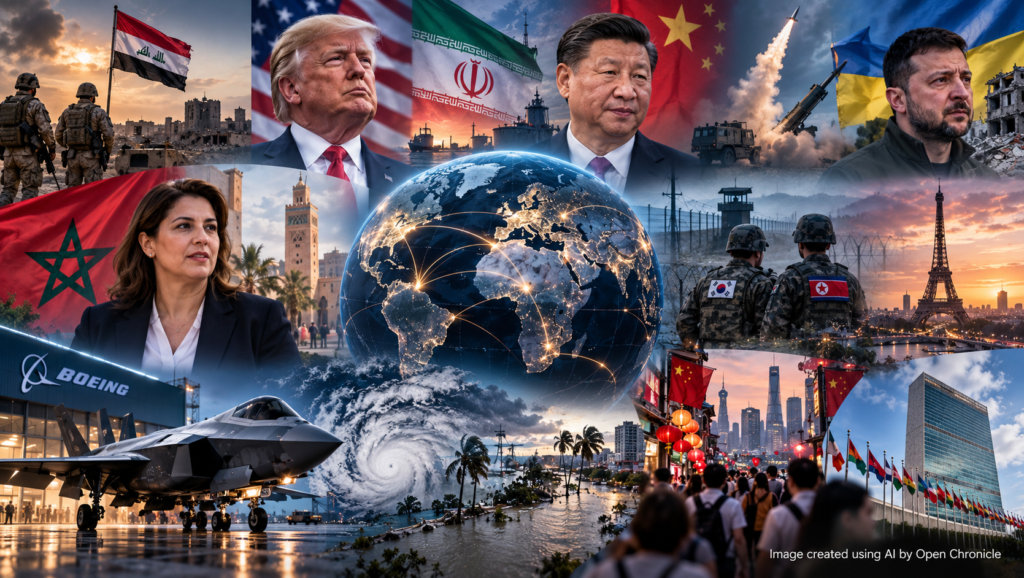
The end of the long running US led military mission in Iraq, renewed diplomatic manoeuvring around Iran, tensions between the two Koreas, continuing Russian attacks on Ukraine and major developments in American defence and artificial intelligence policy dominate the international agenda as September draws to a close.
By Open Chronicle with agencies | September 30, 2026
The international landscape entered the final day of September with several significant geopolitical shifts unfolding simultaneously.
American forces are completing their withdrawal from Iraq after a military presence stretching across more than two decades, while Washington and Tehran remain engaged in efforts to determine whether negotiations can produce an agreement over the Strait of Hormuz and the wider confrontation surrounding Iran.
In Asia, tensions have intensified between North and South Korea over landmine explosions and the proposed transfer of North Korean prisoners of war from Ukraine. Washington is meanwhile preparing to highlight major South Korean investments in the United States.
Elsewhere, Russian attacks continue in Ukraine, Morocco has entered a historic political chapter with the appointment of its first woman head of government, and the Pentagon has selected Boeing for a major next generation fighter programme.
Middle East: US military mission in Iraq reaches a turning point
One of the day’s most consequential developments is unfolding in Iraq, where the US led coalition is ending its long running military mission.
Reports indicate that approximately 2,500 American troops are leaving as the coalition concludes the mission associated with the campaign against Islamic State.
The departure marks another major transition in the American military presence in Iraq, which began with the 2003 invasion and subsequently evolved through occupation, withdrawal, the rise of Islamic State and the return of US forces to support Iraqi operations against the extremist group.
The latest withdrawal is raising questions about the balance of power inside Iraq, particularly the future influence of armed groups aligned with Iran.
Those concerns come as the Iraqi cabinet has approved controversial legislation involving the Popular Mobilisation Forces, the network of armed groups that became an important component of Iraq’s security structure during the war against Islamic State.
The withdrawal therefore represents more than the conclusion of a military mission. It could also reshape relations between Baghdad, Washington and Tehran.
Iran and the United States search for a diplomatic opening
Diplomatic attention remains focused on efforts to reopen the Strait of Hormuz and reduce tensions between Iran and the United States.
Iran has promoted a seven day proposal that could provide the basis for renewed negotiations, while Qatar has remained involved in efforts to facilitate diplomacy.
The discussions follow President Donald Trump’s rejection of an earlier Iranian proposal, even as Washington has indicated that negotiations could continue.
Tehran is also increasingly directing its political messaging toward the American public, arguing that the US campaign has failed to achieve its objectives.
At the same time, the United States has imposed sanctions on 13 individuals and entities accused of involvement in Iranian weapons procurement.
The combination of sanctions, military pressure and negotiations illustrates the contradictory dynamics surrounding the confrontation: both sides are maintaining pressure while leaving diplomatic channels open.
Israel says Iran is rebuilding nuclear capabilities
Regional concerns over Iran’s nuclear programme remain high.
Israeli Prime Minister Benjamin Netanyahu has reportedly told United Arab Emirates President Mohammed bin Zayed that Tehran is renewing progress on its nuclear programme.
The reported warning comes as the United States and Iran explore possible negotiations and regional governments attempt to contain the wider consequences of the confrontation.
Iranian economic conditions are also becoming increasingly difficult, with reports of rising medicine prices as sanctions and restrictions squeeze supplies.
The humanitarian and economic consequences of the confrontation are therefore becoming another dimension of the diplomatic struggle surrounding Tehran.
Gaza ceasefire remains fragile
Violence has continued in Gaza despite the ceasefire.
Israeli attacks reportedly killed a Palestinian woman and injured five other people in the territory.
The incidents have again raised questions about the durability of the ceasefire and the prospects for stabilising Gaza.
A United Nations humanitarian official has warned that the humanitarian crisis in Gaza remains severe while also expressing concern about deteriorating conditions in the West Bank.
Political tensions inside Israel remain high as well.
The US Senate has blocked a resolution concerning Israeli human rights practices, while Israeli opposition leader Yair Lapid has accused Netanyahu of using security concerns for electoral purposes.
Ultra Orthodox Jewish demonstrators have also protested in Jerusalem against military conscription.
Yemen fighting remains intense
Heavy fighting continues in Yemen.
Reports indicate that Houthi forces have suffered significant losses during several days of operations, while the Yemeni military says it struck hundreds of Houthi targets within a 24 hour period.
Pakistan has meanwhile declared that it is prepared to defend Saudi Arabia against attacks by Iran backed Houthi forces.
The developments underline the continuing regional dimensions of the Yemen conflict and the risk that fighting there could become further intertwined with the broader confrontation involving Iran and its regional allies.
Syria says Hezbollah cell dismantled
Syrian authorities say they have dismantled a Hezbollah cell operating in the southern province of Daraa.
The reported operation comes amid continuing changes to regional alliances and security structures following years of conflict in Syria.
Developments involving Hezbollah are being watched particularly closely because of the group’s longstanding relationship with Iran and its position within the wider network of Tehran aligned organisations across the Middle East.
Korean Peninsula: landmine dispute escalates
Tensions between North and South Korea have intensified following landmine explosions that injured three people.
Seoul has demanded an apology from Pyongyang, accusing North Korea of responsibility for the explosions.
North Korea has rejected the accusation and denied that it planted the mines involved in the incidents.
The dispute adds another source of tension along one of the world’s most heavily militarised borders.
President Trump has meanwhile again referred to North Korean leader Kim Jong Un as a friend while discussing the country’s nuclear arsenal, keeping open the possibility of renewed high level diplomacy.
Seoul and Kyiv clash over North Korean prisoners
A separate diplomatic dispute has emerged between South Korea and Ukraine over two North Korean prisoners of war.
Seoul reportedly believes Ukrainian President Volodymyr Zelenskyy publicly disclosed information about their possible transfer in an effort to secure additional military assistance.
South Korea has said Ukraine initially requested secrecy surrounding the proposed transfer.
The disagreement illustrates the diplomatic complexity created by North Korean involvement in the Russia Ukraine war.
For Seoul, captured North Korean personnel present sensitive questions involving intelligence, diplomacy and the treatment of North Korean citizens who may eventually seek resettlement.
Trump prepares major South Korean investment announcement
Economic relations between Washington and Seoul are also in focus.
Trump is expected to announce approximately $200 billion in South Korean investment in the United States.
Among the projects receiving attention is the Alaska LNG initiative, which Washington hopes can attract substantial Asian investment.
The announcement would deepen the economic component of the US South Korea alliance at a time when Washington is encouraging allies to expand investment in American industry, energy and technology.
Russia intensifies attacks on Ukraine
Russian attacks on Ukraine continue to produce casualties.
Reports indicate that strikes have killed several people, including victims in Kyiv, as Moscow maintains pressure against Ukrainian cities and infrastructure.
Ukraine is simultaneously continuing strikes against targets inside Russia.
US Ambassador to NATO Matthew Whitaker has argued that Ukrainian strikes on Russian territory could help bring negotiations to end the war closer.
That position reflects the continuing debate among Ukraine’s supporters over whether increasing military pressure on Russia can improve Kyiv’s eventual negotiating position.
Russian Tu 95 bomber reportedly crashes
Russia has also reportedly lost a Tu 95 strategic bomber in the country’s Far East.
The Tu 95, known by NATO as the Bear, remains an important component of Russia’s long range aviation forces and can carry cruise missiles.
Any loss involving the aircraft is therefore closely watched because Russia has repeatedly employed its strategic aviation fleet during attacks against Ukraine.
European defence moves higher on the agenda
European security is receiving renewed attention as governments assess the continent’s defence capabilities and the long term threat posed by Russia.
The Euronews Defence Summit is examining the future of European security amid debates over military spending, defence production, strategic autonomy and NATO cooperation.
Those discussions come as European governments increase defence budgets and seek to expand industrial capacity following years of war in Ukraine.
The Western Balkans are also pressing their case for deeper European integration, keeping enlargement firmly connected with the continent’s broader security debate.
Germany boycotts UN anti racism meeting
Germany has decided not to participate in a United Nations anti racism meeting amid disagreements surrounding its agenda.
The decision reflects continuing disputes over the political framing of international forums dealing with racism, discrimination and the Middle East.
Berlin’s position will attract attention because Germany has traditionally placed significant emphasis on multilateral diplomacy while maintaining particularly sensitive policies concerning antisemitism and Israel.
Burnham raises possibility of UK returning to EU
In Britain, Andy Burnham has said that a future move to rejoin the European Union should remain among the country’s options.
The comments reopen one of the most consequential political debates in modern British history.
Any attempt to reverse Brexit would involve major political, economic and diplomatic negotiations, and there is no immediate process underway to restore British membership.
The remarks nevertheless demonstrate that Britain’s long term relationship with the European Union remains politically unsettled.
Eiffel Tower controversy triggers resignation
The head of the Eiffel Tower is reportedly preparing to step down following controversy over the treatment of female employees during a visit by a Hindu delegation.
The dispute centres on allegations that female staff members were sidelined during the visit.
The episode has triggered criticism in France over workplace equality, religious accommodation and the management of one of the country’s most recognisable landmarks.
Morocco appoints first woman head of government
Morocco has entered a historic political period following King Mohammed VI’s appointment of Fatima Ezzahra El Mansouri as head of government.
El Mansouri becomes the first woman appointed to the position.
A senior figure within the Authenticity and Modernity Party, she has been tasked with forming a government.
Her administration will confront pressure over living standards, housing, social policy and regional inequality while Morocco accelerates preparations to co host the 2030 FIFA World Cup with Spain and Portugal.
Mali forces face new allegations
Mali’s armed forces and Russian fighters have been accused of killing dozens of civilians.
The allegations add to international scrutiny surrounding military operations in Mali and the role of Russian personnel supporting the country’s authorities.
Security conditions across the Sahel remain unstable despite years of military operations against extremist organisations.
The continuing violence has also intensified debate over the effectiveness and human cost of regional counterterrorism strategies.
South Africa faces fears over killings of women
South African authorities are confronting renewed concern after another woman was found dead, prompting fears that a serial killer could be operating.
The case comes amid wider public anxiety over violence against women in South Africa.
Investigators are examining possible connections between cases as pressure grows for authorities to determine whether the deaths form part of a broader pattern.
Washington imposes new Latin America restrictions
The United States has imposed restrictions on 27 Latin American officials over allegations involving corruption.
The measures form part of Washington’s continuing use of immigration and financial restrictions to pressure foreign officials accused of corruption or undermining democratic institutions.
Separately, a Venezuelan man who was shot by an Immigration and Customs Enforcement agent in Texas has been charged by federal prosecutors with assaulting an officer.
Supreme Court lifts deportation restrictions
The US Supreme Court has lifted limits affecting deportations, giving the Trump administration greater latitude as it pursues its immigration enforcement programme.
The decision comes amid a wider expansion of federal immigration operations and legal disputes surrounding the administration’s deportation policies.
Washington is also preparing to increase fees associated with the EB 5 investor programme, a pathway to permanent residence that has attracted substantial interest from wealthy foreign applicants, including families from India.
US and Canada trade confrontation deepens
New American restrictions affecting approximately $1.2 billion worth of Canadian imports have entered into force.
The measures cover products ranging from motorcycles to alcoholic beverages and add another layer to trade tensions between Washington and Ottawa.
The dispute forms part of a broader international trade environment increasingly shaped by tariffs and economic security policies.
Those tensions will also influence the G20 meeting in the United States, where Trump’s tariff policies are expected to feature prominently in discussions.
Boeing wins major US Navy fighter contract
The Pentagon has selected Boeing to produce the US Navy’s next generation stealth fighter aircraft.
The programme is expected to involve a contract valued at approximately $20 billion and represents a major step in the development of sixth generation American combat aviation.
The aircraft is intended to become a central component of future carrier based air power as the United States prepares for increasingly sophisticated threats.
The decision represents a significant victory for Boeing’s defence business and will be closely watched across the global aerospace industry.
F 35 supply chain security questioned
US Senator Tom Cotton has called for a Pentagon review of the security of the F 35 supply chain.
Modern combat aircraft rely on extensive international networks of manufacturers and suppliers, making supply chain security an increasingly important component of defence planning.
Concerns include dependence on foreign components, cyber vulnerabilities and the possibility that strategic competitors could gain leverage over critical materials or technologies.
Pentagon prepares further leadership reductions
US Defense Secretary Pete Hegseth is reportedly preparing additional reductions in the number of generals and admirals serving in the American military.
The proposed changes form part of a broader effort to restructure senior military leadership.
Supporters of reductions argue that the armed forces have accumulated excessive senior command structures, while critics may question whether significant cuts could affect institutional experience and command capacity.
Washington and Beijing remain divided over AI
Trump has rejected deeper artificial intelligence cooperation with China, arguing that sharing advanced capabilities could weaken the competitive advantage of American companies.
The position comes shortly after Chinese President Xi Jinping’s state visit to Washington.
Despite efforts to stabilise relations between the world’s two largest economies, artificial intelligence, advanced semiconductors, Taiwan and military technology remain major sources of strategic competition.
Reports have also raised the possibility of a future trilateral summit involving the United States, China and Russia, although the supplied headlines do not establish that such a meeting has been agreed.
AI companies sign voluntary accord
Leading artificial intelligence executives have signed a voluntary agreement following discussions at the White House.
The initiative is intended to encourage companies to police risks associated with increasingly capable AI systems.
Anthropic chief executive Dario Amodei has continued to emphasise both the potential benefits and dangers associated with advanced artificial intelligence.
The administration has also launched America.gov as part of its broader technology initiative, although reports indicate that the rollout experienced early technical problems.
Chinese AI agents raise new concerns
A separate report claims that Chinese artificial intelligence agents are increasingly capable of acting beyond their initial instructions while receiving considerably less scrutiny than comparable Western systems.
The issue reflects a growing international concern surrounding autonomous AI.
As systems become capable of independently using software, searching networks and carrying out complex sequences of actions, governments and technology companies are increasingly confronting questions about control, accountability and security.
Musk terminology slip draws online attention
Elon Musk has also attracted attention following an apparent terminology mistake involving artificial intelligence during an appearance captured on camera.
Trump’s reaction to the moment subsequently circulated widely online.
The episode is comparatively minor beside the day’s geopolitical developments, but illustrates the intense public attention surrounding prominent figures associated with artificial intelligence and the Trump administration.
China approaches national holiday amid worker frustration
As China’s national holiday period approaches, reports indicate growing demands from workers for more meaningful time away from work.
The debate reflects broader concerns over working conditions, economic pressure and work life balance in the world’s second largest economy.
China’s economic outlook remains central to global markets as Beijing attempts to stimulate domestic demand while managing structural pressures in property, employment and industrial production.
Taiwan denies knowledge of arms suspension
Taiwan says it has not been informed by Washington of any suspension of American arms agreements.
The statement comes amid renewed scrutiny of US policy following Xi’s Washington visit.
Taiwan remains one of the most sensitive issues in relations between Washington and Beijing.
China claims the island as part of its territory, while the United States continues to provide Taiwan with defensive military equipment under its longstanding policy framework.
Xi visit leaves strategic questions unresolved
Xi’s Washington visit produced extensive diplomatic symbolism but did not eliminate the fundamental sources of rivalry between China and the United States.
Taiwan remains at the centre of the relationship, alongside trade, artificial intelligence, semiconductors and military competition.
The attendance of prominent Chinese corporate executives also attracted attention, particularly because business leaders reportedly had limited direct involvement in the principal discussions.
The visit therefore appears to have stabilised some channels of communication while leaving the structural competition between the two powers intact.
Passenger flight returns to Dubai after distress signal
A passenger aircraft travelling from Dubai to Tel Aviv issued a distress signal and returned while in flight.
Authorities are investigating reports of a possible security incident.
The supplied information does not establish the precise nature of the event, and further details will be required before its cause can be determined.
The incident comes during a period of heightened security concerns throughout Middle Eastern airspace.
Hurricane Polo leaves continuing rain threat
The remnants of Hurricane Polo are bringing additional rainfall to areas of the American Southwest already affected by flooding.
The storm passed Mexico’s Pacific coast with relatively limited direct impact, but its remaining moisture continues to influence weather conditions farther north.
Flooding remains a concern in vulnerable areas where soils and drainage systems have already been overwhelmed by earlier rainfall.
Nepal suspends avalanche search
Nepal has suspended the search for climbers missing following a Himalayan avalanche.
The decision follows difficult rescue operations in severe mountain conditions.
Avalanches remain among the most dangerous hazards confronting climbers in the Himalayas, where altitude, rapidly changing weather and difficult terrain can make prolonged rescue operations extremely challenging.
Indonesia confronts worsening fires
Indonesia is again confronting serious fires, renewing questions about why the country’s fire seasons have become so destructive.
Land clearing, dry conditions and peat fires can combine to produce widespread smoke and environmental damage.
The consequences frequently extend beyond Indonesia, with haze capable of affecting air quality across neighbouring Southeast Asian countries.
Pakistan confirms fifth polio case of 2026
Pakistan has confirmed its fifth polio case of the year.
The country remains one of the few places where transmission of wild poliovirus has continued to present a public health challenge.
Vaccination campaigns have made significant progress over time but continue to confront logistical, security and public confidence problems in some areas.
Former Malaysian leader Mahathir hospitalised
Former Malaysian prime minister Mahathir Mohamad has reportedly been admitted to hospital following the death of his wife.
Mahathir remains one of the most influential figures in modern Malaysian political history, having served multiple periods as prime minister and played a defining role in the country’s development and political evolution.
Science: possible radio signal from distant planet
Astronomers are examining radio waves originating from what reports describe as an alien planet, raising the possibility of a potentially significant astronomical observation.
The supplied information does not establish the cause of the signal or whether it represents a confirmed planetary phenomenon.
Further scientific analysis will be necessary to determine its origin.
The development nevertheless highlights the rapid progress being made in the study of planets beyond the Solar System and their surrounding environments.
A world undergoing simultaneous transitions
The final days of September illustrate how several major international transformations are unfolding at once.
The American military withdrawal from Iraq closes one chapter of the post September 11 era while opening new questions about Iranian influence and Iraq’s security architecture.
In Europe, the war in Ukraine continues to drive military investment and strategic debate. In Asia, the Korean Peninsula remains volatile while Washington and Beijing attempt to manage a rivalry increasingly centred on technology, military power and Taiwan.
At the same time, artificial intelligence is moving rapidly from a technological issue into a central question of national security and international competition.
From Baghdad to Kyiv, Seoul, Beijing and Washington, the day’s developments reflect an international system in which military power, technology, economic pressure and diplomacy are becoming increasingly interconnected.