
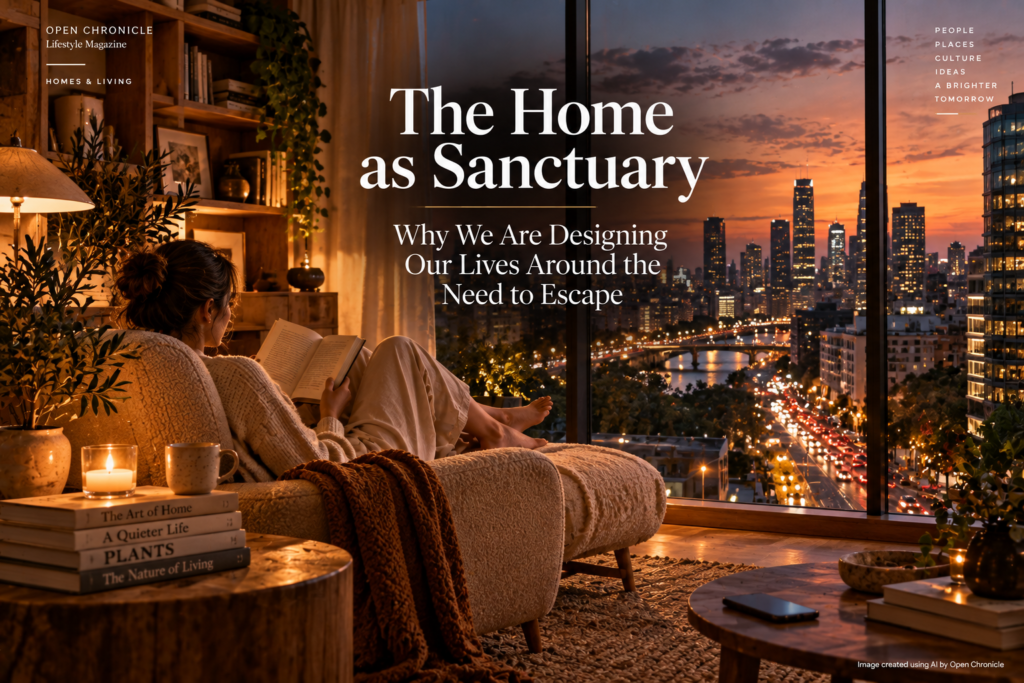
OPEN CHRONICLE LIFESTYLE MAGAZINE · HOMES & LIVING
In an age of constant connection, urban noise and disappearing boundaries between work and private life, the home is being asked to perform a new role. More than somewhere to live, it is becoming somewhere to recover.
By Open Chronicle Lifestyle Magazine
Close the door.
Put down the keys.
Take off the shoes.
For a few seconds, nothing happens.
And perhaps that is precisely what we have been looking for.
Outside, messages continue arriving. Traffic moves. News updates. Work waits somewhere inside a laptop. Social media has discovered another thing we apparently need to know.
Inside, the light is softer.
There is a chair beside the window.
A book has been left unfinished.
The kettle begins to boil.
A phone sits face down on a table.
Home has always meant more than shelter.
It can mean family, memory, privacy, identity, security and belonging.
But something about contemporary life is adding another expectation.
Increasingly, we want home to protect us from the intensity of everything outside it.
We want silence.
We want control.
We want somewhere the notifications cannot quite reach.
Interior design has noticed.
Warm lighting, natural materials, acoustic comfort, reading corners, plants, tactile fabrics, softer colours and rooms designed around rest rather than display have become part of a broader visual language of domestic calm.
But reducing this to another decorating trend misses the larger story.
The home is becoming a sanctuary because modern life is making sanctuary valuable.
And that raises an intriguing question.
When the outside world becomes increasingly demanding, how much are we asking our homes to protect us from it?
1. The House Has Acquired Another Job
For generations, the functions of home seemed relatively clear.
It was where we ate.
Where we slept.
Where children played.
Where families gathered.
Where private life happened after public life ended.
Then the boundaries became less certain.
The smartphone brought the outside world into every room.
Email followed us to the sofa.
Social media entered the bedroom.
Streaming transformed the living room.
Online shopping turned the front door into a delivery point.
Remote and hybrid work turned kitchens, bedrooms and spare rooms into offices.
The home did not simply acquire more technology.
It acquired more responsibilities.
A single room might now be expected to function as workplace in the morning, exercise studio at lunchtime, family space in the evening and place of recovery at night.
The distinction between being at work and being away from work became particularly complicated for people whose workplace moved partially or permanently into their homes.
This transformation has advantages.
Working from home can remove commuting time and offer greater autonomy to some workers.
Digital connectivity allows friendships and families to remain connected across enormous distances.
Entertainment, education and services are available without leaving the house.
But convenience carries a strange consequence.
The outside world no longer needs permission to enter.
It arrives through the screen.
And so the door can be physically closed while psychologically remaining open.
2. Why Silence Has Become a Luxury
Silence is easy to underestimate until it disappears.
Traffic.
Aircraft.
Construction.
Sirens.
Neighbours.
Deliveries.
Music.
Ventilation systems.
Televisions.
Phones.
The contemporary city produces a continuous acoustic landscape.
For millions of people, this is not merely irritating.
It is a public health issue.
The European Environment Agency’s 2025 assessment of environmental noise found that more than 20 percent of Europeans are exposed to harmful transport noise under thresholds used by the Environmental Noise Directive.
Measured against stricter World Health Organization recommendations, the proportion rises above 30 percent.
Road traffic represents the largest source.
The EEA also estimates that millions of Europeans experience severe sleep disturbance or long term annoyance associated with transport noise.
This gives a seemingly decorative question greater significance.
What does a quiet home actually provide?
Recovery.
A bedroom protected from traffic is not simply more luxurious.
It may allow better sleep.
A room where conversation can happen without competing with external noise changes how that room feels.
Curtains, rugs, bookshelves, upholstered furniture, acoustic panels, better glazing and thoughtful room layouts can all influence the acoustic character of domestic space.
Suddenly, the soft interior is not merely an aesthetic.
It is a response to the hard exterior.
3. The Return of the Soft Home
Look at contemporary interiors and a pattern becomes visible.
The aggressively polished home has begun making room for something gentler.
Wood.
Linen.
Wool.
Ceramics.
Plants.
Books.
Warm lamps.
Curved furniture.
Textured walls.
Objects that reveal age.
Materials that invite touch.
This does not mean minimalism has disappeared.
Nor does it mean every contemporary home looks the same.
But the vocabulary of comfort has become increasingly prominent.
There is an obvious visual explanation.
Natural materials photograph beautifully.
Warm rooms perform well on social media.
Hotels, restaurants and interior brands have popularised an international language of restrained, tactile luxury.
But there may be a psychological explanation too.
When much of everyday life happens on smooth glass screens, texture becomes unusually satisfying.
Wood has grain.
Stone has irregularity.
Linen creases.
Leather changes with age.
Ceramics carry small imperfections.
These materials remind us that the physical world is not frictionless.
Perhaps that is part of their appeal.
The screen offers infinite novelty.
The wooden table stays.
4. The Room Without a Screen
For decades, the television determined the geometry of many living rooms.
Sofas faced it.
Chairs were arranged around it.
Furniture accommodated it.
The screen became the domestic hearth.
Today there are more screens than ever, but they are increasingly personal.
Televisions compete with phones, tablets and laptops.
The result is that almost any room can become a media room.
That makes the opposite idea increasingly interesting.
A room, or even a corner, where nothing needs charging.
A chair.
A lamp.
Books.
A window.
Perhaps music.
Nothing revolutionary.
Yet deliberately screen free spaces can feel surprisingly unusual because screens have become so deeply integrated into domestic life.
Not every home has enough space for a separate library or retreat.
The principle does not require one.
A screen free zone can occupy two square metres.
It can be one chair where the phone does not come.
The important part is not the furniture.
It is the boundary.
Modern homes increasingly need boundaries precisely because modern technology is so good at removing them.
5. Light Changes a Room Before Furniture Does
Few elements transform the emotional character of a home as quickly as light.
A room illuminated entirely from above feels different from the same room illuminated by several lower lamps.
Morning light is different from evening light.
A window overlooking trees feels different from one facing a wall.
The Harvard Healthy Buildings programme includes lighting and views among its foundations of healthier buildings, alongside ventilation, air quality, thermal health, moisture, noise, water quality and safety.
This matters because interior wellbeing cannot be reduced to cushions and colour palettes.
A beautiful room with poor ventilation, excessive heat and inadequate daylight may photograph wonderfully while remaining uncomfortable to inhabit.
The sanctuary home therefore begins before decoration.
It begins with the conditions of the building itself.
Can fresh air enter?
Does the bedroom become dangerously hot in summer?
Is there mould?
Can outside noise be controlled?
Does daylight reach the living space?
Is the home physically safe?
These questions are less glamorous than choosing a sofa.
They matter far more.
6. The Air Inside the Sanctuary
We rarely think about the air in a room unless something smells wrong.
Yet the home is an environment we continuously breathe.
Cooking.
Cleaning products.
Furniture.
Heating.
Moisture.
Outdoor pollution entering through windows and gaps.
Pets.
Dust.
All contribute to the indoor environment.
Harvard’s Healthy Buildings programme argues that indoor air quality is an often underestimated component of health and recommends attention to ventilation and filtration alongside other building conditions.
Its Homes for Health project encourages bringing fresh air into homes when outdoor conditions are appropriate and paying attention to sources of indoor contamination.
This introduces another important correction to the Instagram version of wellbeing.
A healthy home is not necessarily the one containing the most plants, candles or expensive natural products.
It is the one that functions well.
Fresh air matters.
Moisture control matters.
Safe temperatures matter.
Clean water matters.
Noise matters.
A home should not merely look calm.
It should support the conditions that make calm possible.
7. Nature Is Coming Indoors
There is a reason so many sanctuary interiors contain plants.
Human beings seem to have an enduring desire to bring the outside world inside.
Flowers on a table.
Herbs on a kitchen windowsill.
A tree visible from a bedroom.
Wood underfoot.
Stone beneath the hand.
Sunlight moving across a wall.
Interior design sometimes describes this relationship through biophilic design, an approach that seeks to strengthen connections between built environments and nature.
But it need not involve expensive architecture or walls covered in vegetation.
Sometimes it is simply a view.
A window positioned toward trees can change the experience of a room.
A balcony with plants can create a small transition between private interior and city.
Even the ritual of caring for something living changes the rhythm of domestic life.
A plant does not care about productivity.
It grows at its own speed.
It requires attention without urgency.
In a world built around acceleration, that may explain some of its appeal.
8. The Kitchen Is Becoming a Room Again
The kitchen has spent decades becoming more efficient.
Machines perform tasks once completed by hand.
Food can arrive at the door within minutes.
Meals can be heated almost instantly.
Convenience has liberated enormous amounts of time, particularly from domestic labour that historically fell disproportionately on women.
That progress should not be romanticised away.
Yet something interesting has happened alongside it.
Cooking has also become a leisure activity for millions of people.
Bread is made slowly.
Coffee becomes ritual.
Friends gather around kitchen islands.
People grow herbs, ferment vegetables or spend Sunday afternoon preparing a meal that could have been ordered in twenty minutes.
Why?
Perhaps because domestic rituals provide something efficiency cannot.
Participation.
Making soup is slower than ordering it.
But chopping, stirring and waiting occupy the body.
The mind has somewhere to go.
The kitchen becomes more than infrastructure.
It becomes a room where time acquires texture.
The sanctuary home is full of these small rituals.
Not because everything must become mindful.
But because ordinary actions can create transitions between the demands of the day and the privacy of evening.
9. Why We Are Rediscovering the Reading Corner
A chair beside a lamp may be one of the simplest pieces of domestic architecture.
It also represents something increasingly scarce.
Single purpose attention.
You sit there to read.
Not to answer email.
Not to watch television while scrolling through a second screen.
Not to perform three activities simultaneously.
Just to read.
The resurgence of reading corners, home libraries and small personal retreats fits naturally into the sanctuary home because these spaces create behavioural cues.
Architecture quietly tells us what to do.
A dining table invites gathering.
A desk invites work.
A bed invites sleep.
A comfortable chair beside books invites stillness.
The design of a home therefore does more than express taste.
It shapes behaviour.
This is why a sanctuary cannot simply be purchased through decoration.
It has to be used.
The most beautiful reading corner in the world is meaningless if nobody ever sits there.
10. When Home Became the Office
No discussion of the contemporary home can avoid work.
For many professionals, remote and hybrid working altered the relationship between domestic and professional space.
The commute disappeared.
But so did one of the clearest boundaries between the two worlds.
The journey home once created transition.
Leave the building.
Walk to the station.
Drive.
Take the bus.
Arrive.
Even an unpleasant commute contained a psychological message.
Work is over.
When the office is three metres from the sofa, that message becomes harder to hear.
The laptop can remain visible.
The unfinished task remains physically present.
A notification can transform the kitchen back into a workplace.
This has encouraged a new kind of domestic design problem.
How do you make work disappear?
For people fortunate enough to have a dedicated office, the answer may be a door.
For everyone else, it can involve smaller rituals.
Close the laptop.
Put it in a drawer.
Move work equipment out of sight.
Change the lighting.
Leave the room and return.
The action may seem trivial.
But sanctuary requires endings.
11. A Beautiful Home Cannot Solve a Bad Housing System
This is where the sanctuary conversation needs perspective.
Not everyone has a spare room.
Not everyone has a garden.
Not everyone can choose quieter windows, better insulation or a neighbourhood surrounded by trees.
Millions of people live with overcrowding, excessive heat, cold, damp, noise, insecure tenure or housing costs that consume an unsustainable proportion of household income.
The World Health Organization’s Housing and Health Guidelines emphasise precisely this larger relationship between housing and health.
They address crowding, indoor temperatures, injury risks and accessibility while also bringing together guidance concerning air quality, neighbourhood noise, water and other environmental conditions.
This matters because the idea of the sanctuary home can easily become another consumer fantasy.
Buy this lamp.
Buy this blanket.
Buy this fragrance.
Buy calm.
But calm cannot always be purchased through objects.
Someone living beside a motorway cannot decorate away traffic noise.
Someone worried about eviction cannot solve housing insecurity with candles.
A family in an overcrowded apartment does not need advice about creating an empty meditation room.
The quality of domestic life depends partly on personal choices.
It also depends on architecture, planning, income, housing policy and infrastructure.
A serious conversation about beautiful homes must include the right to healthy ones.
12. Sanctuary Does Not Mean Isolation
There is another danger in turning the home into a retreat.
We might become too comfortable leaving the world outside.
Delivery services can bring food.
Remote work can remove the commute.
Streaming can replace the cinema.
Online shopping can replace the high street.
Social media can create the feeling of company.
Almost every practical reason to leave home can theoretically disappear.
But human beings still need other human beings.
A sanctuary should restore us for life, not replace life.
The healthiest home may therefore be one that balances retreat with connection.
A table large enough for friends.
A kitchen where people gather.
A balcony where neighbours can be greeted.
A front door that closes when privacy is needed and opens when company is wanted.
The difference between sanctuary and isolation is permeability.
A sanctuary protects us from the world temporarily.
A fortress tries to eliminate it.
13. The Luxury of Being Unavailable
Luxury has traditionally been associated with abundance.
More space.
More rooms.
More technology.
More services.
More objects.
But another definition is emerging.
Less interruption.
A quiet bedroom.
An afternoon without notifications.
A window overlooking something green.
A room where nobody is asking anything from you.
The ability to close a door.
Privacy itself is a luxury.
So is silence.
So is control over your own time.
This may explain why some of the most desirable contemporary interiors do not communicate abundance at all.
They communicate absence.
No clutter.
No obvious technology.
No visual noise.
No urgency.
Of course, achieving that appearance can itself become extremely expensive.
The irony is hard to miss.
An industry can sell us elaborate products designed to recreate the simplicity that consumer culture helped remove.
Yet beneath the commercial language there remains a genuine desire.
We want somewhere to exhale.
14. Designing for the Nervous System, Not the Photograph
For years, social media encouraged us to think about how rooms look from a particular angle.
The sanctuary home asks a different set of questions.
How does the room sound?
How does it feel at seven in the morning?
Can you sleep there?
Is the temperature comfortable?
Can you breathe fresh air?
Where does your eye rest?
Where does your body rest?
Can you sit somewhere without being confronted by a screen?
Does the room still work when it is messy?
Can another person feel welcome there?
Does it support the life you actually live?
These questions lead to a very different understanding of interior design.
A home is not a photograph.
It is an environment experienced through time.
The chair becomes valuable because someone sits in it every evening.
The kitchen table becomes beautiful because of what happens around it.
The worn wooden floor records years of footsteps.
The blanket on the sofa is not perfectly arranged because somebody used it last night.
Life disrupts interiors.
That is not a design failure.
It is the reason the interior exists.
15. The Home We Need Now
Perhaps the sanctuary home is not really a style at all.
It does not require beige walls.
It does not require minimalism.
It does not require expensive furniture, an architect or a rural view.
One person may find sanctuary in a colourful apartment filled with books and music.
Another may need visual simplicity.
One may want family constantly around the table.
Another may need a door that closes.
There is no universal aesthetic of calm.
What matters is the relationship between the person and the place.
Does home reduce some of the demands placed upon us elsewhere?
Does it allow rest?
Does it support health?
Does it contain spaces for connection and spaces for solitude?
Does it feel safe enough for us to stop performing?
Because perhaps that is the deepest meaning of sanctuary.
Home is one of the few places where we should not need to impress anyone.
We do not need to be productive.
Interesting.
Available.
Photogenic.
Successful.
We can simply exist.
In an era when so much of life asks for our attention, our response, our data, our labour and our visibility, that simple possibility has become unexpectedly precious.
The front door closes.
The noise softens.
The phone can wait.
And for a while, the world continues without us.
Perhaps the home of the future will not be defined by how much technology, furniture or space it contains, but by something much harder to manufacture: how well it allows the people inside it to feel at peace.
Open Chronicle Lifestyle Magazine · Homes & Living
Sources and Further Reading
Public health research, environmental evidence and healthy
building guidance informing this exploration of the home
as a place of comfort, recovery and wellbeing.
01 | Housing & Health
World Health Organization
Public Health Guidance
WHO Housing and Health Guidelines
Evidence based recommendations examining the relationship
between housing and health, including crowding, indoor
temperatures, accessibility, injury hazards, air quality
and neighbourhood noise.
02 | Environmental Noise
European Environment Agency
European Environmental Assessment
Environmental Noise in Europe 2025
European assessment of exposure to transport noise and
its consequences for health, sleep, wellbeing and
quality of life.
03 | Healthy Buildings
Harvard T.H. Chan School of Public Health
Healthy Buildings Program
The 9 Foundations of a Healthy Building
Research framework covering ventilation, indoor air
quality, thermal health, moisture, dust and pests,
safety, water quality, noise, lighting and views.
04 | Healthier Homes
Harvard T.H. Chan School of Public Health
Healthy Buildings Program
Homes for Health: 36 Expert Tips for a Healthier Home
Evidence informed guidance examining practical ways
in which domestic environments can support healthier
indoor living.
05 | Sustainable & Equitable Housing
World Health Organization
Public Health & Housing
Healthy Housing for a Sustainable and Equitable Future
Public health guidance explaining why housing conditions
are increasingly important in the context of urbanisation,
demographic change and climate pressures.
Editorial Transparency
This feature combines public health research,
environmental evidence and original lifestyle
commentary. References to the home as a sanctuary
describe a contemporary cultural and design tendency
rather than a universal shift in household behaviour.
Interior design choices can influence comfort and the
experience of domestic space, but they cannot substitute
for safe, affordable and healthy housing. Individual
experiences of home also vary substantially according
to income, household composition, tenure, location,
disability and individual housing needs.
A home should feel as good as it looks.
Open Chronicle Lifestyle Magazine explores the spaces
we inhabit through design, wellbeing, craftsmanship
and the changing meaning of home.
Discover More Lifestyle Stories
Explore inspiring stories about contemporary living, remarkable people, travel, style, wellbeing and the experiences that shape our everyday lives.
← Back to Open Chronicle Lifestyle