
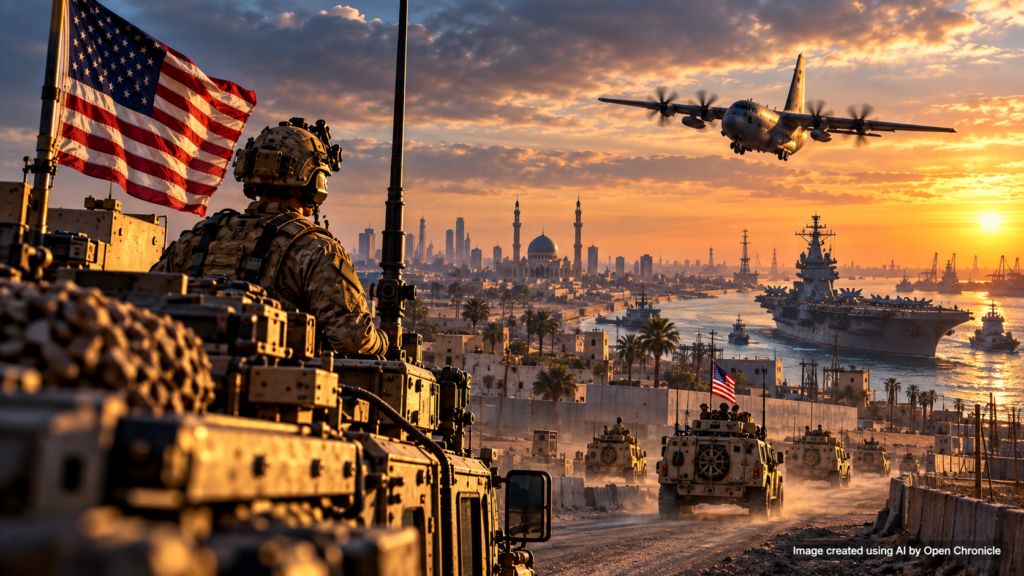
The withdrawal of US forces from Iraq and Syria closes one chapter of the post-9/11 era. But from the Gulf to the Indian Ocean, the emerging American military architecture suggests something very different from disengagement: fewer permanent positions on the ground, but a wider network built for deterrence, air power, maritime warfare and rapid intervention.
By The Grand Strategy Institute Research Division
Grand Strategy Analysis | 30 September 2026
On 30 September 2026, one of the longest chapters in modern American military history came to an end.
The remaining United States forces departed Iraq as Washington completed the termination of the coalition military mission that had brought American troops back to the country in 2014.
Five months earlier, the United States had completed the withdrawal from its remaining major positions in Syria.
Taken together, the two departures appear to represent something historic.
The American military is leaving the two countries that became among the most enduring geographical symbols of the post-9/11 wars.
Iraq was invaded in 2003.
American combat forces departed in 2011.
They returned in 2014 as the Islamic State captured vast territories across Iraq and Syria.
In Syria, American forces established a network of bases and partnerships as Washington supported local forces fighting the Islamic State.
Now those positions have largely disappeared.
But interpreting 30 September as the end of America’s military presence in the Middle East would misunderstand the transformation taking place.
The United States is not simply leaving.
It is changing the geography of American power.
The large political and military commitments associated with occupation, counterinsurgency and long-term ground deployments are being replaced by something more distributed.
Aircraft.
Warships.
Air and missile defence.
Intelligence.
Special operations.
Rapid reaction forces.
Regional bases.
Prepositioned equipment.
Partner militaries.
Access agreements.
Long range strike capabilities.
The emerging architecture requires fewer American soldiers permanently stationed in Iraq and Syria.
It does not necessarily require less American military power.
And the continuing war with Iran is demonstrating why.
30 September and the End of an Era
The symbolism of the date is difficult to ignore.
September 2026 marks twenty-five years since the attacks of 11 September 2001 transformed American foreign and security policy.
Those attacks initiated the strategic period that became known as the Global War on Terror.
Afghanistan followed immediately.
Iraq followed in 2003.
Counterterrorism operations expanded across the Middle East, Africa and South Asia.
Military bases multiplied.
Special operations forces became increasingly important.
Drone warfare expanded dramatically.
Counterinsurgency became a central element of American military doctrine.
For more than two decades, the United States maintained forces across an enormous geographical space in an attempt to destroy terrorist organisations, train partner militaries, stabilise governments and prevent territories from becoming sanctuaries for extremist movements.
Iraq became one of the defining campaigns of that era.
The original invasion removed Saddam Hussein but was followed by insurgency, sectarian violence, political fragmentation and the eventual emergence of the Islamic State.
The American withdrawal of 2011 therefore proved temporary.
Three years later, US forces returned.
This time, the objective was fundamentally different.
The mission was not regime change.
It was the destruction of the Islamic State’s territorial caliphate.
The War That Brought America Back
By 2014, the Islamic State controlled substantial territory across Iraq and Syria.
Mosul had fallen.
Iraqi military formations had collapsed in parts of the country.
The organisation proclaimed a caliphate stretching across the border between Iraq and Syria.
The United States assembled an international coalition and returned militarily to Iraq at Baghdad’s invitation.
American air power, intelligence, special operations forces, advisers and logistical support became critical elements of the campaign.
In Syria, Washington developed a partnership with Kurdish led forces that became the core of the Syrian Democratic Forces.
The Islamic State progressively lost its territorial holdings.
Iraq declared victory over the group’s territorial presence in 2017.
The final enclave controlled by the organisation in Syria fell in 2019.
The caliphate disappeared.
The organisation did not.
ISIS cells continued operating across both countries, conducting attacks and attempting to rebuild networks.
That distinction explains why American troops remained long after the territorial war had effectively ended.
Their mission gradually shifted from defeating an army controlling cities and territory toward preventing an insurgent network from regenerating.
By 2026, Washington concluded that local forces could increasingly assume that responsibility.
Syria Closed First
The Syrian withdrawal accelerated during the opening months of 2026.
American forces departed al-Tanf in February.
The remaining major positions in northeastern Syria were progressively transferred as Damascus consolidated control and Kurdish led forces were integrated into the new Syrian political and security structure.
On 16 April, the final American convoy departed Qasrak Air Base in Hasakah province.
The Syrian government subsequently assumed control of the former American military sites.
It was an extraordinary reversal.
For years, northeastern Syria had existed within an unusual strategic arrangement involving American troops, Kurdish led forces, the Syrian government, Turkey, Russia, Iran and multiple armed organisations.
The American withdrawal removed one of the central external actors from that equation.
It also demonstrated a broader principle that would soon become visible in Iraq.
Washington increasingly believed it could retain the ability to strike terrorist threats without maintaining the same physical footprint inside the countries where those threats originated.
Iraq Closed the Second Door
Iraq represented the larger historical milestone.
The United States and Iraq had agreed in 2024 on a process for ending the coalition military mission.
That transition accelerated through 2025 and 2026.
American and allied forces withdrew from positions across central and southern Iraq before the final stage concentrated on the Kurdistan Region.
By the end of September 2026, the remaining coalition presence was removed.
For Baghdad, the withdrawal is fundamentally about sovereignty.
For Washington, it is about transitioning from a military relationship built around Operation Inherent Resolve toward a more conventional bilateral security partnership.
But the withdrawal creates uncertainty.
ISIS has lost its territory but retains networks.
Iran aligned armed groups remain deeply embedded in Iraq’s security and political environment.
The Iraqi state is attempting to consolidate control over armed organisations that have developed significant military, economic and political power.
The end of the American military presence therefore removes one problem from Iraqi politics while exposing another.
For years, Iran aligned militias justified their weapons partly through the presence of foreign forces.
With those forces departing, Baghdad faces a more direct question.
Who ultimately controls armed power inside Iraq?
That may become one of the most consequential consequences of the withdrawal.
The Iran War Changes Everything
Under different circumstances, the departure from Iraq and Syria might have represented the beginning of a broader American military retrenchment from the Middle East.
The war with Iran has made that interpretation increasingly difficult.
The United States and Israel launched major military operations against Iran in February 2026.
Seven months later, the Iranian government remains in power.
The conflict has evolved into an extended confrontation involving strikes, periods of reduced hostilities, renewed escalation, economic warfare, maritime pressure and intermittent diplomacy.
The Strait of Hormuz has become one of the central strategic arenas.
Oil markets have been disrupted.
American naval forces have conducted operations connected to maritime security and the pressure campaign against Iran.
US aircraft have operated across a geographical network extending far beyond the Persian Gulf.
Iran, meanwhile, has demonstrated the ability to threaten American bases and regional partners with missiles and drones.
The result is a strategic paradox.
America is withdrawing from Iraq and Syria while simultaneously fighting its largest direct regional confrontation in decades.
The post-9/11 deployment architecture is shrinking.
The wider American warfighting architecture is not.
Follow the Forces, Not the Bases Being Closed
Military posture is often misunderstood because attention naturally focuses on visible bases and troop numbers.
But modern military power cannot be measured only by counting soldiers permanently stationed in a particular country.
A carrier strike group can deliver enormous combat power without occupying territory.
Long range bombers can operate from another continent.
Tankers extend the range of combat aircraft.
Satellites and intelligence platforms can monitor a theatre continuously.
Air defence batteries can be moved rapidly between regional installations.
Prepositioned equipment allows forces arriving from the United States or Europe to become operational more quickly.
Special operations forces can deploy temporarily.
Maritime forces can move between the Mediterranean, Red Sea, Arabian Sea and Persian Gulf.
When viewed through this lens, the withdrawal from Iraq and Syria looks less like disappearance and more like redistribution.
The 82nd Airborne Tells a Different Story
One of the clearest indications comes from the US Army.
Elements of the 82nd Airborne Division deployed to the Middle East in 2026 have had their tours extended into 2027 because of continuing operational requirements associated with the Iran confrontation.
That matters strategically.
The 82nd Airborne is not a force designed for static occupation.
It is one of America’s principal rapid deployment formations.
Its continued presence therefore reflects the changing nature of the American posture.
Washington is moving away from large numbers of troops performing enduring missions inside individual states while retaining formations capable of responding rapidly to regional crises.
This is a fundamentally different model.
The soldier does not disappear.
The soldier becomes more mobile.
Air Power Is Carrying More of the Burden
The same transformation is visible in the air.
Fresh fighter squadrons have rotated into the Middle East during the Iran war to replace units that had remained deployed beyond normal cycles.
Combat aircraft represent one of the essential components of the emerging American architecture.
They can defend regional bases.
Intercept drones and missiles.
Escort aircraft.
Conduct reconnaissance.
Strike targets.
Support maritime operations.
And move between theatres much faster than ground formations.
But air power depends on an enormous invisible infrastructure.
Runways.
Fuel.
Tankers.
Maintenance crews.
Weapons stocks.
Secure communications.
Air defence.
Intelligence.
Host nation agreements.
The apparent reduction in America’s ground footprint can therefore conceal the continuing scale of the logistical system required to sustain American power.
The Navy Has Become a Floating Forward Presence
The maritime dimension may be even more important.
The US Fifth Fleet, headquartered in Bahrain, operates across approximately 2.5 million square miles of maritime space encompassing the Persian Gulf, Gulf of Oman, Red Sea, Arabian Sea and parts of the Indian Ocean.
Three of the world’s most important maritime chokepoints lie within that operating environment:
The Strait of Hormuz.
Bab al-Mandeb.
The Suez Canal.
The Iran war has reinforced the importance of all three.
American aircraft carriers, destroyers, submarines, amphibious ships and logistics vessels can create a substantial military presence without requiring permanent ground deployment inside Iraq or Syria.
The USS Abraham Lincoln’s extraordinarily extended 2026 deployment illustrates both the capability and the cost of this model.
Naval power provides flexibility.
It also places extraordinary pressure on ships and crews when temporary deployments become prolonged commitments.
The New Map of American Power
The real map of American military power in the Middle East therefore lies increasingly outside Iraq and Syria.
Bahrain
Bahrain hosts the headquarters of the US Fifth Fleet and remains central to American maritime operations.
Its location provides direct access to the Persian Gulf and connects American naval operations with the wider Arabian Sea and Indian Ocean.
Qatar
Al Udeid Air Base remains one of the most important American military facilities in the region.
The Combined Air Operations Center coordinates multinational air operations across the Middle East.
In January 2026, the United States and regional partners established a new Middle Eastern Air Defense Combined Defense Operations Cell there.
That development is strategically revealing.
The architecture is evolving from purely American protection toward integrated regional air and missile defence.
Kuwait
Kuwait remains a major logistics hub.
Camp Arifjan and other facilities support prepositioned equipment, sustainment and the movement of American forces throughout the CENTCOM theatre.
Its importance is not primarily that forces remain permanently stationed there.
Its importance is that forces can arrive, equip, organise and move onward.
Jordan
Jordan provides geographical access between the Levant, Iraq and the Arabian Peninsula and remains important for counterterrorism, training, intelligence and regional military operations.
Saudi Arabia
The strategic relationship with Saudi Arabia provides access, air defence cooperation, logistical depth and a major regional military partner.
United Arab Emirates
The UAE remains an important defence partner and provides another node within the wider Gulf security network.
No single base replaces Iraq or Syria.
That is precisely the point.
The network replaces the base.
From Territorial Presence to Distributed Power
This is the central transformation.
The post-9/11 model depended heavily on territorial presence.
American forces occupied or maintained substantial footprints inside the countries where campaigns were taking place.
The emerging model is different.
It is built around:
Access rather than occupation.
Mobility rather than permanence.
Regional networks rather than isolated missions.
Air and missile defence rather than counterinsurgency.
Maritime control rather than territorial administration.
Intelligence rather than nation building.
Partner capacity rather than direct governance support.
Rapid intervention rather than indefinite deployment.
This architecture potentially offers Washington considerably greater political flexibility.
It reduces the visibility of American ground forces.
It reduces some forms of vulnerability.
It lowers the domestic political symbolism associated with occupying foreign territory.
And it makes it easier to move forces according to changing crises.
But flexibility should not be confused with disengagement.
The End of Counterinsurgency, Not the End of Intervention
This distinction matters because the United States may be leaving behind one form of military intervention while preserving the ability to conduct another.
Counterinsurgency requires intimate involvement with territory.
Soldiers patrol roads.
Advisers work continuously with local forces.
Bases become semi permanent.
Military personnel become entangled in local politics.
Air and maritime power operate differently.
They can be projected from distance.
This allows Washington to reduce the political burden of physical occupation while maintaining the ability to apply enormous military force.
The result could be an American Middle East posture that is simultaneously lighter and more lethal.
Smaller on land.
Larger in reach.
The Architecture of Deterrence
The Iran war has accelerated another transformation.
Air and missile defence is becoming one of the central organising principles of America’s regional security architecture.
Iran possesses ballistic missiles, cruise missiles and drones capable of threatening bases and infrastructure across the Gulf.
Regional partners face similar threats.
The United States has consequently placed increasing emphasis on connecting sensors, radar systems, command centres and interceptors across multiple countries.
The new coordination structure at Al Udeid reflects this logic.
The strategic objective is no longer simply to defend individual bases.
It is to build a regional detection and response network.
A missile launched toward one country may be detected by sensors in another.
Information may pass through a multinational command centre.
An interceptor may be launched by a third partner.
This represents a radically different military architecture from the occupation forces of Iraq twenty years ago.
But Distributed Power Creates Distributed Vulnerability
There is an important weakness in this model.
A network contains many nodes.
Each can become a target.
Air bases.
Ports.
Fuel depots.
Radar installations.
Command centres.
Communications infrastructure.
Prepositioned equipment.
Runways.
Ships.
The Iran conflict has demonstrated the vulnerability of fixed American installations to missile and drone attack.
That has already triggered discussion inside the Pentagon about whether the future American posture should rely less heavily on large Gulf bases.
The emerging strategic question is therefore not simply whether the United States should maintain forces in the region.
It is how dispersed those forces must become to survive a major missile war.
The Pentagon Is Already Asking the Question
The Department of Defense has begun evaluating whether the postwar American military footprint in the Gulf should eventually become smaller or more distributed.
The issue is particularly important for large installations vulnerable to Iranian missile attack.
This creates a second transformation layered on top of the first.
The United States is leaving Iraq and Syria.
But it may also eventually reconsider the large Gulf installations toward which some of its regional power has shifted.
The logical destination could be an even more distributed architecture.
More temporary deployments.
More dispersed operating locations.
More hardened infrastructure.
More maritime forces.
More prepositioned equipment.
More long range aviation.
More partner operated systems.
And fewer enormous concentrations of American personnel within missile range of Iran.
Burden Sharing Returns
This also helps explain Washington’s growing emphasis on regional partners.
The United States does not want to defend every installation, shipping route and airspace corridor alone.
Integrated air defence requires Gulf states to contribute sensors, interceptors and personnel.
Maritime security requires partner navies.
Counterterrorism requires Iraqi and Syrian forces to contain ISIS networks.
The emerging American strategy therefore depends increasingly on a bargain:
The United States provides the strategic backbone. Regional governments provide more of the local mass.
That is burden sharing in military form.
But its success depends on the capabilities, political reliability and strategic interests of those partners.
And those interests do not always align perfectly with Washington’s.
Iraq Becomes the Test
The withdrawal will therefore test whether the United States can remove forces without losing strategic influence.
Iraq is especially important.
Washington retains diplomatic, economic and security relationships with Baghdad.
Iraqi forces are considerably more capable than during the collapse of 2014.
But ISIS remnants persist.
Iran retains substantial influence.
Powerful armed groups remain outside complete state control.
The Kurdish region faces its own security vulnerabilities.
The success of the withdrawal cannot therefore be measured on 30 September.
It will be measured years later.
If Iraq maintains security, contains ISIS and consolidates state control over armed groups, the withdrawal may demonstrate that a long foreign military mission successfully transferred responsibility.
If instability returns, the historical judgement will become much more complicated.
Syria Presents a Different Experiment
Syria represents an even more uncertain transition.
American strategy once depended heavily on partnership with the Syrian Democratic Forces.
The consolidation of authority by the government of President Ahmed al-Sharaa has transformed that arrangement.
Washington is now relying far more heavily on Syrian and regional actors to prevent ISIS from rebuilding territorial control.
This reduces America’s physical exposure.
It also reduces direct American control.
That is the fundamental trade off of the new strategy.
Less presence means less vulnerability, but also less immediate influence over events on the ground.
Less Troops Does Not Mean Less Responsibility
This is perhaps the most important lesson of the entire transition.
Military footprint and strategic commitment are not the same thing.
A country can withdraw troops while retaining enormous obligations.
The United States remains committed to protecting regional partners and maintaining maritime access.
It continues to operate forces across the CENTCOM region.
It retains major air, naval and intelligence capabilities.
It remains engaged against terrorist organisations.
And most importantly in 2026, it remains involved in an unresolved military confrontation with Iran.
Every one of those commitments can generate new force requirements.
A missile attack creates demand for additional air defence.
A maritime crisis creates demand for additional warships.
A terrorist resurgence creates demand for intelligence and special operations.
A threat to a partner creates political pressure for military reassurance.
A prolonged air campaign requires tankers, maintenance crews, munitions and replacement aircraft.
The footprint can therefore shrink while the burden remains large.
The Hidden Cost of the Light Footprint
This is where the emerging model encounters the same problem that affected the previous one.
Temporary deployments can become permanent patterns.
Rotational forces can remain deployed for extraordinary periods.
Ships can stay at sea longer than originally planned.
Air defence units can be repeatedly extended.
Aircraft can move from one crisis to another.
Rapid reaction forces can become semi permanent theatre forces.
The difference between a permanent deployment and an endlessly renewed temporary deployment eventually becomes semantic.
The 82nd Airborne extension illustrates the problem.
So do extended fighter deployments.
So does the extraordinary duration of recent naval operations.
A lighter footprint does not automatically mean a sustainable footprint.
The Strategic Resource Problem
There is also a global dimension.
Every American destroyer operating in the Arabian Sea is unavailable somewhere else.
Every Patriot or THAAD battery defending a Gulf installation cannot simultaneously defend another theatre.
Every fighter squadron extended in the Middle East accumulates maintenance requirements and personnel fatigue.
Every intelligence platform monitoring Iran has alternative missions elsewhere.
This matters because the United States is simultaneously attempting to deter Russia in Europe and manage strategic competition with China in the Indo-Pacific.
The central question is therefore not whether America possesses enough military power to remain in the Middle East.
It does.
The harder question is:
What opportunity cost does that presence impose on American strategy elsewhere?
China Is Watching the Allocation of American Power
This gives the withdrawal wider significance.
For years, American strategists have argued that reducing military commitments in the Middle East would allow Washington to devote greater attention and resources to the Indo-Pacific.
That logic remains compelling.
China represents a fundamentally different strategic challenge from the insurgencies and terrorist organisations that dominated American security policy after 2001.
Competition with Beijing requires submarines, long range bombers, advanced aircraft, satellites, cyber capabilities, missiles, logistics and industrial capacity.
Many of those are precisely the high value assets increasingly demanded by the confrontation with Iran.
The Middle East therefore continues to compete with the Indo-Pacific for some of America’s most sophisticated military resources.
The United States may be ending its ground wars while discovering that regional deterrence can be equally demanding in different ways.
From the Forever War to the Forever Posture?
That raises an uncomfortable possibility.
The era of the Forever War may be ending.
But it could be replaced by something else.
A Forever Posture.
No large occupation.
No massive counterinsurgency campaign.
No hundreds of thousands of American soldiers patrolling foreign cities.
Instead:
Permanent access.
Rotating aircraft.
Naval patrols.
Air defence batteries.
Intelligence networks.
Special operations.
Prepositioned weapons.
Regional command centres.
Partner militaries.
Occasional strikes.
Crisis deployments.
Each individual commitment may appear limited.
Together, they can create an enduring military architecture.
The Strategic Paradox of 30 September
This is why the withdrawal from Iraq cannot be understood simply by watching the final American aircraft leave.
The physical departure is real.
Its political significance for Iraq is substantial.
The historical importance of ending more than two decades of intermittent American military presence should not be understated.
But American power in the Middle East has not disappeared.
It has migrated.
From bases inside Iraq to regional logistics hubs.
From Syrian outposts to partner governments.
From ground patrols to aircraft.
From counterinsurgency to missile defence.
From territorial presence to maritime power.
From permanent deployment to rotational deployment.
From occupation to access.
That is a very different strategic system.
Strategic Assessment
The Grand Strategy Institute assesses that the withdrawal from Iraq and Syria represents the end of the dominant post-9/11 model of American military intervention in the Middle East rather than an American strategic withdrawal from the region itself.
Three developments support this assessment.
First, the territorial counterterrorism mission is being transferred
Iraqi and Syrian authorities are assuming greater responsibility for preventing an Islamic State resurgence.
American forces retain the ability to support or intervene against emerging terrorist threats without maintaining the same permanent territorial footprint.
Second, American military power is becoming more distributed
The Gulf base network, naval forces, regional airfields, intelligence architecture, logistics hubs and partner relationships allow Washington to project force without maintaining substantial ground formations inside Iraq and Syria.
Third, Iran has replaced counterinsurgency as the principal driver of immediate American force requirements
The ongoing confrontation with Tehran requires precisely the capabilities around which the new posture is organised:
Air power.
Missile defence.
Naval forces.
Intelligence.
Long range strike.
Rapid deployment.
Regional partnerships.
This makes the American withdrawal simultaneously real and misleading.
The troops are leaving.
The strategic commitment is not.
The Question Washington Has Not Yet Answered
The United States entered the post-9/11 era believing military power could transform hostile strategic environments.
Twenty-five years later, Washington appears increasingly reluctant to occupy those environments directly.
That is an important change.
But the new strategy contains its own unresolved contradiction.
The United States wants fewer permanent deployments.
It wants regional partners to carry more responsibility.
It wants to preserve freedom of navigation.
It wants to prevent Iran from dominating the Gulf.
It wants to prevent ISIS from returning.
It wants to defend its bases and partners.
It wants the ability to intervene rapidly.
And it wants to redirect military attention toward Europe and especially the Indo-Pacific.
All of these objectives may be individually understandable.
Together, they may still demand a very large American military commitment.
That is the strategic problem hidden behind 30 September.
America has learned how to leave the bases of the Forever Wars.
It has not yet demonstrated that it can leave behind the obligations those wars helped create.
The next era of American power in the Middle East may therefore be defined by fewer soldiers permanently stationed on the ground, but by an increasingly sophisticated network designed to ensure that overwhelming military power can return quickly whenever Washington decides it is necessary.
The post-9/11 war is ending.
The American military architecture that grew around it is evolving rather than disappearing.
And the ultimate test will not be how many American soldiers remain in Iraq or Syria on 1 October 2026.
It will be whether the United States can maintain deterrence across the Middle East without allowing a lighter footprint to become another open-ended strategic commitment.
Key Findings
01 · 30 September closes the Iraq chapter, not the Middle East chapter
The completion of the US withdrawal from Iraq represents the end of the coalition’s territorial military presence rather than the disappearance of American power from the region.
02 · Syria and Iraq represent the end of the post-9/11 deployment model
Both withdrawals reduce the long-term American ground presence associated with counterterrorism and counterinsurgency operations.
03 · ISIS has lost its territorial state but not disappeared
The principal security challenge has shifted from destroying a territorial caliphate toward preventing surviving networks from regenerating.
04 · Iran has become the immediate driver of American regional force requirements
The continuing confrontation has increased demand for air power, missile defence, naval forces, intelligence and rapid reaction capabilities.
05 · American power is becoming geographically distributed
Regional bases, access agreements, maritime forces and logistics hubs increasingly replace the need for substantial permanent deployments inside individual conflict zones.
06 · The Gulf has become the centre of gravity
Bahrain, Qatar, Kuwait and other regional partners form the logistical, naval and air architecture supporting American operations.
07 · Air and missile defence is becoming a central organising principle
Iranian missile and drone capabilities are accelerating efforts to integrate American and regional detection and defensive systems.
08 · Naval power allows presence without occupation
Carrier groups, destroyers and other maritime assets allow Washington to project substantial force without controlling territory.
09 · Rapid deployment forces remain essential
Extended deployments involving elements of the 82nd Airborne demonstrate that reduced permanent basing does not eliminate the requirement for American ground forces.
10 · A distributed posture also distributes vulnerability
Bases, ports, runways, radar installations and logistics facilities across the region remain potential targets.
11 · The Pentagon is already reconsidering Gulf basing
The Iran conflict has raised questions about the vulnerability of large American installations and whether future posture should become more dispersed.
12 · Burden sharing is becoming structurally necessary
The emerging model depends increasingly on regional governments assuming responsibility for counterterrorism, air defence and local security.
13 · Iraq becomes a test of successful security transfer
The durability of the withdrawal will depend partly on Baghdad’s ability to contain ISIS remnants and establish effective state authority over armed groups.
14 · Smaller deployments do not necessarily mean smaller commitments
Rotational forces, extended naval deployments and persistent air defence requirements can consume substantial military resources even without large occupation forces.
15 · Middle Eastern commitments compete with other theatres
The assets required for regional deterrence overlap with capabilities Washington also needs in Europe and the Indo-Pacific.
16 · The Forever War may be becoming a Forever Posture
America’s future Middle East presence may consist less of occupation and more of permanent access, rotating forces, intelligence networks, maritime operations and rapid intervention capacity.
17 · The central strategic question is sustainability
The test is whether Washington can preserve deterrence and regional influence without allowing a lighter military footprint to recreate the open-ended commitments it was intended to replace.
Research Basis
This analysis draws on official military documentation, international reporting and publicly available information concerning the changing United States force posture across Iraq, Syria and the wider Middle East.
The assessment distinguishes between the physical withdrawal of American forces from individual theatres and the wider regional military architecture through which the United States continues to project power. Troop numbers, basing arrangements, rotational deployments, air and missile defence, naval presence, logistics and regional access are therefore considered as separate but interconnected indicators of strategic commitment.
The Grand Strategy Institute
Continue Exploring Strategic Analysis
Return to The Grand Strategy Institute for strategic assessments, long-form analysis and research examining geopolitics, military affairs, international security, emerging technologies and the changing international order.
← Back to The Grand Strategy Institute