
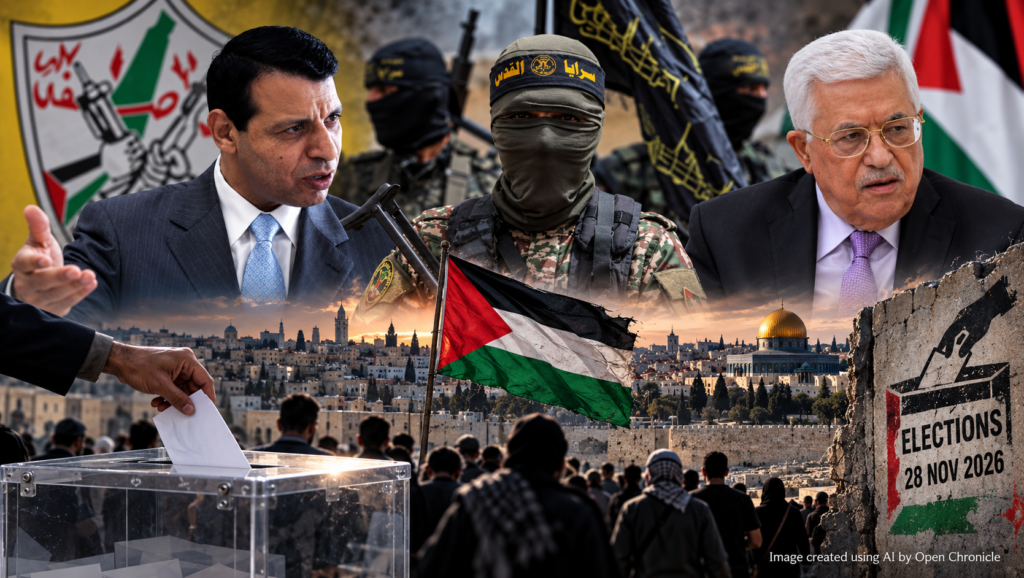
Hamas, Islamic Jihad and the Democratic Reform Current led by former senior Fatah figure Mohammed Dahlan have agreed to support a unified national list in Palestinian legislative elections scheduled for November 28. The emerging alliance is seeking additional factions and independent candidates as it prepares to compete against Fatah, led by Palestinian President Mahmoud Abbas.
By Open Chronicle with agencies | September 30, 2026
Hamas and Islamic Jihad have reached an electoral agreement with a Palestinian faction led by Mohammed Dahlan, creating a new political alliance ahead of legislative elections scheduled for November 28.
According to Palestinian officials cited by the Associated Press, the agreement brings together Hamas, Islamic Jihad and Fatah’s Democratic Reform Current, led by Dahlan, as well as other Palestinian groups.
The factions intend to support what they describe as a “unified national list.”
Efforts are underway to broaden the coalition by bringing additional political groups and independent figures into the initiative.
If the election takes place as scheduled, it would be the first Palestinian legislative vote since 2006.
Islamic Jihad confirms the agreement
Mohammed al Hindi, deputy secretary general of Islamic Jihad, confirmed the formation of the alliance during an interview in Istanbul.
He said the objective was to establish a national electoral list based on consensus rather than create a ticket composed exclusively of members of the participating organisations.
Independent Palestinian figures are expected to be included.
Islamic Jihad has historically declined to participate directly in Palestinian Authority elections.
That position is not expected to change under the new arrangement.
Instead of presenting candidates under its own banner, al Hindi said Islamic Jihad would “support a national list reached through consensus.”
The approach allows the organisation to participate politically in the electoral process without formally contesting the election as Islamic Jihad.
Dahlan faction joins Hamas and Islamic Jihad
The participation of Mohammed Dahlan’s Democratic Reform Current gives the alliance another significant political dimension.
Dahlan was previously one of the most influential figures within Fatah before breaking with the organisation’s leadership.
His faction has since emerged as a rival current within Palestinian politics and has been strongly critical of Abbas and the Palestinian Authority.
Dimitri Diliani, a spokesperson for Dahlan’s faction, confirmed the electoral agreement.
“The Palestinian Authority has failed Gaza and Palestinians everywhere,” Diliani said.
He said other Palestinian groups had already joined the initiative and that negotiations were continuing with additional factions and independent professionals.
The objective, according to Diliani, is to establish what he described as a unified national reconstruction programme.
Opposition to Abbas emerges as common ground
One of the factors bringing the participating factions together is opposition to the leadership of Palestinian President Mahmoud Abbas.
Abbas leads Fatah and heads the Palestinian Authority.
The new alliance could therefore create a significant electoral challenge to the dominant political structure in the West Bank if the November vote proceeds.
The participating groups nevertheless have substantial ideological and political differences.
Hamas and Islamic Jihad are Islamist organisations, while Dahlan’s Democratic Reform Current emerged from Fatah’s secular nationalist political tradition.
Their cooperation appears to be built around shared political objectives rather than ideological convergence.
Central among those objectives is opposition to what the alliance regards as excessive concentration of Palestinian political decision making.
Hamas and Dahlan opened talks in Cairo
The agreement follows months of discussions among Palestinian political factions.
In August, Hamas announced that its Gaza leader, Khalil al Hayya, had met Dahlan in Cairo.
The discussions focused on ways to “end the monopoly over national decision making and formulate a comprehensive national strategy.”
The meeting was notable because of the historically difficult relationship between Hamas and Dahlan.
Dahlan was a senior Fatah security figure in Gaza before Hamas seized control of the territory in 2007.
The willingness of the two sides to cooperate ahead of the proposed elections demonstrates how Palestinian political alignments are changing.
Broader unity talks failed to produce consensus
Al Hindi said the new alliance emerged after previous attempts to bring Palestinian factions together through broader political dialogue failed to produce an agreement.
Those efforts had sought to establish a wider internal consensus before the election.
With comprehensive reconciliation proving difficult, individual factions have instead begun developing their own electoral arrangements.
The unified national list is therefore being presented as an alternative framework capable of bringing together organisations and independent figures that share certain political objectives even where broader ideological differences remain.
First legislative election since 2006
The planned November election carries particular significance because Palestinians have not held legislative elections for two decades.
The last vote took place in 2006.
Hamas won that election, defeating Fatah and dramatically changing the Palestinian political landscape.
The result was followed by months of political confrontation and deteriorating security between Hamas and Fatah.
The struggle culminated in Hamas taking control of the Gaza Strip in 2007.
The Palestinian political system subsequently became divided geographically and institutionally.
Hamas controlled Gaza, while the Palestinian Authority under Abbas remained dominant in parts of the West Bank.
That division has shaped Palestinian politics ever since.
Previous election plans were postponed
Attempts to hold new Palestinian elections have repeatedly failed.
The most recent major effort came in 2021, when elections were announced but later postponed.
Abbas has now announced that legislative elections are scheduled for November 28 in both the Gaza Strip and the West Bank.
Whether voting can proceed across both territories will be one of the central questions surrounding the process.
The political and security environment is considerably different from that of the previous Palestinian legislative election.
Gaza has endured extensive destruction and displacement, while the West Bank remains affected by Israeli military operations, arrests and increasing violence involving Israeli settlers and Palestinians.
A potentially significant challenge to Fatah
The creation of a broad opposition list could alter the electoral dynamics facing Fatah.
Rather than competing separately and dividing opposition votes, Hamas, Dahlan’s faction and their partners are attempting to create a common electoral platform.
The inclusion of independent professionals could also broaden the appeal of the list beyond the traditional constituencies of the factions involved.
Islamic Jihad’s decision to support the project without formally presenting its own candidates further distinguishes the initiative from a conventional coalition of political parties.
Much will depend on which other organisations ultimately join and which independent candidates agree to participate.
The composition of the final list has not yet been announced.
Palestinian political landscape could be reshaped
The November election, if it takes place, could represent the most significant test of Palestinian political opinion in two decades.
A generation of Palestinians has reached adulthood without participating in a national legislative election.
During that period, the political environment has been transformed by the Hamas and Fatah division, repeated conflicts in Gaza, changes in regional diplomacy and growing dissatisfaction with existing Palestinian institutions.
The emergence of an electoral alliance combining Hamas, Islamic Jihad’s political support, Dahlan’s movement and other groups demonstrates the extent to which those traditional political alignments are being reconsidered.
It also creates a potentially formidable opposition bloc to Fatah.
Elections planned amid continuing conflict
The electoral preparations are taking place while violence continues in both Palestinian territories.
Israeli military operations remain underway in the West Bank and Gaza Strip, while attacks by Israeli settlers against Palestinians in the West Bank have increased.
Israeli attacks have also continued in Gaza despite the ceasefire.
Those conditions create substantial practical and political challenges for conducting elections.
Campaigning, voter registration, access to polling locations and the ability of candidates to move between Palestinian territories could all become significant issues.
Despite those uncertainties, Palestinian factions are beginning to position themselves for the November vote.
The agreement between Hamas, Islamic Jihad and Dahlan’s Democratic Reform Current is the clearest indication yet that the election could produce a major confrontation over the future direction of Palestinian politics.
For Fatah and Abbas, the emerging coalition represents a challenge from several political forces that have historically operated separately.
For the factions behind the unified national list, November 28 could provide an opportunity to transform opposition to the existing Palestinian leadership into a coordinated electoral movement.