
How Mao Zedong’s victory in the Chinese Civil War ended decades of revolutionary struggle, transformed the world’s most populous country and created a new geopolitical reality in Asia
By Open Chronicle History Desk
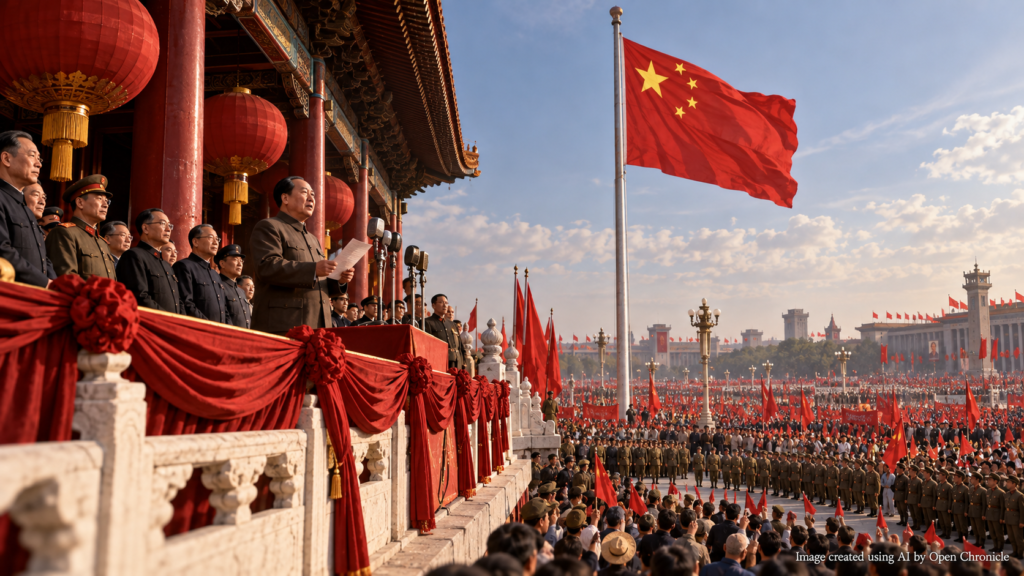
On October 1, 1949, an immense crowd gathered in and around Tiananmen Square in Beijing.
Above them stood Mao Zedong, chairman of the Chinese Communist Party.
China had endured decades of revolution, fragmentation, foreign invasion and civil war.
Now another chapter was beginning.
From the rostrum of Tiananmen, Mao proclaimed the establishment of the People’s Republic of China.
The Communist victory had fundamentally transformed the political map of Asia. Communist forces controlled most of mainland China, while the Nationalist government of Chiang Kai-shek was retreating toward Taiwan. Contemporary and later historical records identify October 1 as the formal establishment of the new People’s Republic. Biblioteca do Congresso
The moment would become one of the defining events of the twentieth century.
But the China born on October 1, 1949 did not emerge suddenly.
Its origins stretched back through decades of imperial collapse, revolution, warlord rule, ideological conflict, Japanese invasion and civil war.
To understand what happened in Tiananmen Square, we have to return to the fall of an empire.
1. The End of Imperial China
For more than two thousand years, China had been governed through successive imperial dynasties.
The final dynasty was the Qing.
By the nineteenth century, however, the Qing state faced enormous pressures.
Foreign powers had forced China into unequal treaties.
Ports had been opened to international trade under coercive conditions.
Territorial concessions weakened Chinese sovereignty.
Internal rebellions devastated enormous regions.
Industrial and military modernization proceeded unevenly.
Japan’s rapid transformation into a modern industrial and military power presented another challenge.
By the beginning of the twentieth century, growing numbers of Chinese intellectuals, soldiers and political activists concluded that the imperial system could no longer protect or modernize the country.
Revolution followed.
2. The Revolution of 1911
In October 1911, an uprising at Wuchang triggered a wider revolutionary movement.
Province after province broke with the Qing government.
The dynasty collapsed.
In 1912, the Republic of China was established.
After centuries of imperial government, China had become a republic.
But establishing a republic proved far easier than creating a stable republican state.
The following decades brought political fragmentation, military competition and competing visions of what modern China should become.
3. Sun Yat-sen and the Nationalist Movement
One of the most important figures in the revolutionary movement was Sun Yat-sen.
Sun helped develop the political movement that became the Kuomintang, or Chinese Nationalist Party.
His political philosophy emphasized nationalism, political rights and economic development.
But Sun never succeeded in unifying all of China under a durable central government.
Much of the country fell under the influence of regional military leaders commonly described as warlords.
China was formally a republic.
In practice, authority was fragmented.
Meanwhile, another political movement was beginning to emerge.
4. The Birth of the Chinese Communist Party
The Russian Revolution of 1917 had demonstrated that a Marxist revolutionary movement could seize state power.
Its influence reached China.
In 1921, the Chinese Communist Party was founded.
Among its early members was a young activist and intellectual from Hunan Province:
Mao Zedong.
At first, the Communist Party was tiny.
Few could have imagined that less than three decades later it would govern most of China.
The transformation required revolution, alliance, betrayal, military defeat, survival and ultimately civil war.
5. Nationalists and Communists
During the 1920s, the Nationalists and Communists temporarily cooperated.
Both sought to overcome China’s political fragmentation.
With Soviet assistance, the Nationalist movement developed a more organized political and military structure.
After Sun Yat-sen’s death in 1925, Chiang Kai-shek emerged as the dominant Nationalist military leader.
Chiang launched the Northern Expedition in 1926.
Its objective was to defeat regional warlords and reunify China.
The campaign achieved substantial success.
But the alliance between Nationalists and Communists collapsed.
6. 1927: The Alliance Breaks
Chiang increasingly regarded Communist influence as a threat.
In 1927, Nationalist forces and allied groups violently suppressed Communists in Shanghai and elsewhere.
The fragile alliance disintegrated.
China now faced not merely political fragmentation but an ideological civil conflict.
The Nationalists sought to consolidate a republican state under Kuomintang leadership.
The Communists sought revolutionary transformation.
The struggle would continue, with interruptions, for more than two decades.
7. Mao Turns Toward the Countryside
Classical Marxist revolutionary theory had emphasized the industrial working class.
China presented a different social landscape.
The overwhelming majority of the population lived in the countryside.
Mao increasingly placed China’s peasantry at the center of revolutionary strategy.
Communist organizers established rural bases.
Land redistribution became an important method of gaining support in some areas.
Armed Communist forces developed guerrilla tactics.
The countryside became the foundation from which the Communist movement would eventually challenge the Nationalist state.
But first it nearly faced destruction.
8. The Long March
By the early 1930s, Nationalist military campaigns placed Communist bases under severe pressure.
In 1934, Communist forces abandoned their major base in Jiangxi.
What followed became legendary in Communist political culture:
the Long March.
Communist forces travelled thousands of kilometres across some of China’s most difficult terrain.
They crossed mountains and rivers.
They endured hunger, disease and military attack.
Enormous numbers did not survive.
The march eventually brought the Communist movement to northwestern China.
Politically, it also strengthened Mao’s position within the party.
A military retreat became a foundational revolutionary narrative.
9. Japan Changes the War
While Nationalists and Communists fought each other, another danger was expanding.
Imperial Japan had seized Manchuria in 1931.
In 1937, conflict escalated into full-scale war between China and Japan.
Japanese forces captured major cities and occupied extensive territory.
The war brought catastrophic civilian suffering.
The Nanjing Massacre became one of its most infamous episodes.
The Japanese invasion forced the Nationalists and Communists into another uneasy period of cooperation.
Both fought Japan.
But both were also preparing for the political struggle that would follow.
10. Eight Years of War
The Sino-Japanese War became part of the wider Second World War.
China suffered immense losses.
Cities were bombed.
Infrastructure was destroyed.
Millions became refugees.
The Nationalist government relocated its wartime capital to Chongqing.
Communist forces expanded guerrilla operations across parts of northern China.
The war changed both movements.
The Nationalists remained internationally recognized as China’s government and bore much of the conventional military burden against Japan.
The Communists, meanwhile, expanded their political networks and military presence in the countryside.
When Japan surrendered in August 1945, the old struggle returned almost immediately.
11. The Civil War Returns
Japan’s defeat left a political vacuum across enormous areas of China.
Nationalist and Communist forces raced to occupy territory.
Negotiations failed to produce a lasting settlement.
Full-scale civil war resumed.
Initially, Chiang Kai-shek’s Nationalist government appeared to possess major advantages.
It controlled many important cities.
It had a much larger conventional military.
It received substantial American assistance.
It possessed international recognition.
Yet those advantages gradually eroded.
12. Why the Nationalists Lost Ground
The outcome of the Chinese Civil War cannot be reduced to a single cause.
Nationalist China faced severe economic problems.
Inflation became devastating.
Corruption damaged confidence in the government.
Years of warfare had exhausted the state and population.
Military leadership was uneven.
Popular dissatisfaction grew in many areas.
The Communists, meanwhile, developed increasingly effective military organization and mobilized support in significant rural regions.
Land policies strengthened their position among sections of the peasantry, although Communist land reform itself could involve coercion and violence.
By the late 1940s, the military balance was shifting dramatically.
13. From Guerrilla Army to Conventional Force
The Communist military forces, eventually known as the People’s Liberation Army, were no longer merely guerrilla formations operating from remote bases.
They had become capable of major conventional operations.
Between 1948 and early 1949, several enormous campaigns transformed the war.
The Liaoshen Campaign.
The Huaihai Campaign.
The Pingjin Campaign.
Nationalist armies suffered catastrophic defeats.
Large numbers of troops were killed, captured, defected or surrendered.
The road toward Communist control of northern and central China opened.
14. Beijing Changes Hands
In January 1949, Communist forces entered Beiping, the city soon restored to the name Beijing.
The transfer occurred after negotiations resulted in the surrender of Nationalist forces defending the city.
For the Communist movement, control of the historic northern capital carried enormous symbolic importance.
Beijing would become the capital of the new state.
But the civil war continued.
15. Crossing the Yangtze
The Yangtze River represented one of the great geographical barriers separating Communist forces from the Nationalist heartland farther south.
In April 1949, Communist armies crossed it.
Nanjing, the Nationalist capital, fell shortly afterward.
Shanghai followed in May.
The Nationalist position on the mainland was collapsing.
Communist forces continued advancing southward.
By autumn, Mao and the Communist leadership were preparing to establish a new national government.
16. A New Political Order
In September 1949, political representatives assembled in Beijing for the Chinese People’s Political Consultative Conference.
The gathering prepared the institutional foundations of the new state.
Beijing would be the capital.
A new national flag was adopted.
The five-star red flag would represent the People’s Republic.
A new government was formed.
Mao became chairman of the Central People’s Government.
The stage was set for the public proclamation.
17. October 1, 1949
Then came October 1.
Crowds gathered in Beijing.
Mao appeared at Tiananmen.
The People’s Republic of China was formally proclaimed.
The five-star red flag was raised publicly in Beijing as part of the founding ceremonies. A Library of Congress country study records both the formal establishment of the People’s Republic on October 1 and the unveiling of its flag in Tiananmen Square that day. Biblioteca do Congresso
For Communist supporters, the event represented victory after decades of struggle.
For Nationalist supporters, it represented the collapse of their position across most of mainland China.
For the international community, it created a major new geopolitical reality.
A country containing roughly one fifth of humanity was now governed by a Communist revolutionary movement.
18. The Civil War Was Not Quite Over
October 1 did not mean that fighting instantly stopped.
Communist forces were still advancing through parts of southern and western China.
Nationalist forces retained control of several territories.
The Republic of China government eventually established its principal seat on Taiwan.
Chiang Kai-shek and large numbers of soldiers, officials and civilians crossed the Taiwan Strait.
Two governments now claimed to represent China.
That unresolved political division would become one of the most enduring geopolitical consequences of 1949. U.S. diplomatic records describe the Communist victory on the mainland and the Nationalist government’s relocation to Taiwan as the central outcome of the civil war. Histórico dos EUA
19. Two Governments Claim China
After 1949, the political geography was extraordinary.
The People’s Republic of China controlled mainland China.
The Republic of China controlled Taiwan and several surrounding islands.
Both governments maintained competing claims concerning China’s legitimate representation.
For decades, this question shaped international diplomacy.
It also became deeply connected to the Cold War.
20. China and the Cold War
The proclamation occurred at precisely the moment when the international system was dividing into rival blocs.
The Berlin Blockade had ended only months earlier.
NATO had been founded in April 1949.
The Soviet Union tested its first atomic bomb in August.
Germany was being divided into rival states.
Then came Communist victory in China.
Western governments had to decide whether and when to recognize the new government in Beijing. U.S. diplomatic records from late 1949 show governments actively debating recognition and the international status of the new regime. Histórico dos EUA
The Cold War had become unmistakably global.
21. China and the Soviet Union
Initially, the People’s Republic developed a close relationship with the Soviet Union.
Mao travelled to Moscow late in 1949.
In February 1950, China and the Soviet Union concluded the Sino-Soviet Treaty of Friendship, Alliance and Mutual Assistance.
But the relationship would not remain permanently close.
Ideological disagreements, strategic rivalry and national interests eventually produced the Sino-Soviet split.
By the 1960s, the two largest Communist states had become bitter rivals.
This would eventually help transform Cold War diplomacy.
22. The Korean War
The new People’s Republic soon faced another enormous conflict.
In June 1950, war erupted on the Korean Peninsula.
When United Nations forces advanced northward toward the Chinese frontier later that year, Chinese forces entered the conflict.
The Korean War dramatically intensified hostility between Beijing and Washington.
It also reinforced the military and political division of East Asia.
For the new Chinese state, the conflict became an early test of its military power and international position.
23. Rebuilding a War-Torn Country
The government established in 1949 inherited a country devastated by decades of conflict.
Infrastructure had been destroyed.
Industrial production had been disrupted.
Inflation had weakened the economy.
Large regions had experienced prolonged warfare.
The new government therefore confronted an immense task:
reconstruct the state while simultaneously transforming society.
Land ownership was reorganized.
Industry was increasingly brought under state control.
Political institutions were reconstructed under Communist Party leadership.
China entered a period of profound social and economic change.
24. Land Reform and Revolutionary Violence
Land reform was central to Communist policy.
Landlords lost property.
Land was redistributed among rural households before agriculture was later reorganized through collectivization.
For many poor peasants, redistribution altered long-established social hierarchies.
But the campaigns also involved coercion, denunciations and executions.
The creation of the new political order therefore combined genuine social transformation with extensive political violence.
That complexity is essential to understanding the early People’s Republic.
25. The Great Leap Forward
Less than a decade after the founding of the People’s Republic, Mao launched one of the most ambitious economic campaigns in modern history.
The Great Leap Forward, beginning in 1958, sought extraordinarily rapid industrial and agricultural development.
Rural populations were organized into large communes.
Production targets became increasingly unrealistic.
Local officials often exaggerated output.
Resources were diverted.
Agricultural disruption combined with policy failures and adverse conditions.
The result was catastrophic famine.
Millions died.
The episode became one of the greatest human disasters in twentieth-century Chinese history.
26. The Cultural Revolution
Another period of upheaval began in 1966.
Mao launched what became known as the Cultural Revolution.
Young activists organized as Red Guards attacked people and institutions accused of representing old ideas, bourgeois tendencies or political disloyalty.
Officials were purged.
Teachers and intellectuals were persecuted.
Cultural objects were destroyed.
Schools and universities were disrupted.
Political factionalism spread.
The Cultural Revolution continued in varying forms until Mao’s death in 1976.
The state created in 1949 had survived, but Chinese society had experienced enormous upheaval.
27. China Returns to the United Nations
For more than two decades after 1949, the Republic of China government based in Taiwan continued to hold China’s seat at the United Nations.
That changed in 1971.
The UN General Assembly adopted Resolution 2758.
Representatives of the People’s Republic replaced those of the Republic of China in the General Assembly and Security Council. Histórico dos EUA
It was a major diplomatic turning point.
Beijing’s international position had fundamentally changed.
28. Nixon Goes to China
Another transformation followed.
In February 1972, U.S. President Richard Nixon travelled to China.
The visit would become one of the most famous diplomatic initiatives of the Cold War.
Washington and Beijing still had profound disagreements.
But both governments had strategic reasons to improve relations, particularly in the context of the Sino-Soviet split.
The Shanghai Communiqué created a framework for further engagement.
The diplomatic isolation that had characterized much of the previous two decades was beginning to end. Histórico dos EUA
29. Diplomatic Recognition
Full diplomatic normalization between the United States and the People’s Republic came later.
On January 1, 1979, Washington formally recognized the government of the People’s Republic of China as the sole legal government of China and established diplomatic relations with Beijing. The United States simultaneously ended formal diplomatic recognition of the Republic of China government on Taiwan, while maintaining unofficial relations with Taiwan. Histórico dos EUA
Thirty years after Mao stood at Tiananmen, the international landscape had changed dramatically.
30. Deng Xiaoping and a Different China
By then Mao was dead.
A new era was beginning under Deng Xiaoping.
From the late 1970s, China introduced far-reaching economic reforms.
Agricultural organization changed.
Private and semi-private economic activity expanded.
Special Economic Zones attracted foreign investment.
International trade increased dramatically.
China remained a one-party state under Communist Party leadership.
But its economic system evolved in ways that would have been difficult to imagine in 1949.
The consequences would transform the global economy.
31. From Revolution to Global Power
The country proclaimed in Tiananmen Square in 1949 was overwhelmingly poor and predominantly rural.
Its international influence was significant but constrained.
Over subsequent decades, China industrialized on an extraordinary scale.
Cities expanded.
Hundreds of millions of people moved from rural areas into urban economies.
Manufacturing transformed global supply chains.
Infrastructure expanded across the country.
China developed nuclear weapons, a space programme and increasingly sophisticated armed forces.
It became one of the world’s largest economies.
The state created on October 1, 1949 eventually became one of the central powers of the twenty-first-century international system.
32. Taiwan and the Unfinished Legacy of 1949
Yet one consequence of the Chinese Civil War remains unresolved.
Taiwan developed separately under the Republic of China government.
Over subsequent decades it underwent profound political, economic and social change, eventually becoming a multiparty democracy.
Beijing maintains that Taiwan is part of China and seeks eventual unification.
Taiwan’s political status and future remain among the most sensitive questions in international relations.
The roots of that dispute cannot be understood without 1949.
The events of October 1 therefore belong not only to history.
Their consequences remain visible in contemporary geopolitics.
33. National Day
October 1 became the National Day of the People’s Republic of China.
The anniversary is commemorated annually.
Tiananmen Square occupies a central place in the ceremonies and symbolism of the Chinese state.
The location where the People’s Republic was proclaimed became inseparable from the political identity of the country.
The ceremony of 1949 therefore continues to shape national memory.
34. Why October 1 Matters
Few dates changed the twentieth-century geopolitical map as profoundly.
October 1, 1949 represented the culmination of decades of conflict.
The Qing Empire had disappeared.
The early republic had fragmented.
The Nationalists and Communists had fought each other.
Japan had invaded.
China had endured a devastating world war.
Civil war had resumed.
And finally, one revolutionary movement had emerged dominant across most of the mainland.
But October 1 was also a beginning.
The People’s Republic would enter the Korean War.
It would ally with and later confront the Soviet Union.
It would experience the Great Leap Forward and Cultural Revolution.
It would acquire nuclear weapons.
It would enter the United Nations.
It would normalize relations with the United States.
It would undertake sweeping economic reforms.
And eventually it would become one of the principal powers shaping the global system.
October 1, 1949: A New China Appears
Imagine Tiananmen Square that afternoon.
Flags moving above an immense crowd.
Soldiers standing in formation.
Political leaders gathered on the monumental gate.
A country exhausted by decades of war waiting to discover what the revolution would bring.
Above them stood Mao Zedong.
The Communist movement that had once survived in remote rural bases now controlled Beijing, Shanghai, Nanjing and most of mainland China.
The Nationalist government was retreating.
The civil war had transformed the political map of East Asia.
The consequences would reach far beyond China’s borders.
Washington would reconsider its strategy in Asia.
Moscow would gain a powerful revolutionary partner, before later becoming its rival.
War would erupt in Korea.
Taiwan would develop separately.
The international balance of power would shift.
And the country proclaimed that day would eventually emerge as one of the most consequential states of the modern world.
October 1, 1949 was therefore not simply the founding date of the People’s Republic of China.
It was one of the moments when the political architecture of the modern world changed.
Open Chronicle History · Research & Sources
Historical Sources and Further Reading
The establishment of the People’s Republic of China in 1949 was one
of the defining political transformations of the twentieth century.
The following institutional collections provide historical material
on the creation of the People’s Republic, the diplomatic consequences
of the Chinese Civil War, China’s representation at the United Nations
and the later normalization of relations between Beijing and Washington.
01 · Library of Congress
China: A Country Study
A comprehensive historical reference examining modern China’s political,
social and institutional development, including the Chinese Civil War,
the Communist victory and the establishment of the People’s Republic
of China in 1949.
02 · U.S. Department of State
Foreign Relations of the United States: China, 1949
The Office of the Historian’s documentary collection covering American
diplomacy during the decisive final year of the Chinese Civil War and
the emergence of the People’s Republic of China.
03 · Office of the Historian
China and the United Nations, 1971
Primary diplomatic documentation concerning the international debate
over Chinese representation at the United Nations and the diplomatic
developments surrounding the People’s Republic of China’s assumption
of China’s UN seat in 1971.
04 · Office of the Historian
U.S.–PRC Diplomatic Relations, 1979
Official diplomatic records documenting the normalization of relations
between the United States and the People’s Republic of China, one of the
major long-term international consequences of the political transformation
that began in 1949.
Editorial Note
Open Chronicle History approaches the founding of the People’s Republic
of China within the broader history of imperial collapse, revolution,
Japanese invasion, civil war and the emerging Cold War. The proclamation
of October 1, 1949 marked the establishment of a new government in Beijing,
but armed conflict continued in parts of China and the Republic of China
government subsequently established its principal seat on Taiwan. The
political consequences of that division continue to shape East Asian and
international affairs.