
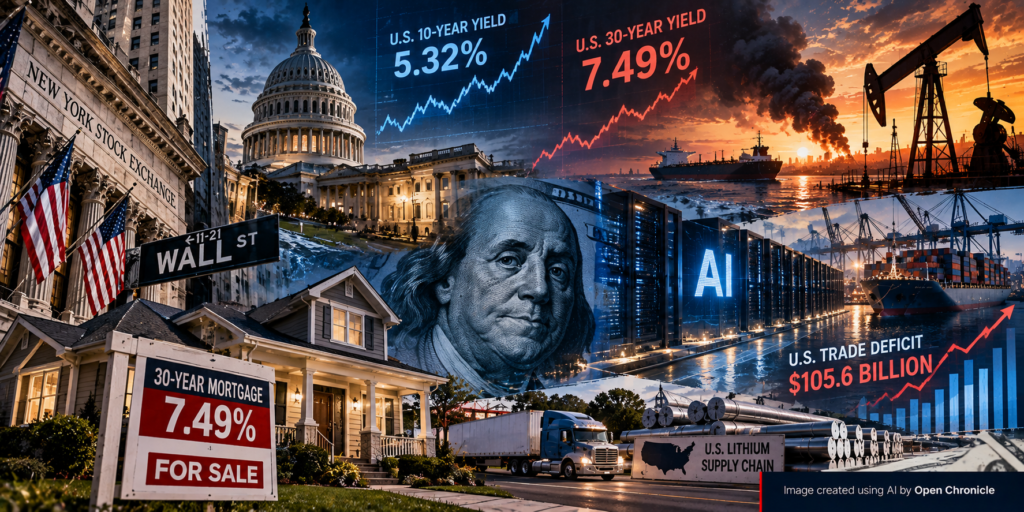
The United States economy is entering a more complicated phase as renewed Middle East tensions push energy prices higher, Treasury yields reach levels not seen in decades and mortgage costs climb sharply. At the same time, Wall Street remains buoyant, the dollar is strengthening and investment linked to artificial intelligence continues to support market confidence.
By Open Chronicle
The American economy is sending increasingly contradictory signals.
Equity markets have reached new highs and enthusiasm surrounding artificial intelligence continues to attract investment. Yet beneath that optimism, borrowing costs are rising, mortgage rates have moved sharply higher, the trade deficit has widened and renewed instability in the Middle East is threatening another energy shock.
Together, these forces are creating a difficult environment for the Federal Reserve and for American households already dealing with elevated living costs.
Treasury Yields Return to the Centre of the Economic Debate
Perhaps the clearest warning is coming from the US government bond market.
The yield on the benchmark 10 year Treasury has climbed to around 5.32%, while the 30 year Treasury yield has reached its highest level in roughly 24 years.
The rise matters far beyond financial markets.
Treasury yields influence borrowing costs throughout the economy, affecting mortgages, corporate financing, consumer credit and government debt servicing. When long term yields remain elevated, financial conditions can tighten even without another increase in the Federal Reserve’s policy rate.
Investors are now trying to determine whether the move reflects confidence in a resilient American economy, persistent inflation concerns, the impact of the Iran war and higher energy prices, or anxiety over the longer term fiscal outlook.
The answer may ultimately involve several of those forces at once.
Mortgage Rates Jump to 7.49%
American households are already feeling the consequences.
The 30 year mortgage rate has climbed to approximately 7.49%, its highest level in nearly three years.
That represents another obstacle for a housing market where affordability has already become a major economic concern.
Higher mortgage rates reduce purchasing power for prospective buyers and can discourage existing homeowners from selling properties financed at much lower rates.
The result can be an unusual combination of weak affordability and constrained housing supply.
For the wider economy, prolonged mortgage rates near or above 7% could also weaken residential investment and reduce spending associated with home purchases.
The Middle East Is Again an Economic Variable
Energy has returned as another major source of uncertainty.
Oil prices increased following renewed attacks in the Middle East, reinforcing concerns that the Iran war and instability surrounding important regional shipping routes could keep global energy costs elevated.
For the United States, another sustained rise in oil prices would complicate the inflation outlook.
Energy costs move through the economy in several ways. Higher fuel prices affect motorists directly, but they can also increase transportation, manufacturing, agricultural and logistics costs.
The risk is particularly significant because markets are already confronting high interest rates.
An energy shock combined with elevated borrowing costs would leave the Federal Reserve facing an uncomfortable balance between controlling inflation and protecting economic growth.
The Dollar Strengthens
The US dollar has benefited from the combination of higher Treasury yields, expectations surrounding Federal Reserve policy and geopolitical uncertainty.
The British pound and Canadian dollar have weakened against the US currency, while gold has fallen to a two month low as the stronger dollar and higher bond yields reduce some of the attraction of non yielding assets.
A stronger dollar can help reduce the cost of imported goods for American consumers.
But there is another side to the equation.
It can make American exports more expensive internationally and reduce the dollar value of overseas earnings reported by multinational US companies.
Currency markets are therefore becoming another transmission mechanism through which monetary policy and geopolitical instability are influencing the economy.
Markets Wait for the Federal Reserve
Attention is now turning toward the Federal Reserve’s latest meeting minutes.
Investors are searching for clues about how policymakers interpret the competing forces affecting the economy.
Soft employment data had previously helped ease some fears about restrictive monetary policy. But rising oil prices and elevated long term Treasury yields have complicated that picture.
If energy costs feed into broader inflation, the Federal Reserve may have less room to loosen monetary conditions.
If employment and economic activity weaken significantly, however, keeping financial conditions restrictive for too long carries its own risks.
That tension is likely to dominate monetary policy discussions.
A Labour Market Increasingly Dependent on Health Care
Employment data also reveal changes beneath the headline numbers.
Health care reportedly accounted for three out of every four new US jobs created over the previous year as hiring cooled in September.
That concentration does not necessarily indicate an economy without employment growth, but it raises questions about how broadly that growth is distributed.
A healthy labour market normally depends on hiring across multiple sectors. If employment expansion becomes increasingly concentrated in health care and a small number of resilient industries, weakness elsewhere in the economy may become more important.
America’s Trade Deficit Widens Again
Trade is another emerging pressure point.
The US trade deficit widened to approximately $105.6 billion in August as imports surged to record levels.
The development is particularly notable because Washington has increasingly relied on tariffs and trade restrictions as instruments of economic policy.
Yet the latest figures suggest that the underlying imbalance between American imports and exports remains substantial.
Trade negotiations with major partners are also proving difficult. Talks between the United States and India continue to face unresolved issues, while India is simultaneously pursuing other trade agreements that could reduce its vulnerability to American tariffs.
The situation illustrates the broader challenge confronting US trade policy. Tariffs can change sourcing decisions and alter bilateral trade relationships, but they do not automatically eliminate the structural forces behind the American trade deficit.
Wall Street Tells a Different Story
Financial markets nevertheless continue to demonstrate remarkable resilience.
The S&P 500 has crossed the 7,800 point threshold, marking another historic milestone for US equities.
Artificial intelligence remains one of the major sources of optimism.
Investment in data centres, computing infrastructure, semiconductors and AI related technologies continues to support expectations of higher productivity and future corporate earnings.
That optimism has also helped global stocks withstand some of the pressure coming from bond markets.
But the divergence is becoming increasingly striking.
Stocks are reaching records while mortgage rates approach 7.5%, long term Treasury yields sit near multi decade highs and energy markets remain exposed to war.
Those conditions can coexist, but they represent very different experiences of the same economy.
AI Investment Becomes an Economic Force of Its Own
Artificial intelligence is no longer simply a technology sector story.
The enormous capital requirements associated with data centres, electricity infrastructure, semiconductor production and advanced computing are increasingly influencing investment, energy demand and financial markets.
For the United States, the AI boom represents a potentially important source of productivity growth.
It is also extraordinarily capital intensive.
That means its expansion is taking place at precisely the moment when financing costs are historically high.
The sustainability of the investment cycle will therefore depend partly on whether the productivity and earnings generated by AI ultimately justify the enormous sums being committed to infrastructure.
Building Domestic Supply Chains
There are also signs of continued efforts to strengthen strategic American industries.
A partnership involving a US national laboratory is helping develop a domestic lithium supply chain, reflecting the growing importance of critical minerals to batteries, electric vehicles, energy storage and advanced manufacturing.
Such initiatives form part of a broader shift toward industrial resilience.
The United States increasingly views supply chains not simply through the lens of economic efficiency, but also through national security, technological competition and geopolitical vulnerability.
That transformation could generate significant domestic investment, although building new supply chains at home can also involve higher costs.
An Economy Pulled in Opposite Directions
The American economy is therefore difficult to describe with a single headline.
There are clear signs of strength.
Equity markets remain near record levels. The dollar is strong. AI investment is accelerating. Strategic industries continue to attract capital.
But significant pressures are accumulating at the same time.
Mortgage rates have reached 7.49%. Long term Treasury yields are around multi decade highs. The trade deficit has widened sharply. Employment growth appears increasingly concentrated. Oil prices are responding to renewed Middle East instability.
For households, businesses and policymakers, the central question is whether the economy can continue absorbing those pressures without a significant slowdown.
Much may depend on inflation.
If higher oil prices prove temporary and price pressures continue to moderate elsewhere, the Federal Reserve could eventually gain greater flexibility.
If the energy shock persists while borrowing costs remain elevated, the United States could instead face a more difficult combination of expensive credit, stubborn inflation and slower growth.
For now, Wall Street remains optimistic.
The bond market is sending a considerably more cautious message.