
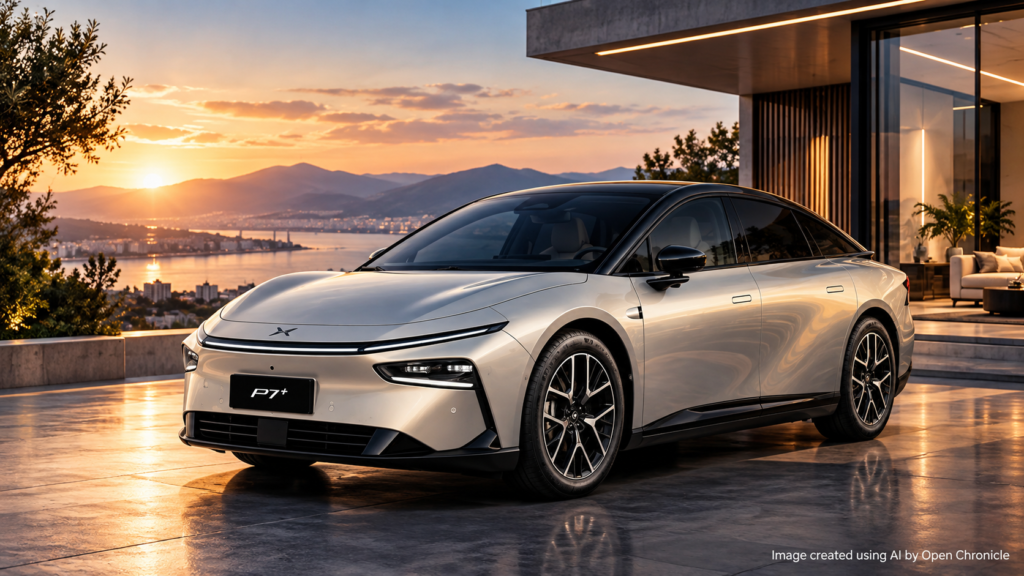
By Open Chronicle Auto Magazine
The electric car race is increasingly becoming a technology race, and the new XPENG P7+ may be one of the clearest examples yet of where the industry is heading.
At more than five metres long, with up to 530 kilometres of combined WLTP range, ultra rapid charging, a 750 TOPS artificial intelligence processor and enough luggage capacity to challenge a traditional estate car, the P7+ is difficult to define simply as another electric saloon.
XPENG prefers the word fastback.
That description makes sense. The P7+ combines a long, aerodynamic silhouette with a large rear hatch and a cabin designed around passenger space rather than the compromises normally associated with a conventional three box saloon.
But its real story is technology.
The P7+ represents XPENG’s attempt to move the electric vehicle conversation beyond battery capacity and acceleration. Instead, the Chinese manufacturer is building the car around computing power, software, charging speed and an electronic architecture designed to evolve after the vehicle leaves the factory.
And unlike many Chinese electric cars arriving in Europe, the P7+ now has another important distinction.
European market cars are being produced in Europe.
Built in Austria for Europe
XPENG introduced the P7+ to European customers at the Brussels Motor Show in January 2026, announcing plans to bring the car to 25 European markets.
European production is taking place at Magna Steyr’s factory in Graz, Austria, alongside other XPENG models.
The first locally produced P7+ rolled off the Graz production line in April 2026.
That decision gives the car an interesting position in the rapidly changing relationship between China’s electric vehicle industry and Europe’s traditional automotive manufacturing base.
XPENG remains a Chinese technology and automotive company, but the P7+ is also becoming part of Europe’s industrial ecosystem.
It is a significant development at a time when Chinese manufacturers are increasingly looking beyond exports and establishing manufacturing operations closer to European customers.
Three Versions, Three Different Personalities
European buyers can choose between three principal configurations: RWD Standard Range, RWD Long Range and AWD Performance.
The Standard Range uses a 61.7 kWh gross LFP battery and a rear mounted electric motor producing around 245 hp. It accelerates from 0 to 100 km/h in approximately 6.9 seconds.
Above it sits what could prove to be the sweet spot of the range.
The RWD Long Range combines a 74.9 kWh LFP battery with a 230 kW, or approximately 313 hp, rear motor producing 450 Nm of torque.
It reaches 100 km/h in 6.2 seconds and has a top speed of 200 km/h.
More importantly for long distance driving, its combined WLTP range reaches 530 kilometres.
Then there is the AWD Performance.
Adding a front electric motor increases total output to 370 kW, equivalent to approximately 503 hp, with combined torque reaching around 670 Nm.
Acceleration from 0 to 100 km/h drops to just 4.3 seconds.
Yet despite that performance, the official WLTP range remains around 500 kilometres.
This gives the P7+ an unusually broad personality. It can operate as an efficient rear wheel drive family fastback or, in its most powerful form, deliver acceleration approaching serious performance car territory.
The 12 Minute Charging Claim
Range is only one part of the P7+ story.
Charging may be more important.
XPENG uses an 800 volt electrical architecture and 5C LFP battery technology. The Long Range and Performance versions can accept up to 446 kW of DC charging power under suitable conditions.
XPENG says the battery can be charged from 10 to 80 percent in as little as 12 minutes when connected to sufficiently powerful charging infrastructure.
The Standard Range can accept up to 350 kW.
These numbers matter because they illustrate a fundamental shift in EV development.
Manufacturers spent the first major phase of the electric transition competing primarily over battery size and maximum range. Increasingly, the question is becoming how quickly useful range can be restored.
A car capable of adding hundreds of kilometres during a short motorway stop changes the practical experience of long distance electric driving.
There is an important qualification, however.
Maximum charging performance depends on battery temperature, state of charge, charging station capability and environmental conditions. A 446 kW peak does not mean the car continuously charges at 446 kW.
Even so, the underlying architecture places the P7+ among the fastest charging production EVs entering the European market.
530 km Without an Enormous Battery
Another interesting element is efficiency.
The Long Range model achieves its 530 km combined WLTP figure using a 74.9 kWh battery rather than relying on an extremely large and heavy battery pack.
Official combined energy consumption starts as low as 15.2 kWh per 100 kilometres for the most efficient version, while the Long Range is rated at approximately 16.4 kWh per 100 kilometres.
Aerodynamics play an important role.
XPENG quotes a drag coefficient of 0.211, an impressively low figure for a car of this size.
That matters because aerodynamic resistance becomes increasingly important as speed rises. Improving airflow therefore helps extend motorway range without simply adding more battery cells and additional weight.
More Than Five Metres Long
The P7+ is not a small car.
It measures 5,071 mm long, 1,937 mm wide and 1,512 mm high, with a substantial 3,000 mm wheelbase.
Those dimensions give XPENG considerable freedom inside the cabin.
The luggage compartment provides 573 litres of capacity. Fold the rear seats and available space expands to 1,931 litres.
That figure helps explain why XPENG positions the P7+ as something broader than a conventional executive saloon.
Its exterior profile may resemble a sleek premium fastback, but its carrying capacity approaches territory traditionally occupied by large estate cars and SUVs.
It can also tow up to 1,500 kg when braked, depending on specification.
For European buyers who like the aerodynamic efficiency and driving position of a conventional car but do not necessarily want an SUV, that combination could prove particularly attractive.
The Turing AI XP5 Chip
Then there is the feature XPENG considers central to the identity of the car: artificial intelligence.
The European P7+ introduces XPENG’s proprietary Turing AI XP5 computing architecture.
Its processor delivers up to 750 TOPS of computing capability.
TOPS means trillion operations per second. It is not a direct measure of how intelligent a vehicle is, but it provides an indication of the computational resources available for processing sensor information and running advanced AI workloads.
The significance is less about the headline number and more about what XPENG intends to do with that processing capacity.
Modern vehicles increasingly need to understand information from cameras, radar and other sensors simultaneously. Driver assistance, parking systems, cabin intelligence and future software functions all require rapid processing.
XPENG is effectively designing the P7+ as a computer platform that happens to be a car.
XPILOT Watches the Road
The P7+ combines its computing architecture with XPILOT advanced driver assistance technology.
Depending on market specification, the system incorporates functions including adaptive cruise control, lane centring assistance, active lane changing, autonomous emergency braking, blind spot detection, rear cross traffic alerts and driver monitoring.
Automated parking assistance is also included, supported by a 360 degree camera system.
XPENG says its sensor architecture uses 27 sensors to monitor the environment around the vehicle.
These remain driver assistance technologies. They do not transform the P7+ into an autonomous car, and the driver remains responsible for controlling the vehicle.
But they demonstrate the direction in which XPENG believes automotive competition is moving.
Mechanical performance still matters.
Computational performance increasingly matters too.
A Cabin Built Around Screens and Software
That philosophy continues inside.
The dashboard centres around a 15.6 inch touchscreen, accompanied by an 8.8 inch digital instrument display.
A head up display places essential driving information in the driver’s field of vision, while some specifications also include an 8 inch rear entertainment and control screen.
Apple CarPlay and Android Auto are supported, alongside XPENG’s own connected software environment.
The company also uses over the air updates, allowing vehicle software to evolve without requiring every improvement to be installed during a workshop visit.
This is increasingly becoming one of the defining differences between modern software defined vehicles and traditional cars.
The vehicle delivered on day one does not necessarily represent its final digital specification.
The Smartphone Becomes the Car Key
The XPENG app extends that digital ecosystem beyond the dashboard.
Owners can remotely access a variety of vehicle functions, including locking and unlocking, climate control and vehicle monitoring.
A digital key allows a compatible smartphone to replace the traditional physical key for everyday use.
There is also a sentry function for monitoring the vehicle.
These features may once have seemed peripheral to the driving experience. They are rapidly becoming expected characteristics of premium electric cars.
For manufacturers such as XPENG, the smartphone and the vehicle are increasingly parts of the same digital environment.
Executive Comfort in the Rear
Technology is only part of XPENG’s premium strategy.
The Long Range and Performance versions can offer Nappa leather seating, while available comfort equipment includes heating, ventilation and massage functions.
Rear passengers are given unusual attention.
Depending on specification, rear seats can provide ventilation and massage functions, while the rear backrest can be electrically adjusted through approximately ten degrees.
There is also a panoramic glass roof, extensive acoustic insulation and soft close doors on higher specifications.
The result reflects another influence from China’s rapidly developing premium EV market.
Rear passenger comfort has become a major competitive battleground, and European buyers are increasingly seeing features once associated with considerably more expensive luxury cars migrate into mainstream premium EVs.
A Sophisticated Chassis Underneath
XPENG has not focused exclusively on electronics.
The P7+ uses double wishbone front suspension and a multi link arrangement at the rear.
Continuously controlled damping is available across European specifications, allowing the suspension to adapt to different road and driving conditions.
Rear wheel drive is standard on the two less powerful versions, while the Performance uses all wheel drive.
That layout should give the car a more sophisticated dynamic foundation than its size and technology heavy marketing might initially suggest.
Whether it translates into genuine driver involvement is something that ultimately requires a proper road test.
The hardware, however, is serious.
Power Beyond the Car
The P7+ also supports Vehicle to Load functionality at up to 3.3 kW.
V2L allows electricity stored in the traction battery to power external electrical equipment through the charging system.
That can turn the car into a mobile energy source for laptops, camping equipment, tools or other devices.
It is another example of how the role of the EV battery is evolving.
The battery is no longer simply the replacement for a fuel tank. It is becoming an energy resource that can potentially interact with devices, homes and eventually electricity grids.
The Portuguese Proposition
Portugal provides an interesting example of XPENG’s aggressive positioning.
The company’s Portuguese operation has advertised the P7+ RWD Standard Range from €38,200 plus VAT under a promotional campaign.
That offer applies to the 61.7 kWh Standard Range version and has been subject to campaign dates, available stock and additional costs, so it should not be confused with a permanent retail list price.
Nevertheless, the positioning is revealing.
XPENG is attempting to offer the technology and physical dimensions of a premium executive EV at a price capable of challenging established European brands.
That combination could make the P7+ particularly relevant for company fleets, business customers and buyers considering an electric executive car.
From Horsepower to Brainpower
For more than a century, automotive competition revolved around mechanical engineering.
Engines became more powerful. Gearboxes became faster. Chassis became more sophisticated.
Those things still matter.
But the P7+ illustrates how rapidly the definition of automotive performance is expanding.
A modern EV can now be judged by battery chemistry, voltage architecture, charging curve, semiconductor performance, software architecture, sensor capability and the speed at which new features can be deployed.
That explains why XPENG talks so much about artificial intelligence.
The company does not simply want to compete with established manufacturers by building another electric car.
It wants to redefine what buyers consider important in one.
A New Kind of European Challenger
The XPENG P7+ arrives at an important moment for Europe’s automotive industry.
Chinese manufacturers are no longer competing only through low prices.
Cars such as the P7+ are increasingly competing through charging technology, software, efficiency, interior equipment and computing power.
At the same time, XPENG’s decision to manufacture the P7+ in Austria complicates the traditional distinction between a Chinese car and a European one.
The engineering philosophy and technology originate from XPENG. Production for European customers is becoming integrated into Europe’s own automotive manufacturing network.
That makes the P7+ more than another new EV.
It is a glimpse of what the next phase of automotive competition may look like.
A five metre fastback with 530 kilometres of range is impressive.
A car capable of charging from 10 to 80 percent in around 12 minutes is more interesting.
But the most significant number may ultimately be neither range nor charging speed.
It could be 750 TOPS.
Because if XPENG is correct about where the industry is heading, tomorrow’s automotive battles will not be decided only by who builds the best electric motor or the largest battery.
They will also be decided by who builds the smartest car.