
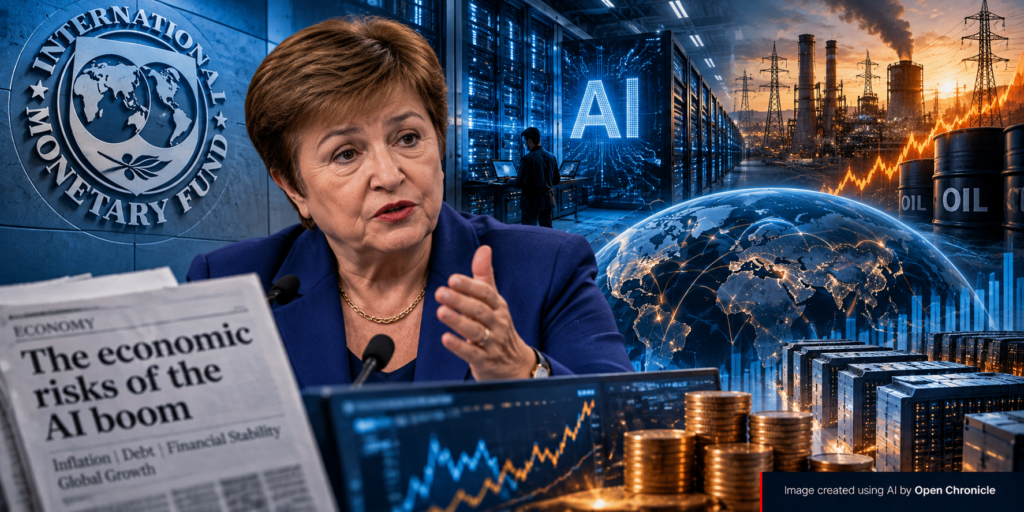
Kristalina Georgieva says artificial intelligence is rapidly reshaping the global economy, but warns that the enormous investment needed to build the technology could intensify inflation, financial instability and fiscal pressures before its full economic benefits emerge.
By Open Chronicle with agencies
Artificial intelligence is becoming a defining force in the global economy, but the extraordinary investment surrounding the technology is creating risks that governments and financial regulators cannot afford to ignore, according to International Monetary Fund Managing Director Kristalina Georgieva.
Speaking in Singapore on Wednesday, October 7, ahead of the IMF and World Bank annual meetings, Georgieva urged policymakers to prepare for the broader economic consequences of the AI boom while confronting another increasingly difficult challenge: rising sovereign debt.
“Love it, hate it, or fear it, AI is here,” Georgieva said.
Her warning reflects a growing dilemma for governments. Artificial intelligence could eventually generate major productivity gains and transform industries, but the transition requires enormous amounts of capital, computing infrastructure and energy.
For the IMF chief, that transition itself may become a source of economic instability.
Two Powerful Forces Are Reshaping the Economy
Georgieva identified two major pressures currently affecting the global economy.
The first is an energy supply shock linked to the war in the Gulf. With crude oil trading above $100 a barrel and refining capacity constrained, retail diesel prices have climbed to record levels.
The second comes from the extraordinary expansion of artificial intelligence infrastructure.
Technology companies are investing heavily in data centres, computing systems and the physical infrastructure required to train and operate increasingly powerful AI models. The scale of those investments means the consequences are no longer confined to the technology industry.
According to Georgieva, the expansion of data centres is contributing to inflationary pressures across the United States, Europe and Asia.
Combined with tariffs, rising defence expenditure and energy shocks, the AI infrastructure boom represents another significant source of pressure on prices and investment.
The Price of Building the AI Economy
The AI revolution is frequently discussed in terms of software, algorithms and computing power. Behind those technologies, however, lies a rapidly expanding physical economy.
Data centres require substantial investment, electricity and advanced computing infrastructure. Building that capacity at extraordinary speed requires enormous amounts of capital.
That creates an unusual economic situation.
The long term benefits of artificial intelligence could be considerable, but much of the expenditure required to create the infrastructure supporting those benefits is occurring now.
Georgieva warned that governments must understand this distinction when assessing the economic impact of the AI boom.
The investment surge itself can generate inflationary pressures long before productivity improvements begin appearing across the wider economy.
Financial Markets Face Another Risk
The IMF is also watching the financial consequences of the technology boom.
Strong corporate earnings have helped push equity valuations higher, producing substantial gains for investors. But Georgieva warned that those gains could become a vulnerability if technology companies ultimately fail to generate the returns markets expect.
Large technology companies and hyperscale computing operators are committing enormous sums to infrastructure.
If expected returns fail to materialise, the consequences could extend well beyond individual companies.
The combination of significant borrowing and the concentration of global wealth in US equities means a major technology downturn could generate wider financial market stress.
In that scenario, a correction in expectations surrounding artificial intelligence could become a broader financial stability problem.
The Dangerous Gap Between Investment and Productivity
Georgieva invoked Amara’s Law, the observation that societies tend to overestimate the impact of new technologies in the short term while underestimating their long term consequences.
Artificial intelligence may follow that pattern.
The technology could eventually transform productivity and economic growth. But the period before those benefits fully materialise may prove particularly difficult.
“It is somewhere in the transition between today’s AI building boom and tomorrow’s arrival of AI’s benefits that we will traverse the period of maximum risk,” Georgieva said.
That transition could leave economies exposed to high investment costs, financial speculation and inflation before the productivity gains expected from artificial intelligence become sufficiently widespread to compensate.
Debt Adds Another Layer of Vulnerability
The AI investment cycle is unfolding as governments are already confronting high sovereign debt.
Georgieva urged policymakers not to postpone difficult fiscal decisions.
Governments face competing demands for expenditure, including defence, energy security and technological infrastructure. At the same time, economic shocks can make servicing existing debt more difficult.
The result is an increasingly complex environment in which policymakers must encourage investment in technologies capable of improving future productivity without allowing fiscal vulnerabilities to become unmanageable.
Regulation Will Matter as Investment Accelerates
Georgieva argued that regulation and effective supervision will be essential as investment in artificial intelligence continues to expand.
The challenge is not simply whether AI succeeds technologically.
Governments and financial institutions must also manage the economic transition created by its development.
The enormous capital flowing into data centres and advanced computing could ultimately support a more productive global economy. But excessive borrowing, inflated expectations or disappointing corporate returns could produce serious consequences before that transformation is complete.
For the IMF, the central question is therefore shifting.
Artificial intelligence is no longer merely an emerging technology whose economic importance can be debated. It is already influencing investment, inflation, financial markets and international competitiveness.
The challenge now is ensuring that the economic system can withstand the journey from the AI investment boom of today to the productivity gains its supporters expect tomorrow.