
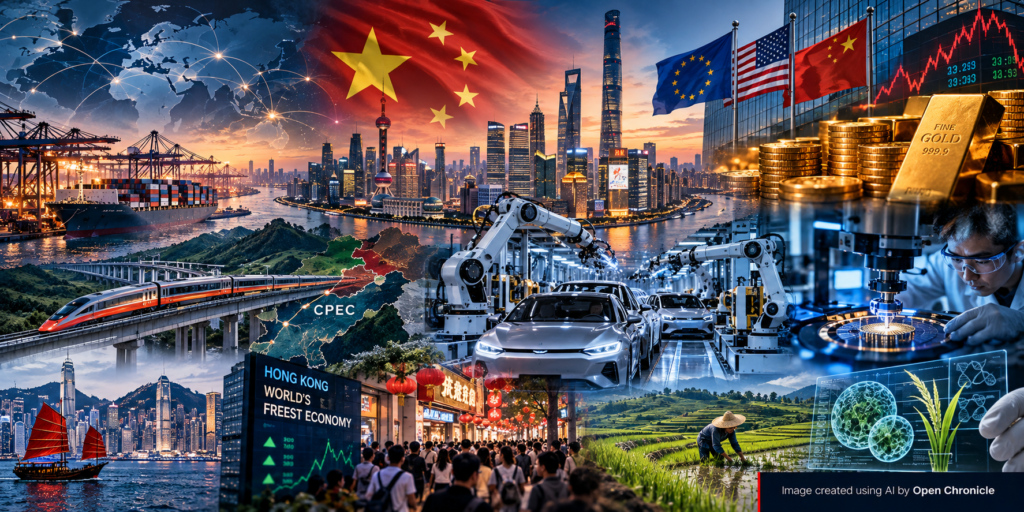
China’s economy is being pulled in several directions at once. Its export machine remains formidable, artificial intelligence and advanced manufacturing are opening new sources of productivity, domestic consumption is showing signs of resilience, and Beijing continues to deepen economic links abroad. At the same time, trade tensions with Europe and the United States, pressure on foreign exchange reserves and growing resistance to Chinese industrial exports are creating a more difficult external environment.
By Open Chronicle
China’s economic story is increasingly becoming a story of transition.
For decades, the country’s extraordinary expansion was built around industrialisation, infrastructure, exports and integration into global supply chains. Those pillars remain important, but the economic landscape surrounding them is changing rapidly.
Recent developments point to an economy attempting to move simultaneously toward advanced technology, greater domestic consumption and deeper international commercial networks, while preserving the manufacturing capacity that made China central to the global economy.
That strategy is increasingly colliding with resistance abroad.
From European concerns about Chinese electric vehicles to restrictions surrounding semiconductors, critical minerals and strategic infrastructure, economic relations between China and several major trading partners are becoming more politically sensitive.
The result is a complicated picture: China remains one of the most powerful engines of global trade, but the environment in which that engine operates is becoming considerably more contested.
China’s Export Machine Faces Growing Resistance
One of the central questions facing Beijing is how much longer China’s export model can continue expanding at its previous pace.
Chinese manufacturers have become highly competitive across sectors ranging from electric vehicles and batteries to electronics, machinery and renewable energy technologies.
But that success is generating political resistance.
European policymakers are debating tougher measures against Chinese imports, while negotiations with Beijing increasingly focus on concerns surrounding inexpensive vehicles and industrial competition.
The United Kingdom is also considering tariffs on Chinese built electric vehicles, while Beijing has warned that it could respond to such measures.
Germany has meanwhile blocked the proposed acquisition of logistics company Zippel by Chinese shipping group Cosco on security grounds.
These developments reflect a broader transformation in the relationship between China and Europe.
Trade policy is increasingly being connected to economic security.
Beijing Pushes Back Against Protectionism
China is responding by presenting itself as a defender of open trade.
Beijing has urged France and Germany to resist protectionist measures and has called on the European Union to maintain stable industrial and supply chain relationships with China.
The argument is strategically important.
China remains deeply integrated into European manufacturing networks, while European companies continue to depend on Chinese suppliers, production capacity and the enormous Chinese consumer market.
But European governments are increasingly concerned about the consequences of that dependence.
The debate is therefore moving beyond traditional questions about tariffs.
It now encompasses strategic industries, technology, infrastructure, critical raw materials and the ability of European economies to remain competitive against heavily scaled Chinese manufacturing.
This tension could become one of the defining economic relationships of the coming decade.
The Export Ceiling Question
The growing resistance abroad raises another question: can China’s export engine eventually encounter a political ceiling?
Individual markets may be able to absorb rapidly increasing volumes of Chinese manufactured goods, but governments can intervene when domestic industries come under pressure.
Electric vehicles provide one of the clearest examples.
Chinese manufacturers have developed significant advantages in manufacturing scale and the electric mobility supply chain. Their international expansion is now prompting governments to consider tariffs and other protective measures.
Similar tensions are emerging around critical minerals and technology.
China’s export controls on strategic materials have demonstrated how supply chains themselves can become instruments of economic power.
The global economy is therefore moving toward a more complicated relationship with Chinese manufacturing: countries want access to inexpensive Chinese products while simultaneously attempting to reduce strategic dependence on China.
AI Moves Onto the Factory Floor
The other major transformation is happening inside China itself.
Artificial intelligence is increasingly moving from software platforms into factories, industrial systems and physical production.
The emergence of specialised AI agents, decision models and increasingly sophisticated automation systems suggests that China’s next productivity push could come from combining its enormous manufacturing base with artificial intelligence.
That combination matters.
China already possesses extensive industrial infrastructure, supply chains and engineering capacity. If AI can improve production planning, robotics, logistics, quality control and factory efficiency, the technology could reinforce sectors where China already holds significant advantages.
Recent developments illustrate the breadth of the effort.
Tencent is expanding specialised AI agents across its applications, while Shanghai AI Laboratory has released smaller models designed to generate decisions rather than simply text.
Elsewhere, Chinese researchers and companies continue to advance robotics, quantum technology, satellite systems and other strategic technologies.
The AI race in China is consequently becoming an industrial race as much as a competition over large language models.
Advanced Technology Becomes an Economic Strategy
Some of the most significant developments are occurring far beyond consumer technology.
Chinese researchers have reported progress in ultra low temperature refrigeration systems designed for quantum chips, while another research team has mapped the complete life cycle of rice through a three dimensional cellular atlas.
Chinese engineers are also developing sophisticated satellite networks and experimenting with reusable rocket infrastructure.
None of these developments individually determines the direction of China’s economy.
Together, however, they illustrate the breadth of the country’s attempt to move further into high value scientific and technological production.
This matters because China’s long term economic competitiveness will increasingly depend on whether technological productivity can compensate for pressures elsewhere in the economy.
Domestic Consumption Shows Another Side of China
China’s enormous domestic market remains another crucial part of the equation.
The National Day holiday provided signs of active travel, tourism and entertainment spending.
Railways experienced heavy holiday traffic, while China’s holiday box office exceeded 950 million yuan. Rural destinations and immersive tourism experiences also attracted growing attention.
These trends matter because Beijing has long sought to strengthen consumption as an economic driver.
A more consumption oriented economy would reduce some of China’s dependence on investment and external demand.
Yet holiday spending alone cannot establish whether a broader structural transition is underway.
The deeper question is whether households become sufficiently confident to spend more consistently across the economy.
Housing remains central to that equation.
New measures in Hengqin intended to stimulate housing demand demonstrate that policymakers are still searching for ways to support parts of the property market.
Gold Buying Sends Another Signal
China’s financial positioning is also attracting attention.
The country’s central bank increased its gold reserves for the twenty third consecutive month, while foreign exchange reserves declined by 1.11 percent in September.
China also recorded its largest monthly increase in gold reserves in three years.
Persistent gold accumulation has become an important feature of Beijing’s reserve strategy.
It comes as debate continues over the international monetary system and the long term role of the US dollar.
Following renewed diplomatic engagement between Washington and Beijing, analysts are closely watching whether China adjusts the composition of its reserves and how aggressively it continues accumulating gold.
For now, the sustained purchases demonstrate that gold remains an important component of China’s reserve management.
Hong Kong Retains Its Financial Importance
Hong Kong remains another important element of China’s economic architecture.
A recent report again ranked Hong Kong as the world’s freest economy, reinforcing its position as one of Asia’s major financial and commercial centres.
Its role is particularly significant because Hong Kong provides a bridge between mainland China and international capital.
At the same time, the territory faces many of the pressures affecting the wider Chinese economy.
Hong Kong equities have recently come under pressure from higher oil prices and weakness in technology and biotechnology shares, illustrating how international energy conditions and global market sentiment continue to influence Chinese financial markets.
Energy Becomes Another Economic Risk
China’s economic outlook cannot be separated from global energy markets.
Higher oil prices create additional costs for transportation, manufacturing and logistics across Asia.
The effects are already visible elsewhere in the Chinese economic sphere, including Macau, where turmoil in oil markets has reportedly increased logistics costs.
For a manufacturing economy operating at China’s scale, sustained increases in energy prices can spread through supply chains quickly.
They also arrive at a difficult moment, as global businesses are simultaneously managing tariffs, geopolitical tensions and increasingly fragmented trade rules.
Economic Corridors Remain Central to Beijing’s Global Strategy
China is also continuing to develop economic relationships beyond its traditional Western markets.
Discussion surrounding the next generation of the China Pakistan Economic Corridor reflects Beijing’s continuing interest in infrastructure based economic integration.
Similar dynamics can be seen across emerging markets, where Chinese companies remain active in transportation, energy, manufacturing and electric mobility.
Kenya’s planned large scale Geely electric mobility initiative is another indication of how Chinese industrial capacity can expand into rapidly growing markets.
These relationships could become increasingly important if access to some European and North American markets becomes more restricted.
Emerging economies therefore represent not merely additional customers for China, but potentially an increasingly important part of the country’s future economic geography.
The Global Imbalance Problem
China’s economic strength creates a paradox.
Its enormous industrial capacity makes Chinese products competitive across the world. But the greater China’s export surpluses become, the stronger the political pressure on governments receiving those exports can become.
This is the emerging challenge behind discussions of global economic imbalances.
China wants to preserve industrial growth.
Europe wants to preserve its manufacturing base.
The United States wants to reduce strategic dependence on Chinese supply chains.
Emerging economies want Chinese investment while also developing industries of their own.
These objectives cannot always be reconciled easily.
The result could be a global economy that remains deeply interconnected with China while simultaneously constructing barriers around strategically important sectors.
China’s Next Economic Model Is Taking Shape
The developments now surrounding China suggest that its next economic model will not simply replace exports with domestic consumption.
Instead, several strategies appear to be developing simultaneously.
China is maintaining its formidable manufacturing and export capabilities while investing heavily in artificial intelligence, robotics, quantum technology and advanced scientific research. It is seeking new markets and economic corridors abroad while encouraging domestic tourism and consumption at home.
At the same time, Beijing is accumulating gold and navigating a global trading system increasingly shaped by economic security.
The greatest uncertainty may therefore lie outside China itself.
Chinese factories can continue becoming more productive. Chinese technology companies can continue developing AI. Consumers can travel and spend. Infrastructure networks can extend into new markets.
But China’s economic rise has become large enough that the policies of other countries increasingly determine how much space remains for that expansion.
The next chapter of the Chinese economy will therefore be shaped not only in Beijing, Shanghai or Shenzhen.
It will also be shaped in Brussels, Washington, London and across the emerging markets where China is competing to build the commercial networks of the future.