
Open Chronicle | Arts Magazine · Art History · The Masterpiece
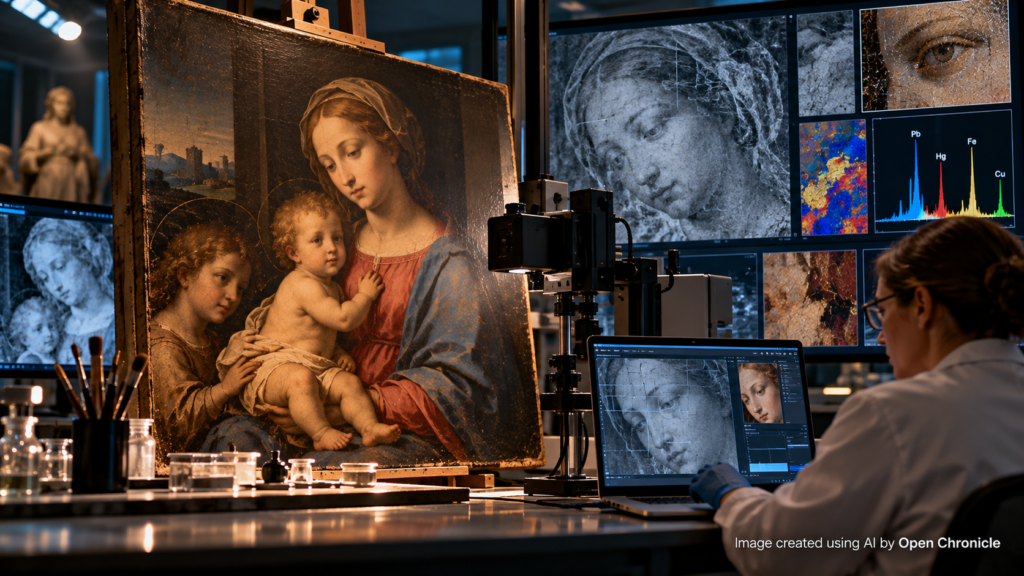
For centuries, the authenticity of a Renaissance masterpiece depended largely on the trained eye of the art historian. Today, artificial intelligence, infrared imaging and chemical analysis are challenging long-established attributions and revealing secrets hidden beneath the paint.
By Open Chronicle Arts Magazine
Introduction: The Mystery Behind a Masterpiece
What makes a painting a Raphael?
Is it the elegance of its composition, the extraordinary delicacy of its figures, or the unmistakable harmony that made Raphael one of the defining artists of the Italian Renaissance?
For centuries, scholars have attempted to answer these questions by examining brushwork, studying historical documents and comparing paintings with works whose authorship is securely established.
But what happens when a scientific instrument identifies something the human eye cannot see?
And what happens when an artificial intelligence system questions an attribution that generations of experts have accepted?
These questions have moved from theoretical debate into the centre of contemporary art history.
New methods of scientific investigation are transforming how museums, conservators and researchers examine historical paintings. Infrared reflectography can reveal preliminary drawings beneath finished compositions. X-ray fluorescence can identify chemical elements associated with pigments. High-resolution imaging can expose subtle changes in technique, while computational systems can compare patterns across large collections of artworks.
The results can be extraordinary.
A painting once dismissed as a workshop production may receive renewed attention. A familiar masterpiece may reveal evidence of collaboration. An apparently unified composition may contain passages executed by different hands.
Few artists illustrate these possibilities more compellingly than Raphael.
More than five centuries after his death, the question of what Raphael painted personally, and what was completed by his assistants, remains one of the most fascinating problems in Renaissance scholarship.
Science is now providing new ways to investigate that question.
But it is also revealing something equally important: determining the authorship of a masterpiece is rarely as simple as identifying a single name.
1. Raphael and the Problem of Artistic Authorship
Raphael, born Raffaello Sanzio in Urbino in 1483, became one of the central figures of the High Renaissance.
Alongside Leonardo da Vinci and Michelangelo, he helped establish an artistic ideal characterized by balanced compositions, expressive human figures and an extraordinary command of perspective.
His Madonnas became particularly influential.
Their carefully constructed relationships between mother and child, their delicate expressions and their subtle emotional qualities helped define Renaissance religious painting.
But Raphael’s success also created a problem that continues to challenge scholars.
He directed a highly productive workshop.
As his reputation grew, commissions multiplied, and assistants participated in the execution of paintings, frescoes and decorative projects.
Among the artists associated with his workshop were Giulio Romano and Gianfrancesco Penni.
The distinction between a painting executed entirely by Raphael and one completed with assistance is therefore not always straightforward.
A composition might have originated in Raphael’s imagination, been developed through his drawings and then received contributions from several painters.
Even when the final result reflects his artistic vision, the physical application of paint may not be entirely his.
Modern scientific analysis has made this distinction increasingly important.
Instead of asking only whether a painting is a Raphael, researchers can investigate which parts may have been painted by the master and which might belong to his workshop.
2. The Madonna della Rosa: A Face That Raised New Questions
One of the most intriguing examples is Madonna della Rosa, also known as The Madonna of the Rose.
The painting depicts the Virgin Mary, the Christ Child, the young Saint John the Baptist and Saint Joseph.
For generations, scholars have debated whether the entire composition was executed by Raphael or whether members of his workshop contributed.
Particular attention has focused on the figure of Saint Joseph.
His darker appearance, position within the composition and perceived differences in execution have prompted questions about whether he was painted by another artist.
In December 2023, researchers led by Professor Hassan Ugail at the University of Bradford published an artificial intelligence analysis that brought renewed attention to the painting.
Their computational system examined visual characteristics learned from accepted works by Raphael.
When the researchers analysed the entire painting, the results were not decisive.
They then examined individual areas.
The system classified the principal figures of the Virgin, Christ Child and Saint John as consistent with Raphael’s work, while identifying the face of Saint Joseph as less consistent with his characteristic style.
The researchers suggested that Joseph may have been executed by another painter, potentially someone associated with Raphael’s workshop.
The finding was significant because it demonstrated how computational analysis might help investigate the distribution of artistic labour within a single painting.
It did not, however, establish the identity of Joseph’s painter beyond doubt.
The algorithm produced an attribution assessment, not direct historical evidence of who held the brush.
3. When Artificial Intelligence Examines a Renaissance Painting
Artificial intelligence systems used for art attribution generally rely on machine-learning techniques that identify statistical patterns in images.
Researchers train or calibrate models using examples associated with particular artists.
Depending on the system, the analysis may examine relationships involving colour, texture, forms, composition and other visual features.
The goal is to determine whether an unfamiliar painting shares characteristics with accepted examples.
This approach can be useful because stylistic differences are not always obvious to human observers.
A painting may appear entirely consistent with Raphael’s work when viewed in a gallery, yet contain small visual patterns that a computational system classifies differently.
But the apparent precision of AI must be interpreted carefully.
A reported accuracy of 98 percent in a particular research setting does not mean that every new painting can be authenticated with 98 percent certainty.
Performance depends on the training data, the quality of the images, the composition of the test set and the similarity between the works being compared.
There are also complications specific to historical painting.
Paintings can be damaged, restored, cleaned or altered over centuries.
Photographs may differ in lighting, colour balance and resolution.
A model may learn characteristics associated with photography, conservation or reproduction rather than the artist’s original technique.
For these reasons, computational findings are most valuable when examined alongside other forms of evidence.
4. The de Brécy Tondo: When Two AI Systems Disagreed
The controversy surrounding the de Brécy Tondo reveals both the possibilities and limitations of AI authentication.
The circular painting depicts the Virgin Mary and the Christ Child in a composition closely resembling figures in Raphael’s celebrated Sistine Madonna.
For decades, its authorship has been disputed.
In 2023, researchers associated with the University of Bradford and the University of Nottingham reported that facial-recognition analysis found strong similarities between the faces in the Tondo and those in the Sistine Madonna.
They argued that their findings supported an attribution to Raphael.
But the conclusion was challenged.
Art historians questioned whether similarity between the images demonstrated common authorship. A copyist, after all, might reproduce the features of an earlier painting with considerable accuracy.
A separate computational assessment by the Swiss company Art Recognition reached the opposite conclusion, reporting an 85 percent probability against Raphael’s authorship under its model.
The disagreement attracted international attention.
Two systems using computational techniques had produced conflicting assessments of the same work.
The case exposed a fundamental problem.
Artificial intelligence does not operate independently of its assumptions.
Different training datasets, analytical methods and definitions of stylistic similarity can lead to different conclusions.
The dispute also highlighted the importance of historical context.
Even a technically convincing comparison cannot, by itself, establish when a painting was produced, why it was created or whether its relationship to another artwork reflects original invention or copying.
The Tondo remains a contested attribution, rather than a universally accepted rediscovered Raphael.
5. Infrared Reflectography: Discovering the Drawing Beneath the Paint
Long before artificial intelligence entered the debate, scientific imaging had already transformed Renaissance art research.
One of the most valuable techniques is infrared reflectography.
This method uses infrared radiation to investigate features beneath the visible paint surface.
Certain drawing materials can absorb infrared radiation differently from surrounding paint layers, allowing cameras and detectors to reveal underdrawings that cannot be seen under normal illumination.
For art historians, these hidden drawings can be extraordinarily informative.
They may reveal how an artist planned a composition, adjusted the position of a figure or reconsidered the arrangement of architectural elements.
They can also expose differences between an original creative process and the mechanical reproduction of an existing image.
A copyist may follow a known composition closely.
An artist developing an original work may experiment, revise and change direction.
Such revisions, often called pentimenti, can provide valuable evidence about the painting’s creation.
Nevertheless, their presence does not automatically prove authorship, and their absence does not necessarily imply copying.
The evidence must be interpreted within the artist’s known working practices.
6. The Madonna of the Pinks: A Scientific Rediscovery
One of the most compelling examples of science contributing to Raphael scholarship is The Madonna of the Pinks, now in the National Gallery in London.
For many years, Raphael’s original version was thought lost, although copies of the composition were known.
In 1991, art historian Nicholas Penny encountered a small painting at Alnwick Castle in Northumberland that warranted closer investigation.
Scientific examination revealed evidence supporting its attribution to Raphael.
Infrared reflectography exposed a highly accomplished underdrawing.
Researchers identified characteristics consistent with Raphael’s known drawing techniques, including the treatment of hands, drapery and forms.
The investigation also revealed changes between the underdrawing and the completed painting.
These modifications suggested an active process of composition rather than straightforward copying.
Chemical examination found pigments consistent with Raphael’s period and artistic practice.
No single discovery established the attribution on its own.
The strength of the case came from the convergence of stylistic observation, technical investigation and historical research.
The National Gallery’s examination of the painting became an important illustration of how scientific methods could contribute to the rediscovery of a Renaissance masterpiece.
7. X-Rays, Pigments and the Chemistry of Art
Paintings are physical objects with complex histories.
Their materials can reveal information that is invisible to the naked eye.
X-radiography can help investigators examine the structure of a painting and differences in the absorption of X-rays by materials within it.
Depending on the work, it may reveal compositional changes, hidden features, damage or aspects of the support.
X-ray fluorescence spectroscopy provides another kind of evidence.
It detects characteristic X-ray emissions from chemical elements, helping researchers identify the elemental composition of materials present in a painting.
This can support the investigation of pigments, although identifying an element does not always uniquely identify a particular pigment.
For example, the presence of lead might be associated with several historically used materials.
Other techniques, including Raman spectroscopy and infrared spectroscopy, can help characterize compounds more specifically.
These methods are particularly valuable when investigators suspect that a painting contains materials inconsistent with its proposed date.
A pigment introduced centuries after Raphael’s death could raise serious questions about an attribution, provided that researchers establish that the material belongs to the original paint rather than a later restoration.
Conversely, materials consistent with the Renaissance do not prove that Raphael painted the work.
An imitator could have used historically appropriate pigments, and some materials remained in use for long periods.
Scientific examination is therefore most effective when its findings are considered together.
8. The Workshop Problem: Who Actually Painted the Masterpiece?
The modern desire to identify a single author can obscure how Renaissance workshops operated.
Artistic production was often collaborative.
Masters developed compositions, trained apprentices, supervised commissions and delegated particular tasks.
Assistants might prepare supports, transfer drawings, execute backgrounds or paint portions of a composition.
The level of involvement varied considerably.
In some works, the master executed nearly every significant passage.
In others, the design may have been his while much of the painting was completed by assistants.
This makes the language of attribution especially important.
A museum catalogue may distinguish between by Raphael, Raphael and workshop, workshop of Raphael, circle of Raphael, follower of Raphael and after Raphael.
These descriptions express different relationships between a work and the artist.
They are not interchangeable.
Scientific analysis may help clarify whether particular areas differ in technique or material composition.
But identifying the exact person responsible can remain difficult.
Raphael’s assistants were trained to work within his artistic language.
Some developed considerable technical skill and later became important artists in their own right.
The more successful the workshop, the more difficult it can be to separate the master’s hand from those of his closest collaborators.
9. Can a Machine Understand Artistic Genius?
The debate over AI attribution raises a philosophical question.
Can a machine recognize artistic genius?
A computational system can identify visual regularities and measure statistical relationships.
It may detect patterns that human observers overlook.
But artistic authorship involves more than repeated visual characteristics.
A painter’s style evolves.
An artist may experiment with unfamiliar techniques, work under different conditions or deliberately depart from established habits.
Historical paintings also exist within networks of influence, training, imitation and collaboration.
Raphael’s artistic language was admired and imitated by generations of painters.
Similarity to Raphael may therefore indicate his influence rather than his direct involvement.
The challenge becomes even greater when algorithms produce numerical results that appear definitive.
A percentage can convey an impression of certainty.
Yet the underlying assessment may depend on assumptions that remain open to debate.
The most productive role for AI is not to replace the judgment of art historians.
It is to introduce another source of evidence, generate testable hypotheses and identify areas that deserve closer examination.
10. Why Provenance Still Matters
A painting’s provenance is the documented history of its ownership, movement and exhibition.
For attribution research, provenance can be essential.
Historical inventories, correspondence, collection catalogues, payment records and other documents may establish where a painting was located at particular moments.
Such evidence can connect a work to an artist’s lifetime or to a known commission.
But provenance records are often incomplete.
Paintings may have changed hands privately, acquired new titles or been described inaccurately.
Some documents survive only in fragments.
Others may refer to compositions without identifying a particular surviving object.
A continuous, well-supported provenance can strengthen an attribution.
A gap does not automatically disprove one.
The strongest investigations consider documentary history alongside technical and stylistic evidence.
This combination helps prevent a common mistake: treating a painting as authentic merely because it resembles a famous artist’s work.
11. The Museum Laboratory as a Place of Discovery
Modern conservation laboratories have become important centres of art-historical research.
Conservators, chemists, imaging specialists and art historians increasingly work together to investigate paintings.
Each discipline contributes a different perspective.
An art historian may identify an unusual stylistic feature.
A conservator may examine whether that feature belongs to the original painting or a later restoration.
An imaging specialist may reveal an underlying drawing.
A materials scientist may identify the composition of a pigment or binding medium.
A computational researcher may compare visual characteristics with those of other paintings.
The findings can reinforce one another, but they may also produce contradictions.
Those contradictions are often valuable.
They encourage researchers to reconsider assumptions and investigate questions that might otherwise remain unexplored.
The laboratory does not remove uncertainty from art history.
It makes uncertainty more visible, more specific and more open to investigation.
12. What Happens When an Attribution Changes?
Attribution has consequences far beyond academic debate.
A painting accepted as an original Raphael carries a different historical, cultural and financial significance from a work attributed to his workshop or a later follower.
Changes in attribution can influence museum catalogues, exhibition narratives, conservation priorities and the interpretation of an artist’s career.
They can also affect the art market.
But the financial consequences should not be confused with the scholarly purpose of authentication.
The central question is not how much a painting might be worth if it were attributed to Raphael.
It is what the available evidence can responsibly establish about the painting’s origin.
Scientific investigation may strengthen an attribution, weaken it or reveal that a more nuanced description is necessary.
Sometimes the most accurate conclusion is that authorship remains unresolved.
That is not a failure.
It is an acknowledgement of the limits of historical evidence.
13. The Future of Art Authentication
Scientific methods will continue to evolve.
Imaging technologies are becoming more sophisticated.
Computational systems can examine increasingly complex datasets.
Researchers are developing methods for combining information from different analytical techniques.
The future may involve integrating high-resolution images, pigment maps, underdrawing analysis, historical documents and computational comparisons into a single research framework.
Such approaches could help scholars identify patterns across workshops, artistic networks and historical periods.
They may also contribute to conservation by distinguishing original paint from later interventions.
But responsible development will require transparency.
Researchers must explain how models are trained, how their accuracy is evaluated and what their results actually mean.
Museums and scholars will also need to address the risk of overconfidence.
A sophisticated instrument does not automatically produce an unquestionable conclusion.
The scientific study of art depends on careful interpretation, reproducible methods and the willingness to revise earlier assessments.
Conclusion: A New Way of Seeing the Renaissance
The question Is it really a Raphael? may appear simple.
The answer rarely is.
A Renaissance painting carries the traces of its creation, the choices of its maker, the involvement of assistants and the effects of centuries of preservation, restoration and ownership.
Scientific analysis can uncover some of these traces.
Infrared imaging can reveal the artist’s first ideas.
Chemical analysis can illuminate the materials used to construct an image.
Artificial intelligence can identify visual relationships that deserve further investigation.
But no single technique can reconstruct the complete history of a painting.
The most important change taking place in art history is not the replacement of human expertise by machines.
It is the emergence of a more collaborative form of investigation.
Art historians, conservators, scientists and computational researchers are learning to ask questions together.
The results may challenge familiar attributions, reveal forgotten masterpieces or expose the complex working methods of Renaissance workshops.
And perhaps that is the greatest contribution of science to art history.
It reminds us that even the most familiar masterpiece can still contain something we have not yet learned to see.
Artwork and Research Information
| Field | Information |
|---|---|
| Principal artist | Raphael (Raffaello Sanzio) |
| Lifespan | 1483–1520 |
| Artistic period | High Renaissance |
| Principal case studies | Madonna della Rosa, de Brécy Tondo, The Madonna of the Pinks |
| Research disciplines | Art history, conservation science, computational analysis |
| Scientific techniques | Infrared reflectography, X-radiography, X-ray fluorescence, spectroscopy, machine learning |
| Central question | How can evidence distinguish an artist’s own work from workshop contributions, copies and later imitations? |
Sources and Further Reading
University of Bradford
AI Study Shows Raphael Painting Was Not Entirely the Master’s Work
Research announcement concerning the 2023 computational examination of Madonna della Rosa and the attribution of Saint Joseph’s face.
The National Gallery, London
How to Spot a Raphael
An examination of The Madonna of the Pinks, including provenance, underdrawing, compositional revisions and pigments.
The National Gallery, London
The Infra-red Examination of Raphael’s Garvagh Madonna
Technical research by Jill Dunkerton and Nicholas Penny, published in the National Gallery Technical Bulletin, Volume 14 (1993).
The Art Newspaper
Old Masters Scholars Reject AI-Attributed Raphael
Reporting on scholarly objections to the proposed attribution of the de Brécy Tondo.
Scientific American
Mystery Portrait May Be a Raphael, Artificial Intelligence Suggests
An examination of the de Brécy Tondo controversy and the distinction between computational similarity and historical attribution.
Editorial Note
This article distinguishes scientific findings, computational attribution claims and established art-historical conclusions. The authorship of the de Brécy Tondo remains disputed. Artificial intelligence assessments should not be interpreted as definitive proof of authenticity.
Open Chronicle Arts Magazine
Explore the world of art, creativity and culture. Discover extraordinary artists, timeless masterpieces, contemporary movements and the stories behind the works that shape our world.
Back to Arts Magazine