
The Unexplained Files | Investigation 001
By Open Chronicle | The Unexplained Files
In the winter of 1959, nine young Soviet hikers vanished into the northern Ural Mountains. What rescuers discovered became one of the most enduring mysteries of the twentieth century. More than six decades later, scientific research has brought investigators closer to an explanation, but the full story of their final night remains beyond recovery.
The Mountain That Kept Its Secrets
On a remote slope in the northern Ural Mountains, somewhere between the last hours of February 1 and the early morning of February 2, 1959, something went catastrophically wrong.
Nine experienced hikers, most of them students or graduates of the Ural Polytechnic Institute, abandoned their tent in freezing darkness. They left behind essential clothing, footwear and equipment. Some moved downhill wearing little more than the garments in which they had been sleeping.
The temperature was far below freezing. Strong winds swept across the exposed mountainside. The nearest substantial shelter lay more than a kilometre away, among the trees below.
None of the nine survived.
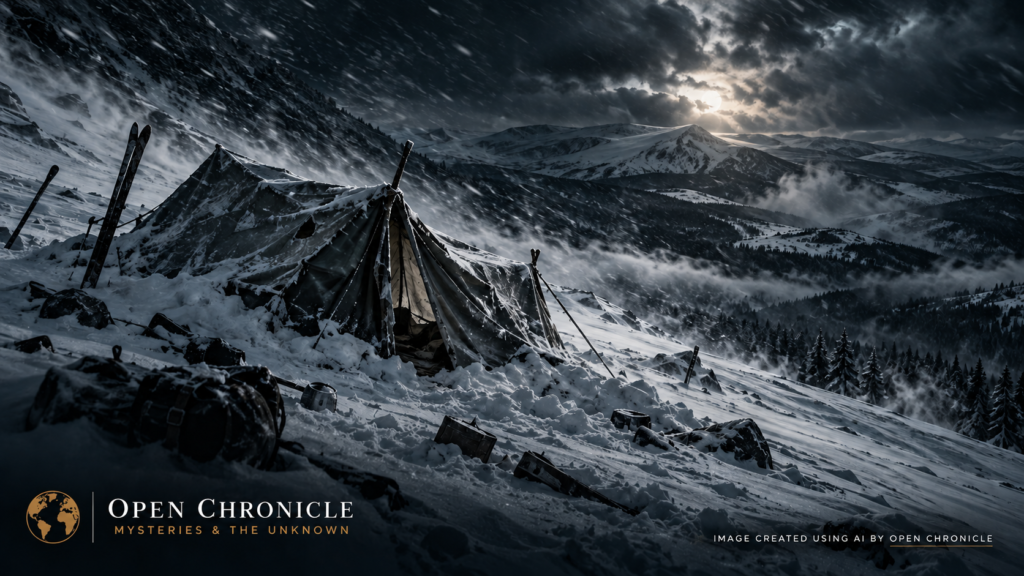
When search teams eventually located their campsite, they found a scene that would generate decades of speculation. The tent had been damaged and partly buried in snow. Investigators concluded that cuts in its fabric had been made from inside. Footprints led away towards the forest.
The bodies were discovered in different locations over the following weeks. Some victims appeared to have died primarily from exposure. Others had sustained severe injuries, including fractured ribs and skull trauma.
The Soviet investigation failed to establish a precise sequence of events.
In the absence of a convincing public explanation, the tragedy acquired a life of its own.
It became known as the Dyatlov Pass incident, named after the expedition’s leader, Igor Dyatlov.
For generations, the question remained essentially unchanged.
What could have driven nine experienced mountaineers to abandon their only shelter in conditions that made survival almost impossible?
1. The Expedition: Ten Set Out, Nine Continued
The expedition began in January 1959.
Its members were undertaking a demanding ski journey through the northern Urals, a region of forests, isolated settlements, mountain ridges and severe winter conditions.
The expedition leader, Igor Dyatlov, was 23 years old. He was an engineering student and an experienced outdoor enthusiast who had already participated in challenging journeys.
The original group consisted of ten people.
The nine who died were:
- Igor Dyatlov, 23
- Zinaida Kolmogorova, 22
- Lyudmila Dubinina, 20
- Yuri Doroshenko, 21
- Georgiy Krivonischenko, 23
- Rustem Slobodin, 23
- Alexander Kolevatov, 24
- Nikolai Thibeaux-Brignolle, 23
- Semyon Zolotaryov, 38
The tenth participant, Yuri Yudin, left the expedition before the group entered its most remote and demanding section because of illness.
That decision saved his life.
The hikers intended to cross difficult terrain and reach Mount Otorten. The journey was demanding even by the standards of experienced Soviet winter travellers.
They carried a large shared tent, skis, food, warm clothing, photographic equipment and supplies for an extended expedition.
Their surviving diaries and photographs portray a group accustomed to hardship but still capable of humour and camaraderie.
They were not inexperienced adventurers recklessly entering unfamiliar territory.
They understood the mountains.
That fact would later make their apparent decision to leave the tent without adequate clothing especially difficult to explain.
2. February 1, 1959: The Final Campsite
On February 1, the group travelled through difficult weather towards the slopes of a mountain commonly identified as Kholat Syakhl.
The mountain’s name is often translated from the Mansi language as Dead Mountain, although popular accounts have attached more ominous meanings to it than the historical evidence justifies.
The hikers established their final camp on an exposed slope rather than descending into the forest below.
Why they selected that location remains a subject of interpretation. One plausible explanation is that they wished to avoid losing elevation before continuing their planned route.
Setting up the tent required preparing a relatively level platform in the snow.
The hikers cut into the slope, creating space for their shelter.
This detail would become central to a scientific explanation developed more than sixty years later.
The surviving photographic record and expedition documents provide evidence of the group’s progress, but no complete account of what happened after they settled in for the night.
There were no survivors to describe the final hours.
Everything that followed must be reconstructed from the physical evidence.
3. The Search: A Tent Without Its Occupants
The group was expected to complete its journey and communicate its return in February.
When no message arrived, concern grew among relatives and members of the institute.
Search operations began, involving volunteers, experienced hikers and Soviet authorities.
On February 26, searchers located the expedition’s tent on the mountainside.
The shelter was badly damaged, partly covered by snow and abandoned.
Equipment and personal belongings remained inside.
Among the most disturbing findings were cuts in the tent fabric. Subsequent examination indicated that at least some of the cuts had been made from the inside.
The implication was extraordinary.
The hikers may have believed that escaping immediately was more important than using the tent’s normal entrance or recovering their equipment.
Tracks observed below the campsite suggested that members of the group had moved towards the forest.
These traces did not provide a complete account of the evacuation, nor did they establish exactly what had frightened or endangered the hikers.
The original scene had also been exposed to weeks of severe winter weather before investigators arrived.
Snow accumulation, wind and the passage of time had already altered the evidence.
The mountain had begun erasing the circumstances of the tragedy.
4. The First Bodies: A Desperate Attempt to Survive
The first two bodies were found near a large cedar tree at the forest’s edge.
They were Yuri Doroshenko and Georgiy Krivonischenko.
Both were inadequately dressed for the conditions.
Nearby, investigators found evidence of a fire.
Branches had been broken from the tree, suggesting attempts to obtain fuel, improve visibility or gain a better view of the slope.
The discovery indicated that at least some of the hikers had survived long enough after leaving the tent to attempt organised action.
They had reached the forest.
They had tried to create warmth.
But the fire had not saved them.
Other bodies were found between the cedar and the abandoned campsite.
Igor Dyatlov, Zinaida Kolmogorova and Rustem Slobodin lay at different points along the slope.
Their positions were consistent with the possibility that they had attempted to return towards the tent.
Whether they were trying to retrieve clothing, equipment or other members of the group cannot be established.
The forensic findings identified fatal hypothermia among these victims, although individual injuries and circumstances differed.
The scene suggested a progressive struggle for survival rather than nine simultaneous deaths.
Some members of the group may have tried to maintain a fire, others to recover the tent, and others to find protection from the wind.
It was a landscape in which every decision became increasingly dangerous.
5. The Ravine: The Most Disturbing Discovery
The final four bodies were discovered in May, after the winter snow had begun to melt.
They were Alexander Kolevatov, Semyon Zolotaryov, Lyudmila Dubinina and Nikolai Thibeaux-Brignolle.
They lay beneath deep snow in a ravine near the forest.
Investigators also found a makeshift arrangement of branches nearby, interpreted as an attempt to create insulation or shelter.
The discovery reinforced the possibility that the group had divided its efforts between returning to the tent and surviving in the forest.
But the forensic evidence introduced further questions.
Dubinina and Zolotaryov had sustained severe chest injuries. Thibeaux-Brignolle had suffered a serious skull injury.
Some injuries were substantial enough to suggest exposure to powerful mechanical forces.
The apparent absence of correspondingly dramatic external wounds in certain cases became a major focus of later speculation.
Popular accounts frequently described the injuries as inexplicable.
That description goes too far.
Severe internal injuries can occur when the body is subjected to substantial compression or blunt force, including forces associated with snow movement or impact.
The difficult question was not whether such injuries were physically possible.
It was whether the known conditions at the campsite could have produced them.
There were also reports of missing soft tissues, including eyes and part of Dubinina’s tongue.
These details became central to sensational interpretations of the case.
However, the bodies had remained exposed to environmental processes for months, and some had been recovered from a wet, snow-filled ravine.
Postmortem decomposition and environmental damage offer plausible explanations for soft-tissue loss.
The injuries must be considered in their forensic context, not treated automatically as evidence of an unknown attacker.
6. The Soviet Investigation: An Unidentified Natural Force
The original criminal investigation began in February 1959 and was closed later that year.
Investigators examined the campsite, recovered bodies, interviewed witnesses and commissioned forensic examinations.
The official conclusion did not identify a criminal perpetrator.
Instead, it attributed the deaths to an overwhelming natural force that the hikers had been unable to overcome.
The wording was broad.
It described the presumed character of the danger without establishing exactly what had occurred.
That ambiguity helped create the legend.
For some observers, the absence of a detailed explanation suggested incompetence or institutional secrecy.
Others interpreted the case through the political atmosphere of the Cold War, when Soviet military activity and government restrictions encouraged suspicion.
Over time, theories multiplied.
The hikers had allegedly encountered a secret weapons test.
They had supposedly witnessed unusual aerial phenomena.
Some accounts proposed an attack by local inhabitants, while others suggested unknown animals, psychological disturbances or atmospheric effects.
Many of these claims relied on speculation rather than direct evidence.
The fact that an investigation was inconclusive did not make every alternative explanation equally credible.
7. The Radioactivity Question
One of the most frequently repeated details concerns traces of radioactive contamination found during forensic testing of certain clothing samples.
The findings were real enough to enter the investigative record.
But their meaning has often been exaggerated.
The tests did not demonstrate that a nuclear explosion occurred at the campsite or that radiation caused the deaths.
The contamination was not established as the source of the hikers’ fatal injuries.
Some participants had backgrounds involving Soviet industrial or nuclear-related facilities, a factor that has contributed to alternative explanations for contamination on clothing.
However, the available evidence does not allow every detected trace to be assigned confidently to a particular source.
The correct conclusion is narrower than the popular legend.
Radioactive contamination was reported on some material, but it does not establish a secret military operation or a radiological cause of death.
The distinction matters.
An unusual forensic result is not automatically proof of an extraordinary event.
8. Strange Lights and the Birth of a Conspiracy
Accounts of luminous objects in the sky have also become part of the Dyatlov Pass story.
Reports of unusual lights circulated in connection with the broader period, and later commentators connected them with Soviet missile testing or unidentified flying objects.
But the available testimony does not establish that the hikers themselves witnessed such lights on their final night.
Nor does it demonstrate that an aerial phenomenon caused them to leave their shelter.
The theory gained strength because it appeared to explain the sudden evacuation, the injuries and the atmosphere of secrecy surrounding the Soviet investigation.
Yet a theory that can be made to fit several unexplained details is not necessarily supported by independent evidence.
No verified physical evidence establishes that a missile, experimental weapon or unidentified craft struck the hikers’ campsite.
The mystery remained compelling precisely because the original evidence was incomplete.
And incomplete evidence is fertile ground for stories.
9. The Avalanche Hypothesis Returns
For decades, the avalanche explanation faced serious objections.
The slope appeared relatively gentle.
Searchers had not documented the unmistakable debris field associated with a large avalanche.
The tent had not been carried far downhill.
And some of the injuries seemed unusual for victims of a snow slide.
These objections were substantial.
A conventional large avalanche did not appear to fit the scene particularly well.
But a different form of snow movement offered another possibility.
In 2021, researchers Johan Gaume and Alexander Puzrin published a study in the scientific journal Communications Earth & Environment examining whether a small slab avalanche could explain the tragedy.
Their work combined snow mechanics, terrain analysis and numerical modelling.
The researchers proposed that the hikers’ preparation of the tent platform had disturbed the snowpack.
Wind subsequently transported additional snow onto the slope above the campsite.
Under suitable conditions, the added weight could have caused a compact slab of snow to detach after a delay.
Such a slab might have struck the tent without producing the enormous debris field expected from a major avalanche.
The model also examined whether compression by moving snow could produce injuries comparable to those recorded in the autopsy reports.
The results indicated that the mechanism was physically plausible.
This did not prove that the researchers had reconstructed the exact event.
But it demonstrated that several apparently contradictory observations could be compatible with a relatively small avalanche.
For the first time in decades, one of the oldest explanations gained a substantially stronger scientific foundation.
10. Why Would They Leave the Tent?
The avalanche hypothesis offers a possible answer to the central question.
If a slab of snow struck the shelter, the hikers may have believed that the campsite was no longer safe.
They could have feared further snow movement.
Damage to the tent, pressure from snow or the difficulty of escaping through the normal entrance might have prompted an emergency evacuation.
In darkness, wind and severe cold, they may have decided to descend towards the forest, where trees offered some protection.
The decision could have seemed rational in the immediate circumstances.
Its consequences were catastrophic.
Without adequate clothing and footwear, the hikers faced rapidly worsening exposure.
The forest offered limited shelter but no guarantee of survival.
The group may have attempted to organise its response, maintaining a fire, preparing a sheltered area and sending some members back uphill.
The physical evidence is broadly compatible with such a sequence.
Yet the details remain uncertain.
The avalanche model does not establish precisely who was injured at the tent, who made particular decisions or the order in which all nine died.
It provides a credible physical mechanism, not an eyewitness account.
11. The Evidence That Changed the Debate
The scientific investigation did not end with the 2021 study.
In 2022, Gaume and Puzrin published a follow-up account describing new field observations in the Dyatlov Pass area.
Their work addressed several objections to the avalanche theory.
One concerned the slope.
Although the broader mountainside appeared relatively gentle, more detailed terrain analysis indicated that local sections could be sufficiently steep for slab release.
Another concerned the absence of avalanche debris.
During subsequent expeditions, researchers and mountain guides documented slab avalanches in the surrounding area.
They also observed how rapidly wind-driven snow could obscure traces of a small slide.
This finding was important because the original searchers reached the campsite weeks after the deaths.
A small avalanche could have occurred without leaving obvious signs by the time the tent was discovered.
The follow-up observations did not establish that a slab avalanche struck the Dyatlov tent in 1959.
They did, however, weaken the argument that such avalanches were impossible in the region.
The scientific debate had shifted.
The question was no longer simply whether an avalanche could occur there.
It was whether the proposed mechanism best explained the totality of the surviving evidence.
12. The 2020 Russian Reinvestigation
Before the publication of the Swiss researchers’ model, Russian prosecutors had already revisited the case.
The renewed investigation focused on natural explanations and considered the effects of snow movement, weather and visibility.
In 2020, Russian authorities announced that an avalanche and the hikers’ subsequent inability to return safely to their tent explained the deaths.
The official interpretation emphasised the danger of severe weather after the group abandoned its shelter.
This conclusion broadly aligned with the direction later explored through physical modelling, although the investigations did not reconstruct every event in exactly the same way.
The renewed Russian findings were not universally accepted.
Some relatives, independent investigators and long-time researchers continued to question whether an avalanche adequately explained the injuries and the physical condition of the campsite.
Such disagreement does not, by itself, invalidate the avalanche hypothesis.
It does show why a responsible account must distinguish between an official conclusion, a scientific model and definitive historical proof.
They are not interchangeable.
13. What Remains Unanswered?
The Dyatlov Pass incident is no longer an event for which science has no plausible explanation.
The avalanche hypothesis has substantial support from physical modelling and subsequent field observations.
Nevertheless, important uncertainties remain.
The exact moment at which the hikers decided to leave the tent cannot be established.
The complete sequence of injuries is unknown.
The actions of individual group members after reaching the forest must be inferred from the positions of bodies and recovered objects.
The original snow conditions cannot be measured directly.
And no surviving witness can confirm whether the proposed avalanche actually occurred.
Some aspects of the case, including the interpretation of individual forensic findings, remain disputed.
These limitations are unavoidable.
Investigators are reconstructing a short, violent sequence of events from evidence that was discovered weeks or months later and preserved under imperfect conditions.
Scientific modelling can establish what was possible and assess which explanations are more consistent with the evidence.
It cannot restore the missing testimony of the nine people who were there.
14. Nine Lives Behind the Legend
The most enduring feature of the Dyatlov Pass story is often its catalogue of strange details.
A tent cut from within.
Footprints leading into darkness.
A fire beneath a cedar tree.
Bodies found in snow.
Fractured bones.
Missing soft tissues.
Unusual forensic findings.
Each detail has been repeated countless times, sometimes without the context needed to understand it.
But behind those details were nine people who had embarked on a difficult expedition together.
They were students, graduates, friends and experienced travellers.
They recorded their journey, photographed one another and made plans for the route ahead.
Whatever happened on their final night, the available evidence indicates that at least some of them struggled to survive after leaving the campsite.
The fire, the improvised shelter and the apparent attempts to return uphill suggest human beings responding to an emergency with the limited options available to them.
Their story deserves more than sensationalism.
It deserves the same careful examination given to any historical tragedy.
Conclusion: A Mystery Transformed by Science
For much of the twentieth century, the Dyatlov Pass incident seemed to resist ordinary explanation.
The combination of an abandoned tent, severe injuries and an ambiguous Soviet investigation encouraged speculation that ranged from military secrecy to the supernatural.
Modern research has changed the balance of evidence.
A small slab avalanche, potentially triggered after the hikers disturbed the snowpack and wind deposited additional snow, provides a scientifically credible explanation for the initial emergency.
Severe cold, poor visibility and the loss of essential equipment offer a compelling account of why the subsequent struggle for survival ended in tragedy.
But credible is not the same as proven.
No scientific paper can identify every decision made on that mountainside. No investigation can reconstruct the final conversations of the nine hikers.
The exact sequence of their deaths may remain unknowable.
The deeper lesson of Dyatlov Pass is not that nature must have concealed some extraordinary force.
It is that ordinary physical processes, operating under extreme conditions, can produce events so devastating and unusual that they appear almost impossible to explain.
The mountain may not have kept a supernatural secret. It may simply have witnessed a catastrophe whose survivors were never able to tell the story.
The Unexplained Files | Case Assessment
Case: Dyatlov Pass Incident
Location: Northern Ural Mountains, Soviet Union
Date: Night of February 1–2, 1959
Victims: Nine hikers
Original investigation: 1959
Renewed Russian investigation: 2019–2020
Major scientific studies: 2021 and 2022
Classification: Partially Explained
Leading explanation: A small slab avalanche or related snow instability, followed by evacuation, severe exposure and fatal injuries.
Evidence supporting the explanation: Snow mechanics modelling, terrain analysis, documented avalanche activity in the area, forensic findings and the environmental conditions associated with the tragedy.
Remaining uncertainties: The precise trigger, the full sequence of events, the timing of individual injuries and the decisions made by the hikers after leaving the tent.
Editorial assessment: The avalanche hypothesis is the strongest developed natural explanation supported by the scientific studies examined here. It should not be presented as a direct reconstruction of events established beyond doubt.
Sources and Further Reading
1. Original Soviet Criminal Investigation, 1959
Dyatlov Pass Case Files
Digitised records from the original criminal investigation, including the campsite inspection, expedition diaries, witness statements, autopsy reports and the decision to close the case.
https://dyatlovpass.com/case-files
2. Johan Gaume and Alexander M. Puzrin, 2021
Mechanisms of Slab Avalanche Release and Impact in the Dyatlov Pass Incident in 1959
Communications Earth & Environment, Volume 2, Article 10.
Peer-reviewed scientific study examining the physical possibility of delayed slab avalanche release and the mechanical forces capable of producing injuries.
https://doi.org/10.1038/s43247-020-00081-8
3. Alexander M. Puzrin and Johan Gaume, 2022
Post-publication Careers: Follow-up Expeditions Reveal Avalanches at Dyatlov Pass
Communications Earth & Environment, Volume 3, Article 63.
Follow-up field observations documenting avalanche activity in the region and evaluating objections to the original model.
https://doi.org/10.1038/s43247-022-00393-x
4. Dyatlov Pass Historical Archive
Criminal Case File No. 659
A further digital collection of historical documents and archival material associated with the 1959 investigation. As an independent archive, it should be used with attention to document provenance and transcription accuracy.
https://dyatlovpass.org/en/archive
Editorial Note
This article distinguishes documented findings from later interpretations, sensational claims and scientific hypotheses. The 2021 avalanche model and the 2022 field observations support a plausible natural explanation, but neither constitutes direct proof of the exact events of February 1959.
The nine victims are treated as historical individuals rather than characters in a supernatural narrative. Where the surviving evidence cannot establish a conclusion, uncertainty is preserved.
The Mystery Continues
Explore real mysteries, unexplained phenomena and extraordinary stories through evidence, history and investigation.
RETURN TO MYSTERIES & THE UNKNOWN →