
Open Chronicle | Arts Magazine · Architecture & Design · Exhibitions & Museums
Ten years after opening on the banks of the Tagus, Lisbon’s Museum of Art, Architecture and Technology offers a compelling story about contemporary culture, industrial heritage and the changing relationship between museums and cities.
By Open Chronicle Arts Magazine
A Museum That Changed Lisbon’s Waterfront
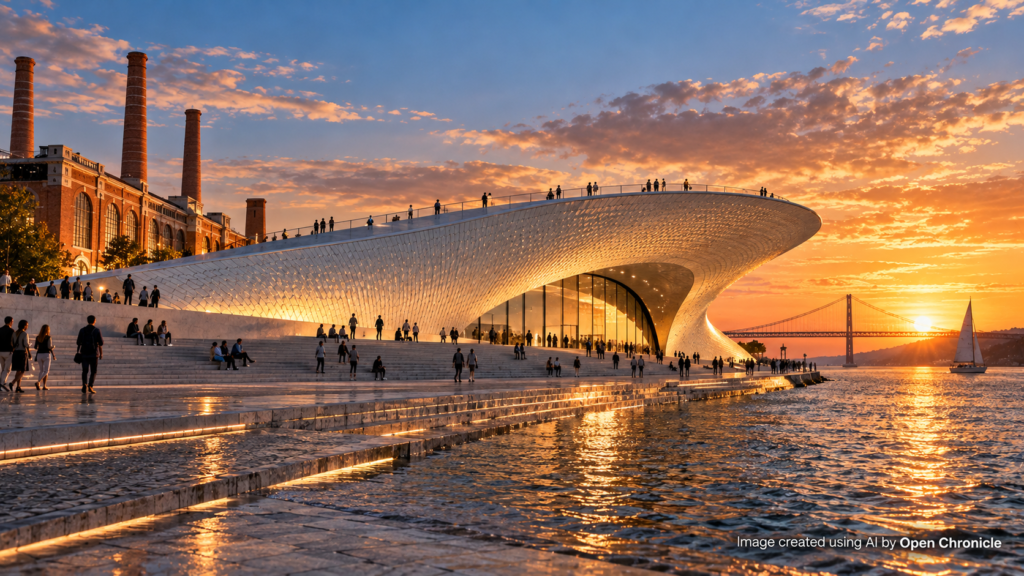
On the banks of the Tagus River, where Lisbon’s maritime history meets the ambitions of a contemporary European capital, a remarkable architectural structure appears to rise from the waterfront.
Its white, gently curving surface catches the changing Atlantic light. Its roof becomes a public promenade. Its form seems to extend the movement of the river into the city.
This is MAAT, the Museum of Art, Architecture and Technology, one of Portugal’s most recognizable contemporary cultural institutions.
Opened in October 2016, the museum was conceived as something more ambitious than a conventional exhibition venue. It was designed to establish connections between artistic expression, architectural experimentation, technological development and the wider public.
A decade later, MAAT offers an opportunity to examine how cultural institutions can influence the identity of a city.
Its significance lies not only in the exhibitions presented within its galleries, but also in the relationship between the museum, Lisbon’s industrial past and the changing public spaces of Belém.
The building has become an architectural landmark, a place for cultural encounters and a recognizable part of Lisbon’s contemporary image.
Yet the story of MAAT is also the story of a much older site, one that once generated electricity for the Portuguese capital.
Understanding the museum therefore requires looking beyond its striking contemporary façade.
It means exploring the relationship between industry and art, technology and imagination, historical preservation and architectural innovation.
1. From an Industrial Power Station to a Cultural Landmark
The history of MAAT begins long before the arrival of its contemporary building.
In the early twentieth century, Lisbon was undergoing a transformation driven by industrialization, urban expansion and the growing demand for electricity.
The Tejo Power Station, whose construction began in 1908, became an important part of the infrastructure supporting the capital’s development.
Its industrial architecture, with its imposing brick façades, machinery and large production spaces, reflected an era when electricity represented technological progress and the modernization of everyday life.
For decades, the complex was associated with the production of energy rather than the presentation of art.
As Lisbon’s electrical infrastructure evolved, the station eventually ceased its original industrial operations. Its historical and architectural importance, however, remained.
The complex was classified as a building of public interest in 1986. In 1990, it opened to visitors as the Museum of Electricity, preserving an important chapter in Portugal’s industrial history.
This transformation represented a shift in the understanding of industrial heritage.
Factories and power stations were no longer regarded solely as obsolete structures awaiting demolition or redevelopment. They could become spaces of historical interpretation, education and public engagement.
When MAAT emerged in 2016, this industrial legacy became an essential part of its identity.
The museum did not simply replace the old power station with a new cultural building.
It brought together two architectural worlds, allowing visitors to move between the technological heritage of the twentieth century and the artistic questions of the twenty-first.
2. Amanda Levete and the Architecture of Movement
The contemporary MAAT Gallery was designed by the London-based architectural practice AL_A, founded by British architect Amanda Levete.
Rather than producing a conventional museum building with a monumental entrance and clearly defined front façade, the architects developed a structure closely connected to its riverside location.
The building’s low, sweeping form creates the impression of a continuous surface rising gently from the ground.
Its exterior is covered with thousands of three-dimensional ceramic tiles, whose glazed surfaces interact with Lisbon’s distinctive light.
Throughout the day, the façade changes in appearance.
Morning sunlight produces one set of reflections, while the warmer light of the afternoon creates another.
This responsiveness gives the architecture a sense of movement even though the structure itself remains still.
The ceramic cladding also establishes a relationship with Portugal’s long tradition of architectural tiles, particularly the azulejo.
The building does not imitate historical Portuguese architecture directly. Instead, it reinterprets a familiar material through contemporary construction and design.
Perhaps its most distinctive characteristic is the accessible roof.
Visitors can walk across the building and enjoy panoramic views of the Tagus, the waterfront and the surrounding urban landscape.
The roof transforms the museum into part of Lisbon’s public space.
It allows people to experience the architecture even without entering an exhibition.
This decision is central to the project’s cultural significance.
The museum is not conceived as an isolated object separated from the city. Its architecture actively encourages movement between the waterfront, the public realm and the exhibition spaces.
3. Two Buildings, Two Centuries, One Cultural Institution
MAAT’s architectural identity depends on the relationship between its two principal buildings.
The former Tejo Power Station, now MAAT Central, represents the industrial history of Lisbon.
Its brick architecture, historic equipment and preserved interiors provide a tangible connection to the technological transformations that shaped the modern city.
The contemporary MAAT Gallery introduces a different architectural language.
Its curving surfaces, reflective ceramics and open relationship with the river emphasize experimentation and the possibilities of contemporary design.
Together, the buildings establish a dialogue between two periods.
The power station represents a time when technological innovation was associated primarily with industrial production and the generation of energy.
The contemporary gallery reflects an era in which technology also influences artistic expression, communication, design and the ways people understand the world.
This relationship is more than a contrast between old and new architecture.
It expresses one of the museum’s central ideas: technological change is inseparable from cultural change.
The machines that once supplied electricity to Lisbon and the contemporary artworks displayed nearby belong to different historical contexts, but both reveal how human creativity transforms society.
The museum’s physical organization allows visitors to encounter this continuity directly.
4. Art, Architecture and Technology: A New Museum Philosophy
Traditional museums have often been organized around clearly defined disciplines.
Art museums exhibit paintings, sculptures and other visual works. Architecture museums examine buildings and design. Science and technology museums explain inventions, industrial processes and scientific developments.
MAAT was founded on a different premise.
Its name brings together three disciplines that are increasingly difficult to separate.
Contemporary artists use digital technologies, sound, artificial intelligence, video and immersive environments to explore social and philosophical questions.
Architects rely on advanced engineering, computational design and new materials to develop structures that would once have been difficult or impossible to construct.
Technological innovation, meanwhile, influences the visual languages through which societies communicate and imagine the future.
MAAT’s interdisciplinary approach reflects these connections.
An exhibition may explore contemporary painting while also addressing political history, environmental transformation or the impact of technology on human experience.
Another may investigate architecture through its relationship with energy, landscape or social organization.
The institution’s broader ambition is to encourage critical thinking rather than simply present objects for admiration.
This philosophy positions the museum as a space where artistic experimentation can contribute to public debate.
5. The Opening of MAAT in 2016
MAAT’s programme began on 30 June 2016 with exhibitions in the renovated spaces of the former power station.
The contemporary gallery building opened to the public on 5 October of the same year.
The opening was accompanied by exhibitions and cultural activities intended to introduce the institution to Lisbon’s residents and international visitors.
Among the inaugural exhibitions were The World of Charles and Ray Eames, The Form of Form and Pynchon Park, the latter a large-scale installation by French artist Dominique Gonzalez-Foerster.
These exhibitions demonstrated the institution’s ambition to move beyond traditional disciplinary boundaries.
The work of Charles and Ray Eames represented the relationship between design, architecture and modern life.
The Form of Form explored architectural thinking and the processes through which ideas become physical structures.
Gonzalez-Foerster’s installation demonstrated how contemporary art could transform architectural space into an immersive environment.
The opening programme established the foundations of an institution interested in experimentation, international dialogue and the relationship between creative disciplines.
It also introduced a new architectural landmark to Lisbon’s cultural landscape.
6. How MAAT Changed the Experience of Lisbon’s Waterfront
The relationship between MAAT and the Tagus River is fundamental to the museum’s identity.
Lisbon has always been shaped by its waterfront.
For centuries, the river supported maritime trade, exploration, industrial activity and the movement of people and goods.
During the twentieth century, substantial areas of the waterfront were dominated by infrastructure and industrial facilities.
The gradual transformation of these spaces has allowed the city to reconsider how residents and visitors interact with the river.
MAAT belongs to this wider process.
Its roof and surrounding public spaces create opportunities for walking, gathering, photography and contemplation.
The building is experienced not only as a museum but also as a destination within the urban landscape.
This is an important distinction.
A cultural institution can influence a city through its exhibitions, but it can also contribute through the spaces it makes accessible to the public.
MAAT demonstrates how architecture can expand the relationship between a museum and its surroundings.
Its distinctive silhouette has become a recognizable element of Lisbon’s contemporary visual identity.
Yet the most significant architectural gesture may be the simplest: allowing the public to walk over the museum and look back toward the city.
7. The First Decade: Building an International Cultural Identity
Between 2016 and 2026, MAAT developed a programme encompassing Portuguese and international contemporary art, architecture, photography, installations and interdisciplinary projects.
Its exhibitions have addressed questions ranging from artistic identity and historical memory to environmental change and the relationship between technology and society.
The institution has also provided a platform for established artists and emerging creative voices.
This combination of national and international perspectives is especially important for Lisbon.
Portugal possesses a rich artistic and architectural heritage, but contemporary cultural institutions also have a role in connecting Portuguese creative production with wider international conversations.
MAAT has sought to contribute to this exchange through exhibitions, public discussions, educational activities and collaborations.
The museum’s relationship with the EDP Foundation Art Collection adds another dimension.
Rather than functioning solely as a venue for temporary exhibitions, MAAT also participates in the preservation, interpretation and presentation of contemporary artistic production.
Its tenth anniversary therefore represents more than the survival of a cultural institution.
It provides an opportunity to examine how a museum develops its identity over time and how its programme responds to changing artistic and social questions.
8. The Tenth Anniversary: Lisbon Celebrates MAAT in October 2026
On 4 and 5 October 2026, MAAT celebrated its tenth anniversary with two days of special programming and free admission.
The celebrations brought together exhibitions, guided tours, workshops, conversations, performances and activities for different audiences.
Four new exhibitions formed a central part of the anniversary programme.
VENUS: Valentino Garavani Through the Eyes of Joana Vasconcelos
The exhibition VENUS – Valentino Garavani through the eyes of Joana Vasconcelos explores the relationship between fashion, artistic imagination and contemporary visual culture.
Joana Vasconcelos, one of Portugal’s internationally recognized contemporary artists, is known for installations that reinterpret familiar objects, materials and cultural symbols.
The exhibition creates a dialogue between her artistic language and the creative legacy of Italian fashion designer Valentino Garavani.
Its presence at MAAT reflects the museum’s interest in forms of expression that move across the boundaries between fine art, design and fashion.
Pedro Cabrita Reis: Without Sorrow of Heart
Portuguese artist Pedro Cabrita Reis occupies an important position in contemporary European art.
His practice encompasses painting, sculpture, installation and the use of construction materials.
The exhibition without sorrow of heart, presented in Portuguese as com o coração livre de cuidados, offers an opportunity to consider the relationship between artistic identity, memory and the material presence of artworks.
Cabrita Reis frequently uses materials associated with architecture and construction, creating a particularly relevant dialogue with MAAT’s architectural environment.
João Pimenta Gomes: New Age
New Age, by João Pimenta Gomes, contributes another perspective to the anniversary programme.
The artist’s practice explores relationships between sound, image, objects and technological systems.
His inclusion reinforces the interdisciplinary identity that MAAT has cultivated since its foundation.
Exhibiting, Publishing: MAAT in Print (2016–2026)
The exhibition Exhibiting, Publishing: MAAT in Print (2016–2026) examines a decade of the museum’s publishing activity.
Publications are an important but sometimes overlooked dimension of museum work.
Exhibition catalogues, essays and research materials allow artistic ideas to circulate beyond the physical duration of an exhibition.
They also contribute to the historical record of an institution.
By reflecting on its publishing history, MAAT places its own development within a broader conversation about cultural memory and the preservation of knowledge.
9. Joana Vasconcelos and the International Reach of Portuguese Art
The presence of Joana Vasconcelos in MAAT’s anniversary programme highlights a broader question about Portuguese contemporary art.
How can artists working from a particular national and cultural context participate in international artistic conversations without losing the distinctive qualities of their work?
Vasconcelos has developed an artistic language that frequently transforms domestic objects, textiles and everyday materials into large-scale installations.
Her work explores questions of identity, gender, cultural tradition, consumption and spectacle.
The relationship between her artistic practice and the world of Valentino Garavani creates an opportunity to examine the connections between fashion and contemporary art.
Fashion has long influenced artistic representation, while artists have frequently challenged the distinction between decorative objects and works of art.
At MAAT, this dialogue takes place within a museum explicitly dedicated to crossing disciplinary boundaries.
The exhibition therefore connects with one of the institution’s defining ambitions.
It demonstrates how contemporary art can reinterpret cultural objects and traditions while creating new visual experiences.
10. The Role of Technology in Contemporary Artistic Expression
Technology has transformed the creation, presentation and circulation of art.
Digital photography, video, computer-generated imagery, interactive installations and artificial intelligence have expanded the possibilities available to artists.
These developments have also introduced new questions.
What constitutes authorship when artistic production involves algorithms?
How does digital technology change the relationship between an artwork and its audience?
Can immersive environments create forms of artistic experience that traditional exhibition formats cannot provide?
Museums such as MAAT offer spaces in which these questions can be explored.
The relationship between art and technology is not limited to the use of advanced equipment.
It also concerns the cultural consequences of technological change.
Artists can examine the influence of digital communication on identity, the environmental costs of industrial systems and the ways technological development shapes collective imagination.
MAAT’s connection to a former power station gives these discussions an additional historical dimension.
The institution occupies a place where technological progress was once expressed through industrial machinery.
Today, that same site hosts artistic investigations into the consequences and possibilities of technological transformation.
11. Architecture as Public Art
One of the most interesting aspects of MAAT is the difficulty of separating its architectural identity from its cultural role.
The contemporary building is a functional exhibition venue, but it is also experienced as an architectural artwork.
Its ceramic surfaces, curved geometry and relationship with the river create a visual composition that changes according to light and perspective.
Visitors walking along the waterfront encounter the building as part of the landscape.
Those moving across its roof experience the city from a new vantage point.
Inside, the galleries provide environments for artistic installations and exhibitions.
The building therefore operates at several levels simultaneously.
It is architecture, public space, cultural infrastructure and an object of visual interest.
This combination raises an important question for contemporary museum design.
Should the architecture of a museum attract attention to itself, or should it remain secondary to the art it contains?
MAAT suggests that the relationship can be more complex.
A distinctive building can encourage public curiosity and create new forms of urban experience, while its galleries continue to support changing artistic programmes.
The challenge is to maintain a productive relationship between architectural identity and cultural content.
12. Industrial Heritage and the Memory of Energy
The former Tejo Power Station remains essential to MAAT’s identity.
Its preservation provides visitors with an opportunity to understand the technological systems that supported Lisbon’s modernization.
Industrial heritage is often overlooked in traditional narratives of architectural history.
Cathedrals, palaces and civic monuments are frequently celebrated as expressions of artistic achievement, while factories and infrastructure are regarded primarily as functional structures.
Yet industrial buildings also reveal important aspects of architectural innovation.
Their design reflects technological requirements, engineering solutions, construction methods and the organization of labor.
The Tejo Power Station is therefore valuable not only as a historical industrial facility, but also as a record of the relationship between architecture and technological development.
Its transformation into a cultural institution demonstrates how historic infrastructure can acquire new public functions.
Preservation, in this context, does not mean freezing a building in time.
It means allowing historical structures to remain relevant while maintaining the evidence of their original purpose.
The coexistence of MAAT Central and MAAT Gallery makes this relationship particularly visible.
13. Museums and the Future of the City
MAAT’s first decade invites reflection on the changing role of museums in contemporary cities.
Museums are no longer understood solely as places where collections are preserved and displayed.
Increasingly, they are expected to contribute to education, public debate, cultural participation and the quality of urban life.
Their buildings may create new public spaces.
Their exhibitions may address environmental challenges, technological change and social transformation.
Their educational programmes may introduce younger audiences to artistic practices and critical thinking.
At the same time, museums face significant challenges.
They must balance international visibility with meaningful engagement with local communities.
They must consider the environmental consequences of exhibitions, construction and cultural tourism.
They must also ensure that their programmes remain accessible to audiences with different backgrounds and interests.
MAAT’s location, architecture and interdisciplinary identity make it a particularly interesting institution through which to examine these questions.
Its future significance will depend not only on the exhibitions it presents, but also on its ability to remain relevant to the changing cultural life of Lisbon.
Conclusion: Ten Years Between Memory and Imagination
Ten years after its opening, MAAT stands at the intersection of several important narratives.
It is part of the history of Lisbon’s industrial waterfront.
It is a contemporary architectural landmark designed by Amanda Levete and her practice AL_A.
It is a cultural institution dedicated to the relationship between art, architecture and technology.
And it is a public space where residents and visitors encounter the city from a different perspective.
Its significance comes from the interaction between these roles.
The former power station preserves the memory of an industrial age that transformed Portuguese society.
The contemporary gallery represents a new generation of architectural thinking, one that seeks to connect cultural buildings more closely with their urban environments.
The exhibitions and artistic programmes create opportunities to examine the ideas, technologies and cultural questions shaping the present.
MAAT’s tenth anniversary is therefore not simply a celebration of a building or an institution.
It is an opportunity to consider how cities use culture to reinterpret their past and imagine their future.
On the banks of the Tagus, Lisbon has created a place where industrial memory, architectural ambition and artistic experimentation can coexist.
The next decade will reveal how this relationship continues to evolve.
Museum & Architectural Information
| Field | Information |
|---|---|
| Institution | MAAT, Museum of Art, Architecture and Technology |
| Location | Belém, Lisbon, Portugal |
| Contemporary gallery architect | Amanda Levete, AL_A |
| Institution’s programme launched | 30 June 2016 |
| Contemporary gallery inaugurated | 5 October 2016 |
| Historic building | Tejo Power Station, construction begun in 1908 |
| Institutional foundation | EDP Foundation |
| Principal spaces | MAAT Gallery, MAAT Central, MAAT Garden |
| Tenth anniversary celebrations | 4–5 October 2026 |
| Cultural focus | Contemporary art, architecture, technology, industrial heritage and public engagement |
Sources and Further Reading
MAAT — About the Museum
Institutional history, architectural background and the relationship between the contemporary gallery and Central Tejo.
MAAT — 10th Anniversary
Official anniversary programme, including the exhibitions, activities and celebrations held on 4 and 5 October 2026.
EDP Foundation — MAAT Opens on 5 October
Original opening announcement documenting the contemporary building’s inauguration and its inaugural exhibitions.
MAAT — 2026 Exhibitions
Official overview of the museum’s tenth-anniversary exhibition programme.
Editorial Note
This Open Chronicle feature examines MAAT’s architectural, historical and cultural significance on the occasion of its tenth anniversary in October 2026. Historical and programme information is based on institutional documentation from MAAT and the EDP Foundation. Interpretations of the museum’s role in Lisbon’s urban and cultural development are independent editorial analysis.
Open Chronicle Arts Magazine
Explore the world of art, creativity and culture. Discover extraordinary artists, timeless masterpieces, contemporary movements and the stories behind the works that shape our world.
Back to Arts Magazine