
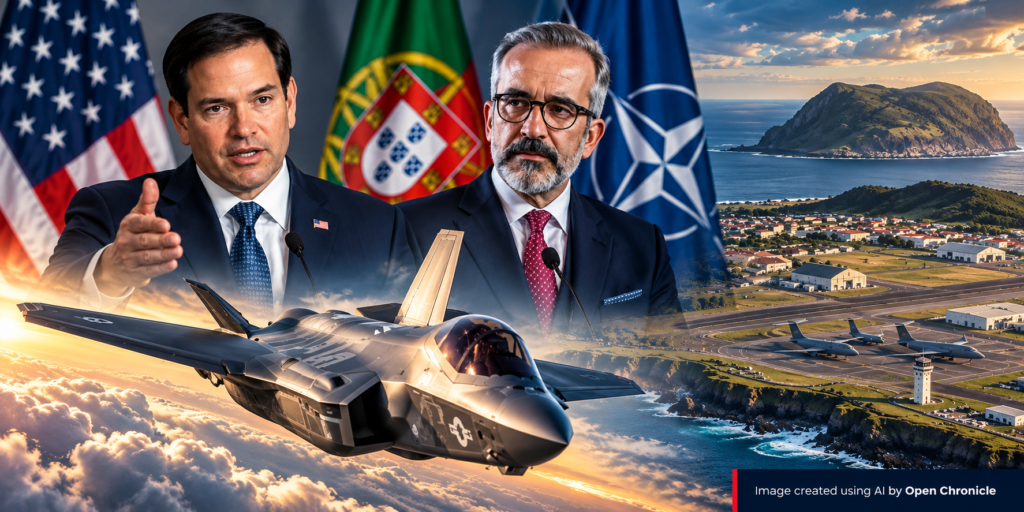
US Secretary of State Marco Rubio has encouraged Portugal to acquire the American F-35 stealth fighter as Lisbon considers the future of its combat aircraft fleet. During talks with Portuguese Foreign Minister Paulo Rangel, the two governments also addressed NATO cooperation, Chinese investment, critical infrastructure and the war in Ukraine. The future of the strategically important Lajes Air Base was not discussed, according to Rangel.
By Open Chronicle with agencies
US Secretary of State Marco Rubio has urged Portugal to consider purchasing the Lockheed Martin F-35 Lightning II as the country prepares for the eventual replacement of its F-16 fighter aircraft.
Speaking alongside Portuguese Foreign Minister Paulo Rangel during a visit to Lisbon, Rubio described the F-35 as the world’s best fighter aircraft and made clear Washington’s interest in supporting Portugal’s military modernization.
“You should buy the F-35. It is the best fighter in the world,” Rubio said, while acknowledging that the final decision belongs to the Portuguese government.
The comments came during a visit that also included talks with Portuguese Prime Minister Luís Montenegro and discussions on transatlantic relations, economic cooperation and international security.
Although defence modernization featured prominently, Rangel said the future of the Lajes Air Base in the Azores had not been on the agenda.
Washington Makes Its Case for the F-35
Rubio’s remarks place renewed attention on one of the most consequential decisions facing Portugal’s air force: the replacement of its ageing F-16 fleet.
The F-16 has served as the backbone of Portuguese fighter aviation for decades, supporting air defence, NATO commitments and international operations.
Rubio recalled the American role in supplying F-16 aircraft to Portugal, presenting the relationship as an example of longstanding defence cooperation between the two countries.
He said Washington wants to work with Lisbon on renewing its military capabilities.
The F-35, manufactured by Lockheed Martin, represents a major technological change from the F-16.
Designed as a fifth generation multirole combat aircraft, it combines low observable characteristics with advanced sensors, electronic warfare capabilities and integrated information systems.
Its ability to collect and share information across military networks has made it an important component of modernization programmes in several NATO countries.
However, acquiring the F-35 would also involve substantial financial, operational and infrastructure commitments.
Portugal has not announced a final decision on the replacement of its fighter fleet.
Rangel Says Portugal Will Decide According to Its National Interest
Paulo Rangel declined to confirm whether Portugal intends to purchase the American aircraft.
Instead, he emphasized that the government would assess its options according to the country’s national interest.
That position leaves open the question of which aircraft Portugal will ultimately select.
The decision will involve considerations extending beyond the technical characteristics of individual fighters.
Acquisition costs, maintenance requirements, training, infrastructure, operational capabilities and long term defence commitments are all relevant to a major fighter procurement programme.
For Portugal, the choice will also influence the country’s military relationship with its NATO allies for decades.
Rubio’s endorsement of the F-35 therefore represents a clear American preference rather than an agreement to purchase the aircraft.
Portugal Described as a Strategic NATO Partner
The meeting also reinforced the importance both governments attach to Portugal’s position within NATO.
Rangel described Portugal as a strategic partner of the alliance and emphasized the country’s commitment to transatlantic relations.
He characterized Portugal as one of the countries that consistently prioritizes cooperation across the Atlantic.
The Portuguese minister also said relations between Lisbon and Washington were becoming increasingly strong.
Portugal’s geographical position gives it a distinctive role within the alliance.
Located on Europe’s Atlantic coast and extending into the ocean through the Azores and Madeira, the country occupies an important position for transatlantic communications, maritime activity and military cooperation.
That geography helps explain why defence, infrastructure and economic security featured in the discussions.
The Future of Lajes Air Base Was Not Discussed
Despite the prominence of defence cooperation, Rangel said the future of the Lajes Air Base had not been discussed during the meeting with Rubio.
“It was not on the menu,” the Portuguese foreign minister said.
Rangel explained that the discussions had focused on subjects including tourism and economic relations, adding that an appropriate bilateral commission exists to address relevant matters.
The Lajes facility, located on Terceira Island in the Azores, has long been associated with military cooperation between Portugal and the United States.
Its Atlantic location has given it strategic significance for transatlantic aviation and military operations.
Questions surrounding the use of the base have attracted renewed attention amid international military tensions.
Rubio declined to comment on an investigation opened by Portugal’s Public Prosecutor’s Office concerning the use of the facility.
He also rejected criticism attributed to Amnesty International over the base’s use, describing the criticism as a “fraud” and arguing that attention should instead be directed toward people killed during protests in Iran.
His remarks reflected a sharp disagreement with the human rights organization’s criticism, rather than a resolution of the questions surrounding the base.
Portugal’s Strategic Importance Goes Beyond Military Aviation
Rubio also highlighted Portugal’s importance in areas that extend beyond conventional defence.
He specifically identified submarine cables, critical minerals and data centres as sectors with growing geopolitical relevance.
These industries have become increasingly important as governments reassess their economic security and dependence on international infrastructure.
Submarine communications cables carry essential international digital traffic, making their protection a significant concern for countries connected to major maritime routes.
Portugal’s Atlantic position gives it a role in international communications networks.
Rangel emphasized the importance of protecting these systems.
“The security of submarine cables is fundamental. It is a major concern,” he said.
The discussion illustrates how national security is increasingly connected to telecommunications, technology and economic infrastructure.
Rubio Warns Against Excessive Dependence on China
China’s economic presence in Portugal was another important subject.
Rubio argued that it would not be beneficial for Portugal to depend excessively on Beijing and encouraged greater diversification of economic relationships.
His comments reflected Washington’s broader concern about strategic dependence in sectors considered important to national security.
Portugal has longstanding economic relationships with China, including investment and commercial ties.
Rangel acknowledged those historical connections while emphasizing that Portugal makes economic decisions according to the quality of individual agreements and its national interests.
The exchange highlighted different priorities within the transatlantic relationship.
Washington is encouraging European partners to reduce vulnerabilities associated with concentrated economic dependence.
Lisbon, meanwhile, is seeking to preserve the ability to evaluate investment opportunities while maintaining its security commitments.
Economic Diplomacy Becomes a Priority
Rubio’s visit was also presented as an opportunity to strengthen economic relations between the United States and Portugal.
On arriving in Lisbon, the American secretary of state said he wanted to transform economic diplomacy into economic opportunity.
The discussions with Portuguese officials included investment, tourism and broader commercial cooperation.
These subjects are becoming increasingly important as governments seek to combine traditional diplomatic relationships with strategic economic partnerships.
For Portugal, cooperation with the United States offers opportunities in sectors ranging from technology and infrastructure to defence and international services.
For Washington, closer economic engagement can complement existing military and political ties.
Ukraine: Rubio Says Negotiations or Escalation Are the Two Paths
The war in Ukraine also featured in the joint press conference.
Rubio argued that the conflict faces two broad possible directions: negotiations or further escalation.
He said there was no military solution to the war, emphasizing the importance of diplomatic efforts to bring the fighting to an end.
His comments followed reports of another deadly Russian attack in Ukraine that killed 33 people.
Rubio described the conflict as dangerous and reiterated the need to pursue an end to the war.
Rangel expressed support for American diplomatic efforts while condemning the devastating attacks affecting Ukrainian civilians.
The Portuguese minister’s position reinforced Lisbon’s concern about the humanitarian consequences of the conflict.
The discussion demonstrated that Ukraine remains a central issue in relations between the United States and its European NATO partners.
A Visit Focused on Strengthening Bilateral Relations
Rubio also rejected suggestions that his visit to Lisbon was intended to send a political message to neighbouring Spain.
Before arriving in Portugal, he said the purpose of the trip was to strengthen bilateral ties.
The visit included a meeting with Prime Minister Luís Montenegro before the joint appearance with Rangel.
Across the discussions, the central themes were defence cooperation, economic opportunities, strategic infrastructure and international security.
The absence of a discussion about the future of Lajes was particularly notable given the base’s longstanding importance in relations between the two countries.
A Fighter Decision With Long Term Consequences
Rubio’s public endorsement of the F-35 adds an important diplomatic dimension to Portugal’s future fighter procurement decision.
The United States has made clear that it would welcome Portugal joining the growing group of countries operating the American aircraft.
But Lisbon has not committed to that outcome.
Rangel’s emphasis on national interest suggests that the government intends to preserve its decision making autonomy while maintaining close defence cooperation with Washington.
The wider visit also demonstrated that the relationship between Portugal and the United States now encompasses far more than traditional military cooperation.
Submarine cables, critical minerals, data centres, investment diversification and economic security have become central elements of the bilateral agenda.
For Portugal, the challenge will be to balance those opportunities with its European commitments, longstanding international partnerships and national priorities.
The F-35 may have dominated the headlines, but the Lisbon talks revealed a broader strategic conversation about Portugal’s role in the Atlantic and its relationship with the United States.
Editorial Note: This article is based on statements attributed to Marco Rubio and Paulo Rangel during their October 8, 2026, press conference in Lisbon. No Portuguese decision to purchase the F-35 has been announced in the supplied reporting. Rubio’s assessment of the aircraft reflects his stated position.