
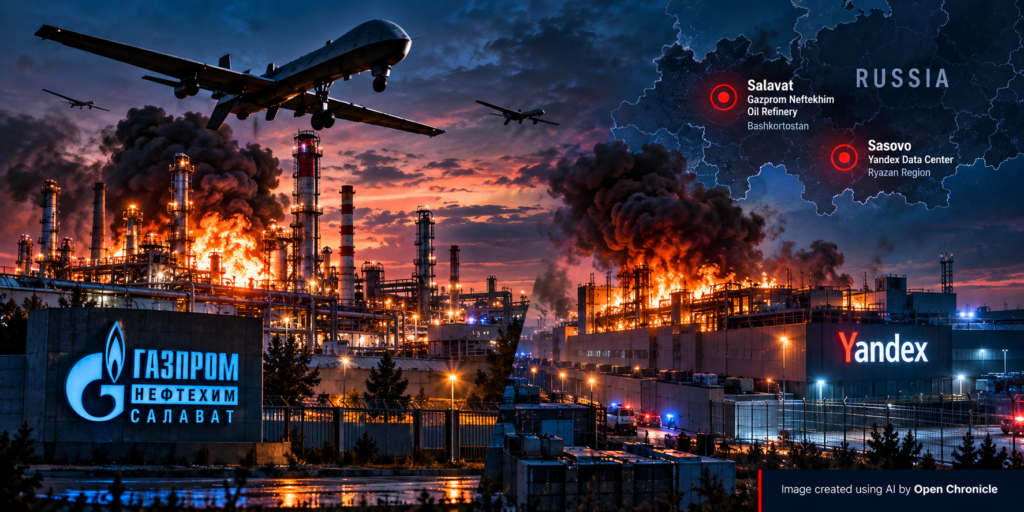
Ukrainian drones have reportedly struck the Gazprom Neftekhim Salavat oil refining complex in Bashkortostan and a Yandex data center in Russia’s Ryazan region, triggering fires and disrupting digital services. The attacks come as Kyiv intensifies pressure on Russian energy and industrial infrastructure, while Moscow claims its air defenses intercepted nearly 400 drones.
By Open Chronicle with agencies
Ukraine has reportedly carried out a series of drone attacks against Russian industrial, energy and technological infrastructure, striking facilities in Bashkortostan, the Ryazan region and Krasnodar overnight on October 7 and 8, 2026.
Among the reported targets were the Gazprom Neftekhim Salavat oil refining complex, one of the major industrial facilities in the Russian republic of Bashkortostan, and a Yandex data center located within the Sasta industrial complex in Sasovo.
The attacks triggered fires, interrupted digital services and prompted emergency responses across several Russian regions.
Russian authorities confirmed incidents involving drone debris and industrial fires, although the extent of the damage and the precise impact on production remain unclear.
The operations come shortly after Ukrainian President Volodymyr Zelenskyy announced plans to intensify strikes against Russian oil refining infrastructure.
Gazprom Neftekhim Salavat Comes Under Attack
The Gazprom Neftekhim Salavat complex in the city of Salavat was reportedly targeted by Ukrainian drones during the early hours of October 8.
Ukrainian monitoring channels Exilenova+ and Supernova+ reported the attack, while the independent Russian outlet Astra examined eyewitness photographs and videos and concluded that the fire most likely occurred within the refinery’s grounds.
Authorities in Bashkortostan declared an air raid alert as reports of incoming drones emerged.
Marat Zagidullin, head of Salavat’s city administration, subsequently confirmed that debris from several drones had caused a fire in the city’s industrial zone.
He did not identify the affected enterprise by name.
According to Zagidullin, emergency services responded to the incident, no casualties were reported and operations at the facility were continuing.
The statement did not establish whether individual production units had sustained damage or whether refinery output had been affected.
A Major Russian Energy and Petrochemical Facility
Gazprom Neftekhim Salavat is an important component of Russia’s oil refining and petrochemical industry.
The industrial complex processes petroleum and produces refined products and petrochemical materials.
Its significance extends beyond the immediate region because refineries form part of the infrastructure supplying fuel and industrial products to the wider Russian economy.
The facility has reportedly been targeted by Ukrainian drones on several occasions since Russia launched its full scale invasion of Ukraine.
Repeated attacks against such installations can create operational challenges even when facilities avoid complete shutdowns.
Fires, equipment damage, inspections and repairs can interrupt individual production processes and place additional pressure on industrial maintenance and logistics.
However, the latest available information does not establish the extent of any damage at Salavat or confirm a reduction in production following the October 8 incident.
Yandex Data Center Hit in Ryazan Region
A separate attack reportedly struck a Yandex data center in the city of Sasovo, in Russia’s Ryazan region.
The facility is located on the premises of the Sasta factory, an industrial enterprise involved in manufacturing metalworking machinery.
According to the supplied reports, Sasta also provides equipment to companies operating in the Russian defense industry.
Eyewitness footage circulating after the attack showed a substantial fire at the industrial site.
Initial statements from Yandex referred to an incident affecting part of its infrastructure.
The company subsequently confirmed that the facility had been struck.
A Yandex representative said the attack caused a fire at the data center and forced operations there to stop completely.
Unlike the reported refinery incident, where the operational consequences remain uncertain, Yandex acknowledged a direct interruption to its data center activities.
Yandex Cloud Reports Power Supply Problems
The effects of the Sasovo attack extended into digital services.
Yandex Cloud reported problems with electricity supplies in one of its data center zones and advised customers to transfer workloads to other available zones.
Users also reported disruptions affecting Yandex Disk and Yandex Documents.
The incident illustrates how damage to physical infrastructure can affect services delivered through digital networks.
Data centers depend on reliable electricity, cooling equipment, networking systems and other supporting infrastructure.
A serious disruption at one facility can therefore affect cloud computing and storage services even when users are located far from the physical site.
Yandex has not provided a complete public assessment in the supplied material of the damage, restoration costs or expected duration of the disruption.
The Sasta Factory’s Industrial Role
The location of the Yandex data center within the Sasta industrial complex has attracted additional attention.
Sasta manufactures metalworking machinery, including equipment used by industrial enterprises.
According to the reports, its customers include companies connected to Russia’s defense industry.
This industrial connection is relevant to understanding the wider context of Ukrainian attacks against Russian manufacturing infrastructure.
However, the presence of the data center at the same industrial site does not establish that the digital facility itself was being used for military purposes.
The supplied reports also do not confirm whether the factory’s manufacturing operations were damaged or interrupted.
Those distinctions remain important when assessing the nature and consequences of the strike.
Another Industrial Fire Reported in Krasnodar
The overnight attacks also affected Russia’s Krasnodar region.
Local emergency authorities reported that fragments from drones fell within the grounds of an industrial enterprise.
The debris reportedly damaged a building and caused a fire.
No casualties were reported.
Officials did not identify the enterprise involved or provide a detailed assessment of the damage.
The Krasnodar incident adds to the geographic scope of the overnight events, which affected industrial facilities across several widely separated Russian regions.
Russia Claims 399 Ukrainian Drones Were Shot Down
Russia’s Defense Ministry reported an extensive overnight air defense operation.
According to the ministry, Russian forces intercepted and destroyed 399 Ukrainian drones from the evening of October 7 onward.
The ministry said the interceptions occurred over Russian regions, Russian occupied Crimea and the Black Sea.
The figure represents an official Russian military claim and has not been independently verified in the supplied reporting.
The ministry’s statement also does not establish how many drones were launched in total or how many reached their intended targets.
The reported fires in Bashkortostan, Ryazan and Krasnodar demonstrate that several locations experienced damage or disruption during the period covered by the Russian announcement.
Russia’s Refineries Face Continuing Pressure
The attacks come against the background of a sustained Ukrainian campaign targeting Russian oil infrastructure.
Russia’s Defense Ministry has acknowledged that drone attacks have forced some refineries to reduce or suspend production.
Previous interruptions were also linked in the supplied reports to fuel supply difficulties experienced in Russia during the summer.
Oil refineries are economically important because they convert crude oil into usable petroleum products, including gasoline and diesel.
Disruptions can affect domestic fuel availability, transportation costs and industrial supply chains.
The economic consequences depend on the capacity of affected refineries, the duration of shutdowns and the ability of other facilities to compensate for lost production.
While the latest attack on Salavat fits within this broader pattern, there is not yet enough confirmed information to calculate its specific impact on Russian fuel supplies.
Zelenskyy Signals Intensified Attacks on Oil Infrastructure
Earlier in October, Ukrainian President Volodymyr Zelenskyy announced that Kyiv intended to increase attacks against Russian oil refineries.
The statement signaled continued Ukrainian emphasis on striking infrastructure beyond the immediate battlefield.
Ukraine has repeatedly sought to impose economic and logistical costs on Russia through operations against facilities supporting the country’s industrial and energy sectors.
The October 8 attacks appear consistent with that wider approach, although the Ukrainian government has not provided a detailed operational account of every reported strike in the supplied material.
Moscow Warns of an Expanded Response
Russia’s Defense Ministry has warned that it could expand attacks against targets in Ukraine in response to the campaign against Russian infrastructure.
The warning raises concerns about a further cycle of long range strikes.
Russian forces have continued conducting missile and drone attacks across Ukraine, while Ukrainian forces have increasingly targeted facilities inside Russian territory.
The reciprocal operations have extended the geographical reach of the war and placed additional pressure on infrastructure far from the front lines.
The potential for further escalation remains significant, particularly if either side increases attacks against energy, transportation or industrial facilities.
Energy and Digital Infrastructure Become Part of the Wider War
The reported attacks on Gazprom Neftekhim Salavat and the Yandex data center highlight two different dimensions of the conflict.
The refinery is part of Russia’s physical energy and industrial economy.
The data center supports digital infrastructure and services that depend on continuous power and functioning technical systems.
Damage to either type of facility can produce consequences beyond the immediate location of an attack.
Energy disruptions can affect fuel production and supply chains, while data center outages can interrupt digital services used by businesses and individuals.
At the same time, the civilian and military functions of infrastructure must be distinguished. Under international humanitarian law, attacks must be directed at lawful military objectives and comply with the applicable rules on distinction, proportionality and precautions.
The supplied information does not establish the legal status of each reported target.
A Growing Campaign Against Russian Infrastructure
The October 8 incidents demonstrate the continuing expansion of Ukraine’s ability to conduct strikes against facilities deep inside Russian territory.
In Bashkortostan, authorities confirmed a fire in Salavat’s industrial zone following drone activity.
In Sasovo, Yandex acknowledged a strike and the suspension of operations at its data center.
In Krasnodar, officials reported damage and a fire at an unidentified industrial site.
Russia, meanwhile, claims to have intercepted 399 Ukrainian drones during the overnight attacks.
The full military and economic consequences remain uncertain.
But the events reinforce a broader development in the war: energy production, industrial infrastructure and digital systems are increasingly exposed to the consequences of long range drone operations.
As Kyiv signals further attacks against Russian refineries and Moscow warns of an expanded response, the conflict’s impact on infrastructure far from the front lines may continue to grow.
Editorial Note: This article is based on Ukrainian monitoring reports, Russian regional authority statements, reporting by Astra, Yandex’s public communications and Russian Defense Ministry claims concerning events on October 7 and 8, 2026. The extent of physical damage, total number of drones involved and operational consequences at several facilities remain unverified.