
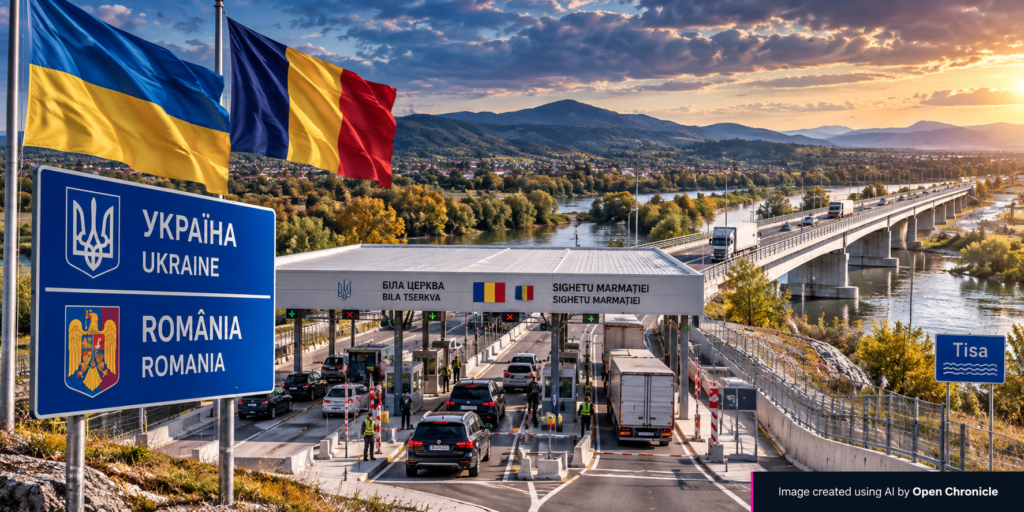
A new road crossing over the Tisza River has opened between Ukraine and Romania, strengthening transport connections between the two neighbouring countries. The Bila Tserkva to Sighetu Marmației route is expected to ease congestion, improve mobility for border communities and eventually accommodate commercial freight and international bus services.
By Open Chronicle with agencies
Ukraine and Romania have opened a new road border crossing over the Tisza River, marking the first addition to their shared border infrastructure in Ukraine’s Zakarpattia region in nearly two decades.
The crossing, connecting Bila Tserkva in Ukraine with Sighetu Marmației in Romania, officially opened on October 8, 2026.
Ukrainian Infrastructure Minister Mykola Kalashnyk announced the development, describing it as the third road crossing linking Zakarpattia with Romania.
The project represents an important step in improving cross border mobility between the two countries, particularly at a time when Ukraine’s transport connections with its European neighbours have become increasingly significant.
A New Bridge Across the Tisza River
The new crossing is built around a road bridge over the Tisza River, which forms part of the natural border between Ukraine and Romania.
The infrastructure provides an additional route for travellers moving between the two countries, reducing dependence on existing border crossings.
For residents of Zakarpattia, the development is particularly important because road connections with Romania have historically been limited.
The opening creates another direct link between communities separated by the international border.
It also represents the first new crossing of its kind in the region in almost 20 years.
Initial Capacity of 400 Passenger Cars Per Day
The crossing will begin operations with a limited capacity while construction of the permanent border facilities continues.
During the initial phase, authorities expect it to process up to 400 passenger cars daily.
This arrangement will allow travellers to begin using the route before the entire infrastructure complex is completed.
Temporary customs and border control facilities have already been installed on the Ukrainian side.
The phased opening is intended to deliver immediate transport benefits while work continues on the larger project.
Easing Congestion at Existing Border Crossings
One of the principal objectives is to reduce congestion along the Ukrainian Romanian border.
Existing crossings serve local residents, international travellers and commercial transport, creating pressure on available road and inspection infrastructure.
The new Bila Tserkva to Sighetu Marmației connection is expected to distribute some of that traffic across an additional route.
For travellers, this could mean shorter journeys and fewer delays, depending on traffic volumes and border processing conditions.
The additional crossing also gives authorities greater flexibility in managing vehicle movements between the two countries.
A Vital Connection for Local Communities
Beyond its transport significance, the project has an important social dimension.
The crossing is expected to benefit residents of the Solotvyno community in Zakarpattia, an area with a substantial ethnic Romanian population.
Many families maintain close personal and cultural connections with relatives living across the border.
For these communities, international travel is not simply a matter of tourism or commerce.
It can involve family visits, employment, education and access to services.
The new crossing will make those connections more accessible by providing an additional route across the Tisza River.
Ukraine and Romania Shared Construction Responsibilities
The project was developed through cooperation between Ukrainian and Romanian authorities.
Ukraine was responsible for constructing the access road leading to the crossing and installing temporary border and customs facilities.
Romania undertook construction of the bridge across the Tisza River and the associated border crossing infrastructure.
This division of responsibilities allowed the two countries to coordinate development on both sides of the international boundary.
The result is a shared transport project designed to serve communities and travellers in both countries.
A Permanent Border Complex Is Still Under Construction
Although the crossing is now operational, construction has not been fully completed.
The initial opening relies on temporary facilities while work proceeds on a permanent border complex.
Once the completed infrastructure becomes operational, the crossing is expected to handle significantly more traffic.
The planned additional daily capacity includes:
-
360 trucks, expanding opportunities for commercial road freight.
-
50 buses, supporting international passenger transport.
These figures represent the expected capacity after completion of the permanent facilities, rather than services already available during the initial operating phase.
The eventual addition of freight and bus traffic will substantially broaden the crossing’s role.
A Future Route for Commercial Transport
The planned capacity for 360 trucks per day could make the crossing increasingly important for commercial transport between Ukraine and Romania.
Freight infrastructure has become particularly significant for Ukraine as the country works to maintain international trade and transport connections during the war with Russia.
Additional road crossings can help diversify transport routes and reduce pressure on established border facilities.
For businesses operating between Ukraine and European markets, improved road access may offer greater flexibility in planning deliveries.
The full economic impact will depend on completion of the permanent infrastructure, customs arrangements and the volume of commercial traffic using the new route.
Strengthening Ukraine’s Connections With Europe
The new crossing also reflects the broader importance of Ukraine’s transport links with European Union member states.
Romania has become an important neighbouring partner for Ukraine, particularly in transport and regional connectivity.
Improved border infrastructure can support economic activity, facilitate personal travel and strengthen cooperation between local authorities.
The Bila Tserkva to Sighetu Marmației project demonstrates how practical infrastructure investments can improve international connections at a regional level.
Rather than relying exclusively on major transport corridors, smaller crossings can play an important role in supporting communities and distributing traffic more efficiently.
A New Chapter for the Ukrainian Romanian Border
The opening of the new crossing is a significant development for Zakarpattia and the communities on both sides of the Tisza River.
After nearly two decades without a new road crossing in the region, Ukraine and Romania have added another permanent connection to their shared transport network.
For now, the facility will serve passenger cars through temporary border infrastructure.
Once the permanent complex is completed, its planned expansion to accommodate trucks and buses could transform it into a more important regional transport route.
For local residents, the immediate benefit is simpler access across the border.
For Ukraine and Romania, the project represents another step toward stronger infrastructure cooperation and closer connections between their communities and economies.